8th IOAA · Preliminary data analysis · Atmospheric refraction · 50 т.
Внимание: Бележка към темата
This is the complete preliminary Problem 1 preserved in the archived solution booklet, not a question on the final photographed examination. The supplied text contains numerical, sign, molecular-label and unit inconsistencies, retained with source notes in the solution.
Условие
The light refraction in the atmosphere of a planet is an optical effect, which is due to the optical inhomogeneity of the atmosphere, thus the light propagation obey the Fermat principle. In this problem you have to find out if it is the possible that due to the atmospheric refraction an astronaut could see his back. The atmospheric absorption is negligible and the structure of the atmosphere is stable. Here you have some theoretical issues to help you to solve the problem:
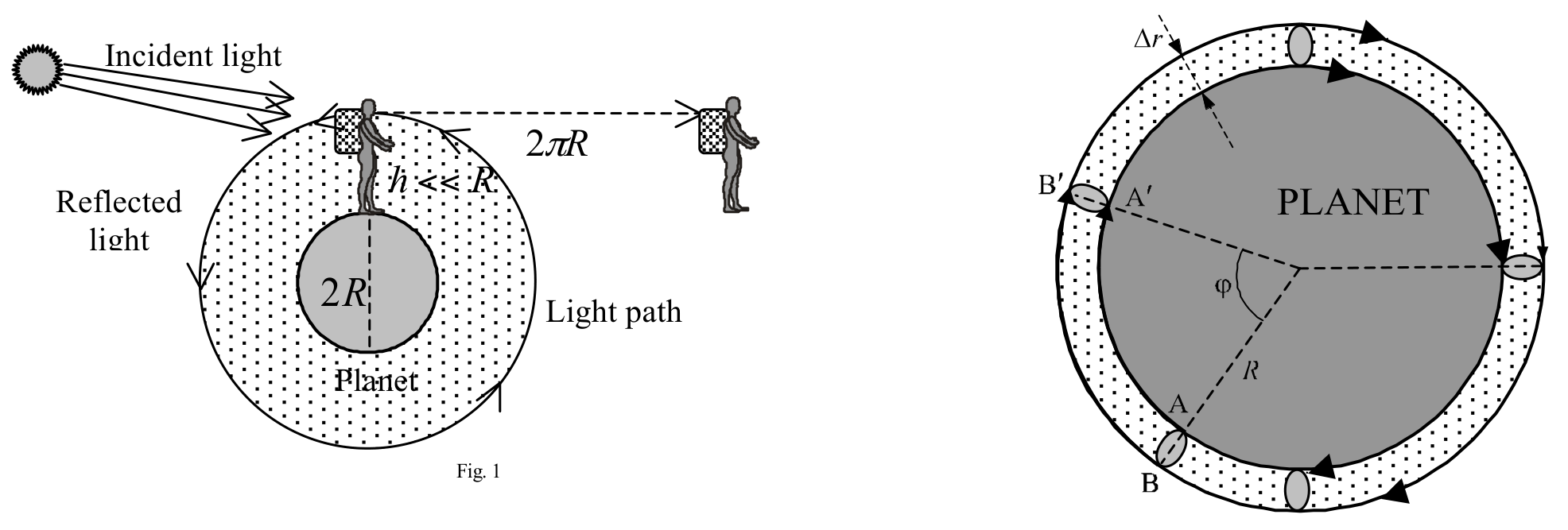
The situation you have to investigate is sketched in the figure 1.
Fig. 1. Proposed light path and concentric atmospheric layers.
The non-homogeneity of the atmosphere can be simulated by considering the atmosphere consisted of concentric spherical thin layers of thickness Δr. In one layer the refractive index is n>1 due to the presence of the gas molecules. The refractive index of vacuum is nvacuum=1.
The plane wave-front of the light AB has to remain normal on the surface of the planet and at the same distance from it, despite that the propagation occurs through an inhomogeneous atmosphere consisted of concentric spherical thin, homogenous layers.
The consequence of the model is that near the planet surface the following relationship occurred
n−1=αN,
whith N the gas molecules concentration, and α a constant.
For Earth atmosphere near the surface:
n−1≈11.35⋅10−5.
In the table are given the data for 10 planets (8 from Solar System and 2 exoplanets).
R – planet radius in m; m – the mass of on gas molecule of the dominant one near the surface of the planet in atomic mass unit (1a.m.u.=1.66⋅10−27kg); p – atmospheric pressure near the surface of the planet in bar (1bar=105Pa=105Nm−2); T – atmosphere temperature near the surface of the planet in K; g – gravitational acceleration in ms−2; You will assume that the molecules are spheres with an effective diameter d. The Boltzmann-constant is k=1.38⋅10−23J/K.
Planet
R (105 m)
The gas
m (amu)
p (105 Pa)
T (K)
g (m/s2)
d (m)
Mercur
24
CO2
44
10−14
450
3.7
3.75⋅10−10
Venus
62
CO2
44
100
700
8.5
3.75⋅10−10
Earth
64
N2
28
1
300
9.8
3⋅10−10
Mars
34
CO2
44
10−2
200
3.7
3.75⋅10−10
Jupiter
715
H2
2
1
340
23
2⋅10−10
Saturn
600
H2
2
1000
400
10.4
2⋅10−10
Uranus
260
H2
2
1000
50
8.8
2⋅10−10
Neptun
250
H2
2
1000
70
11.1
2⋅10−10
Exoplanet X
72.5
H2
28
15
500
20
2⋅10−10
Exoplanet Y
25.75
CH4
16
20
600
15
4⋅10−10
By using the data, you have to analyze and justify the possibility of the occurrence of the described phenomenon for each planet, considering the propagation of the light in the near the planet surface layer of the atmosphere.
a)
Derive the necessary geometrical condition for producing the light refraction around a planet, if Δn is the small variance of the refractive index of the gas medium correlated with the small gas layer thickness Δr.
b)
Express the previous condition in terms of the thermodynamic parameters of the gas near the surface of the atmosphere i.e. the pressure, the temperature, the concentration of the gas molecules, the mass of a molecule, by calculating the value of coefficient α for the gas in the layer near the Earth surface. The refractive index n of the gas, near the surface of each planet, obey this relation
nΔn=nαΔN≈αN.
c)
Calculate the numerical values of those parameters which allow you to establish the possibility of the occurrence of the described optical phenomenon. Around which planets the phenomenon occurs. A table which centralize the data is an advantage for better understanding the solution.
Решение
The following is the complete supplied preliminary key. Source inconsistencies are retained and identified; this problem is absent from the final photographed data-analysis examination.
Marking scheme
Part
Criterion
Points
a
Any relations which drive to the correct answer
10
b
Total
20
b
Thermodynamic analysis
10
b
The value and signification of α
10
c
Total
20
c
Calculations for each planets
15
c
Correct identification of the planets
5
a) The optical condition for the light refraction in the planet atmosphere
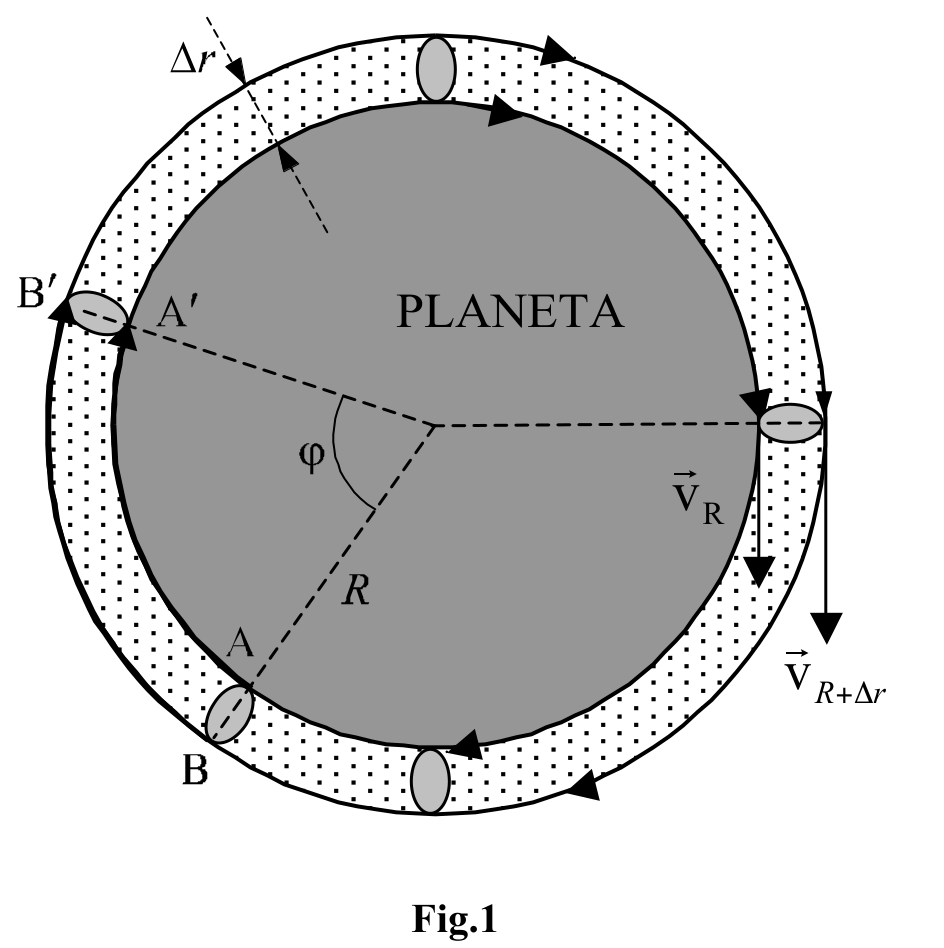
As seen in the figure 1 the plane wave front AB has to remain perpendicular to the surface of the planet, and at the same distance from that. If we consider the thin layer near the planet which can be considered homogenous the time of light travel will be the same on the circle sectors AA′ și BB′ corresponding to the same angle φ.
Fig. 1. Wave-front travel at radii R and R+Δr, with original velocity labels.
t=vRAA′=vR+ΔrBB′,
vR – speed of light in the thin spherical homogenous layer near the planet surface – radius R; vR+Δr – speed of light in the thin spherical homogenous layer near the planet surface – radius R+Δr;
vR+Δr>vR;nR=vRc;nR+Δr=vR+Δrc<nR,
c speed of light in vacuum, nR refraction index of the atmosphere layer – radius R, nR+Δr refraction index of the atmosphere layer – radius R+Δr.
Results:
AA′nR=BB′nR+Δr;nR+Δr<nR;
AA′=Rφ;BB′=(R+Δr)φ;
RnR=(R+Δr)nR+Δr;nR+Δr=nR+Δn,
where Δn<0 is the variance of the refraction index of the atmospheric gas associated with the height Δr;
RnR=(R+Δr)(nR+Δn);ΔrΔn≈0;
−nRΔrΔn=R1;
nR=n;−nΔrΔn=R1;Δr−Δn/n=R1;−nΔrΔn=R1.
The condition of the occurrence of the refraction around the planet:
−ΔrΔn/n=R1.
Using the following notations:
theoretical curvature of the Earth surface Csuprafata planeta=1/R;
the curvature of the light ray in the atmosphere layer near the Earth surface Clight=−Δn/(nΔr);
Thus:
Clight=Csurface of the planet.
b1) Relationship between the refractive index and the physical properties of the gas near the planet surface
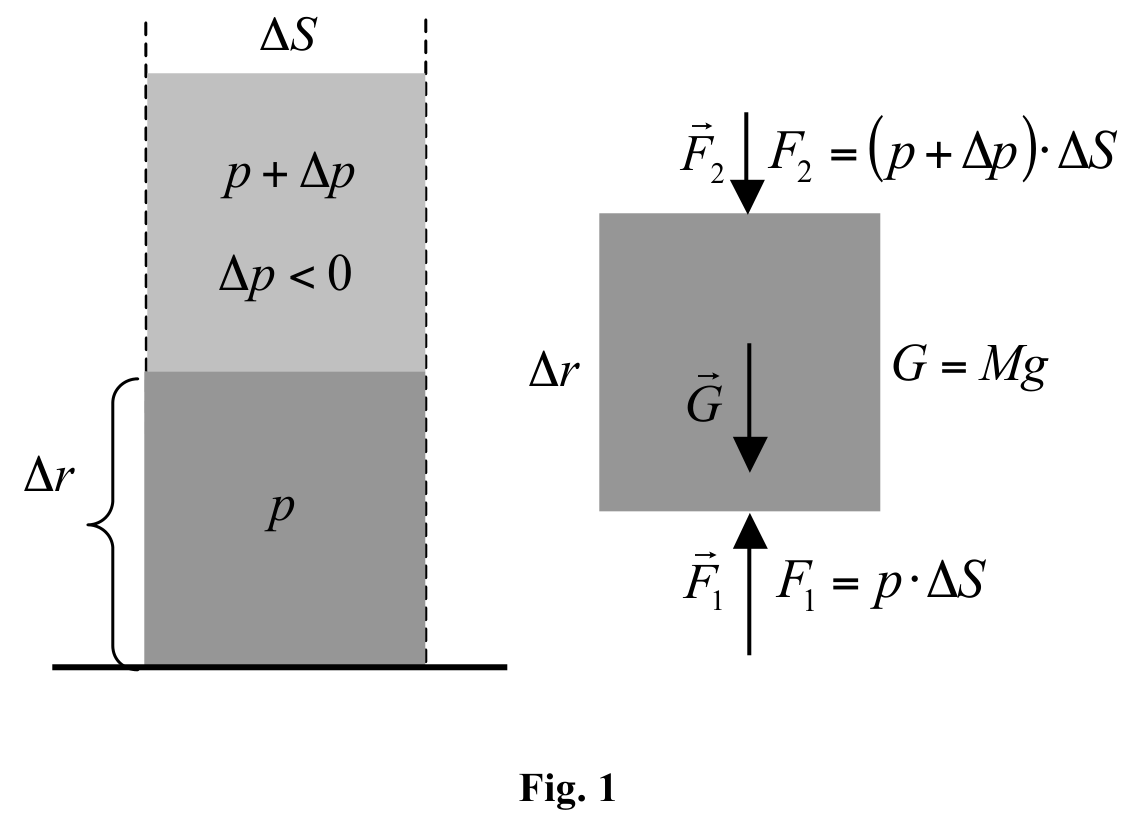
According with the notations in figure 1 it can be obtain the equilibrium condition for the gas column near the Earth's surface.
Fig. 1. Atmospheric gas column and force equilibrium.
F1+G+F2=0;F1−G−F2=0;
pΔS−Mg−(p+Δp)ΔS=0;
pΔS−Mg−pΔS−ΔpΔS=0;
−ΔpΔS=Mg;−ΔpΔS=NmgΔrΔS;−Δp=NmgΔr,
where m is the mass of a molecule, and g is the gravitational acceleration at the base of the atmosphere:
p=NkT;Δp=kTΔN;−kTΔN=NmgΔr;
−ΔrΔN=NkTmg.10 points
According to the relationship n−1=αN, and the fact that nvid=1 the coefficient α represents the volume.
⟨N⟩SI=m−3;⟨α⟩SI=m3
and n>1 being proportional to the concentration of the molecules in the atmosphere.
n−1=αN;Δ(n−1)=Δ(αN);Δn=αΔN;
nΔn=nαΔN;n≈1;nΔn=nαΔN≈αΔN.
Using the relation (1):
nΔn=αΔN;ΔN=αnΔn;−ΔrΔN=NkTmg;
−ΔrΔn/(αn)=NkTmg;−αnΔrΔn=NkTmg.
The relationship between the light curvature and the physical properties of the atmosphere will be:
Clight=−nΔrΔn=αNkTmg.(2)
This one can be experimental determined for each planet atmosphere and compared with the each planet surface curvature.
Clight,experimental=αNkTmg;Cplanet=R1.
The condition is
Clight=Cplanet.(3)
b2) The value of α, corelated with the volume of the gas molecule
α represents the volume of a gas molecule.
For Earth:
n−1≈11.35⋅10−5=αN;p=1bar=105Nm−2;T=300K,
so
N=kTp=1.38⋅10−23J/K⋅300K105Nm−2,
where k=1.38⋅10−23J/K (constanta lui Boltzman);
N≈2.41⋅1025m−3,
Is the nytrogen concentration in the Earth atmosphere;
11.35⋅10−5=α⋅2.41⋅1025m−3;α≈4.70⋅10−30m3.
The volume of an nytrogen molecule with the diameter dN2≈3⋅10−10 m is:
V1,N2=34π(2dN2)3=34⋅3.1489⋅10−30m3;
Thus
V1,N2≈4.71⋅10−30m3≈α.
c) Data analysis
20 points. Each original numerical substitution and printed result follows. The source occasionally interchanges the units of α and N in their product; those units and the gas subscripts are retained below. Numerical inconsistencies are not silently recalculated.
Earth
For Earth atmosphere considered full of nitrogen where p=1 bar and temperature T=300 K, the key again writes
Source notes: the original question prints Δn/n≈αN; the derivation later uses αΔN. The nitrogen-volume substitution prints 9 where cubing the given 3 would require a different factor. The source table calls Exoplanet X's gas H₂, with mass 28 and diameter 2⋅10−10 m, while its key uses nitrogen. Mercury and Exoplanet Y calculations print an H₂ volume subscript despite their other molecular data. The curvature table contains inconsistent reciprocal values and prints a greater-than sign for Mercury despite its own numerical entries. These original values, labels and conclusion are retained, not endorsed as corrected physical calculations.