IOAA 2014, Анализ на данни · окончателна тема — Задача 3. IOAA Observer on an extrasolar planet
8th IOAA · Final data analysis paper
Внимание: Бележка към темата
The final paper is preserved in six photographed sheets. Its three whole problems differ from the preliminary solution booklet: Black Hole is renumbered, Thermodynamic test is separate, and the observer problem replaces seven Big Dipper stars with four Mizar-system stars and adds uncertainty estimates. Applicable key material is distinguished from variant comparisons; absent final-key portions and the missing orbit-plot annex are explicit.
Условие
The Sirius star, located in the constellation of Canis Major, is the brightest star in the night sky of the Earth. What the observer's eye sees as a single star is actually a binary star system.
The high brightness of Sirius is a consequence of two facts: its intrinsic luminosity and its proximity to the Earth.
The Mizar multiple star system, in the constellation of Ursa Major, consists of 4 stars seen along the same line of sight from the Earth. Some of these stars form a gravitationally bound system.
Let's assume that an observer (observer A) is located on one of the planets of the Sirius system.
Determine:
a)
The magnitude of the Sun as seen by observer A ().
b)
The magnitude of Sirius star system as seen by the observer A ().
c)
The combined intrinsic luminosity of the Mizar system, .
d)
The average distance between gravitationally bound stars of the Mizar system and Earth.
e)
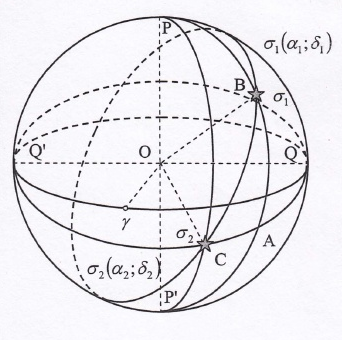
The geocentric angular distance between Mizar system and Sirius, .
f)
The physical distance between the gravitationally bound stars of the Mizar system and the observer A ().
g)
The magnitude of the entire Mizar system as seen by the observer A ().
Also estimate amount of errors in all your answers.
Data
The following data may be used:
- – the Sirius–Earth distance;
- – the apparent magnitude of Sirius measured from the Earth;
- – the Sun–Earth distance;
- – the apparent magnitude of the Sun as seen from Earth;
- – distance between Sirius and its planet where the observer A is located.
In the table below information for the stars from the Mizar system as measured from the Earth is given.
| Star number | Name of the star | Apparent magnitude | Parallax (mili arc seconds) |
|---|---|---|---|
| 1 | Alcor | ||
| 2 | Mizar A | ||
| 3 | Mizar B | ||
| 4 | Sidus Ludoviciana |
The equatorial coordinates of Mizar system () and respectively of Sirius (), located on the heliocentric map are:
Note
Решение
Внимание: Непълно решение
The available preliminary Problem 3B key uses seven Big Dipper stars, whereas the final photographed problem asks about four Mizar-system stars and uncertainties. No matching final key for c, d, f, g or the error estimates was found. The compatible Sun calculation and explicitly conditional earlier Sirius calculation are reproduced; the earlier angular calculation is identified as a source discrepancy.
This is a partial recovery from the preliminary Problem 3B solution, not a complete official solution to the final Mizar version. The changed stellar table is not interchangeable with the final one.
a) Sun — compatible calculation
The key uses , and , and obtains
b) Earlier Sirius calculation — different supplied data
The preliminary key assumes , which is not supplied in the final problem. With , it writes
and obtains using .
This is the earlier key's result under its extra luminosity assumption. The final question instead supplies the apparent Sirius magnitude measured from Earth; the value above is not presented as a verified answer for that changed data.
e) Earlier angular calculation — printed discrepancy
The earlier key uses the same printed coordinate pair, but calls the first star Big Dipper rather than Mizar. It applies
then sets , , and writes
Source note: these are the printed earlier calculation and approximations, which are inconsistent. They are retained as a comparison with the archived key, not as a corrected or validated solution of the final question. Its seven-star luminosity, distance and magnitude calculations do not answer the final four-star Mizar problem and have not been imported here.
Оригинал в Архива: ioaa11.jpg · официални решения: DA_Solution.pdf · допълнителни данни: ioaa12.jpg · допълнителни данни: ioaa13.jpg · допълнителни данни: ioaa14.jpg · допълнителни данни: ioaa15.jpg · допълнителни данни: ioaa16.jpg