8th IOAA — Team Competition — Suceava–Gura Humorului, August 2014
Внимание: Бележка към темата
One connected native asteroid-defence team task, four sections and 16 lettered requests. All available retained key content and diagrams are preserved; C(c) has no separate written answer after the bare C(b)/(c) labels in the source. Points unspecified. Literal source contradictions are identified separately. The mixed English/Romanian key is attributed to the archive.
Native cover, materials and scaled sheets
8th International Olympiad on Astronomy and Astrophysics — Suceava - Gura Humorului - August 2014 — TEAM COMPETITION.
The original is one connected team exercise with a Real facts prelude and sections A, B and C, containing 16 lettered requests. The question allows one hour and half and specifies the materials to return in the box. The two native construction sheets are preserved with their complete point geometry and drawing area. For measurements in millimetres or printing at the original physical scale, use the linked original question PDF. The matching archived key repeats all seven question pages and gives the available worked construction, numerical and balance methods; no score or grading rubric is printed.
Условие
For this test you have to use the materials you found in the box: milimetric paper, plasticine, a ruler, wire, knife, scissors, auto adhesive paper, adhesive band, pins and a support plate.
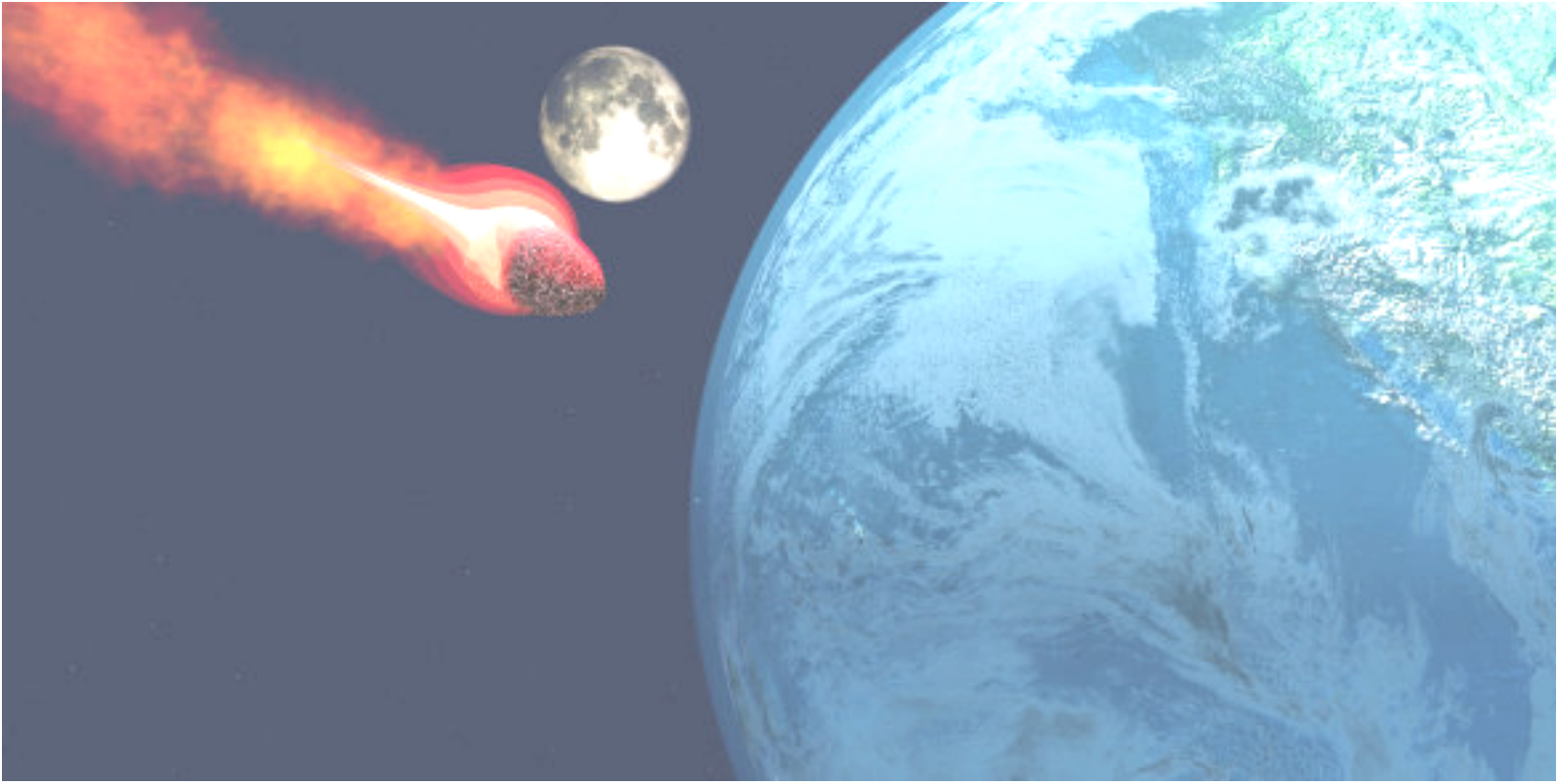
A giant asteroid, potentially dangerous for Earth flight towards the Earth. The collision is inevitable so from an artificial Earth's satellite a nuclear missile will be launched in order to brake into parts the asteroid. You are in a control post, with no computers, only with materials from the box you receive. In one hour and half you have to send the box with the solution of the following problems in order to plan the defensive strategy for our planet.
Real facts — The asteroid 2013 UX11 (Galați – Romania 2013)
During the night between 29th and 30th of October 2013, two astronomers Ovidiu Tercu and Alex Dumitriu from the Astronomic Observatory from Galati, Romania discovered an asteroid in the Torro constellation. The asteroid named 2013 UX11 has a diameter of D=2,5km. This was the first time that an asteroid was discovered by Romanian astronomer in order to make this problem for IOAA. After analyzing the data in the “Minor Planet Center” the following communication was received: 2013 UX11 is an asteroid from the Main Belt of Asteroids, orbiting between the orbits of Mars an Jupiter with period T=4,2years with an eccentricity e=0,15.
a) Find out the characteristics of orbit of the 2013 UX11 regrdless to the Sun — (a,b,c,rmin,rmax). You know the mass of the Sun M=9,1⋅1030kg and the gravitational constant K=6,67⋅10−11Nm2kg−2.
b) Find out the maximum and respectively the minimum of the temperatures of the surface of the asteroid. You know: Temperature of the surface of the Sun TS=6000K; the radius of the Sun RS≈7⋅105km; the albedo of the surface of the asteroid α=0,2.
A. For a given speed of the missile, the problem have only one solution
The plan
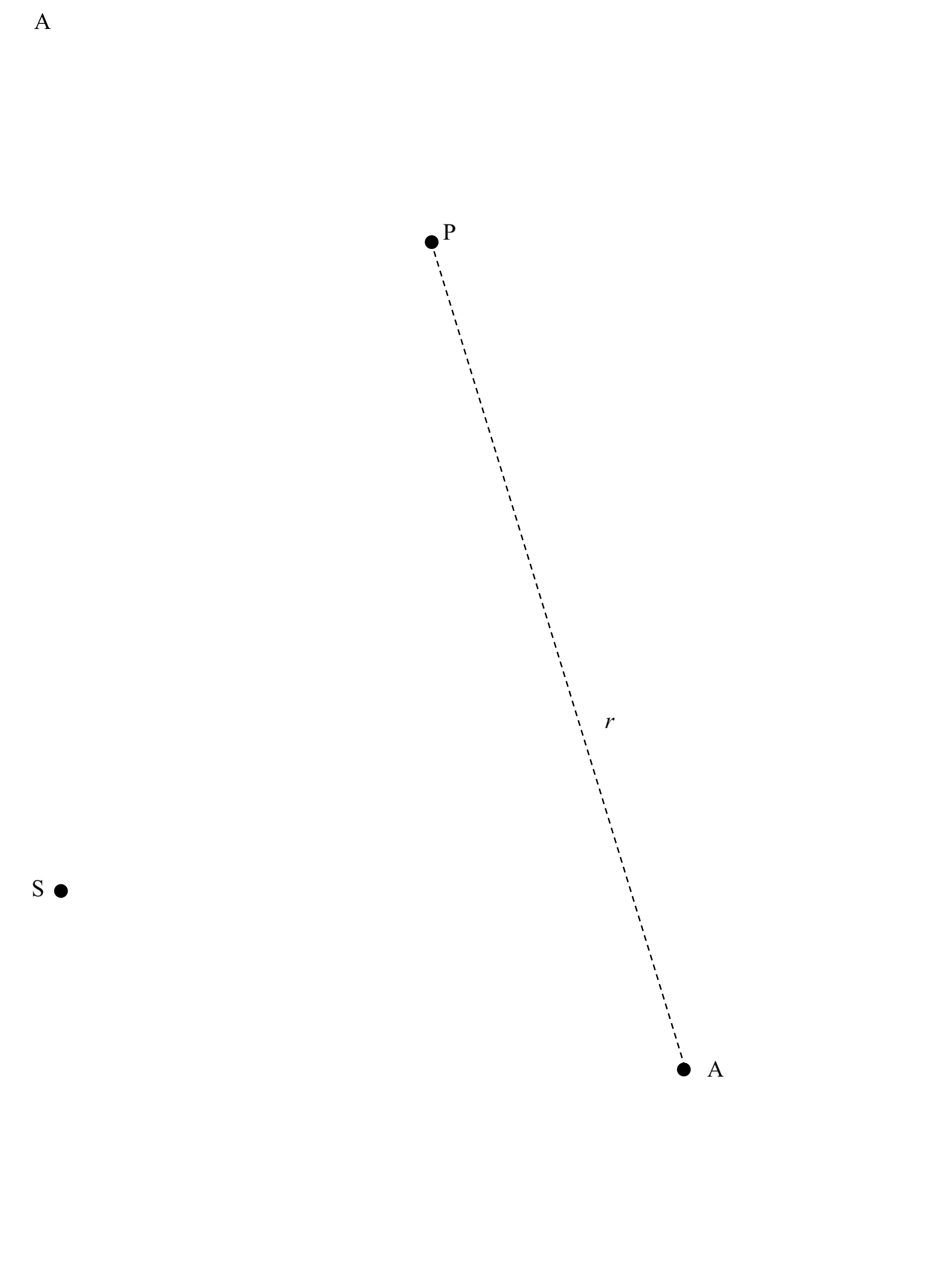
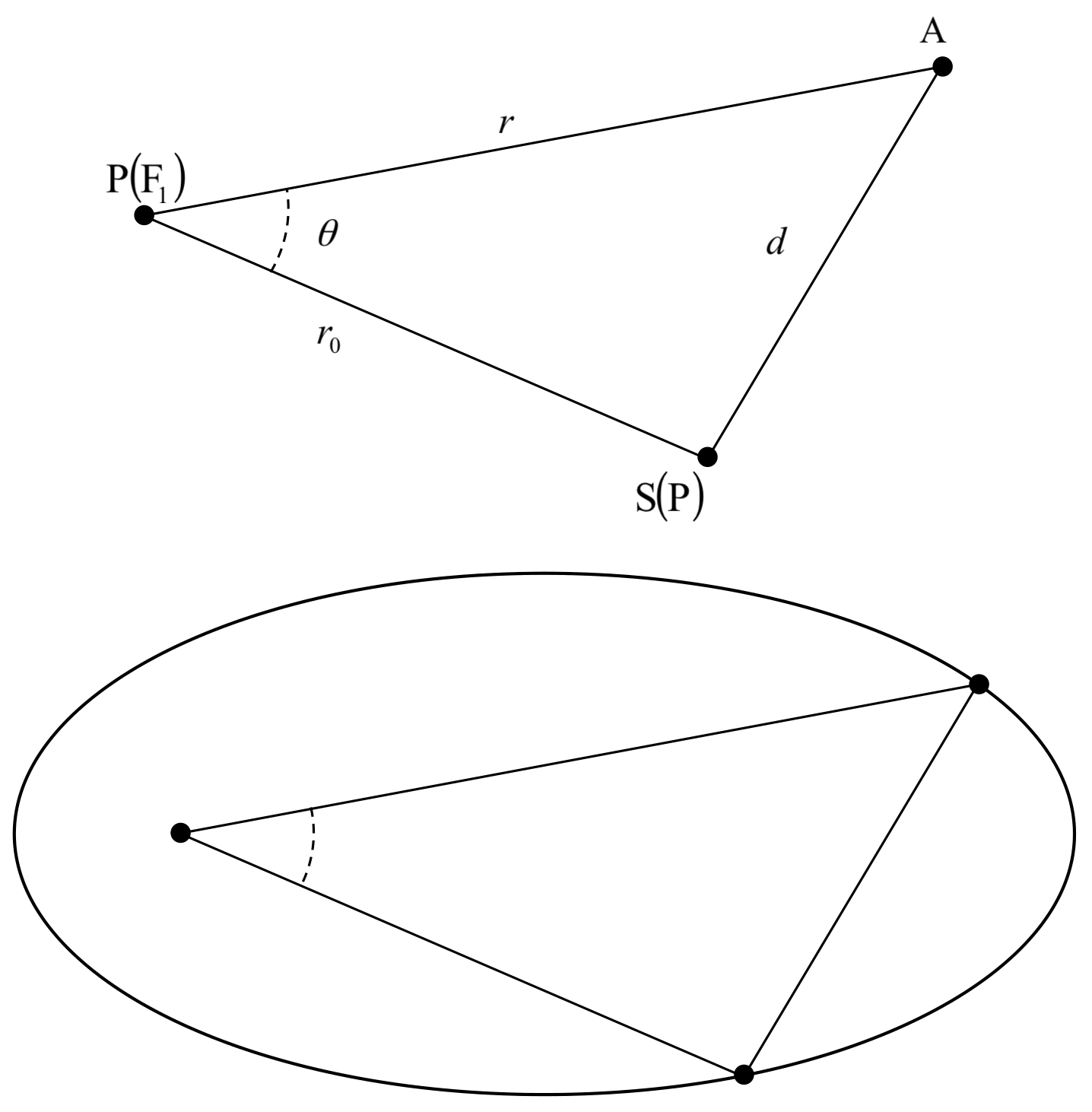
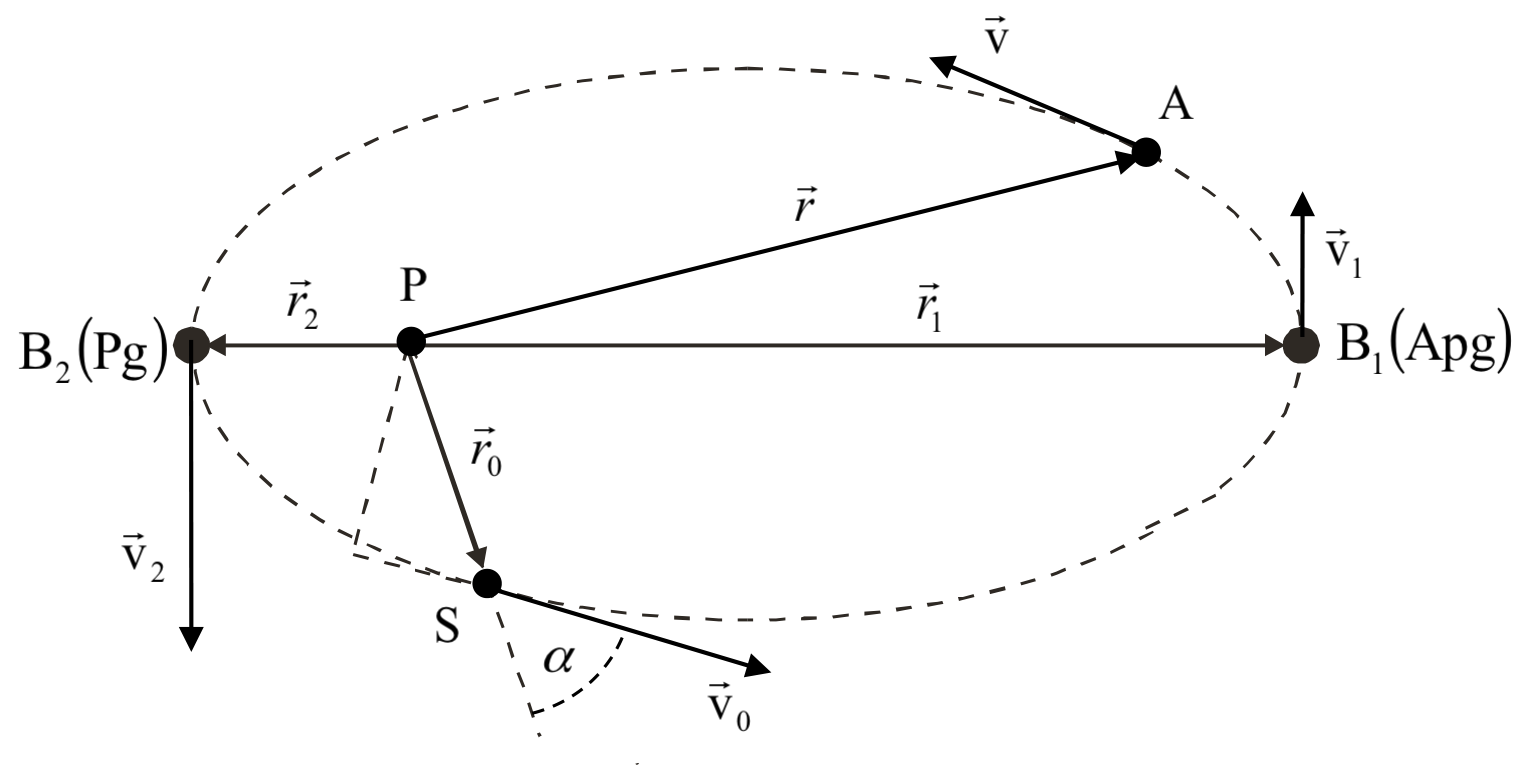
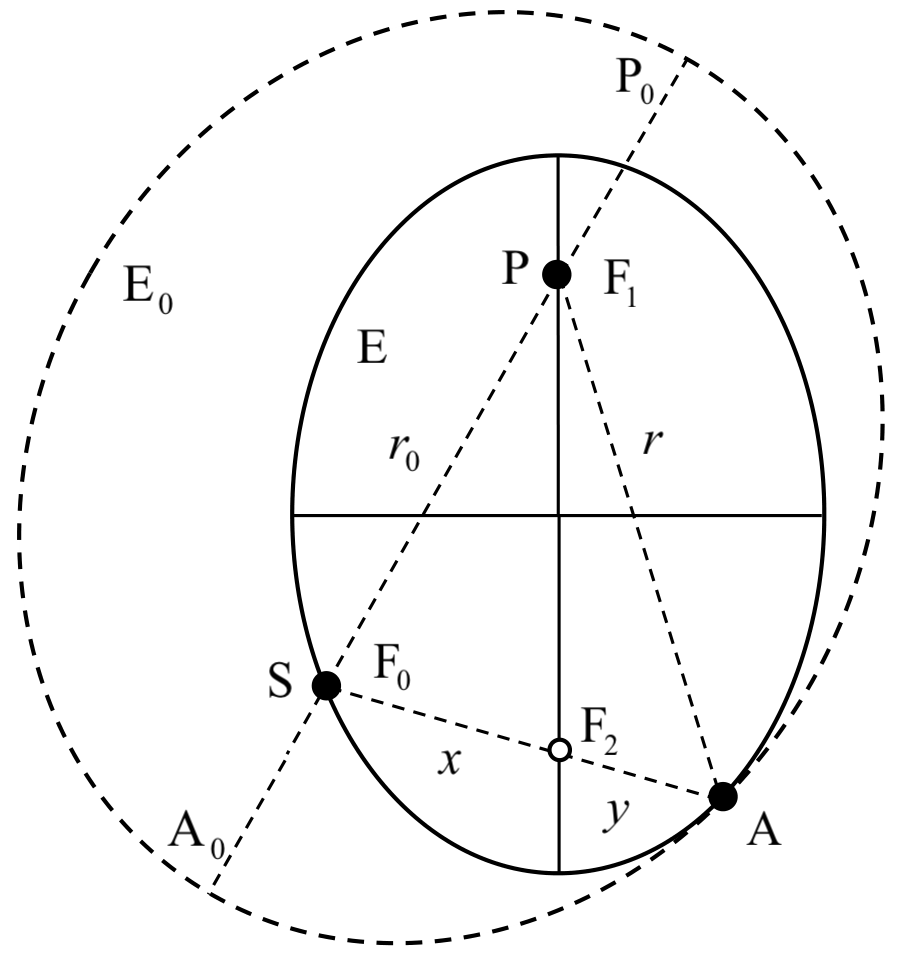
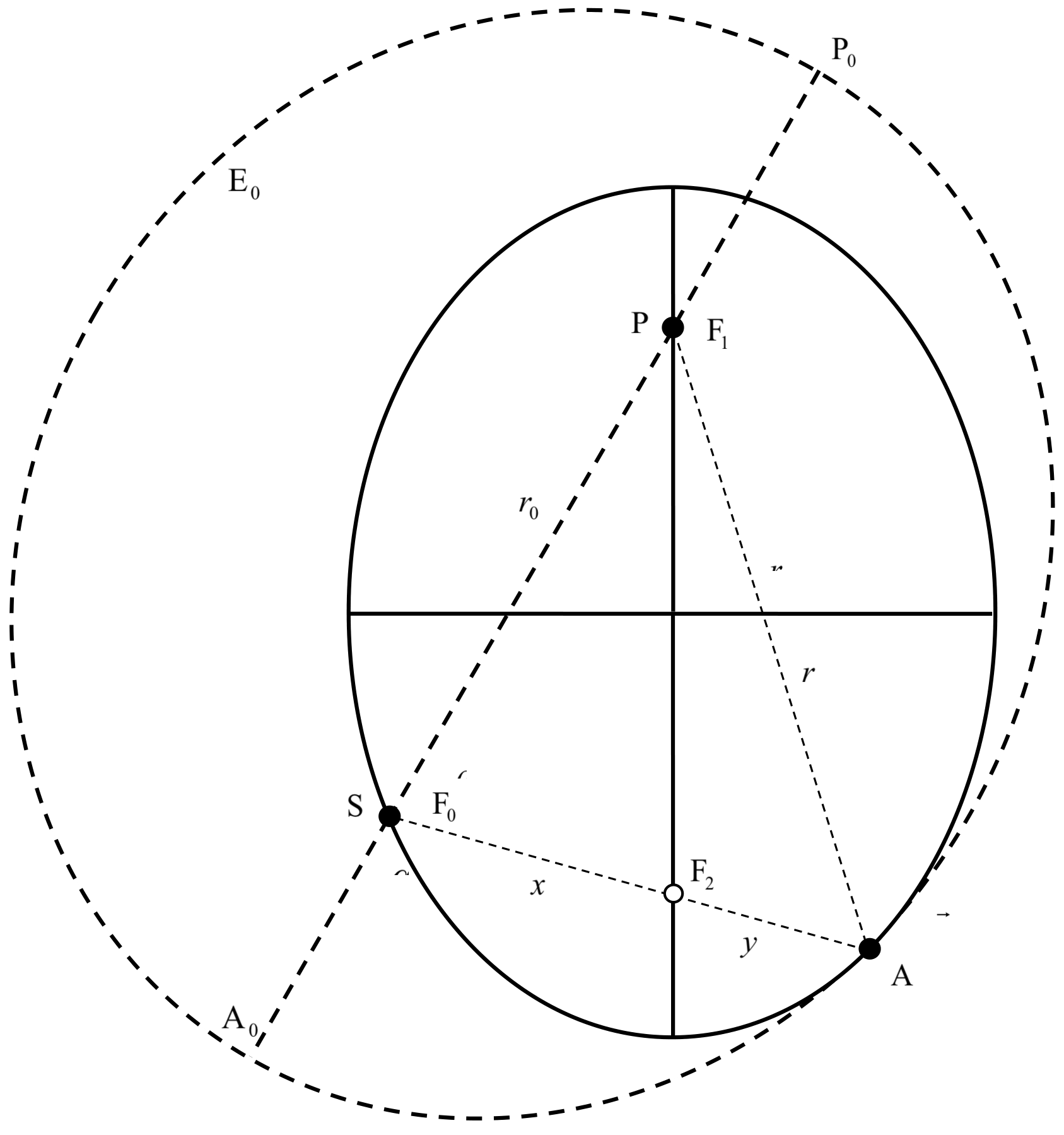
You have received a scaled sketch of the positions of the Earth (P), satellite (S) and the point where the missile have to hit the asteroid. The distance between asteroid and the Earth is r=30000km.
You have to analyze the problem of saving the Earth only by using the materials from the box in the following conditions:
For a given speed of the missile v0, the problem have only one solution i.e. there is only one trajectory form S to A, available for the missile in order to hit the asteroid. You have to determine by using the materials:
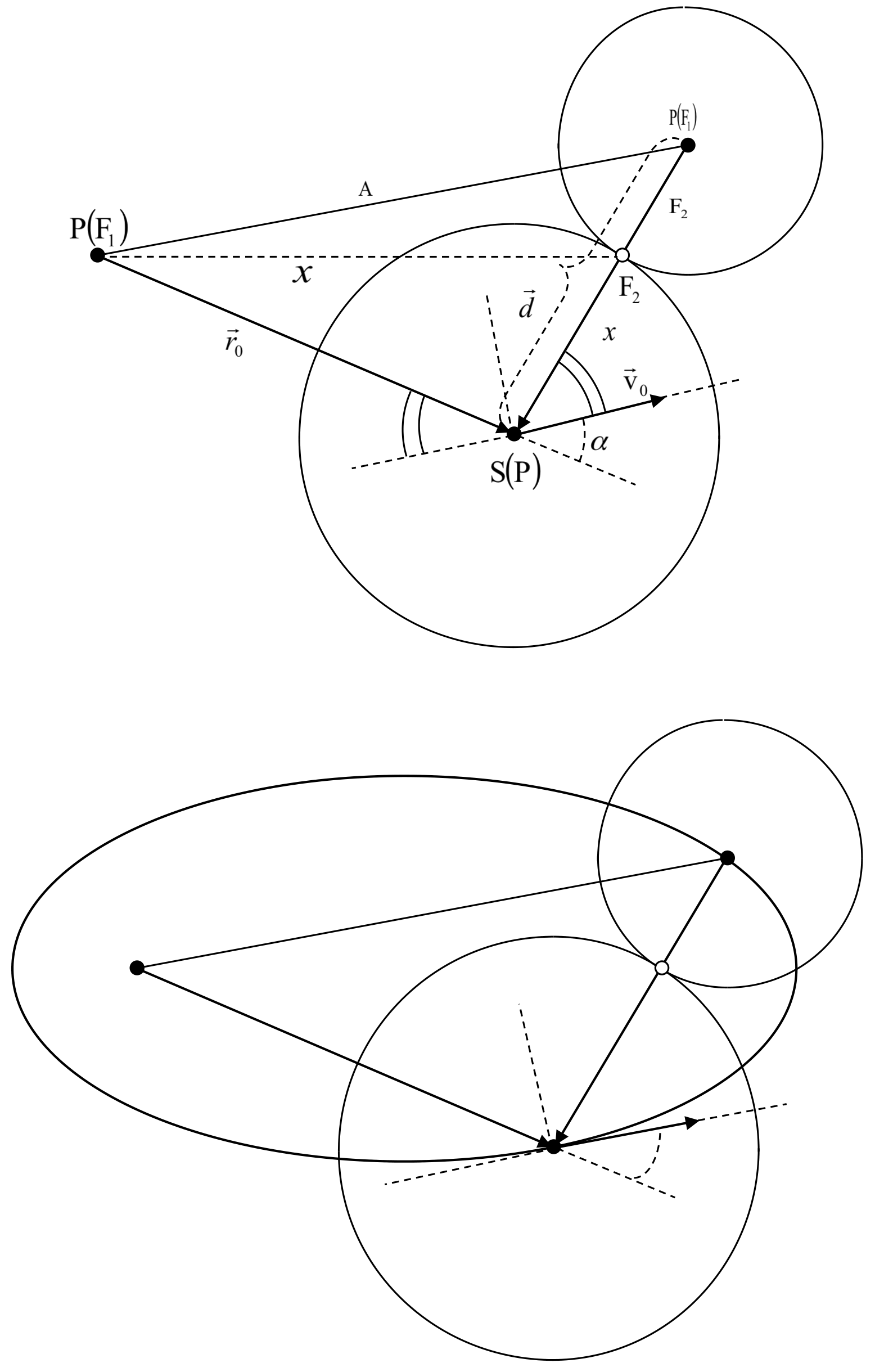
a) the elements of the missile trajectory;
b) the direction of the initial speed of the missile v0 in order to be able to hit the asteroid. Indicate on the paper sheet the angle you measured.
c) Calculate the launch velocity of the missile v0 if you know the mass of the Earth M=6⋅1024kg and the gravitational constant G=6.67⋅10−11Nm2kg−2
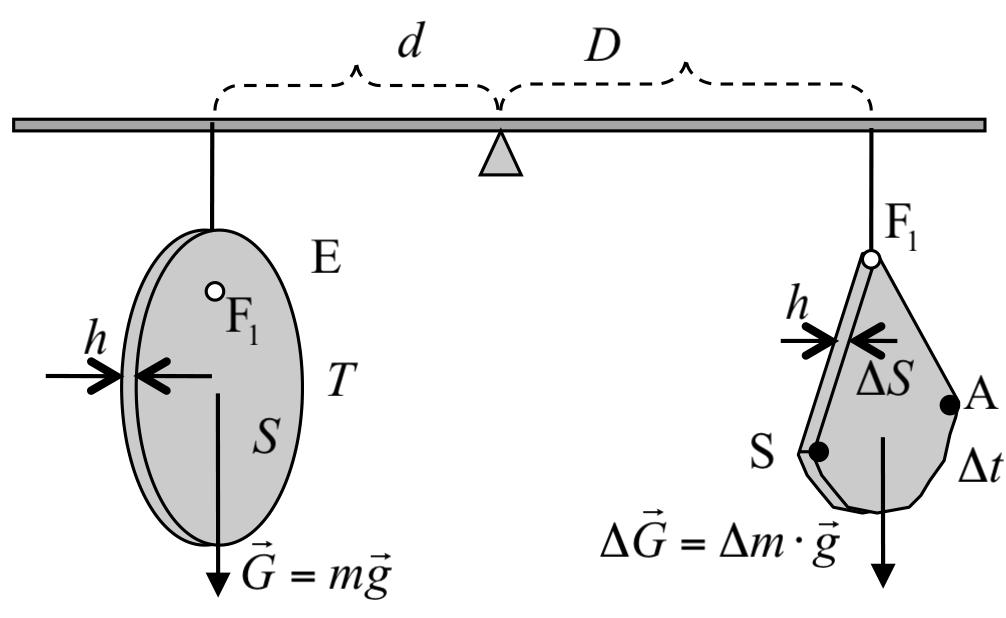
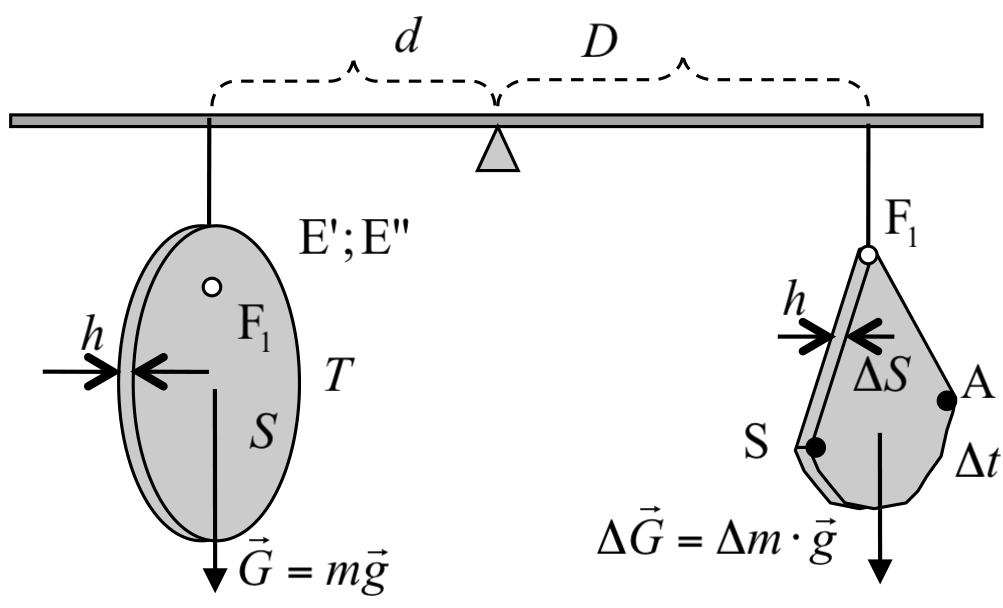
d) Using the plasticine imagine a very simple device in order to calculate the duration of missile flight from launch untill the impact with the asteroid.
e) Using the wire, measure the distance covered by the missile from the launch-point to the impact-point.
B. Two solutions
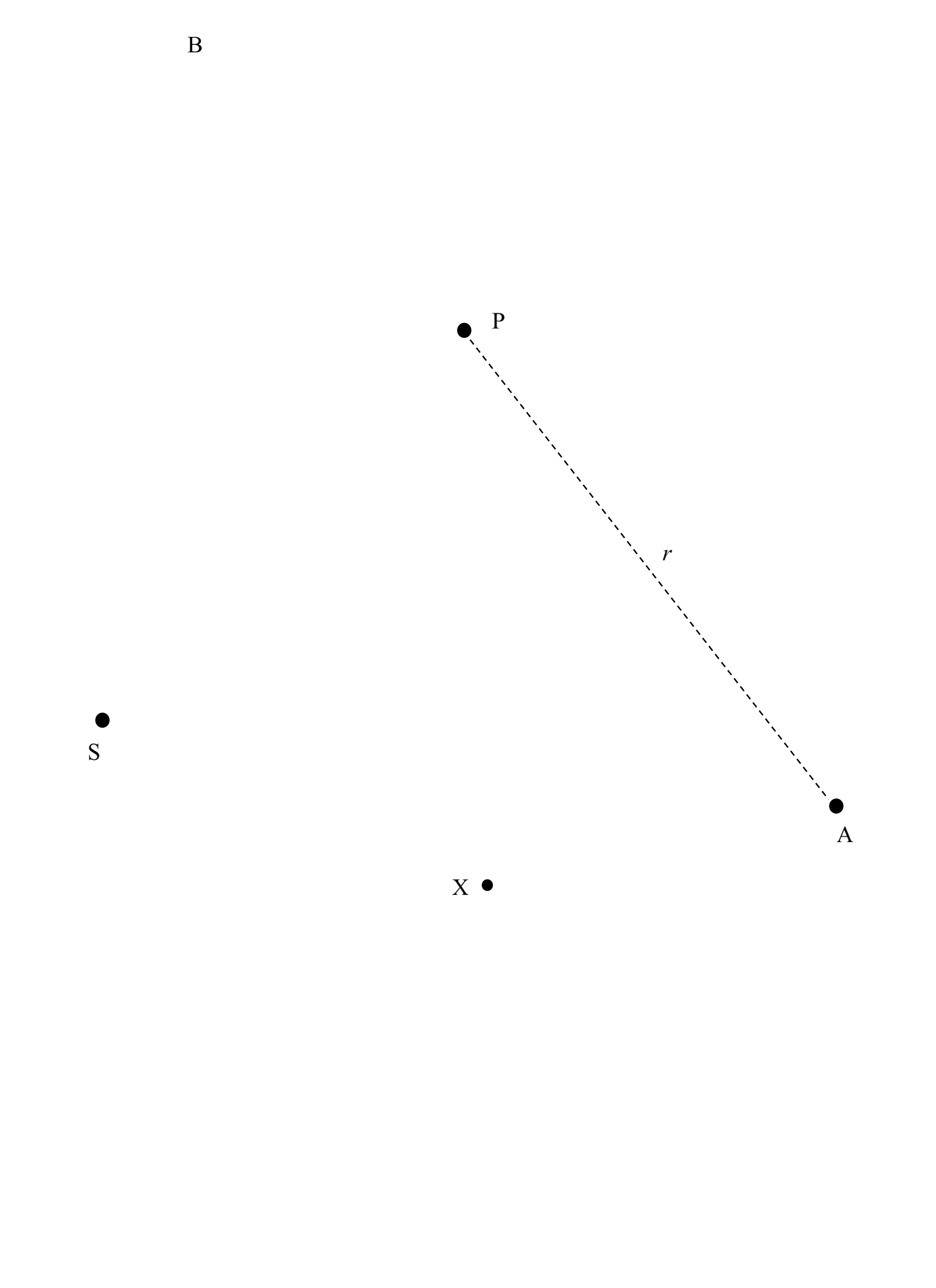
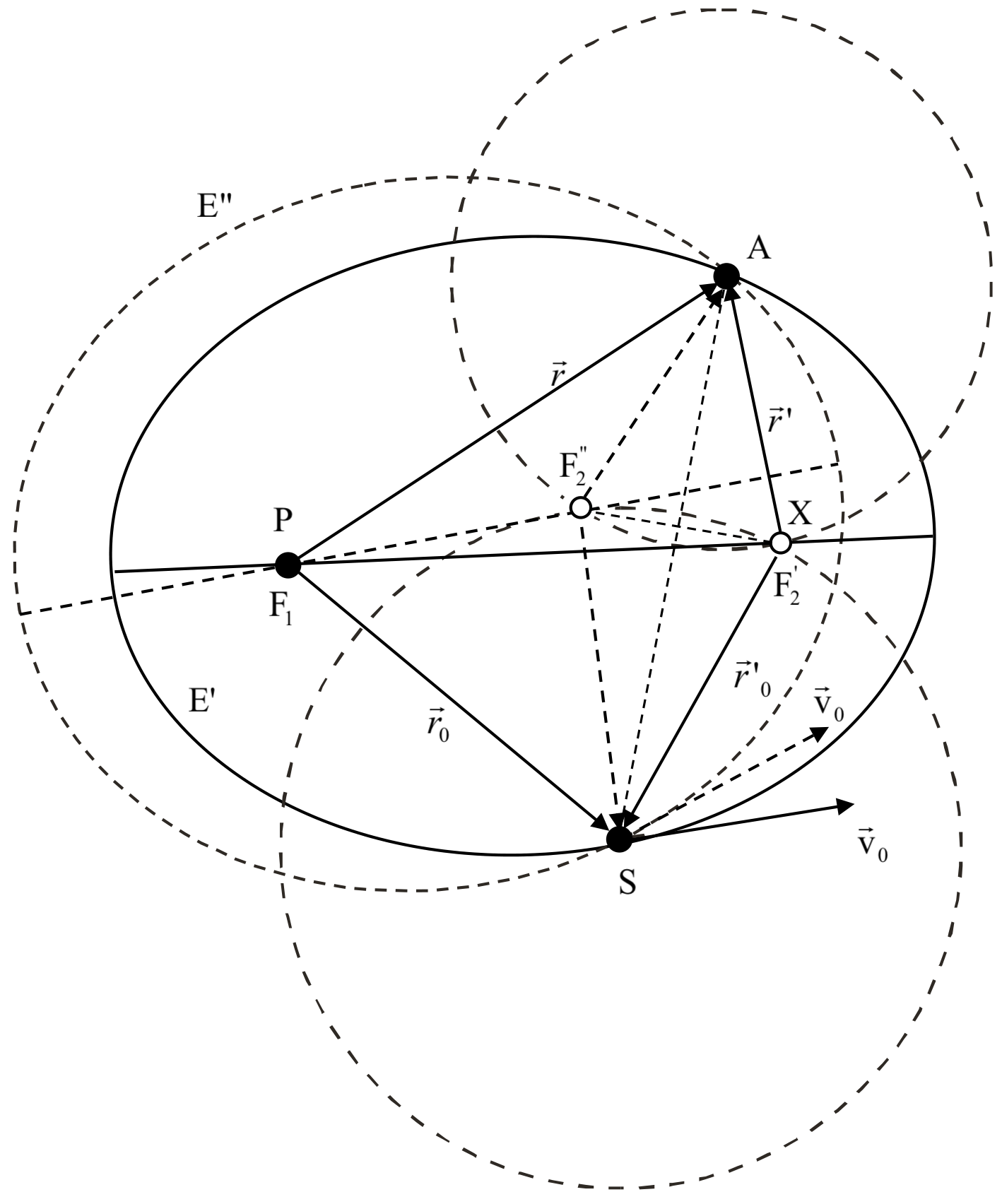
To be sure that the asteroid will be destroyed from another satellite orbiting the Earth at another altitude will be launched in the same moment of time, a second missile in order to hit the asteroid simultaneously with the first missile. Notations P — center of the Earth; S — launch position of the new missile, A — the impact point at distance r=30000km from the Earth.
In this configuration you know that there are two possible trajectories, form S to A for the second missile. For that a mysterious point X is marked on the sketch.
You have to find out:
a) the elements of the two possible trajectories.
b) For each trajectory determine the directions of the launch-speeds, at the same velocity which allows the missile to hit the target;
c) The launch-velocity v0, if you know the maa of the Earth M=6⋅1024kg and the gravitational constant K=6,67⋅10−11Nm2kg−2;
d) Using the plasticine imagine a very simple device in order to calculate the durations of missile flight from launch till the impact with the asteroid for the both trajectories
e) Using the wire, measure the distances covered by the missile from launch-point to the impact-point.
C. Security zone
You have to delimitate around the Earth a security zone. From the point A of this problem you know that there is a unique possible trajectory for the defensive missile. This means that the pointA on the sketch is locate on a curve which delimitates a security yone for the Earth.
a) If you know that the triangle defined by the points P — the Earth, S — Sun, A — impact point remains unchanged in time establish the shape of the curve which delimitates the security zone
b) Draw on the paper this curve and determine its parameters
c) Where have to be situated the impact-point A in order to hit the asteroid simultaneously with to missiles
d) Use your plasticine device to fiind out the time spent by an fragment of the asteroid which flies after the impact with the missile, on the curve which delimitates the security zone
Решение
Внимание: Непълно решение
The matching retained key provides all available derivations and diagrams, but page28 prints only b) and c) labels after the security ellipse diagram. No separate written simultaneous-hit condition for C(c) is supplied. No grading rubric or points is present.
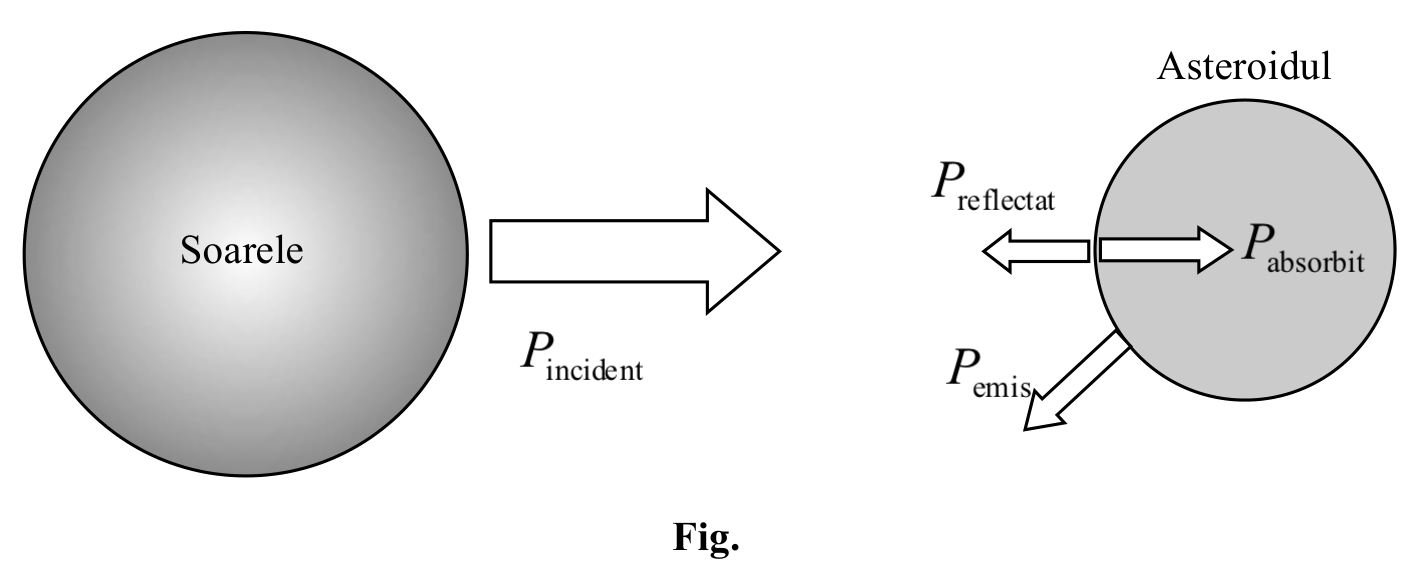
Densitatea fluxului energetic al Soarelui, la distanţa rAS faţă de acesta (acolo unde se află Asteroidul), însemnează energia tuturor radiaţiilor emise de Soare, care traversează unitatea de arie a unei suprafeţe, sub incidenţă normală, în unitatea de timp, adică:
Semisfera asteroidului expusă radiaţiilor solare este echivalentă cu un disc plan circular, având raza RA şi aria suprafeţei πRA2, aşezat perpendicular pe direcţia Soare – Asteroid, astfel încât fluxul radiaţiilor solare incidente, F, la nivelul Asteroidului (adică energia solară incidentă le nivelul Asteroidului, în unitatea de timp), este:
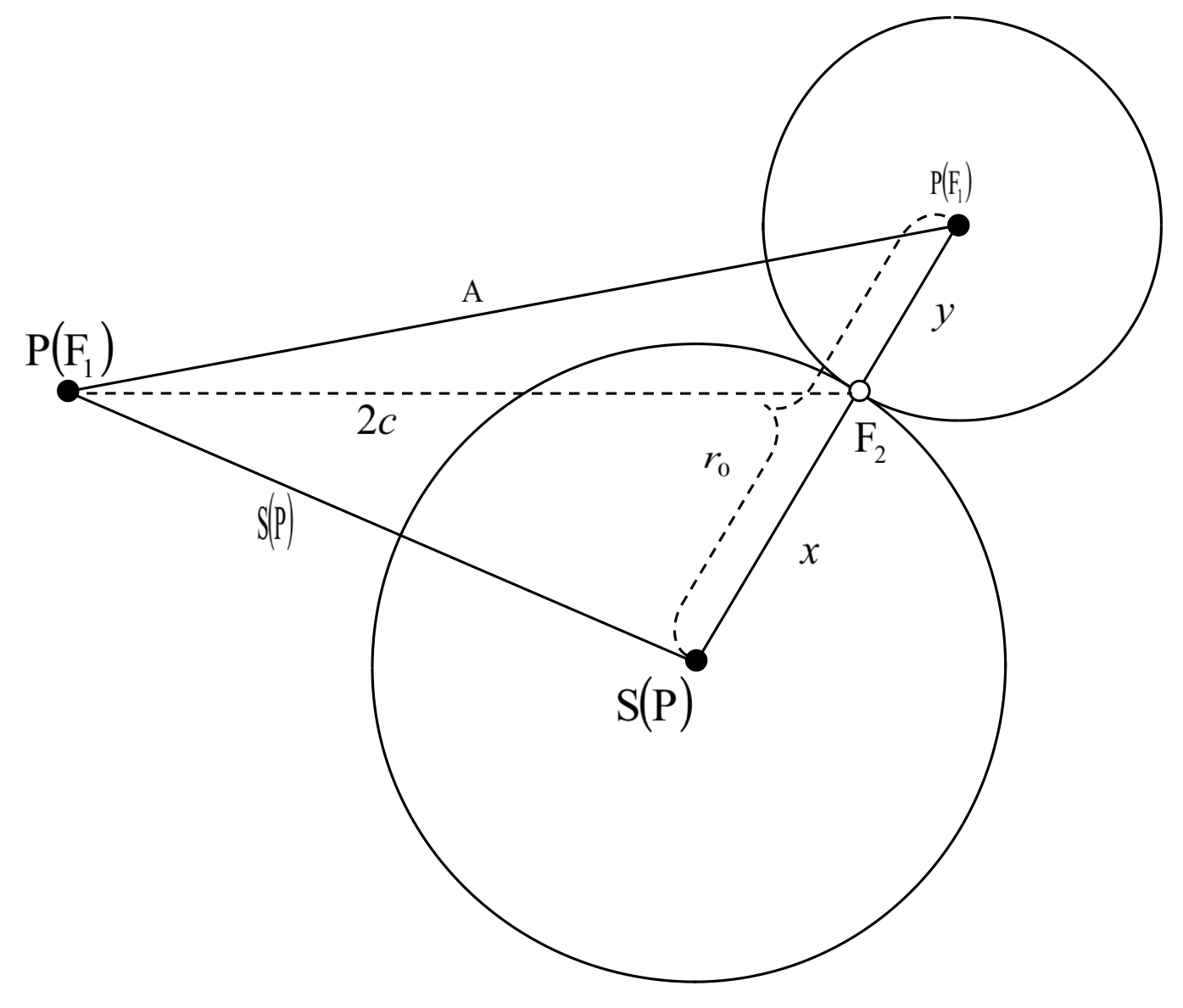
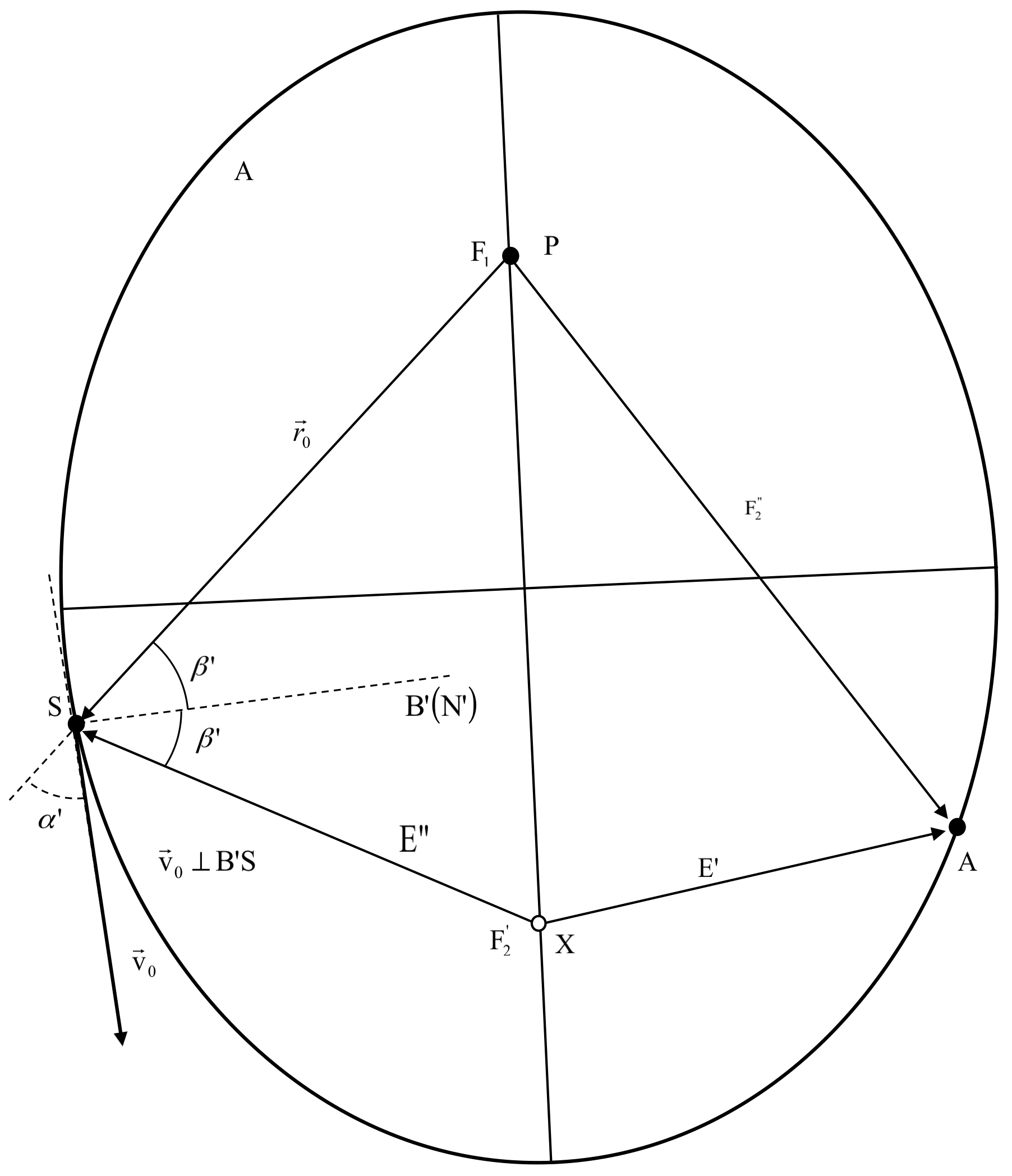
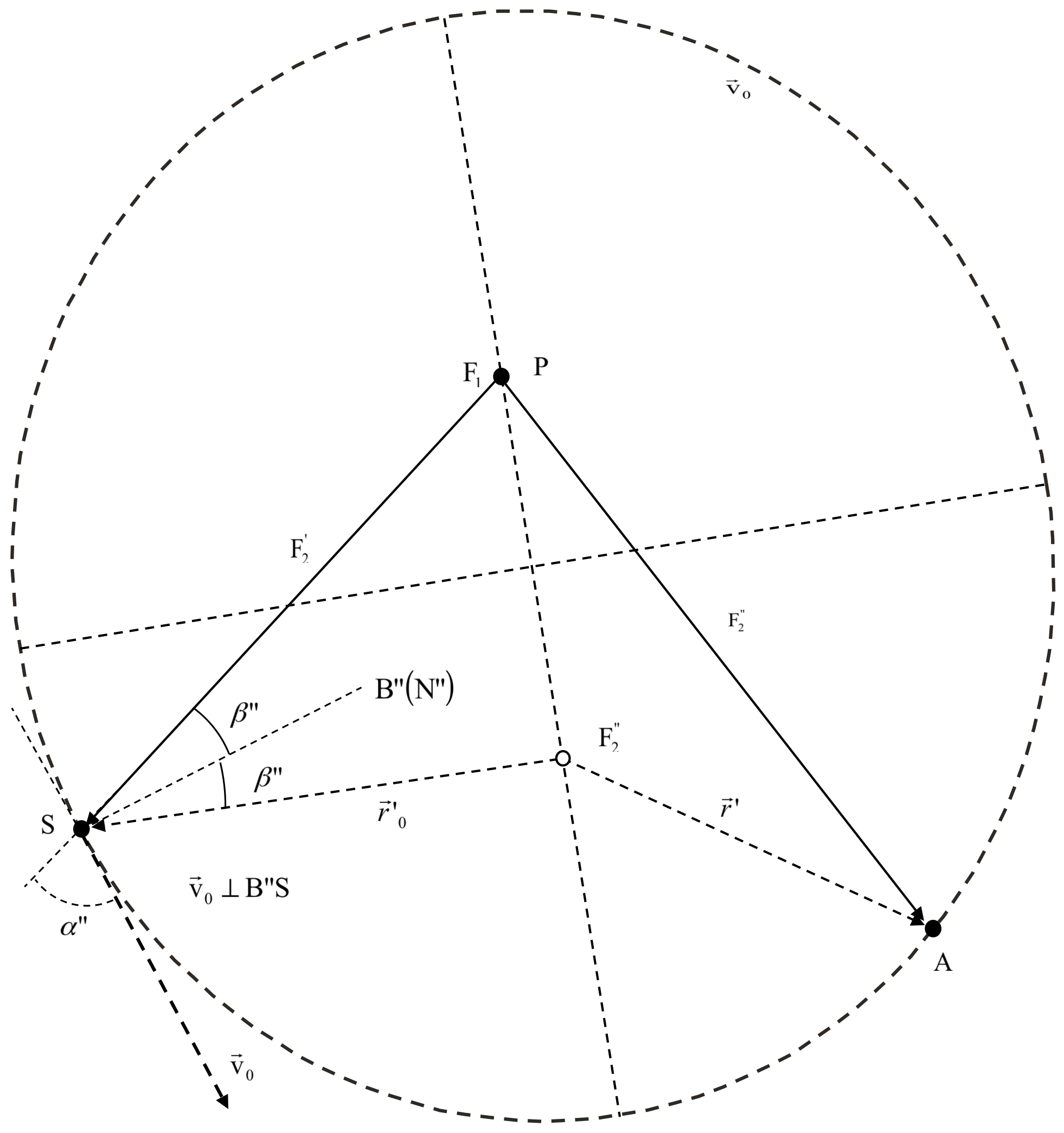
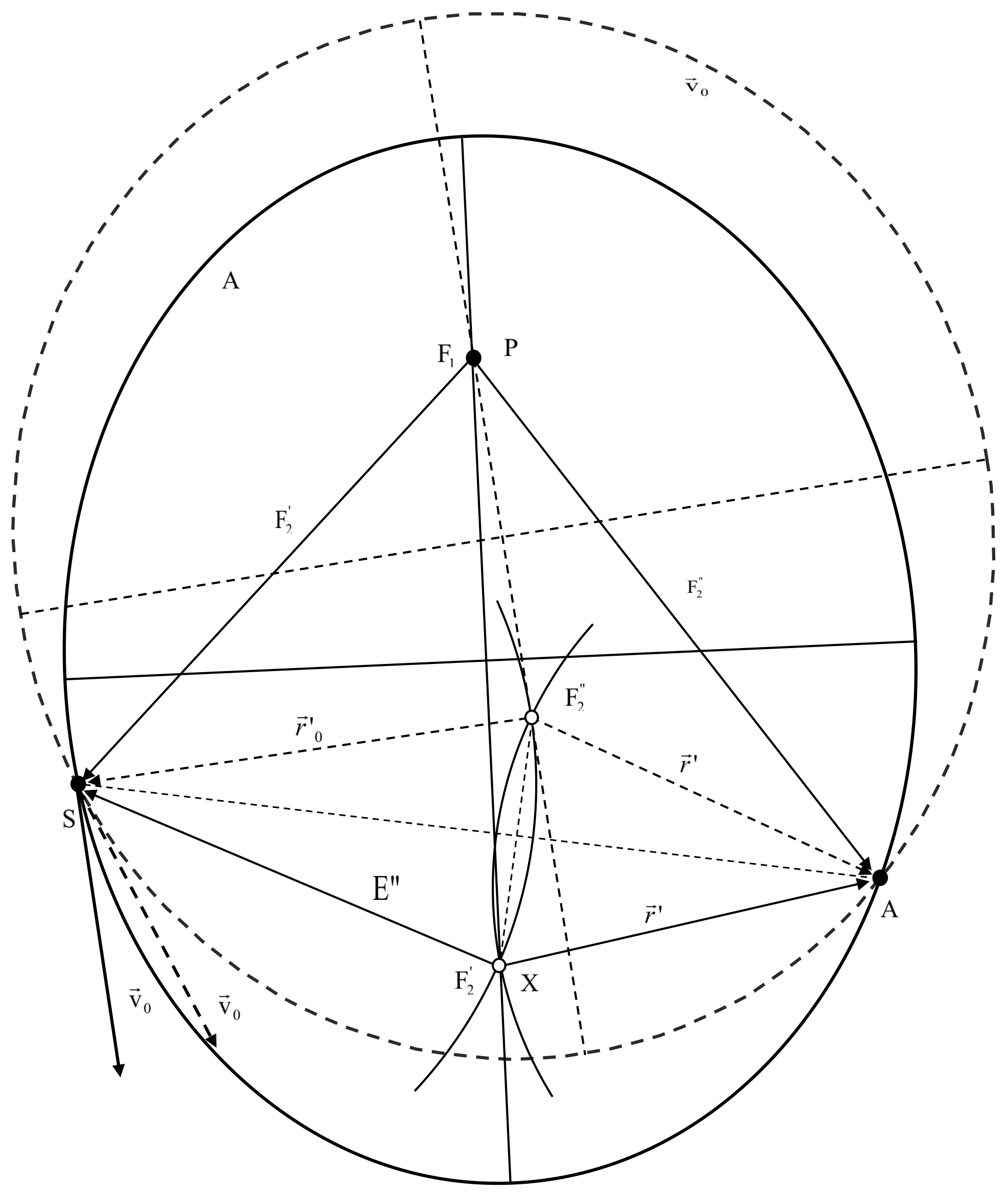
B. a) The 2 elipses have a common focar so the injection point will go in the same point r0, with initial velocity, v0. The both elipses semiaxes are identical:
a=2KM−r0v02KMr0.
2c1=2c2;2b1=2b2;e1=e2.
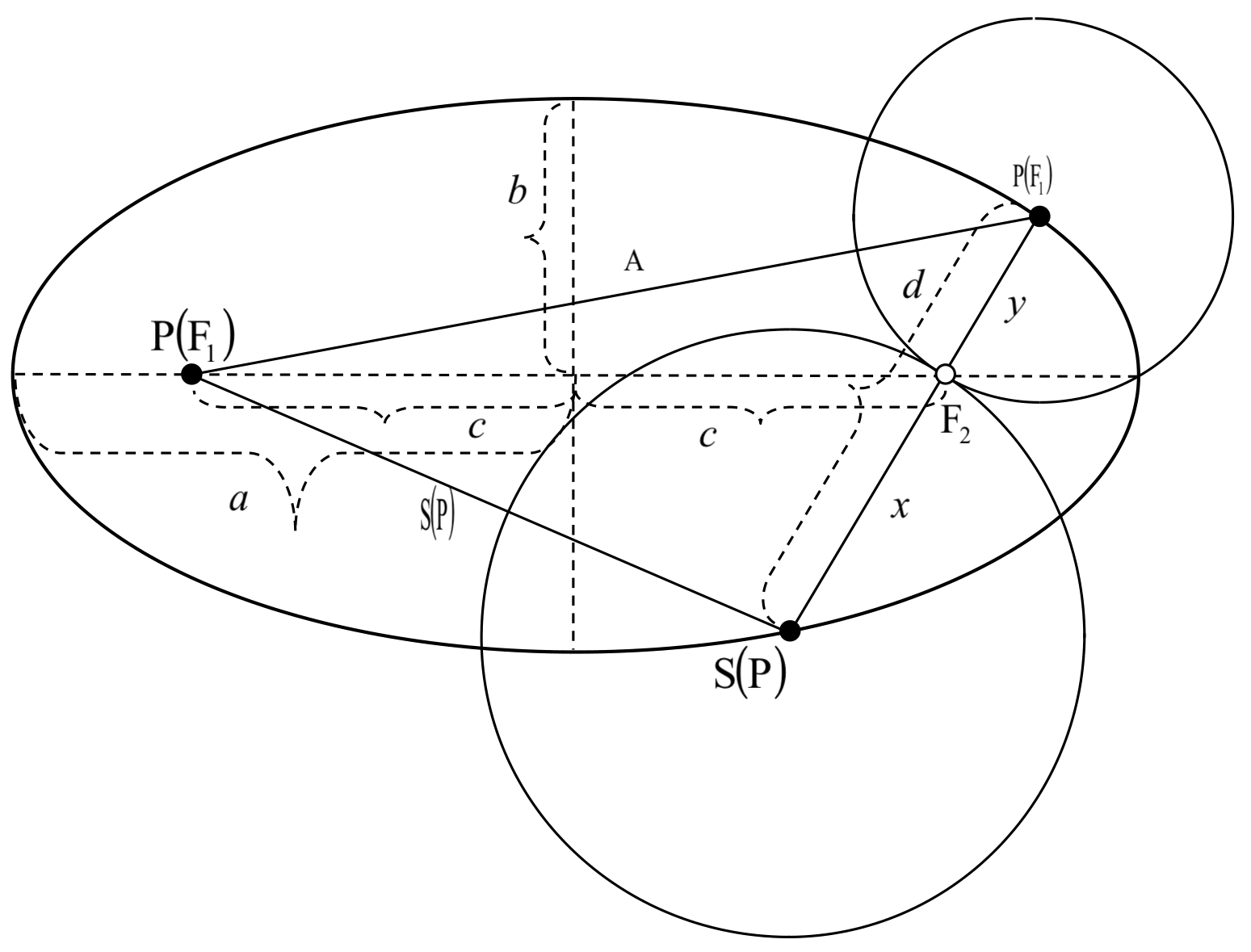
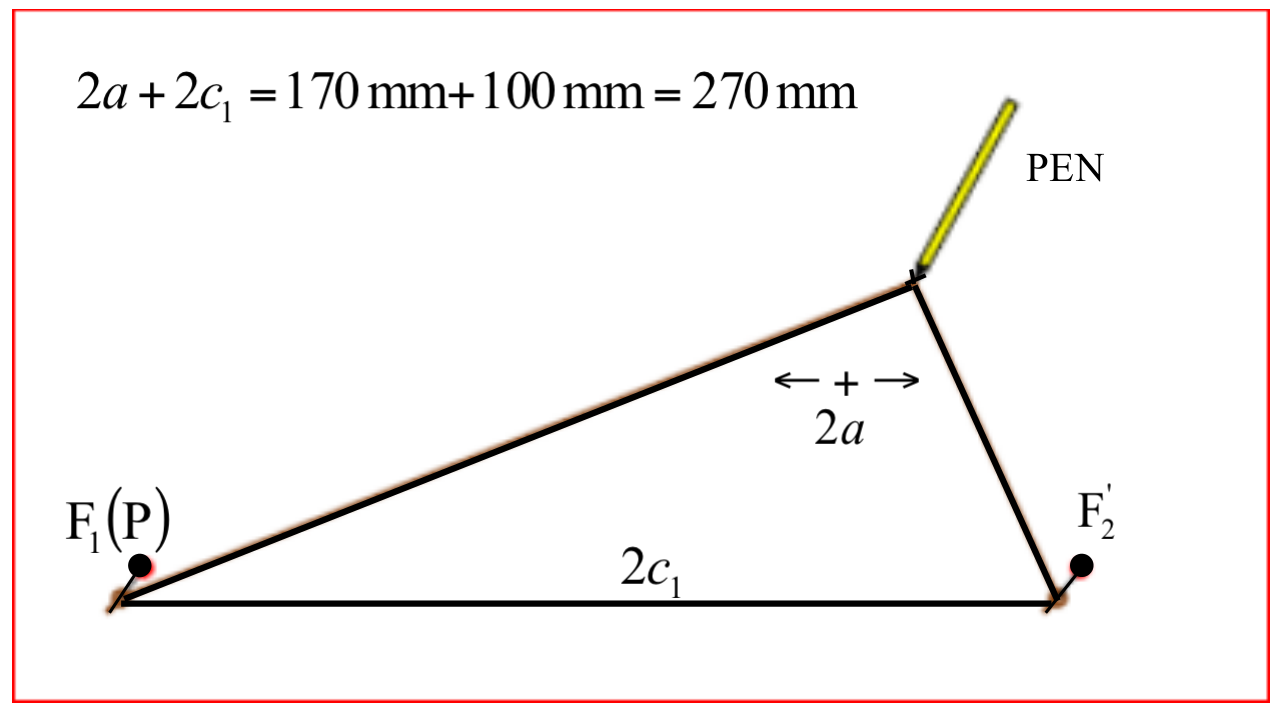
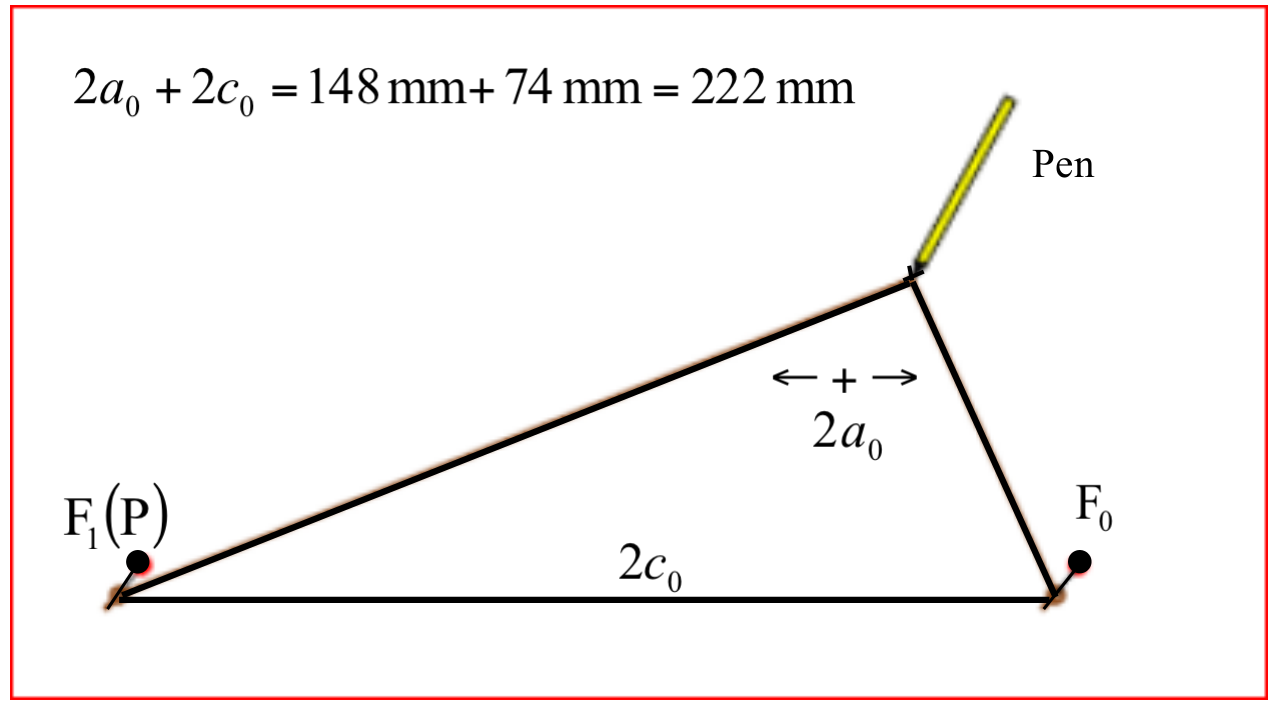
PS+SX=PA+AX=170mm;X≡F2′.
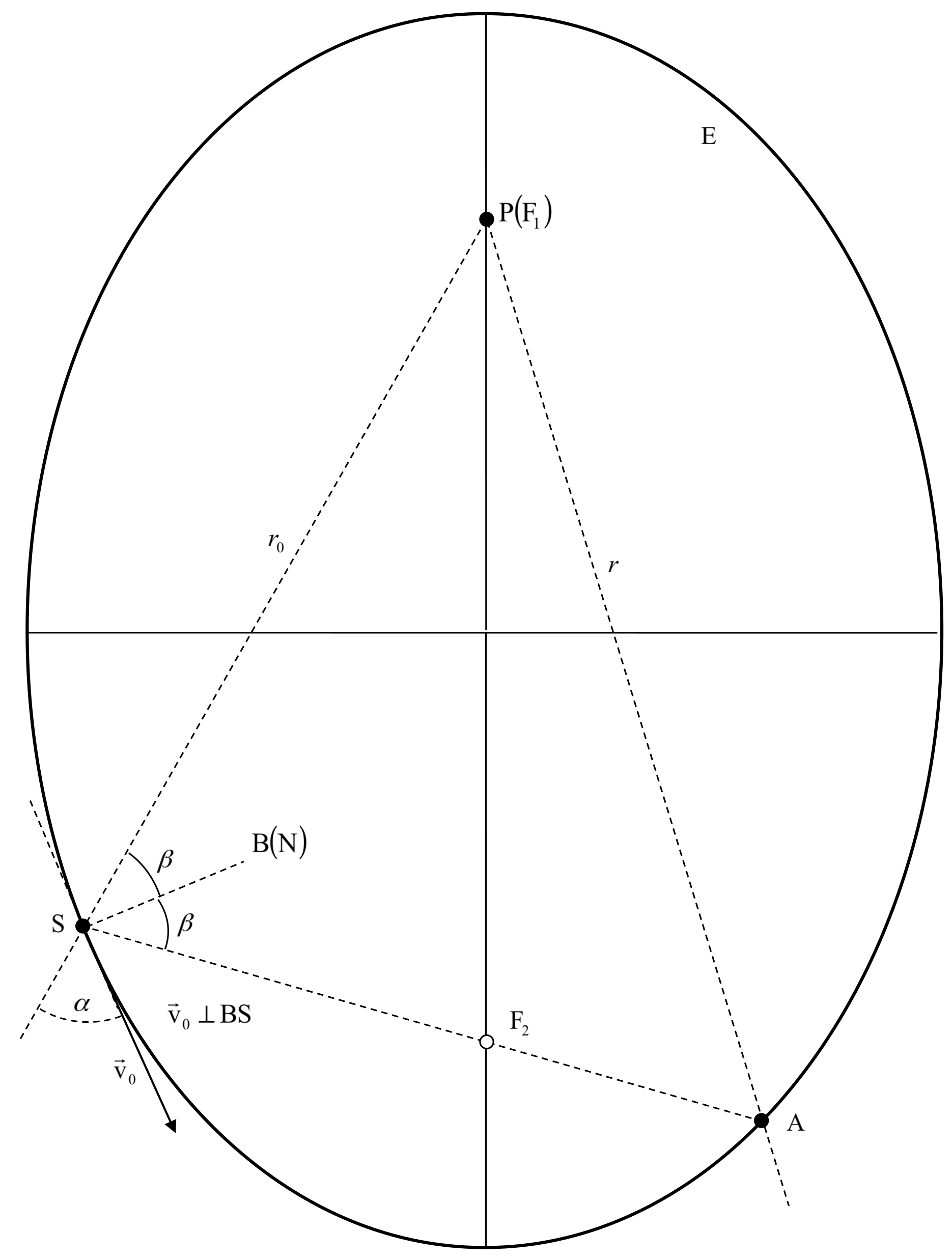
AAfter localizing the focuses of the elipses the axes can be drawn.
r0+r0′=2a;r+r′=2a.
Measuring r0 and r0′, or r and r′, can be calculated:
Conturul elipsei de siguranță se trasează așa cum indică desenul din figura alăturată.
b)
c)
Archive source gap: the retained key page 28 prints these bare labels after the diagram, without a separate written answer to C(b) or C(c). The parameters and drawing associated with the security ellipse are retained above. No additional simultaneous-hit condition has been supplied here.
Archive source notes: The primary question wording is retained, including “Defensing”, “brake”, “regrdless”, “maa”, “security yone”, “fiind” and “to missiles”. Both editions print the solar mass 9,1⋅1030kg; the key's subsequent orbital arithmetic and rounded b,c and temperatures remain literal. The key energy-flow line equates Pincident to Pemis,Soare even though the next line includes the intercepted-area factor; both lines are preserved. Primary A(c) prints G=6.67⋅10−11 and B(c) prints K=6,67⋅10−11; the repeated key uses K in A(c) and G in B(c), while the worked key uses K. C(a) labels S “Sun”, although the plan and construction use S as the satellite/launch point. The key says both ellipse “semiaxes are identical”, then prints unequal minor axes. Its A measurement r0+r+d does not exactly match its rounded 2a, and both numerical security-ellipse constructions (52235,29 and 52352,94 km) are preserved. The unlabelled final key page 29 retains T in its measurement line and T0 in its preceding period and final complement. No numerical corrections, additional scoring authority or missing answer have been invented.