IOAA 2014, Теория, дълги задачи — Задача 13. Eagles on the Caraiman Cross !
THEORETICAL TEST Long problems · 50 т.
Внимание: Бележка към темата
The final key has blank pages 6 and 14 and broken maps on page 15. Eagles A2 (delay derivation and Fig. 4), C1–C2 final formulas, and Antipod a), marking scheme and maps are recovered from the archived preliminary key (original pages 7–8, 14 and 24–25). Antipod a) in that key uses latitude 43° although both questions give 44°; its printed answer is retained as an alternate-edition answer. Other printed numerical discrepancies are preserved.
Indications
1. The problems were elaborated concerning two aspects:
a. To cover merely all the subjects from the syllabus;
b. The average time for solving the items is about 15 minutes per a short problem;
2. In your folder you will find out the following:
a. Answer sheets
b. Draft sheets
c. The envelope with the subjects in English and the translated version of them in your mother tongue;
3. The solutions of the problems will be written down only on the answer sheets you receive on your desk. PLEASE WRITE ONLY ON THE PRINTED SIDE OF THE PAPER SHEET. DON’T USE THE REVERSE SIDE. The evaluator will not take into account what is written on the reverse of the answer sheet.
4. The draft sheets is for your own use to try calculation, write some numbers etc. BEWARE: These papers are not taken into account in evaluation, at the end of the test they will be collected separately . Everything you consider as part of the solutions have to be written on the answer sheets.
5. Each problem have to be started on a new distinct answer sheet.
6. On each answer sheet please fill in the designated boxes as follows:
a. In PROBLEM NO. box write down only the number of the problem: i.e. 1 to 12 for short problems, 13 to 14 for long problems. Each sheet containing the solutions of a certain problem, should have in the box the number of the problem;
b. In Student ID – fill in your ID you will find on your envelope, consisted of 3 letters and 2 digits.
c. In page no. box you will fill in the number of page, starting from 1. We advise you to fill this boxes after you finish the test
7. We don’t understand your language, but the mathematic language is universal, so use as more relationships as you think that your solution will be better understand by the evaluator. If you want to explain in words we kindly ask you to use short English propositions.
8. Use the pen you find out on the desk. It is advisable to use a pencil for the sketches.
9. At the end of the test:
a. Don’t forget to put in order your papers;
b. Put the answer sheets in the folder 1. Please verify that all the pages contain your ID, correct numbering of the problems and all pages are in the right order and numbered. This is an advantage of ease of understanding your solutions.
c. Verify with the assistant the correct number of answer sheets used fill in this number on the cover of the folder and sign.
d. Put the draft papers in the designated folder, Put the test papers back in the envelope.
e. Go to swim
GOOD LUCK !
Note on marking
ALL THE CORRECT SOLUTIONS WHICH ARE DIFFERENT FROM THE AUTHOR’S SOLUTION WILL BE EVALUATED AND MARKED ACORDINGLY TO THE MARKING SCHEME.
Условие
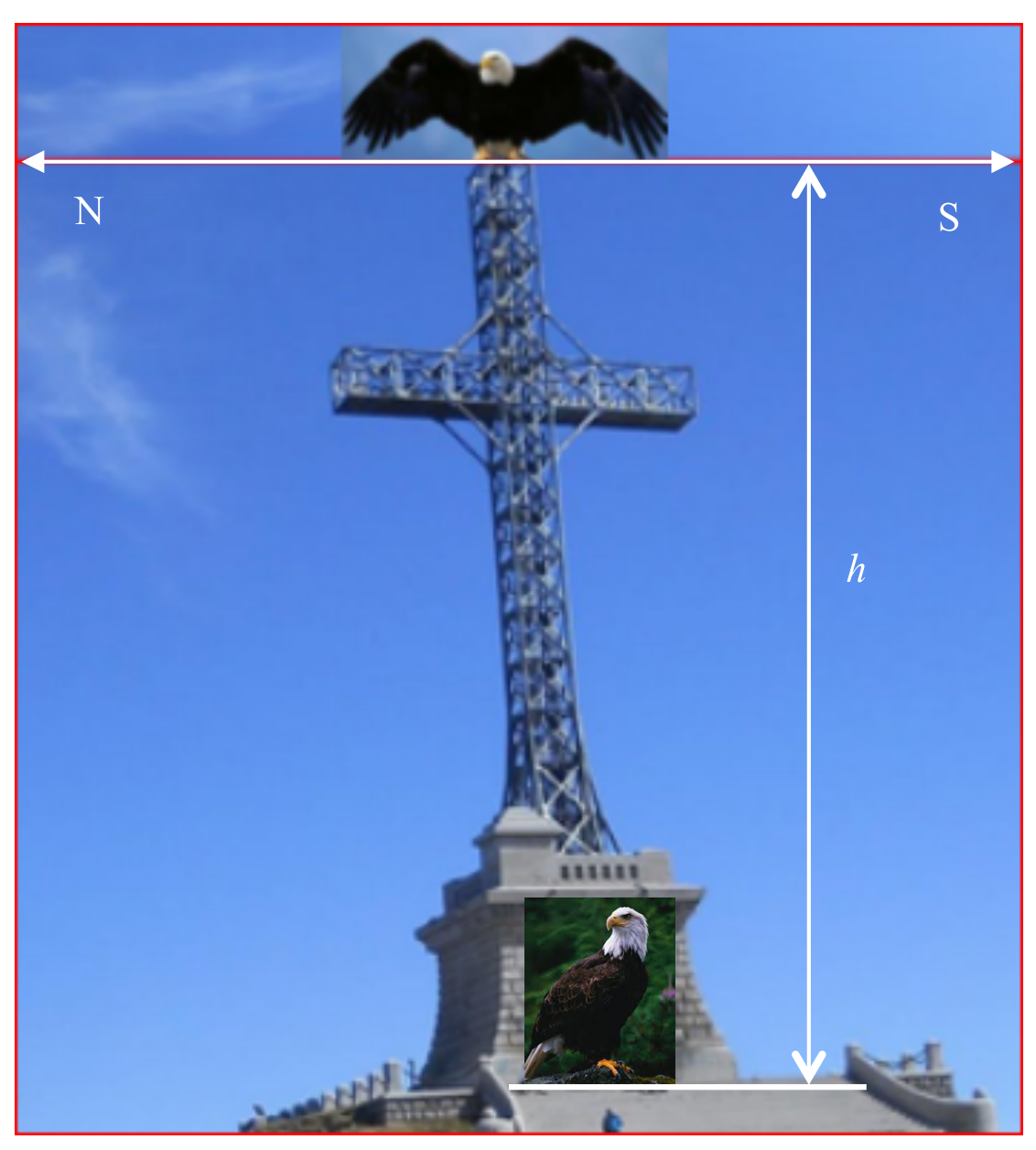
The tallest cross built on a mountain peak is located on a plateau situated on the top of the peak called Caraiman in Romania at altitude from the sea level. Its height, including the base-support is . The horizontal arms of the cross are oriented on the N-S direction. The latitude at which the Cross is located is .
A.
On the evening of 21st of March 2014, the vernal equinox day, two eagles stop from their flight, first near the monument, and the second, on the top of the Cross as seen in figure 1. The two eagles are in the same vertical direction. The sky was very clear, so the eagles could see the horizon and observe the Sun set. Each eagle began to fly right at the moment it observed that the Sun disappeared completely.
At the same time, an astronomer is located at the sea-level, at the base of the Bucegi Mountains. Assume that he is in the same vertical direction as the two eagles.
Assuming the atmospheric refraction to be negligible, solve the following questions:
1) Calculate the duration of the sunset, measured by the astronomer. [10 т.]
2) Calculate the durations of sunsets measured by each of the two eagles and indicate which of the eagles leaves the Cross first. What is the time interval between the moments of the flights of the two eagles. [10 т.]
The following information is necessary:
The duration of the sunset measurement starts when the solar disc is tangent to the horizon line and stops when the solar disc completely disappears.
The Earth’s rotational period is , the radius of the Sun , Earth – Sun distance , the latitude of the Heroes Cross is .
B)
At a certain moment the next day, 22nd March 2014, the two eagles come back to the Heroes Cross. One of the eagles lands on the top of the vertical pillar of the Cross and the other one land on the horizontal plateau, just at the tip of the shadow of the vertical pillar of the Cross, at that moment of the day when the shadow length is minimum.
1) Calculate the distance between the two eagles and the second eagle’s distance from the cross. [10 т.]
2) Calculate the length of the horizontal arms of the Cross , if the shadow on the plateau of one of the arm of the cross at this moment has the length [10 т.]
C)
At midnight, the astronomer visits the cross and, from its top, he identifies a bright star at the limit of the circumpolarity. He named this star „Eagles Star”. Knowing that due to the atmospheric refraction the horizon lowering is , calculate:
1) The “Eagles star” declination; [5 т.]
2) The “Eagles star” maximum height above the horizon. [5 т.]
Отговори
A., 1) 3 min
Official solution: τ ≈ 3 min.
A., 2) 3.354 s
Official solution: τ1 ≈ 2,9350 min (eagle on the plateau), τ2 ≈ 2,9309 min (eagle on the top of the Cross); the eagle from the plateau leaves the cross first; Δt = 0,0559 min = 3,354 s.
B), 1) d ≈ 55,58 m; umin = 39,3 m
Official solution: d = h/cos φ ≈ 55,58 m and umin = h·tan φ = 39,3 m.
B), 2) 7 m
Official solution: lb = ub·tan φ = 7 m.
C), 1) 42.9 deg
Printed in archived preliminary key, original page 14; omitted from the final key.
C), 2) 87.9 deg
Printed in archived preliminary key, original page 14; omitted from the final key.
Решение
Marking scheme
Long problem 1. Marking scheme - Eagles on the Caraiman Cross
| 1) | 10 |
|---|---|
| 2) | 10 |
| B1) | 10 |
| B2) | 10 |
| C1) | 5 |
| C2) | 5 |
A. 1)
1 The following notations are used: the diameter of the Sun, Earth-Sun distance, angular diameter of the Sun as seen from the Earth:
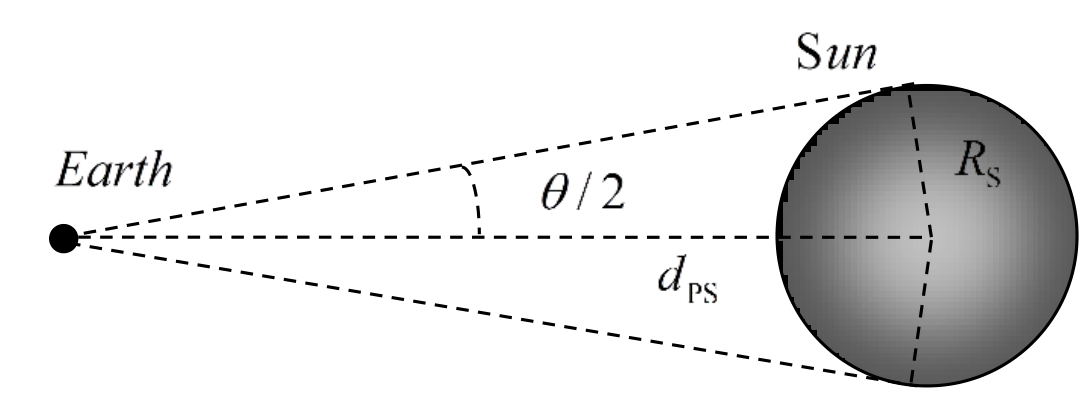
According the fig. 1 the angular diameter of the Sun can be calculated as follows
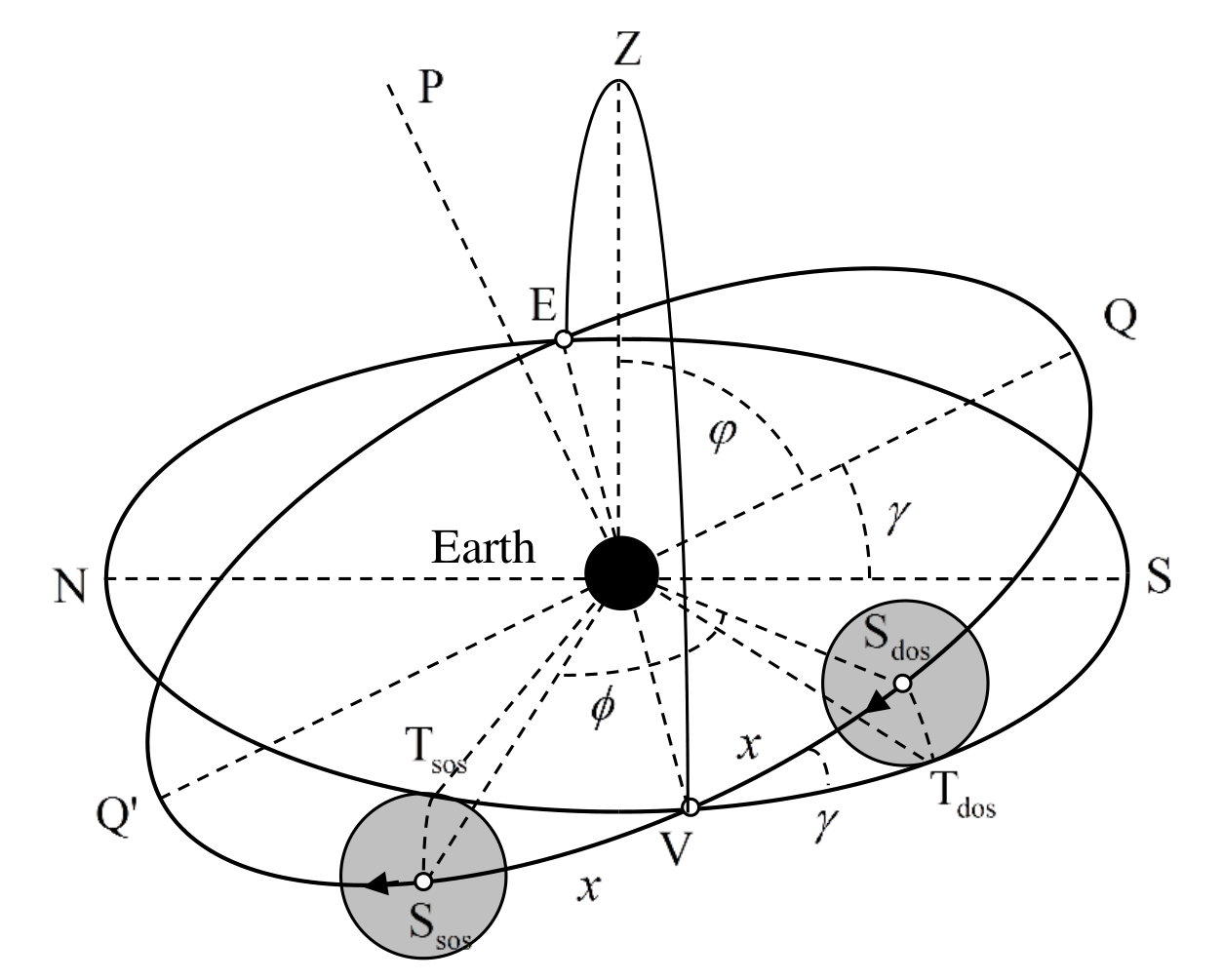
The figure 2 presents the Sun’s evolution during sunset as seen by the astronomer. In an equinox day the Sun moves retrograde along the celestial equator. There are marked the following 3 positions of the Sun:
- The solar disc is tangent to the equatorial plane above the standard horizon – the start of the sunset;
- The center of the solar disc on the celestial equator in the moment of the sunset starts;
- The solar disc is tangent to the equatorial plane bellow the standard horizon – the end of the sunset
- The center of the solar disc on the celestial equator in the moment of the sunset ends;
The duration of the sunset is . During this time the center of the Sun moves along the equator from to . The vector-radius of the Sun rotates in equatorial plane with angle and in vertical plane with angle . i.e. the angular diameter of the Sun as seen from the Earth.
Considering that the Sun travels the distance along the equatorial path with merely constant i.e. during time and that the spherical right triangle can be considered a plane one the following relations can be written:
A. 2)
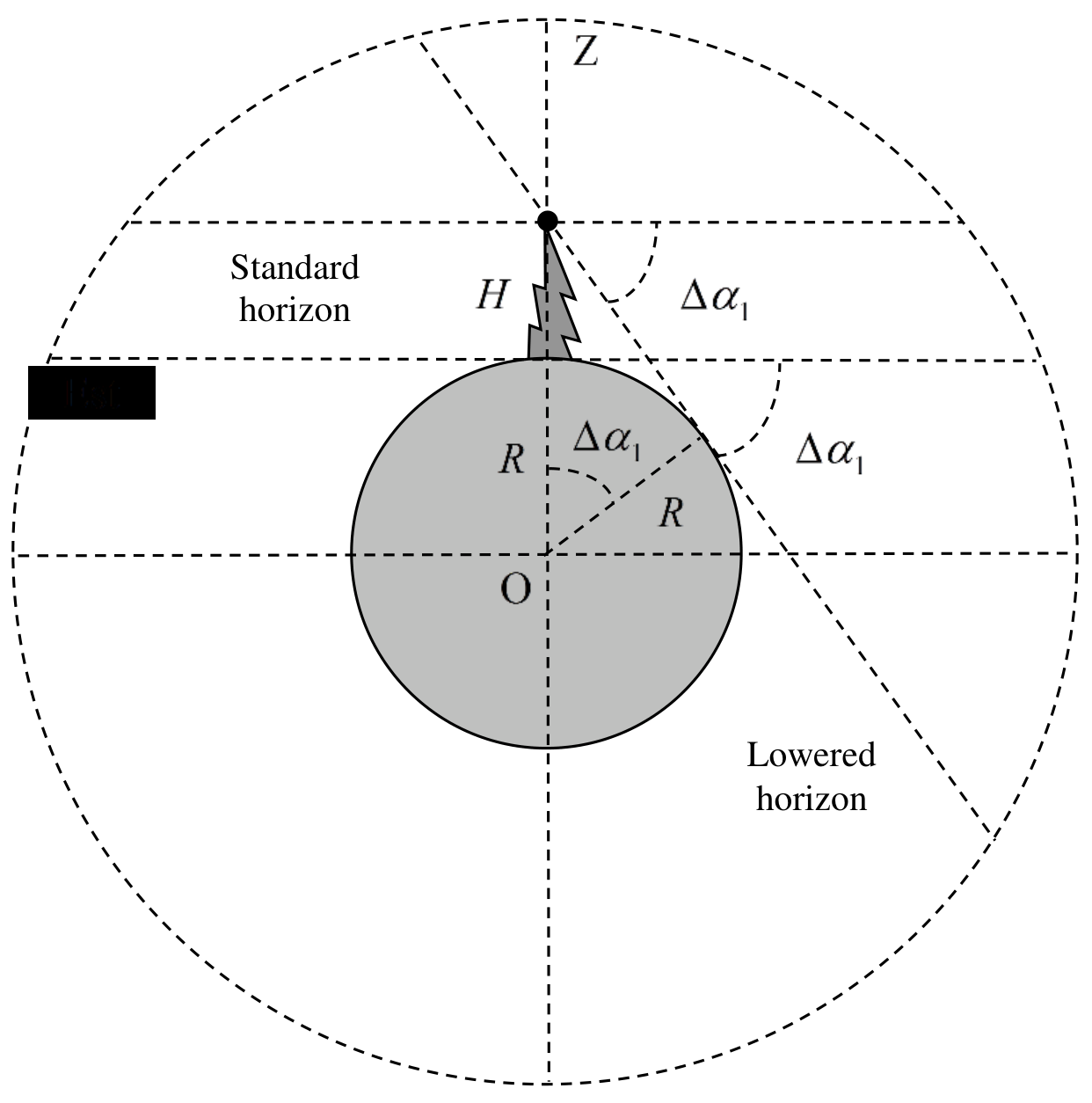
If the atmospheric refraction is negligible the eagle on the top of the cross on figure 3 is on the same latitude , as the astronomer but at the altitude H. Thus from the point of view of the the horizon line is below the standard horizon line with an angle ,
For the observer the Sun will go below the lowered horizon after moving down under the standard horizon with angle and moving along the equator with an angle , as seen in fig. 4
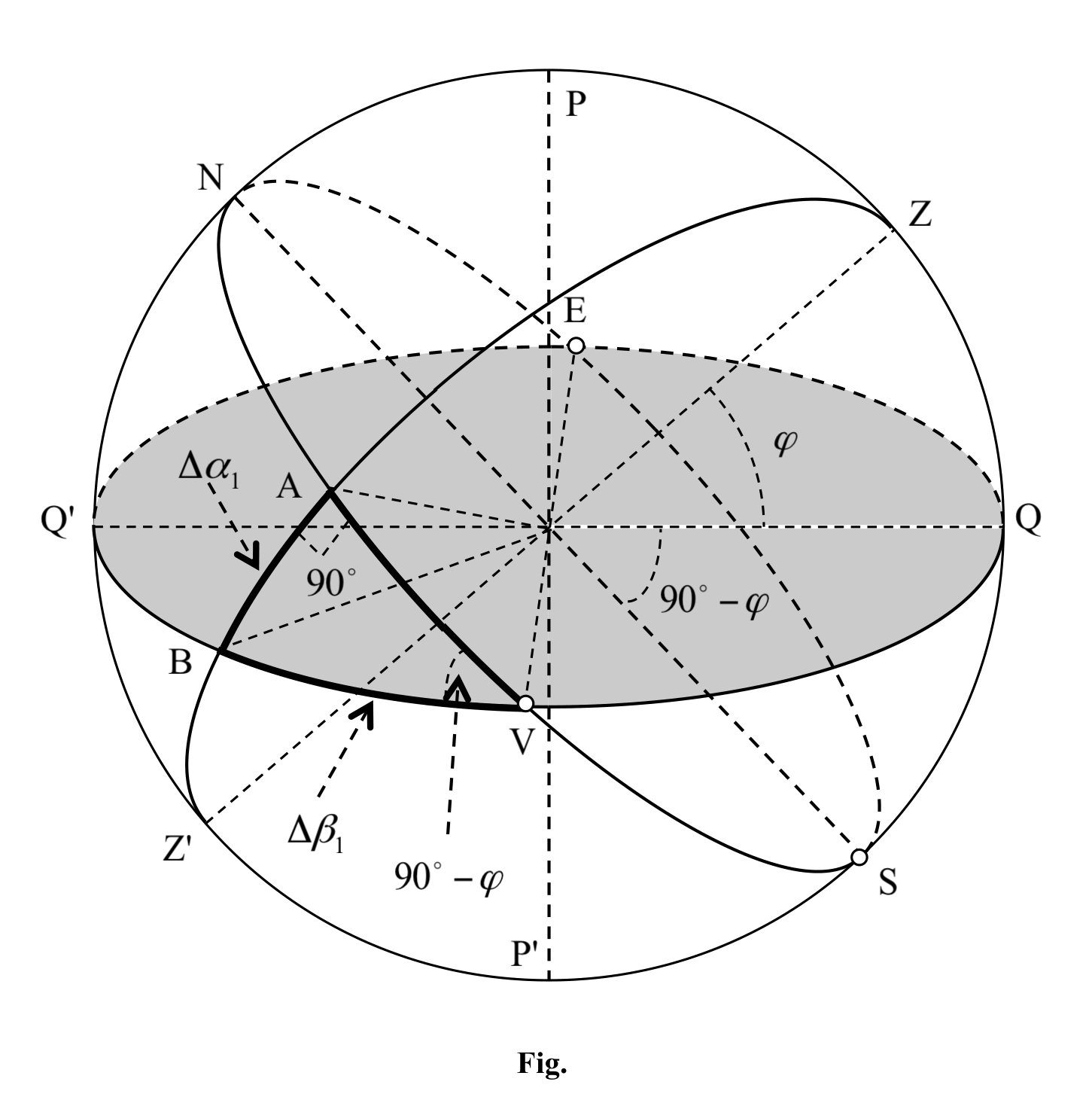
In the right spherical triangle ABV by using the sinus formula :
Which represents the delay of the start of the sunset from the point of view of V1 regardless to the astronomer due to the V1 observer’s altitude.
The altitude effect on the total time of sunset can be calculated by using the fig. 5
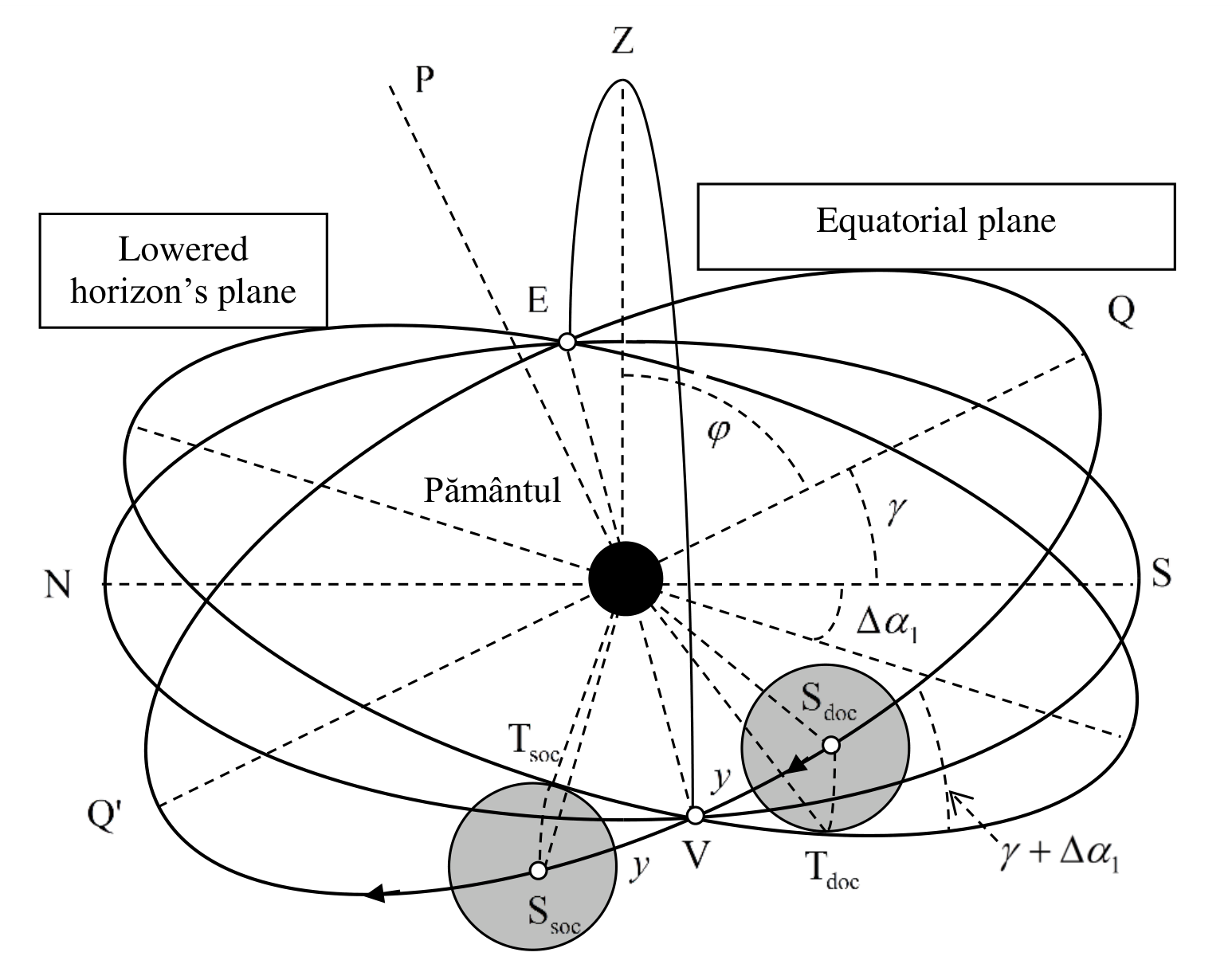
Which represents the total duration of sunset for at altitude H.
Similarly for eagle at the same latitude , but altitude (the top of the cross), the lowering effect on the horizon is measured by angle thus
Which represents the delay of the start moment of the sunset for due to the altitude .
Similar the total duration of the sunset for the observer :
We may note the following:
- the horizon- lowering is increased by the increase of the altitude;
- the delay of the moment of sunset start is increased by the increase of the altitude:
- the total duration of sunset is reduced by the increase of the altitude:
Conclusions:
If we consider the moment of sunset star for the astronomer
- for the sunset starts at and ends at
- for the sunset starts at and ends at
- Thus eagle from the plateau leaves first the cross;
- The time between the leaving moments is:
B. 1)
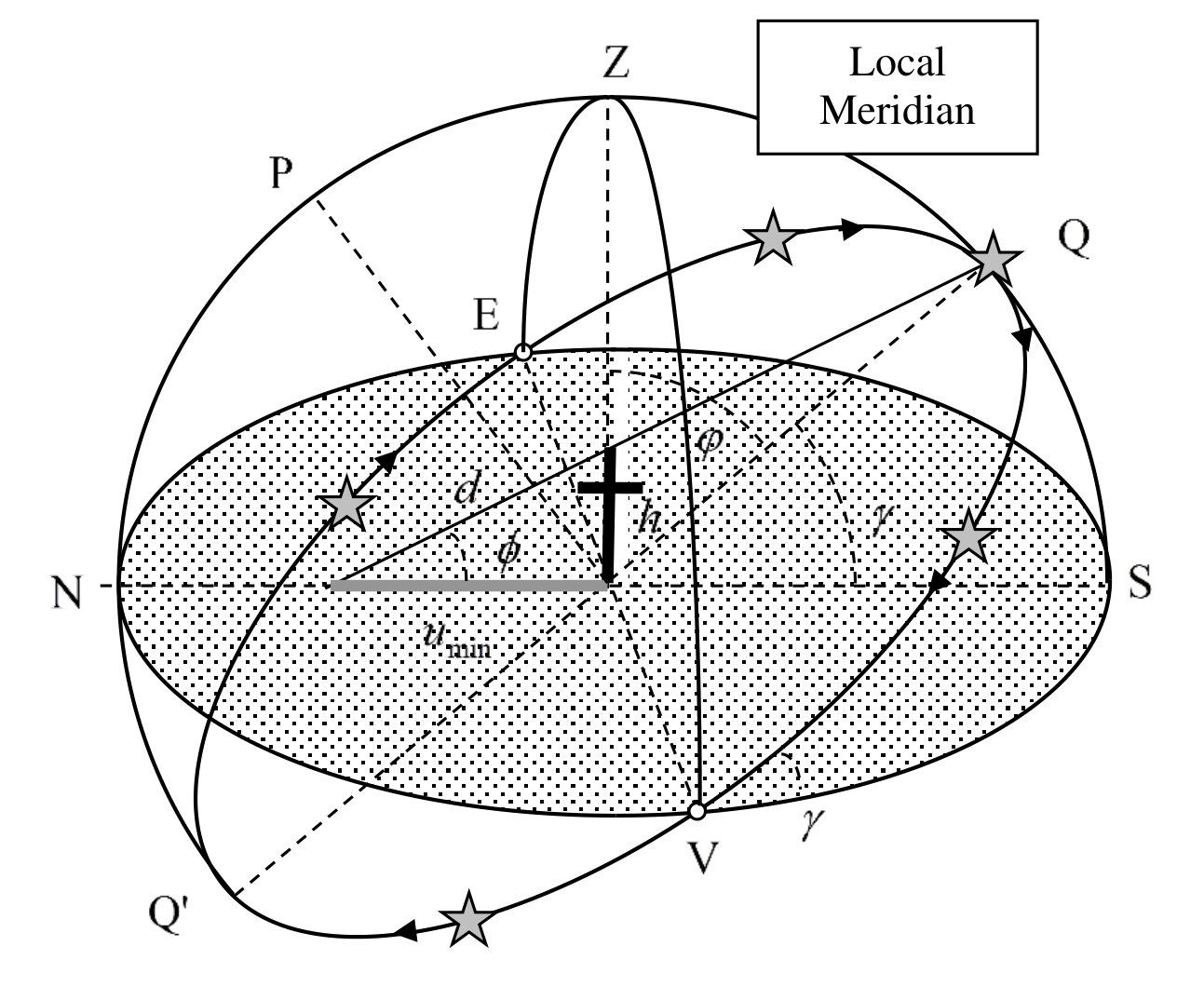
As seen in fig. 6 the length of the cross on the plateau will be minimum when the Sun passes the local meridian, i.e. the height of the Sun above the horizon will be maximum:
.
Thus the shadow of the horizontal arms of the cross is superposed on the shadow of the vertical pillow.
In this conditions :
The distance between the two eagles is
B. 2)
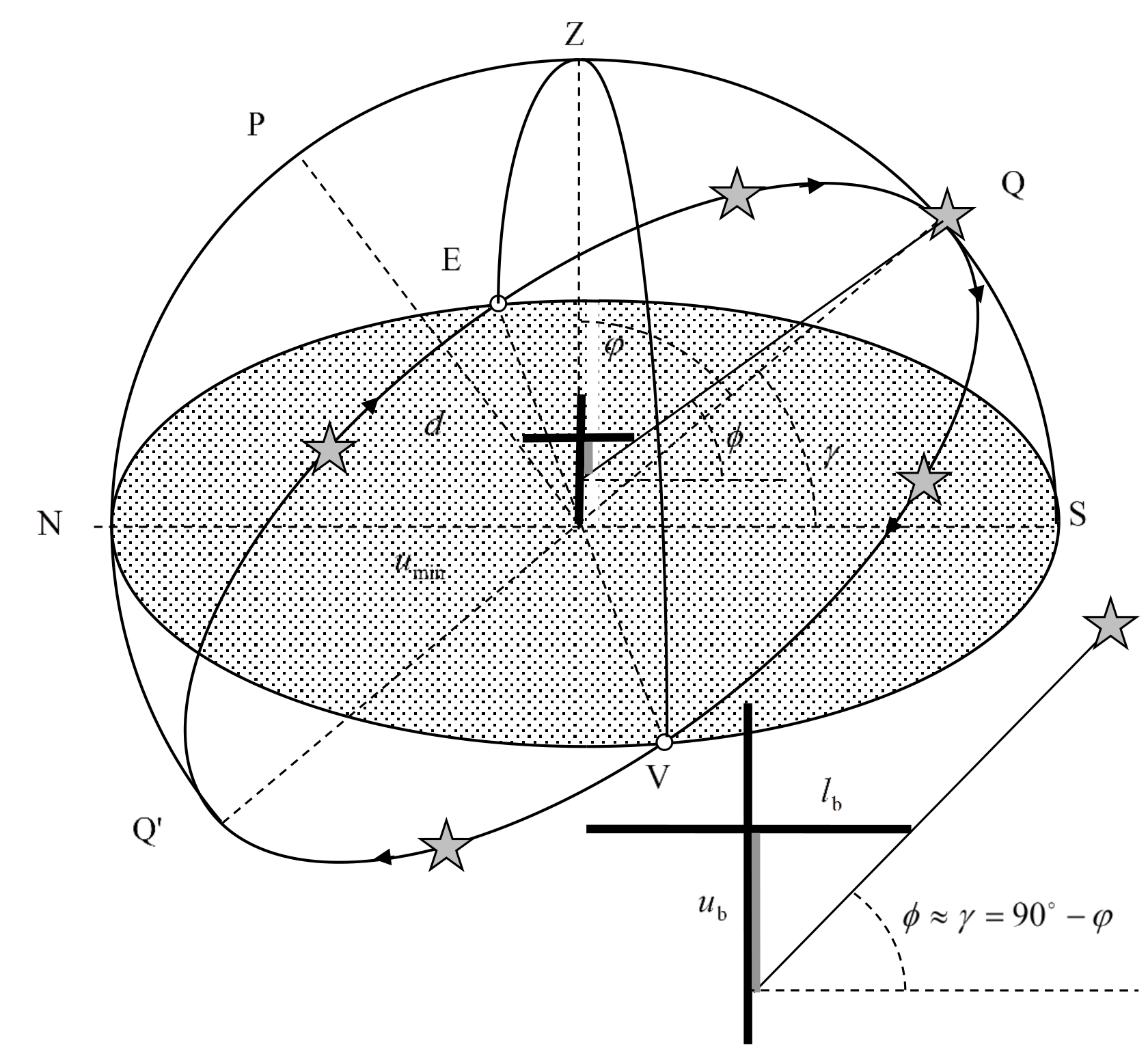
In the above mentioned conditions the shadow of the arm oriented toward South is on the vertical pillow of the cross, as seen in fig. 7:
Which represents the length of the cross arm.
C. 1)
For an observer situated in the center O of the celestial topocentric sphere, at latitude , at sea level, al the stars are circumpolar ones see fig. 8. Their diurnal parallels, parallel with the equatorial parallel, are above the real local horizon . The star is at the circumpolar limit because its parallel touches the real local horizon in point but still remains above it. Thus is a marginal circumpolar star. Without taking into account the atmospheric refraction:
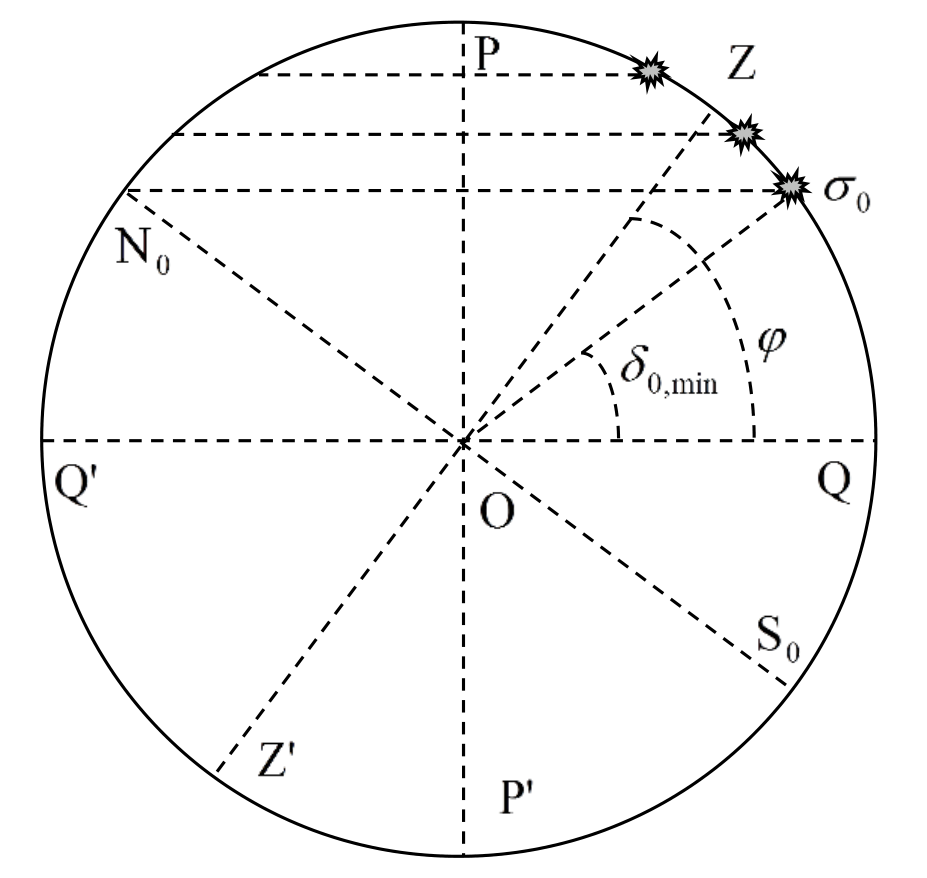
From the isosceles triangle results the declination:
By taking into account the atmospheric refraction the horizon line changes to line , with angle , as seen in fig. 9. The star remains a circumpolar one but above the limit. In this conditions the star gather the limit conditions its declination been . In this conditions for an observer situated in the center of the topocentric celestial sphere, at latitude and altitude zero, the star , with declination is on the limit of the circumpolarity.
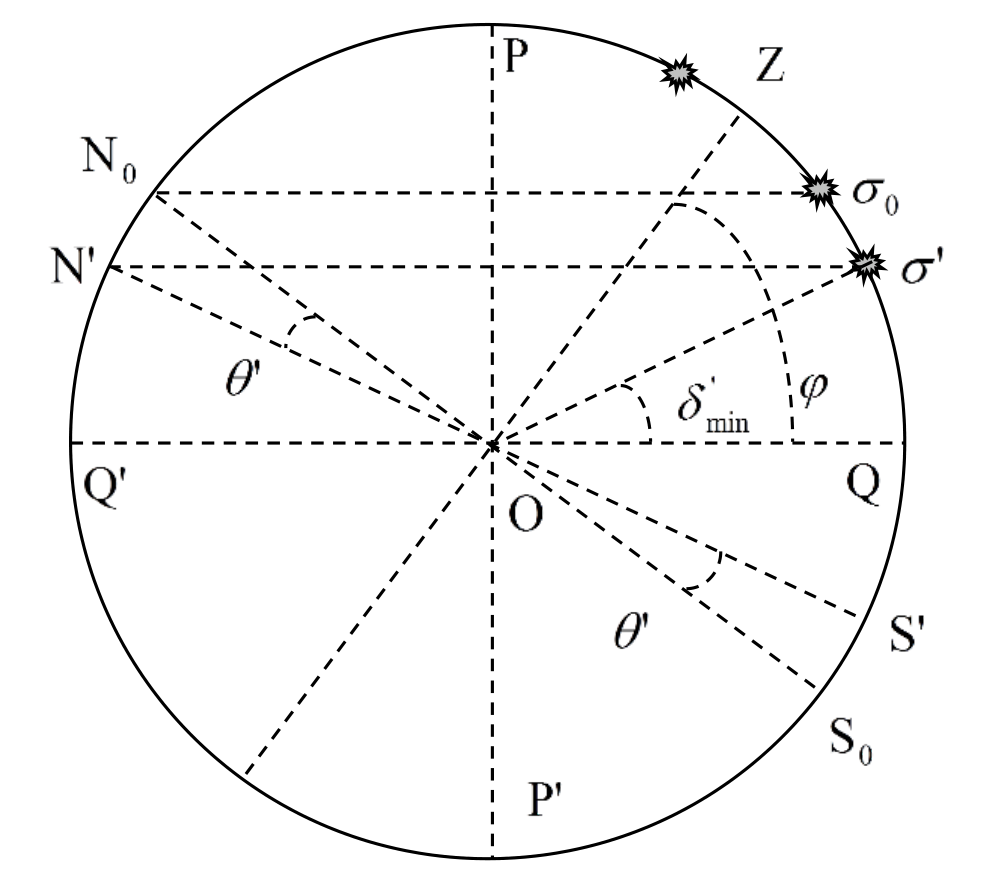
From the isosceles triangle the declination will be :
For the observer at latitude , but at height h, taking into account the effect of lowering of the horizon the star will meet the problem requirements see figure 10. The new horizon is and declination of is . Star remains a circumpolar one but above the limit.
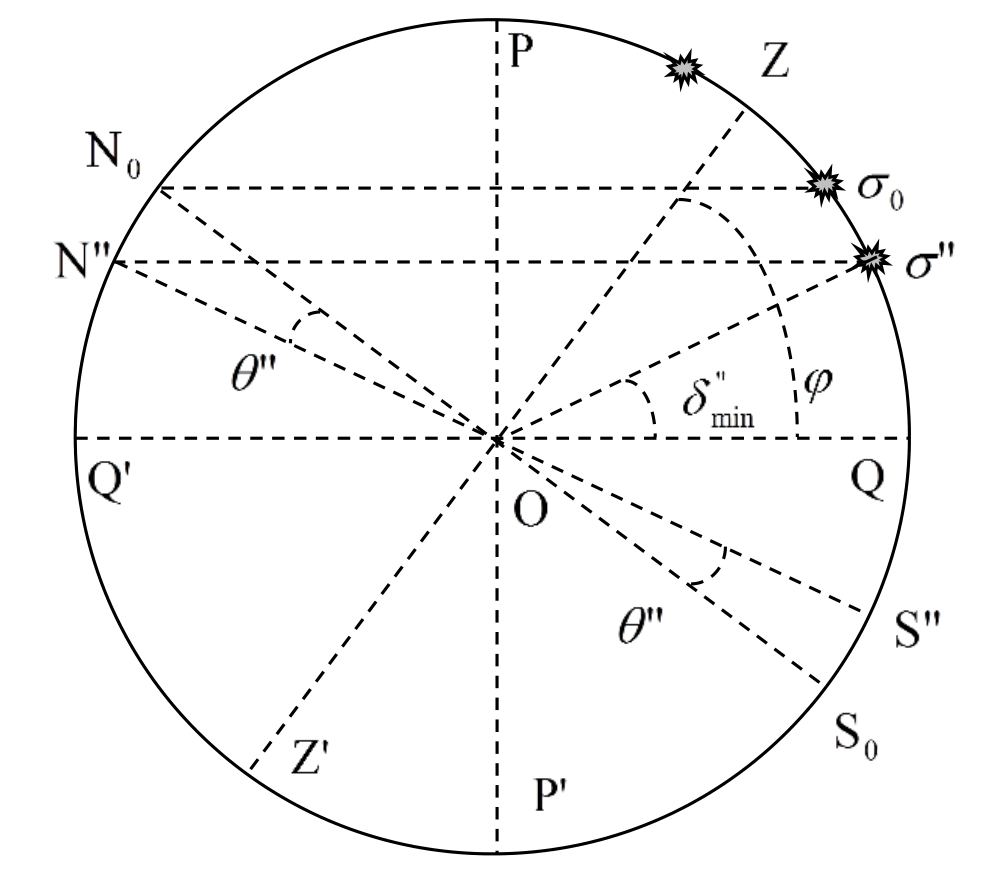
From the isosceles triangle the declination of star will be:
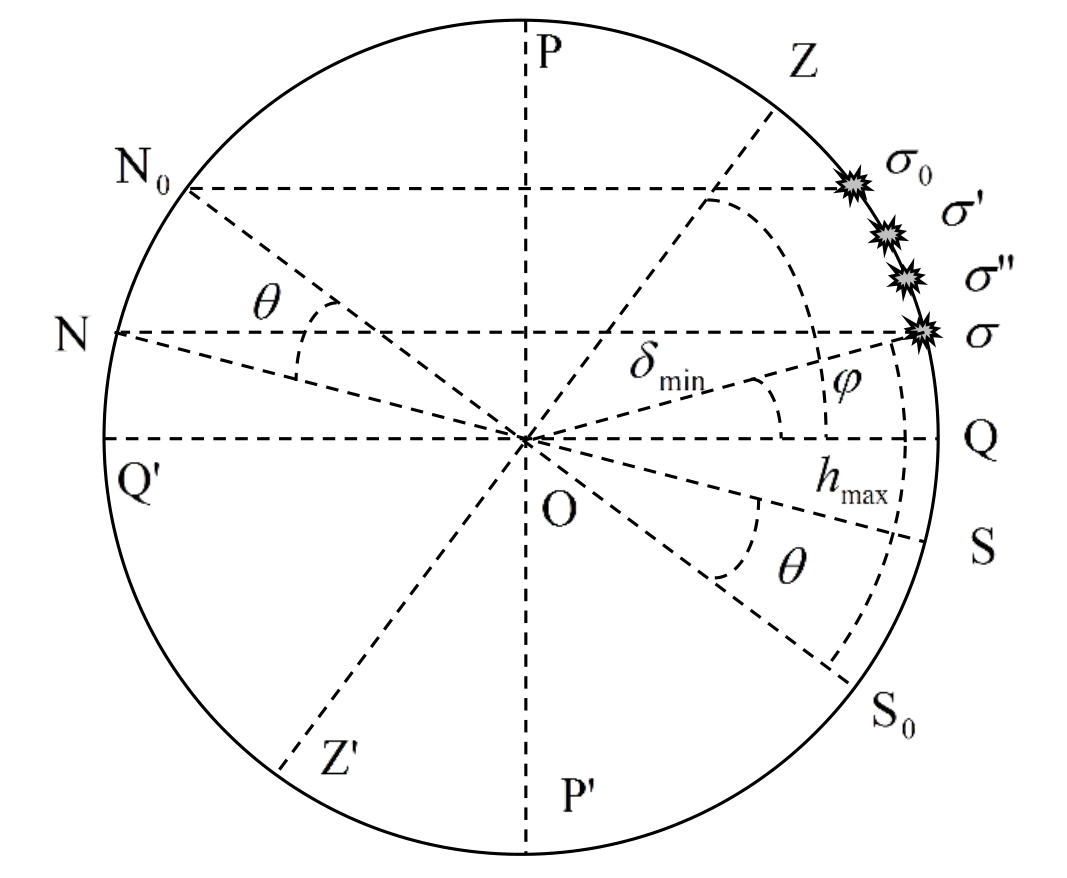
By taking into account the refraction effect and the altitude effect, from triangle in figure 11, the declination will be
C. 2)
The maximum height above the horizon will be
Оригинал в Архива: long_problems.pdf · официални решения: long_final_sol.pdf · допълнителни данни: th_long_ver1_sol.pdf