IOAA 2015, Теория, дълги задачи, английски — Задача 3
International Olympiad on Astronomy and Astrophysics 2015, Central Java - Indonesia — Long Problems
Внимание: Бележка към темата
The revised official marking scheme is primary. Earlier image-key questions and marking weights differ and are labelled separately. The revised key leaves problem 3(d) blank; the earlier distance derivation adds an assumption absent from the final question. Printed algebraic inconsistencies are retained.
Instruction — Theoretical Round
Write your answer on the answer-sheet only. You can use more than one sheet for one problem. Please ask the organizer for the additional answer-sheets.
Different problems should be done on different sheets.
You can use your own calculator without program and graphic facility.
You can ask the organizer for rough paper.
Astronomical and Physical Constants — 20150729
| Constant | Value |
|---|---|
| Astronomical unit (AU) | |
| Light year (ly) | |
| Parsec (pc) | |
| Jansky (Jy) | |
| 1 Sidereal year | 365.2564 solar days |
| 1 Tropical year | 365.2422 solar days |
| 1 Calendar year | 365.2425 solar days |
| 1 Sidereal day | |
| 1 Solar day | units of sidereal time |
| 1 Å | |
| 1 erg | |
| 1 dyne | |
| Mass of Earth | |
| Mean radius of Earth | |
| Equatorial radius of Earth | |
| Mean velocity of Earth on its orbit | |
| Mass of Moon | |
| Radius of Moon | |
| Mass of Jupiter | |
| Mean Earth – Moon distance | |
| Mass of Sun | |
| Radius of Sun | |
| Effective temperature of the Sun | 5780 K |
| Luminosity of the Sun | |
| Solar constant | |
| Brightness of the Sun in V-band | −26.8 mag. |
| Absolute brightness of the Sun in V-band | 4.75 mag. |
| Absolute bolometric brightness of Sun | 4.72 mag. |
| Angular diameter of the Sun | 30′ |
| Speed of light in vacuum (c) | |
| Gravitational constant (G) | |
| Boltzmann constant (k) | |
| Universal gas constant (R) | |
| Stefan–Boltzmann constant (σ) | |
| Planck constant (h) | |
| Wien's constant (b) | |
| Hubble constant (H₀) |
Astronomical and Physical Constants — continuation
| Constant | Value |
|---|---|
| electron charge (e) | |
| Mass of hydrogen atom | |
| Current inclination of the ecliptic (ε) | 23º 26.3′ |
| Coordinates of the northern ecliptic pole for epoch 2000.0 (αE, δE) | |
| Coordinates of the northern galactic pole for epoch 2000.0 (αG, δG) |
You can try to solve an equation using iteration: .
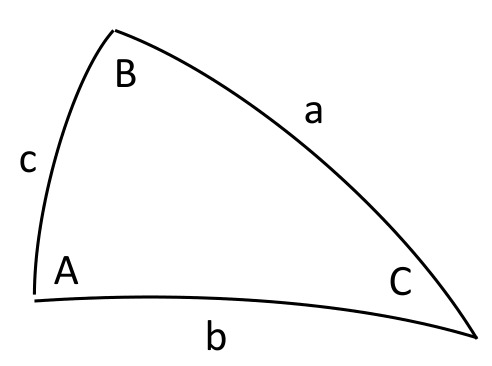
Basic equations of spherical trigonometry
Rayleigh-Jeans formula (long wavelength approximation of Planck’s Law):
Условие
Suppose a static spherical star consists of neutral particles with radius (see Figure 3).
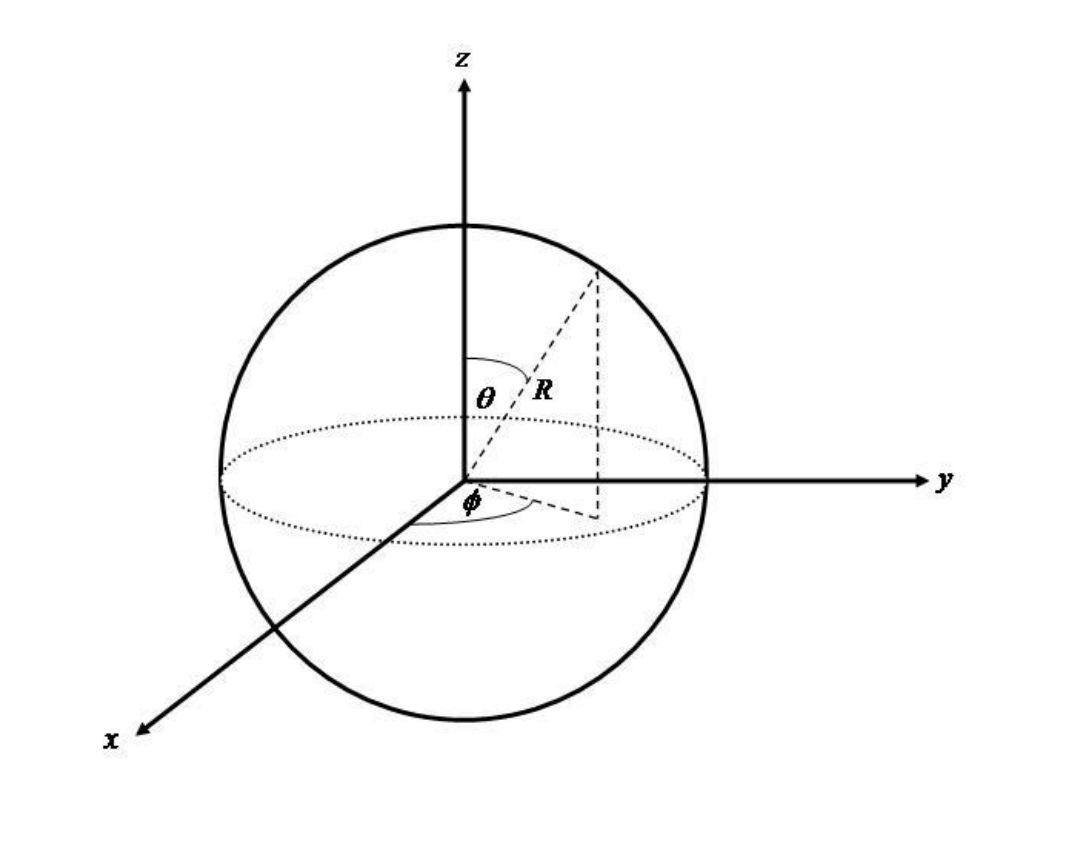
with , , satisfying the following equation of states
where and are the pressure inside the star and the volume of the star respectively, is the Boltzmann constant. and are the temperatures at the surface and the temperature at the center respectively. Assume that .
a. Simplify the stellar equation of state (1) if (this is called ideal star)
(Hint: Use the approximation for small )
Suppose the star undergoes a quasi-static process, in which it may slightly contract or expand, such that the above stellar equation of state (1) still holds.
The star satisfies first law of thermodynamics
where , , and are heat, mass of the star, and work respectively, while is the light speed in the vacuum and .
In the following we assume to be constant, while varies.
b. Find the heat capacity of the star at constant volume in term of and at constant pressure expressed in and (Hint: Use the approximation for small )
Assuming that is constant and the gas undergo the isobaric process so the star produces the heat and radiates it outside to the space.
c. Find the heat produced by the isobaric process if the initial temperature and the final temperature are and , respectively.
d. Suppose there is an observer far away from the star. Using information from part c., estimate the distance of the observer from the star.
For the next parts, assume the star is the Sun.
e. If the sunlight is monochromatic with frequency Hz, estimate the number of photons radiated by the Sun per second.
f. Calculate the heat capacity of the Sun assuming its surface temperature varies from 5500 K to 6000 K in one second.
Basic equations of spherical trigonometry — reference diagram
Решение
Внимание: Непълно решение
The revised official key leaves final problem 3(d) blank (15 points). The earlier image edition gives a distance derivation only after adding a 0.1% temperature-error assumption absent from the final question; it is retained separately, not presented as a complete final-edition answer.
Revised marking scheme — a. (15 т.)
Defining and , we have
using , we then obtain
Revised marking scheme — b. (30 т.)
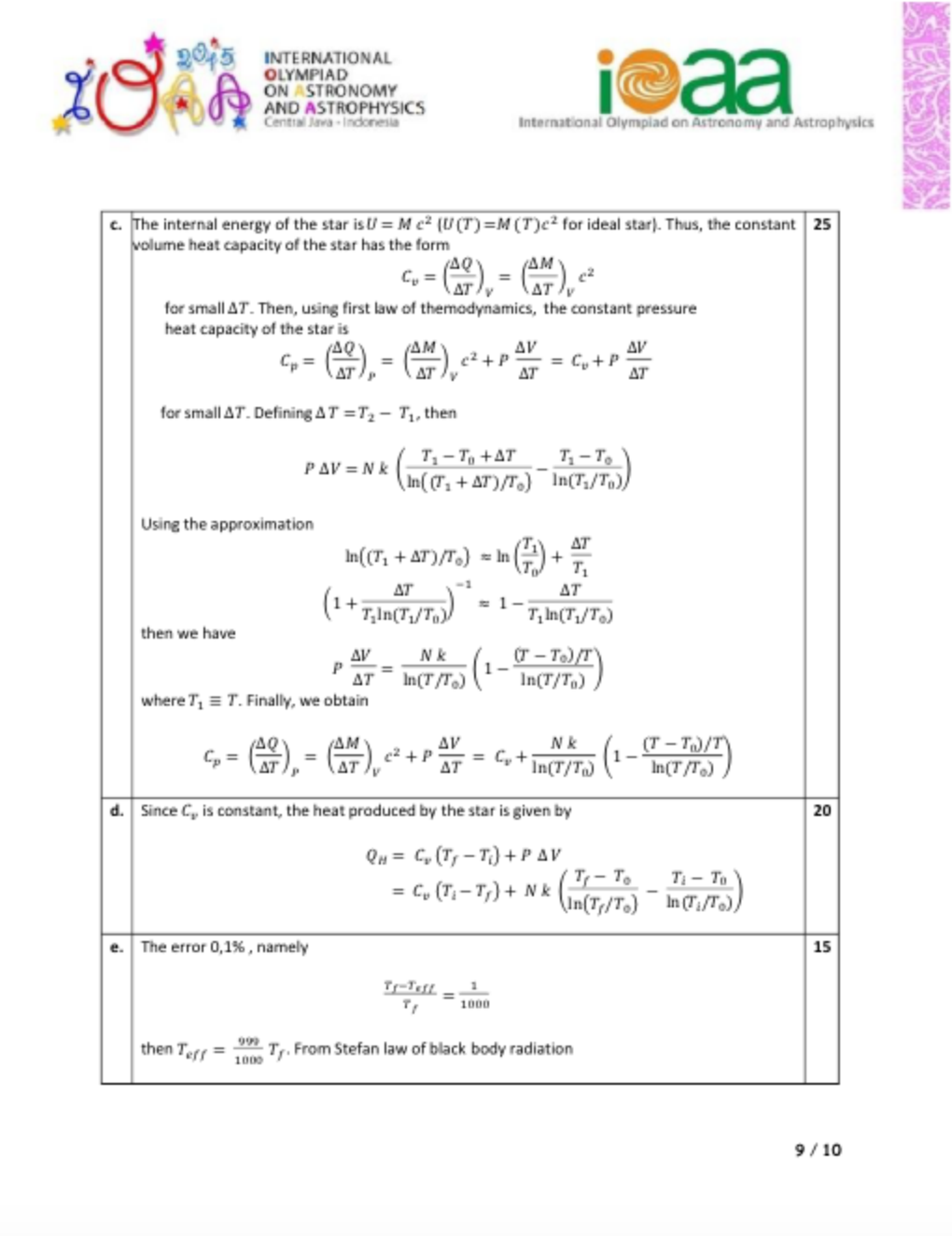
The internal energy of the star is ( for ideal star). Thus, the constant volume heat capacity of the star has the form
for small . Then, using first law of thermodynamics, the constant pressure heat capacity of the star is
for small . Defining , then
Using the approximation
then we have
where . Finally, we obtain
Revised marking scheme — c. (20 т.)
Since is constant, the heat produced by the star is given by
Revised marking scheme — d. (15 т.)
| Part | Points |
|---|---|
| d. | 15 |
Revised marking scheme — e. (10 т.)
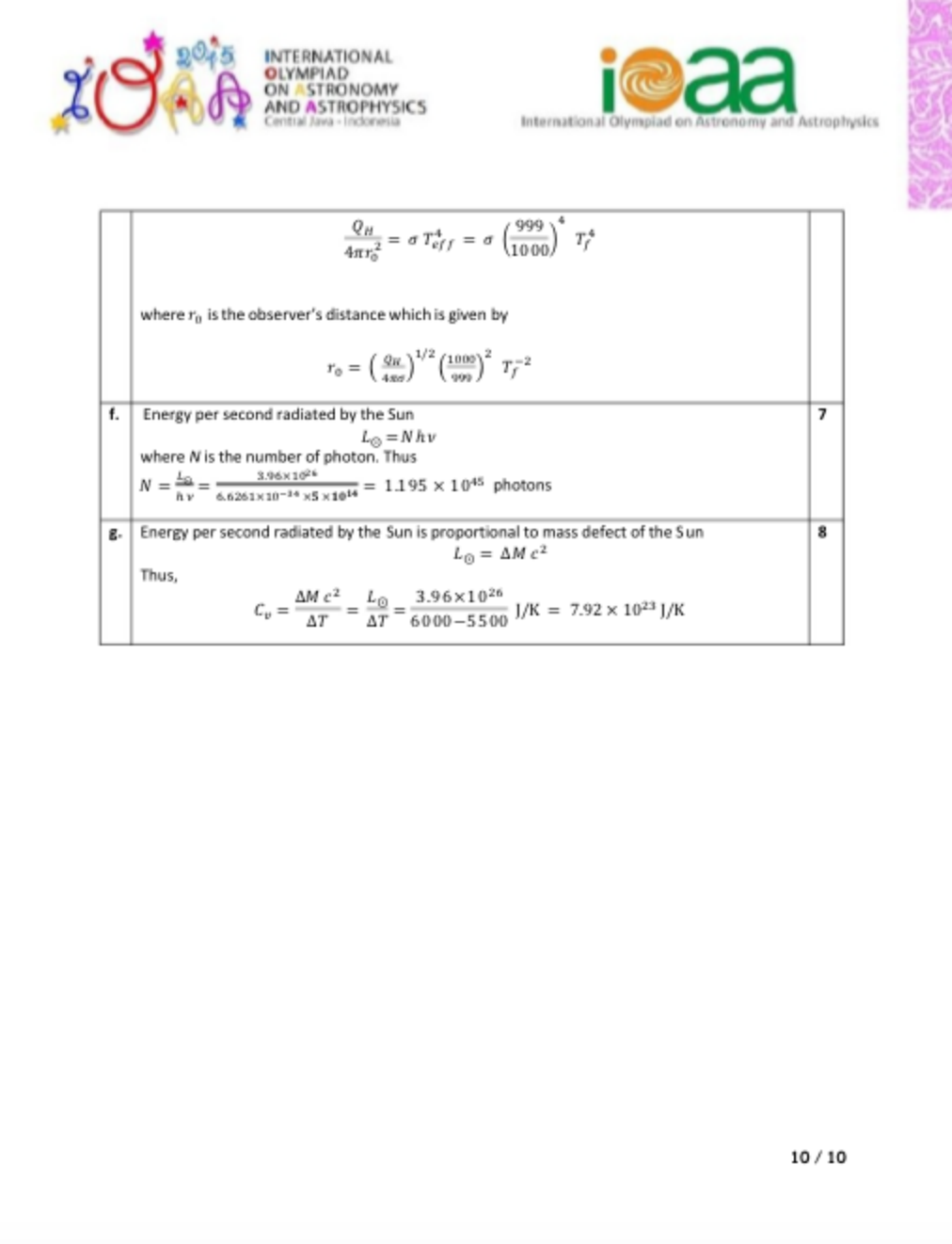
Energy per second radiated by the Sun
where is the number of photon. Thus
Revised marking scheme — f. (10 т.)
Energy per second radiated by the Sun is proportional to mass defect of the Sun
Thus,
Earlier image edition — b. Isothermal work (15 т.)
Find the work of the star when it expands from to in isothermal process where and are constants.
If the gas undergoes isothermal process where and are constant, then the work has the form
Earlier image edition — e. Distance with 0.1% temperature error (15 т.)
Suppose there is an observer far away from the star. Related to point d., estimate the distance of the observer if the observer has 0.1% error in measuring the effective temperature around the star.
The error 0.1%, namely
then . From Stefan law of black body radiation
where is the observer's distance which is given by
Earlier image edition — marking weights
| Part | Points |
|---|---|
| a. | 10 |
| b. Isothermal work | 15 |
| c. Heat capacities | 25 |
| d. Isobaric heat | 20 |
| e. Distance | 15 |
| f. Photons | 7 |
| g. Heat capacity | 8 |
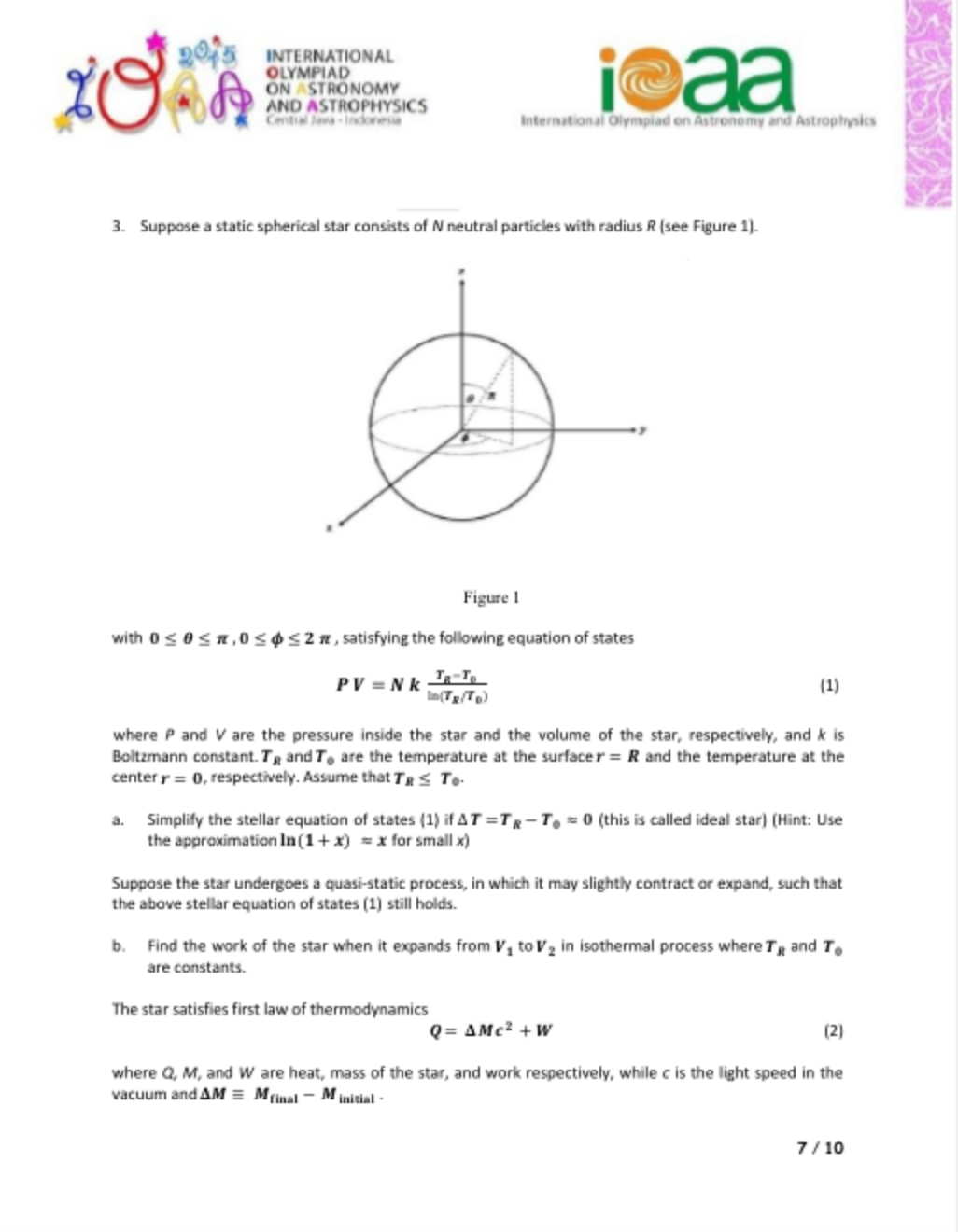
Earlier image edition — original page 7
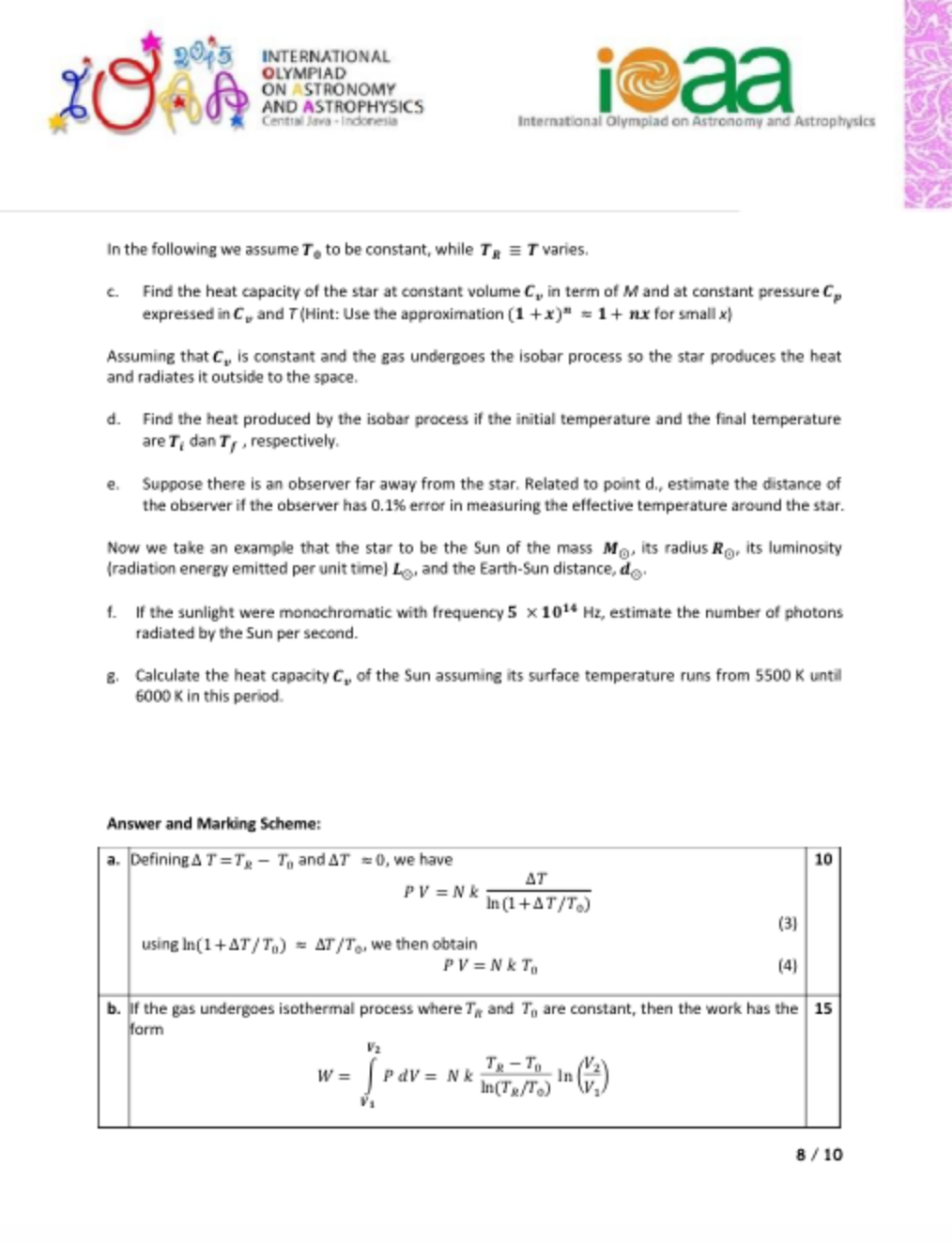
Earlier image edition — original page 8
Earlier image edition — original page 9
Earlier image edition — original page 10
Оригинал в Архива: Long_problem_Final_EN.pdf · официални решения: Long Problem Solution-Marking Scheme [Revised] - 310715 - 13.58.pdf · допълнителни данни: long_sol_1.png · допълнителни данни: long_sol_2.png · допълнителни данни: long_sol_3.png · допълнителни данни: long_sol_4.png · допълнителни данни: long_sol_5.png · допълнителни данни: long_sol_6.png · допълнителни данни: long_sol_7.png · допълнителни данни: long_sol_8.png · допълнителни данни: long_sol_9.png · допълнителни данни: long_sol_10.png · допълнителни данни: 9th IOAA Constants Table 20150729.pdf · допълнителни данни: constants.pdf · допълнителни данни: instructions.docx