Answer and Marking Scheme:
1 Determine coordinates of Lima and Yogyakarta. [15]
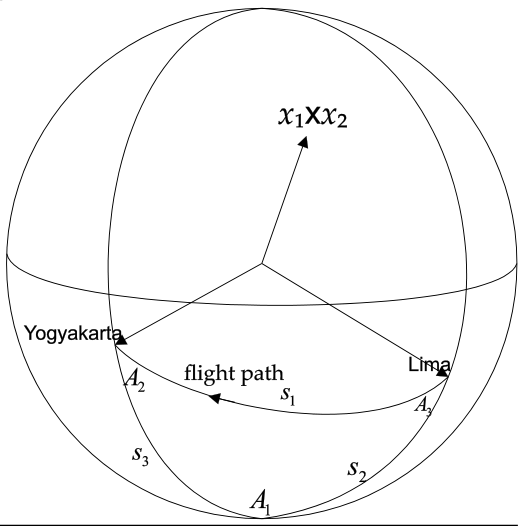
Assume that the equator is the z = 0 z = 0 z = 0
The Cartesian coordinates of the Lima is
x 1 = ( x 1 , y 1 , z 1 ) \boldsymbol{x_1} = (x_1, y_1, z_1) x 1 = ( x 1 , y 1 , z 1 ) = ( cos ( − 1 2 0 2 ′ ) cos ( 28 2 ∘ 5 8 ′ 48 ) , cos ( − 1 2 ∘ 2 ′ ) sin ( 28 2 ∘ 5 8 ′ 48 ) , sin ( − 1 2 0 2 ′ ) ) = (\cos(-12^{0}2')\cos(282^{\circ}58'48), \cos(-12^{\circ}2')\sin(282^{\circ}58'48), \sin(-12^{0}2')) = ( cos ( − 1 2 0 2 ′ ) cos ( 28 2 ∘ 5 8 ′ 48 ) , cos ( − 1 2 ∘ 2 ′ ) sin ( 28 2 ∘ 5 8 ′ 48 ) , sin ( − 1 2 0 2 ′ )) = ( 0.2197308726 , − 0.9530236794 , − 0.2084807188 ) = (0.2197308726, -0.9530236794, -0.2084807188) = ( 0.2197308726 , − 0.9530236794 , − 0.2084807188 ) The Cartesian coordinates of the Yogyakarta is
x 2 = ( x 2 , y 2 , z 2 ) = ( cos ( − 7 0 4 7 ′ ) cos ( 11 0 0 2 6 ′ ) , cos ( − 7 ∘ 4 7 ′ ) sin ( 11 0 0 2 6 ′ ) , sin ( − 7 0 4 7 ′ ) ) \boldsymbol{x_2} = (x_2, y_2, z_2) = (\cos(-7^{0}47')\cos(110^{0}26'), \cos(-7^{\circ}47')\sin(110^{0}26'), \sin(-7^{0}47')) x 2 = ( x 2 , y 2 , z 2 ) = ( cos ( − 7 0 4 7 ′ ) cos ( 11 0 0 2 6 ′ ) , cos ( − 7 ∘ 4 7 ′ ) sin ( 11 0 0 2 6 ′ ) , sin ( − 7 0 4 7 ′ )) = ( − 0.3459009563 , 0.9284459898 , − 0.1354273699 ) = (-0.3459009563, 0.9284459898, -0.1354273699) = ( − 0.3459009563 , 0.9284459898 , − 0.1354273699 ) 2 Determine the normal of the plane defined by Lima, Yogyakarta, and center of the Earth. [20]
The normal of the plane containing the two places and the center of the Earth is
x 1 × x 2 = ( a , b , c ) = ( 0.3226285776 , 0.1018712545 , − 0.12564355210 ) \boldsymbol{x_1}\times\boldsymbol{x_2} = (a, b, c) = (0.3226285776, 0.1018712545, -0.12564355210) x 1 × x 2 = ( a , b , c ) = ( 0.3226285776 , 0.1018712545 , − 0.12564355210 ) 3 Find the equation of the (shortest flight) path from Lima to Yogyakarta. [25]
Let the equation of the place be a x + b y + c z = 0 ax + by + cz = 0 a x + b y + cz = 0
y = − a ′ x − c ′ z y = -a'x - c'z y = − a ′ x − c ′ z where a ′ = − 3.16702272082062 a' = -3.16702272082062 a ′ = − 3.16702272082062 c ′ = 1.23335628599724 c' = 1.23335628599724 c ′ = 1.23335628599724 a ′ a' a ′ c ′ c' c ′ a a a c c c
Intersection of the Earth and the plane is the large circle x 2 + ( − a x − c z ) 2 + z 2 = 1 x^2 + (-ax - cz)^2 + z^2 = 1 x 2 + ( − a x − cz ) 2 + z 2 = 1
( 1 + a 2 ) x 2 + 2 a c x z + ( 1 + c 2 ) z 2 − 1 = 0 (1+a^2)x^2+2acxz+(1+c^2)z^2-1=0 ( 1 + a 2 ) x 2 + 2 a c x z + ( 1 + c 2 ) z 2 − 1 = 0 It is also the equation for the shortest flight path from Lima to Yogyakarta.
4 Determine the z-value of the southernmost point of the path (at the point, the discriminant of the equation
( 1 + a 2 ) x 2 + 2 a c m x + ( 1 + c 2 ) m 2 − 1 = 0 (1 + a^2)x^2 + 2acmx + (1 + c^2)m^2 - 1 = 0 ( 1 + a 2 ) x 2 + 2 a c m x + ( 1 + c 2 ) m 2 − 1 = 0 equals zero). [30]
The plane z = m z = m z = m
( 1 + a 2 ) x 2 + 2 a c m x + ( 1 + c 2 ) m 2 − 1 = 0 (1 + a^2)x^2 + 2acmx + (1 + c^2)m^2 - 1 = 0 ( 1 + a 2 ) x 2 + 2 a c m x + ( 1 + c 2 ) m 2 − 1 = 0 The discriminant is
D = ( 2 a c m ) 2 − 4 ( 1 + a 2 ) [ ( 1 + c 2 ) m 2 − 1 ] D = (2acm)^2 - 4(1 + a^2)[(1 + c^2)m^2 - 1] D = ( 2 a c m ) 2 − 4 ( 1 + a 2 ) [( 1 + c 2 ) m 2 − 1 ] = 4 + 4 a 2 − ( 4 + 4 a 2 + 4 c 2 ) m 2 = 4 + 4a^2 - (4 + 4a^2 + 4c^2)m^2 = 4 + 4 a 2 − ( 4 + 4 a 2 + 4 c 2 ) m 2 Therefore D = 0 D = 0 D = 0 m = ± 1 + a 2 1 + a 2 + c 2 = 0.937444937497383 m = \pm\sqrt{\frac{1 + a^2}{1 + a^2 + c^2}} = 0.937444937497383 m = ± 1 + a 2 + c 2 1 + a 2 = 0.937444937497383
z = − 0.937444937497383 z = -0.937444937497383 z = − 0.937444937497383 5 Determine the latitude of the southernmost point. [10]
Thus, the latitude of the point is sin − 1 z = 1.21521692653748 = 69.626801065129 0 ∘ = 6 9 ∘ 3 7 ′ 3 6 ′ ′ S \sin^{-1}z = 1.21521692653748 = 69.6268010651290^{\circ} = 69^{\circ}37'36''S sin − 1 z = 1.21521692653748 = 69.626801065129 0 ∘ = 6 9 ∘ 3 7 ′ 3 6 ′′ S
Answer and Marking Scheme:
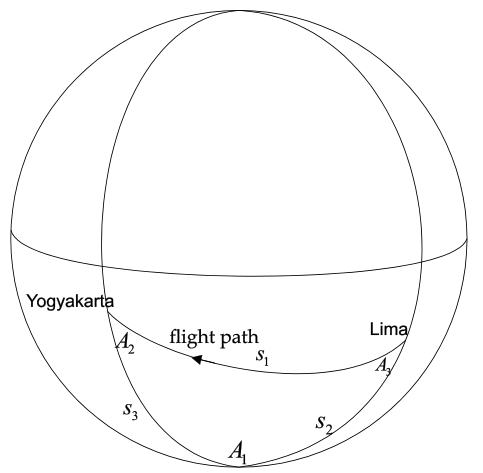
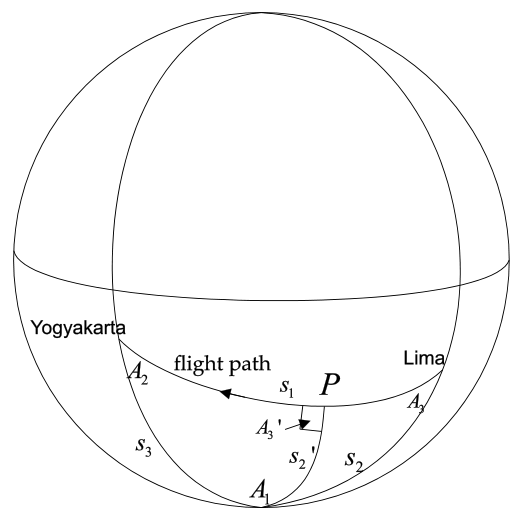
1 Determine length of the sides of the triangle [20]
s 2 = 9 0 ∘ − 1 2 ∘ 2 ′ = 7 7 ∘ 5 8 ′ = 1.3608 r a d , s 3 = 9 0 ∘ − 7 ∘ 4 7 ′ = 8 2 ∘ 1 3 ′ = 1.4350 r a d ; A 1 = ( 18 0 ∘ − 7 7 ∘ 1 ′ ) + ( 18 0 ∘ − 11 0 ∘ 2 6 ′ ) = 17 2 ∘ 3 3 ′ = 3.0116 r a d s_2 = 90^{\circ} - 12^{\circ}2' = 77^{\circ}58' = 1.3608\ rad, s_3 = 90^{\circ} - 7^{\circ}47' = 82^{\circ}13' = 1.4350\ rad; A_1 = (180^{\circ} - 77^{\circ}1') + (180^{\circ} - 110^{\circ}26') = 172^{\circ}33' = 3.0116\ rad s 2 = 9 0 ∘ − 1 2 ∘ 2 ′ = 7 7 ∘ 5 8 ′ = 1.3608 r a d , s 3 = 9 0 ∘ − 7 ∘ 4 7 ′ = 8 2 ∘ 1 3 ′ = 1.4350 r a d ; A 1 = ( 18 0 ∘ − 7 7 ∘ 1 ′ ) + ( 18 0 ∘ − 11 0 ∘ 2 6 ′ ) = 17 2 ∘ 3 3 ′ = 3.0116 r a d
Using Law of Cosines for sides
cos s 1 = ( cos s 2 ) ( cos s 3 ) + ( sin s 2 ) ( sin s 3 ) ( cos A 1 ) \cos s_1=(\cos s_2)(\cos s_3)+(\sin s_2)(\sin s_3)(\cos A_1) cos s 1 = ( cos s 2 ) ( cos s 3 ) + ( sin s 2 ) ( sin s 3 ) ( cos A 1 ) to obtain s 1 = 2.7724. r a d s_1 = 2.7724.\mathrm{rad} s 1 = 2.7724. rad
2 Determine the angles of the triangle [30]
Then use
cos s 2 = ( cos s 1 ) ( cos s 3 ) + ( sin s 1 ) ( sin s 3 ) ( cos A 2 ) \cos s_2 = (\cos s_1)(\cos s_3) + (\sin s_1)(\sin s_3)(\cos A_2) cos s 2 = ( cos s 1 ) ( cos s 3 ) + ( sin s 1 ) ( sin s 3 ) ( cos A 2 ) to obtain A 2 = 0.35921 A_2 = 0.35921 A 2 = 0.35921
cos s 3 = ( cos s 1 ) ( cos s 2 ) + ( sin s 1 ) ( sin s 2 ) ( cos A 3 ) \cos s_3 = (\cos s_1)(\cos s_2) + (\sin s_1)(\sin s_2)(\cos A_3) cos s 3 = ( cos s 1 ) ( cos s 2 ) + ( sin s 1 ) ( sin s 2 ) ( cos A 3 ) to get that A 3 = 0.3642 A_3 = 0.3642 A 3 = 0.3642
3 Use Law of Cosines for sides to construct an equation in cos s 2 ′ \cos s_2' cos s 2 ′ [20]
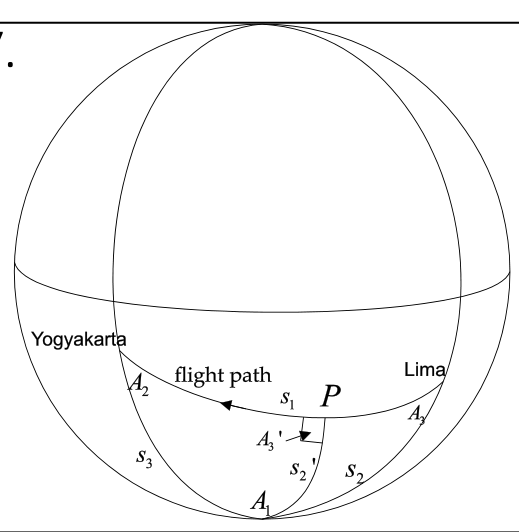
If P is the southernmost point, then the angle A 3 A_3 A 3 A 3 = π 2 A_3 = \frac{\pi}{2} A 3 = 2 π
cos s 3 = cos s 1 ′ cos s 2 ′ + sin s 1 ′ sin s 2 ′ cos A 3 = cos s 1 ′ cos s 2 ′ \cos s_3=\cos s_1'\cos s_2'+\sin s_1'\sin s_2'\cos A_3=\cos s_1'\cos s_2' cos s 3 = cos s 1 ′ cos s 2 ′ + sin s 1 ′ sin s 2 ′ cos A 3 = cos s 1 ′ cos s 2 ′ Thus,
cos s 1 ′ = cos s 3 cos s 2 ′ = 0.13538 cos s 2 ′ . \cos s_1'=\frac{\cos s_3}{\cos s_2'}=\frac{0.13538}{\cos s_2'}. cos s 1 ′ = cos s 2 ′ cos s 3 = cos s 2 ′ 0.13538 . Then substitute it to get
cos s 2 ′ = cos s 1 ′ cos s 3 + sin s 1 ′ sin s 3 cos A 2 \cos s_2'=\cos s_1'\cos s_3+\sin s_1'\sin s_3\cos A_2 cos s 2 ′ = cos s 1 ′ cos s 3 + sin s 1 ′ sin s 3 cos A 2 = cos s 3 cos s 2 ′ cos s 3 + 1 − ( cos s 3 cos s 2 ′ ) 2 sin s 3 cos A 2 =\frac{\cos s_3}{\cos s_2'}\cos s_3+\sqrt{1-\left(\frac{\cos s_3}{\cos s_2'}\right)^2}\sin s_3\cos A_2 = cos s 2 ′ cos s 3 cos s 3 + 1 − ( cos s 2 ′ cos s 3 ) 2 sin s 3 cos A 2 4 Solve the equation [20]
Let x = cos s 2 ′ x = \cos s_2' x = cos s 2 ′
x = 0.018328 x + x 2 − 0.018328 x 2 × 0.92756 x = \frac{0.018328}{x} + \sqrt{\frac{x^2 - 0.018328}{x^2}}\times0.92756 x = x 0.018328 + x 2 x 2 − 0.018328 × 0.92756 Multiply both sides by x x x
x 2 = 0.018328 + x x 2 − 0.018328 x 2 × 0.92756 x^2 = 0.018328 + x\sqrt{\frac{x^2 - 0.018328}{x^2}}\times0.92756 x 2 = 0.018328 + x x 2 x 2 − 0.018328 × 0.92756 x 2 − 0.018328 = x x 2 − 0.018328 x 2 × 0.92756 x^2 - 0.018328 = x\sqrt{\frac{x^2 - 0.018328}{x^2}}\times0.92756 x 2 − 0.018328 = x x 2 x 2 − 0.018328 × 0.92756 ( x 2 − 0.018328 ) 2 = ( x 2 − 0.018328 ) × ( 0.92756 ) 2 (x^2 - 0.018328)^2 = (x^2 - 0.018328)\times(0.92756)^2 ( x 2 − 0.018328 ) 2 = ( x 2 − 0.018328 ) × ( 0.92756 ) 2 x 4 − 0.89702 x 2 + 0.016105 = 0 x^4 - 0.89702x^2 + 0.016105 = 0 x 4 − 0.89702 x 2 + 0.016105 = 0 which is a quadratic equation of x 2 x^2 x 2 ± 0.13538 \pm0.13538 ± 0.13538 ± 0.93739 \pm0.93739 ± 0.93739
5 Determine the Latitude [10]
Thus,
s 2 ′ = cos − 1 0.93739 = 0.35574 r a d = 2 0 ∘ 2 3 ′ s_2' = \cos^{-1}0.93739 = 0.35574\ \mathrm{rad} = 20^{\circ}23' s 2 ′ = cos − 1 0.93739 = 0.35574 rad = 2 0 ∘ 2 3 ′ or
s 2 ′ = cos − 1 0.13538 = 1.4350 r a d = 8 2 ∘ 1 3 ′ s_2' = \cos^{-1}0.13538 = 1.4350\ \mathrm{rad} = 82^{\circ}13' s 2 ′ = cos − 1 0.13538 = 1.4350 rad = 8 2 ∘ 1 3 ′ The latitude is 6 9 ∘ 3 7 ′ S 69^{\circ}37'S 6 9 ∘ 3 7 ′ S
6 9 ∘ 3 7 ′ S 69^{\circ}37'S 6 9 ∘ 3 7 ′ S Answer and Marking Scheme:
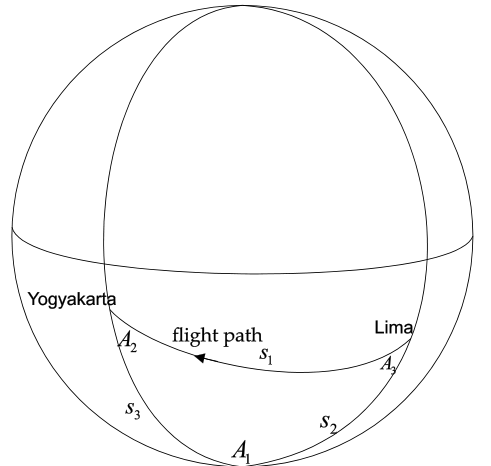
1 Determine length of the sides of the triangle [20]
s 2 = 9 0 ∘ − 1 2 ∘ 2 ′ = 7 7 ∘ 5 8 ′ = 1.3608 r a d , s 3 = 9 0 ∘ − 7 ∘ 4 7 ′ = 8 2 ∘ 1 3 ′ = 1.4350 r a d ; A 1 = ( 18 0 ∘ − 7 7 ∘ 1 ′ ) + ( 18 0 ∘ − 11 0 ∘ 2 6 ′ ) = 17 2 ∘ 3 3 ′ = 3.0116 r a d s_2 = 90^{\circ} - 12^{\circ}2' = 77^{\circ}58' = 1.3608\ rad, s_3 = 90^{\circ} - 7^{\circ}47' = 82^{\circ}13' = 1.4350\ rad; A_1 = (180^{\circ} - 77^{\circ}1') + (180^{\circ} - 110^{\circ}26') = 172^{\circ}33' = 3.0116\ rad s 2 = 9 0 ∘ − 1 2 ∘ 2 ′ = 7 7 ∘ 5 8 ′ = 1.3608 r a d , s 3 = 9 0 ∘ − 7 ∘ 4 7 ′ = 8 2 ∘ 1 3 ′ = 1.4350 r a d ; A 1 = ( 18 0 ∘ − 7 7 ∘ 1 ′ ) + ( 18 0 ∘ − 11 0 ∘ 2 6 ′ ) = 17 2 ∘ 3 3 ′ = 3.0116 r a d
Using Law of Cosines for sides
cos s 1 = ( cos s 2 ) ( cos s 3 ) + ( sin s 2 ) ( sin s 3 ) ( cos A 1 ) \cos s_1=(\cos s_2)(\cos s_3)+(\sin s_2)(\sin s_3)(\cos A_1) cos s 1 = ( cos s 2 ) ( cos s 3 ) + ( sin s 2 ) ( sin s 3 ) ( cos A 1 ) to obtain s 1 = 2.7724. r a d s_1 = 2.7724.\mathrm{rad} s 1 = 2.7724. rad
2 Determine the angles of the triangle [30]
Then use
cos s 2 = ( cos s 1 ) ( cos s 3 ) + ( sin s 1 ) ( sin s 3 ) ( cos A 2 ) \cos s_2 = (\cos s_1)(\cos s_3) + (\sin s_1)(\sin s_3)(\cos A_2) cos s 2 = ( cos s 1 ) ( cos s 3 ) + ( sin s 1 ) ( sin s 3 ) ( cos A 2 ) to obtain A 2 = 0.35921 A_2 = 0.35921 A 2 = 0.35921
cos s 3 = ( cos s 1 ) ( cos s 2 ) + ( sin s 1 ) ( sin s 2 ) ( cos A 3 ) \cos s_3 = (\cos s_1)(\cos s_2) + (\sin s_1)(\sin s_2)(\cos A_3) cos s 3 = ( cos s 1 ) ( cos s 2 ) + ( sin s 1 ) ( sin s 2 ) ( cos A 3 ) to get that A 3 = 0.3642 A_3 = 0.3642 A 3 = 0.3642
3 Find the latitude of the point [50]
Let P P P
sin s 2 ′ = sin s 3 sin A 2 \sin s_2'=\sin s_3\sin A_2 sin s 2 ′ = sin s 3 sin A 2 to get s 2 ′ = 0.35576 r a d = 2 0 ∘ 2 3 ′ s_2' = 0.35576\ rad = 20^{\circ}23' s 2 ′ = 0.35576 r a d = 2 0 ∘ 2 3 ′ P P P
9 0 ∘ − 2 0 ∘ 2 3 ′ = 6 9 ∘ 3 7 ′ S 90^\circ-20^\circ23'=69^\circ37'S 9 0 ∘ − 2 0 ∘ 2 3 ′ = 6 9 ∘ 3 7 ′ S