IOAA 2016, theory — Задача 11. Gravitational Waves
Автор: Olympiads XYZ · транскрипция на официалните материали
Проверена срещу оригинала на 13.9.2026 от същия модел, който я е транскрибирал (без независима проверка)
Theoretical Examination · 50 т.
Внимание: Бележка към темата
Решенията липсват — в този прозорец е показан само документът с задачи.
Условие
The first signal of gravitational waves was observed by two advanced LIGO detectors at Hanford and Livingston, USA in September 2015. One of these measurements (strain vs time in seconds) is shown in the accompanying figure. In this problem, we will interpret this signal in terms of a small test mass orbiting around a large mass (i.e., ), by considering several models for the nature of the central mass.
The test mass loses energy due to the emission of gravitational waves. As a result the orbit keeps on shrinking, until the test mass reaches the surface of the object, or in the case of a black hole, the innermost stable circular orbit – ISCO – which is given by , where is the Schwarzschild radius of the black hole. This is the "epoch of merger". At this point, the amplitude of the gravitational wave is maximum, and so is its frequency, which is always twice the orbital frequency. In this problem, we will only focus on the gravitational waves before the merger, when Kepler's laws are assumed to be valid. After the merger, the form of gravitational waves will drastically change.
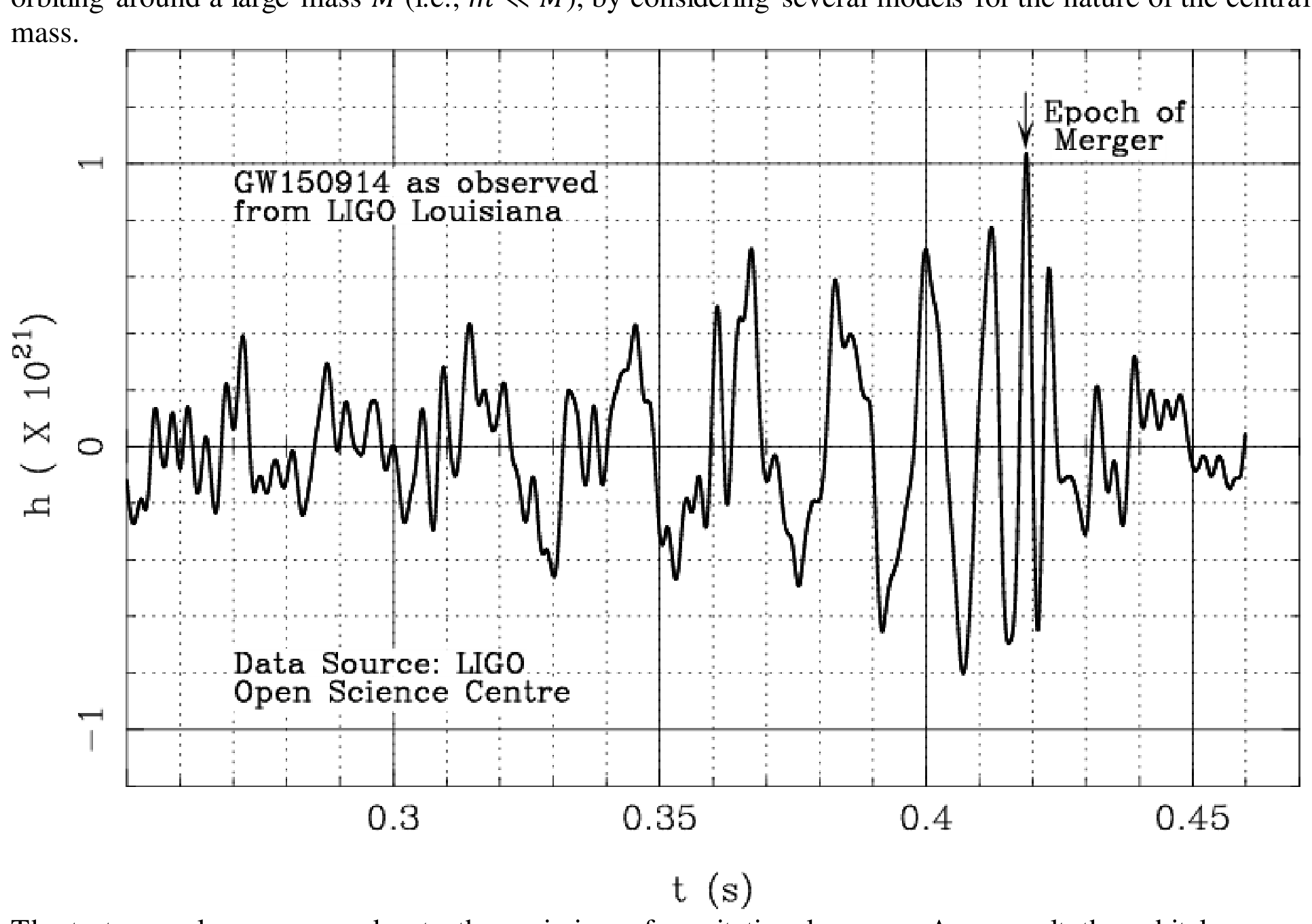
T11.1 Consider the observed gravitational waves shown in the figure above. Estimate the time period, , and hence calculate the frequency, , of gravitational waves just before the epoch of merger. [3 т.]
T11.2 For any main sequence (MS) star, the radius of the star, , and its mass, , are related by a power law given as,
where for and for .
If the central object were a main sequence star, write an expression for the maximum frequency of gravitational waves, , in terms of mass of the star in units of solar masses () and . [10 т.]
T11.3 Using the above result, determine the appropriate value of that will give the maximum possible frequency of gravitational waves, for any main sequence star. Evaluate this frequency. [9 т.]
T11.4 White dwarf (WD) stars have a maximum mass of (known as the Chandrasekhar limit) and obey the mass-radius relation . The radius of a solar mass white dwarf is equal to 6000 km. Find the highest frequency of emitted gravitational waves, , if the test mass is orbiting a white dwarf. [8 т.]
T11.5 Neutron stars (NS) are a peculiar type of compact objects which have masses between 1 and and radii in the range 10 – 15 km. Find the range of frequencies of emitted gravitational waves, and , if the test mass is orbiting a neutron star at a distance close to the neutron star radius. [8 т.]
T11.6 If the test mass is orbiting a black hole (BH), write the expression for the frequency of emitted gravitational waves, , in terms of mass of the black hole, , and the solar mass . [7 т.]
T11.7 Based only on the time period (or frequency) of gravitational waves before the epoch of merger, determine whether the central object can be a main sequence star (MS), a white dwarf (WD), a neutron star (NS), or a black hole (BH). Tick the correct option in the Summary Answersheet. Estimate the mass of this object, , in units of . [5 т.]
Решение
Покажи официалното решение
Оригинал в Архива: theory-qp.pdf · официални решения: theory_sol.pdf