IOAA 2019, Нощни наблюдения и планетариум — Планетариум 3. PROBLEM 3
OBSERVATIONAL ROUND – QUESTION SHEET
Бележка
Telescope: 150/750 Newton
Eyepieces: 25 mm, 10 mm, Barlow lens: 2x
Note:
- Telescope is already polar aligned.
- In case of bad sky conditions at low altitudes, task 1 and 2 will be replaced by alternative tasks 1 and 2 (see page 3). In this situation, the telescope assistant will cross out Tasks 1 and 2.
- You have to use 25 mm eyepiece for tasks 1, 3 and 4.
- For these tasks, if you finish before the allotted time, you must keep tracking the object with the telescope till the end of allotted time. The telescope assistant will check the object only at the end of the allotted time.
- For task 2, we recommend using 10 mm eyepiece and Barlow 2x.
- For task 5, you are not allowed to use the telescope.
PLANETARIUM ROUND – ANSWER SHEET
3 projected images with questions. Each part is 15 minutes long. Total time: 45 minutes.
Условие
For this view, we are now standing on the Moon. At this instant viewed, the Earth is centrally eclipsing the Sun (see the red circle on the sky). Consequently the Moon is at one of its nodes now. Assume the longitudinal and latitudinal librations are exactly 0° at this moment.
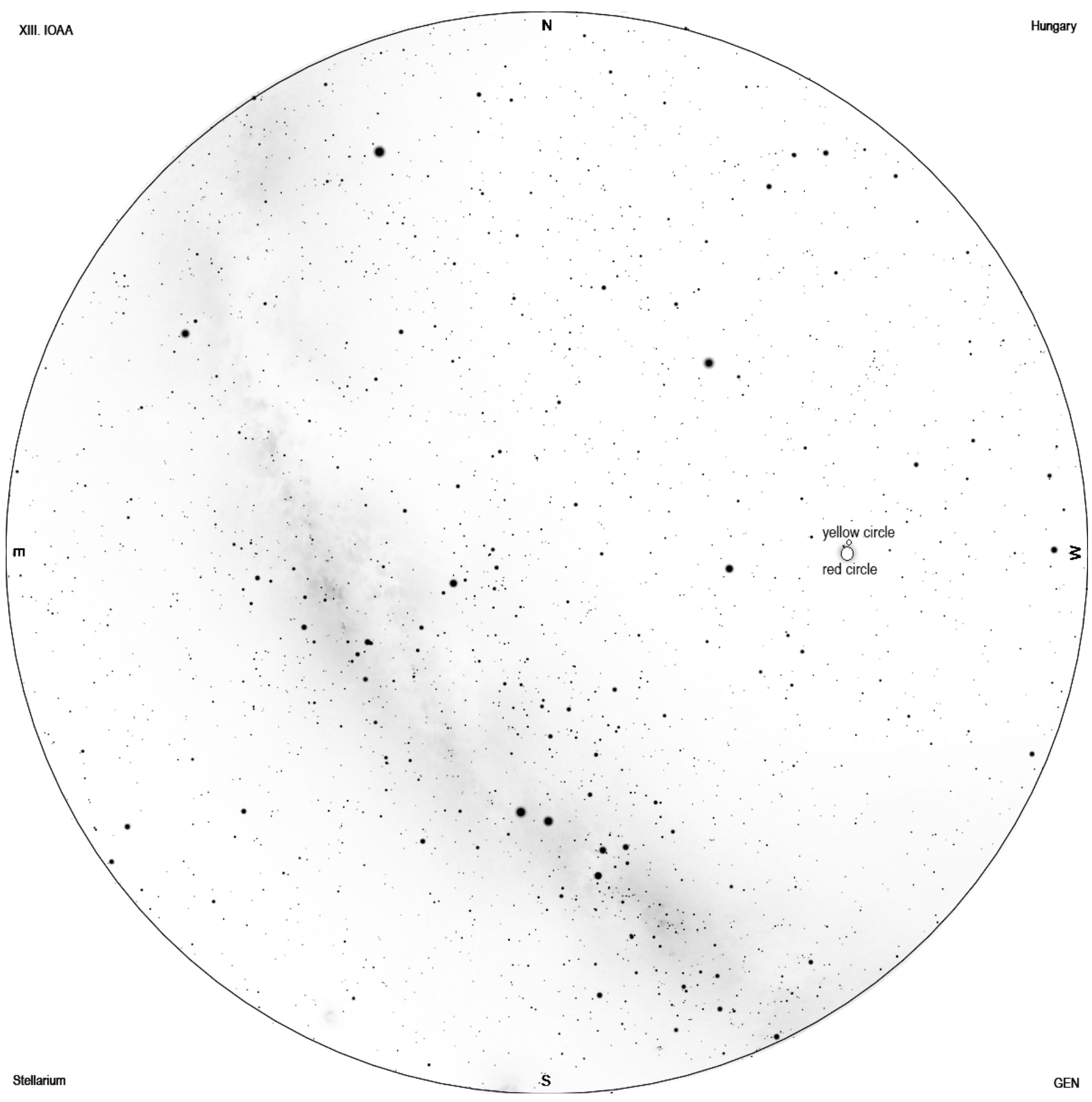
QUESTIONS / TASKS:
3.1. At the time of this observation, which season is it in Hungary? (Circle the correct answer.)
Spring / Summer / Autumn / Winter
3.2. There is a yellow circle on the projected sky (next to the red circle), which denotes minor planet Juno, which is at a distance of exactly 3 au from the Sun at this moment. Estimate its distance to the Moon at this instant. (Rounded to the nearest integer in units of million km.) Assume all orbits to be circular.
………………………………million km
3.3. Approximately how much time (in Earth days) after the projected event will …
…the Sun set at your observing site? ………………………………
…the Earth set at your observing site? ………………………………
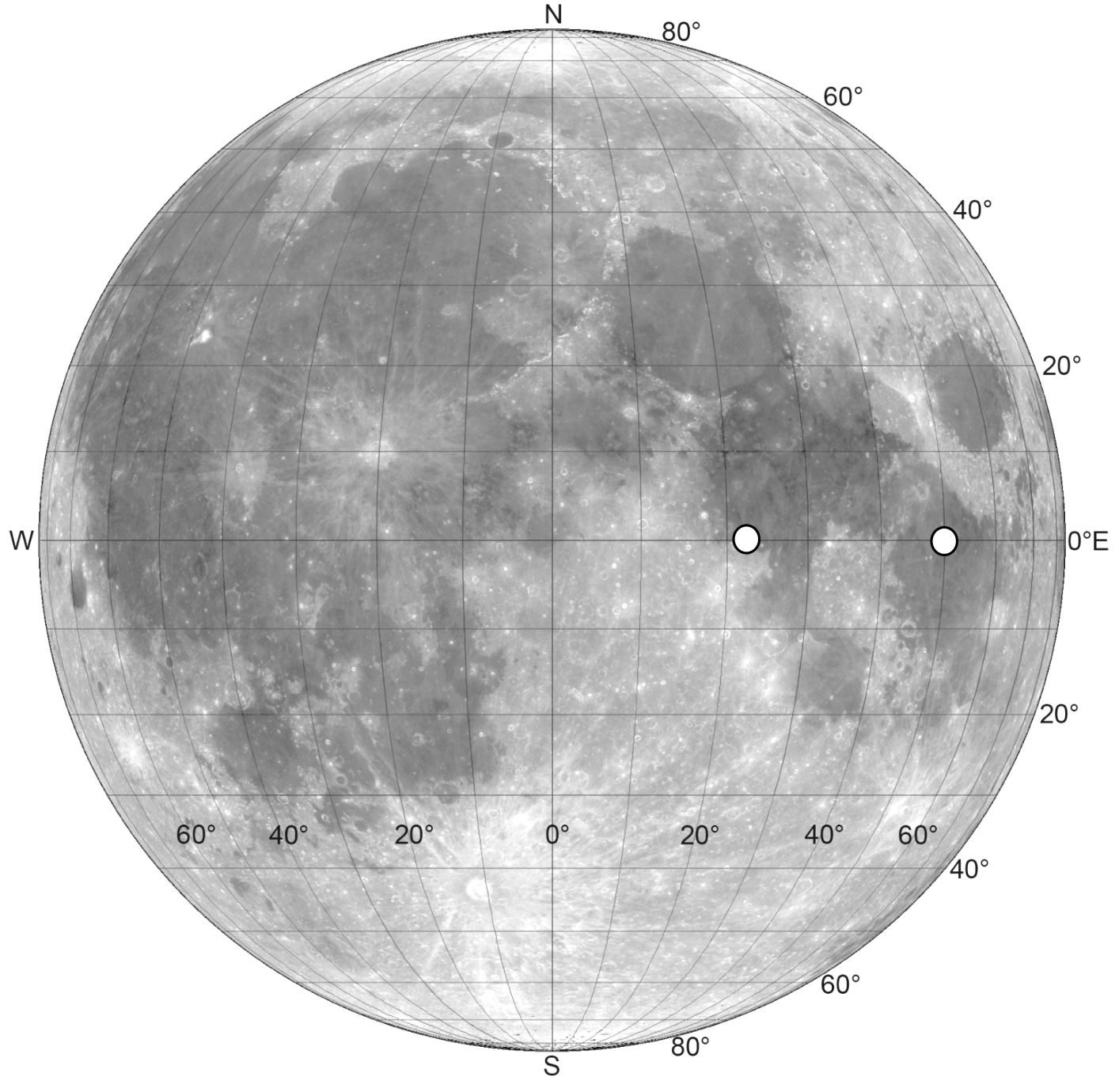
3.4. Determine the Lunar (Selenographic) coordinates of this observing site (as defined in the lunar map on the next page):
What is the name of the large surface lunar area, where your observing site is situated? Do not use your national language, please use the official IAU nomenclature.
(See lunar map on next page.)
3.5. Estimate the distance from the observing site to the Apollo-11 landing site (0.6875 N, 23.4333 E):
……………………………… km
Решение
Planetarium round — problems, solutions, marking
3.1.
Autumn (fall). The Moon, Earth and Sun are on the same line. From Earth the Sun is in Virgo, next to the autumnal equinox point. Marking: Autumn: 2 points. Maximum: 2 points.
3.2.
598.8 (approximately 599) million km. Juno–Sun–Earth–Moon are nearly on the same line, so the distance is 3 AU + 1 AU + d(Earth–Moon) = (4 × 149.6) + 0.4 million km = 598.8 million km. Marking: within ±1 million km: 2 points; within ±2 million km: 1 point. Maximum: 2 points. The solution question asks for rounding to 0.1 million km; the question edition above asks for the nearest integer.
3.3.
Solution 1: Sunset is about 3–4 terrestrial mean solar days later. The lunar day equals the synodic month: 29.53 days (708.72 hours). The Sun moves 360°/29.53 = 12.2° per day from East to West. It is 40° above the horizon and we are exactly on the equator, so setting takes 40°/12.2° = 3.28 days = 78.7 hours. The solar disc adds half an hour until complete sunset. Marking: 3–4 days: 4 points; 2 or 5 days: 2 points. Maximum: 4 points.
Solution 2: Earth never sets. The Earth–Moon system has synchronous rotation. The observing site is on the near side, outside the libration zone; Earth is continuously observable. Marking: 2 points. Maximum: 2 points.
3.4.
Solution 1: Latitude 0°, longitude 50° E. At the origin of selenographic coordinates the solar eclipse by Earth would be at the zenith. Here it is almost exactly West at altitude 40°, so we are on the lunar equator about 50° East of the origin.
Marking 1: Latitude within ±2° (S 2°–N 2°): 3 points; within ±5° (S 3–5° or N 3–5°): 2 points. Longitude within ±2° (48–52°): 3 points; within ±5° (45–47° or 53–55°): 2 points. Maximum: 6 points.
Solution 2: Mare Fecunditatis, Sea of Fecundity, or Sea of Fertility. Marking 2: any of these names: 6 points. Maximum: 6 points.
3.5.
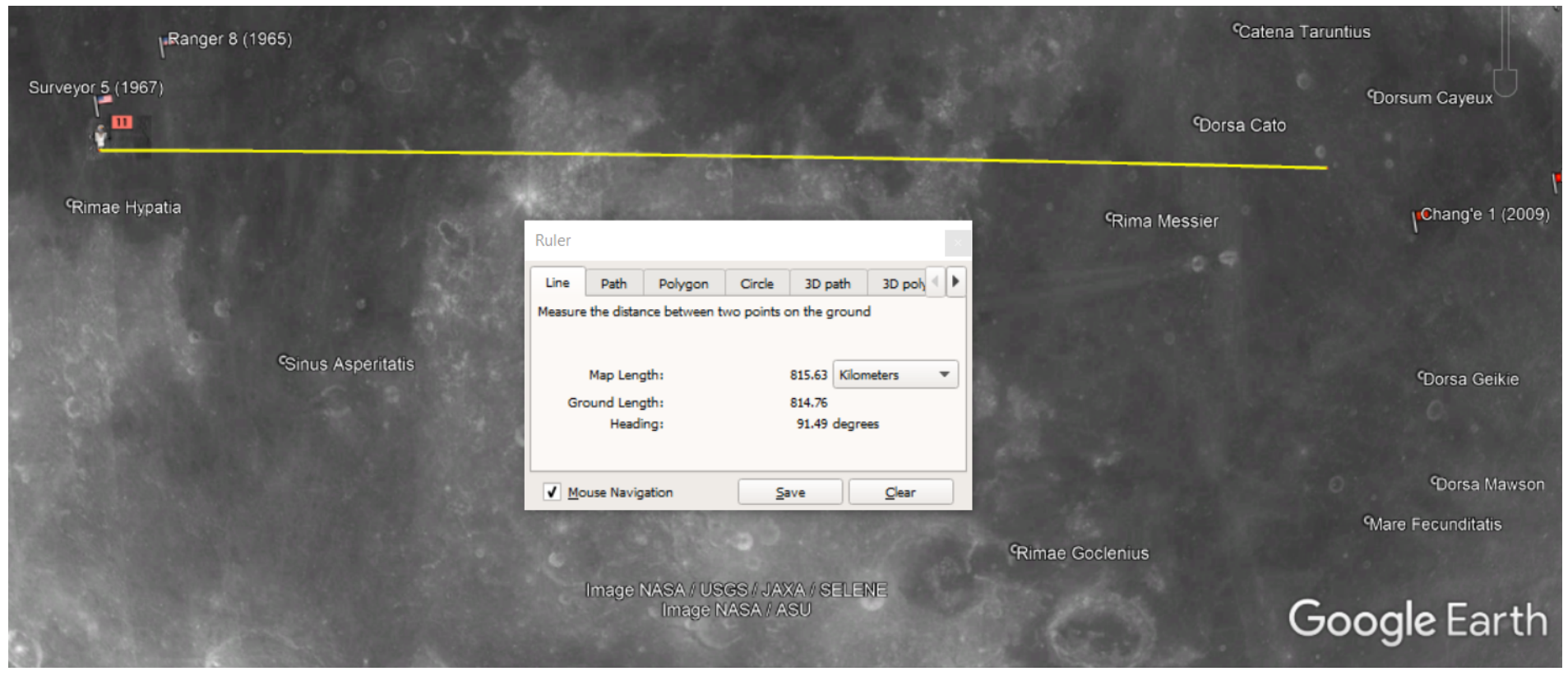
About 800 km. This is a tribute to the Apollo-11 astronauts on the 50th anniversary of the first lunar landing, a few days before IOAA2019. Disregard the latitudinal difference (less than 1°), and consider both sites on the equator, a great circle. Its circumference is D_Moon × π = 3474 km × 3.14 = 10914 km, corresponding to 360°. The longitudinal difference is 50° − 23.473° = 26.527°, giving an arc length of 803.7 km. The solution prints 23.473° here; the question prints 23.4333°.
Marking: ±100 km (700–900): 6 points; ±200 km (600–699 or 901–1000): 5 points; ±300 km (500–599 or 1001–1100): 4 points; ±400 km (400–499 or 1101–1200): 3 points. Maximum: 6 points.
Теми и трудност
Трудност: неоценена.
Слънчева система · Небесна сфера и сферична астрономия · Затъмнения и покрития · Небесни координати
Предпоставки: Гимназиална подготовка
Оригинал в Архива: Observational Problems.pdf · официални решения: NO-solution.pdf · допълнителни данни: PL-solution.pdf · допълнителни данни: PL-problem-final.pdf