IOAA 2019, Нощни наблюдения и планетариум — Планетариум 2. PROBLEM 2
OBSERVATIONAL ROUND – QUESTION SHEET
Бележка
Telescope: 150/750 Newton
Eyepieces: 25 mm, 10 mm, Barlow lens: 2x
Note:
- Telescope is already polar aligned.
- In case of bad sky conditions at low altitudes, task 1 and 2 will be replaced by alternative tasks 1 and 2 (see page 3). In this situation, the telescope assistant will cross out Tasks 1 and 2.
- You have to use 25 mm eyepiece for tasks 1, 3 and 4.
- For these tasks, if you finish before the allotted time, you must keep tracking the object with the telescope till the end of allotted time. The telescope assistant will check the object only at the end of the allotted time.
- For task 2, we recommend using 10 mm eyepiece and Barlow 2x.
- For task 5, you are not allowed to use the telescope.
PLANETARIUM ROUND – ANSWER SHEET
3 projected images with questions. Each part is 15 minutes long. Total time: 45 minutes.
Условие
We are standing somewhere on the Earth. The projected sky does not show any Solar System objects.
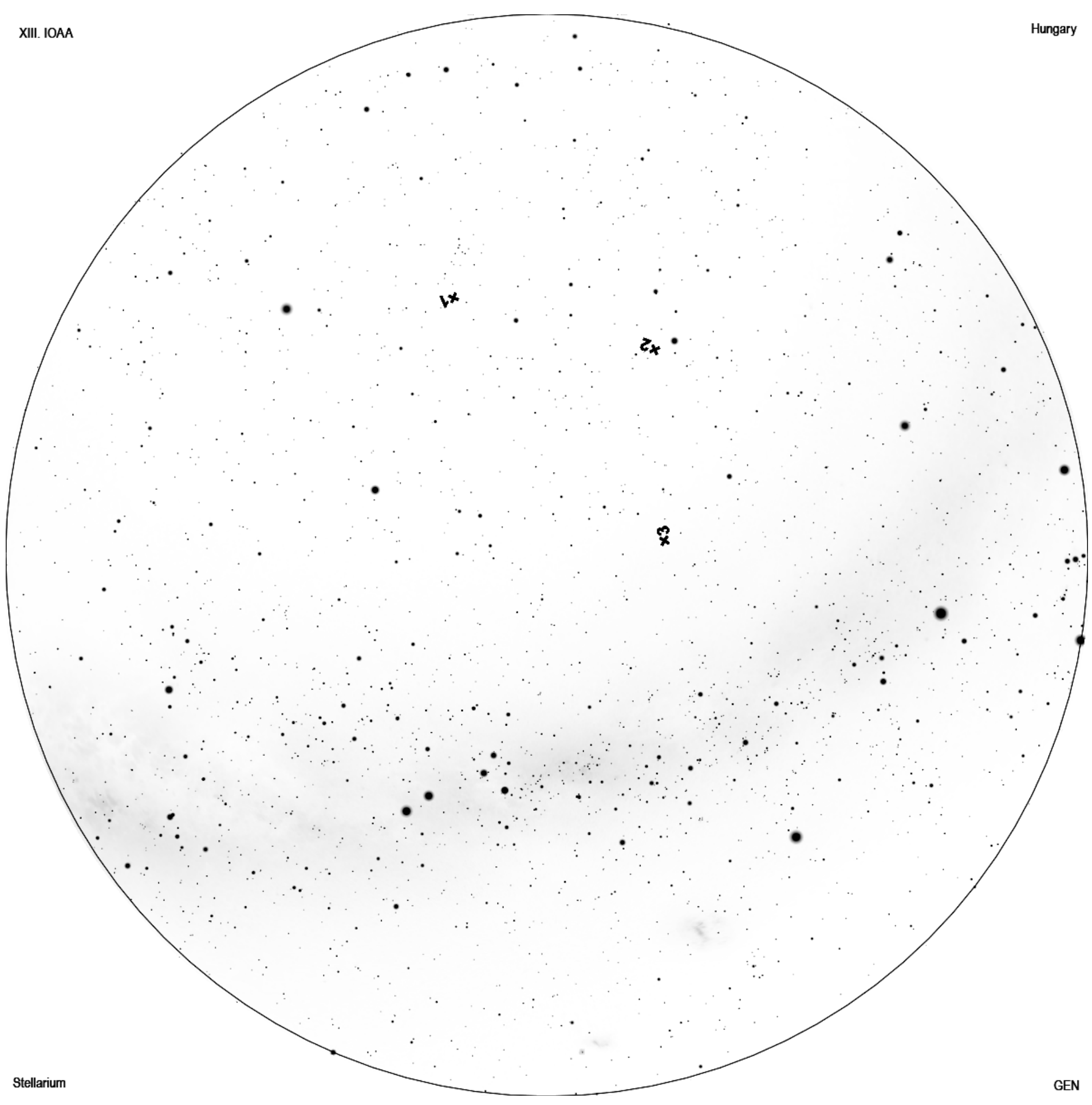
QUESTIONS / TASKS:
2.1. Determine the geographical latitude of this observing site: …………….°
In which hemisphere is the site situated? N / S (Circle the right one.)
2.2. Determine the azimuth of the 3 brightest stars on the projected sky. Azimuth is measured from North towards the East. Write the name of these stars in English or using their Bayer designation and their azimuths in the list below.
Bright star / name: …………………………….…… Az: ………………°
Bright star / name: …………………………….…… Az: ………………°
Bright star / name: …………………………….…… Az: ………………°
2.3. Yellow × signs show the position of 3 comets. Which comet is closest to the ecliptic? (Circle the number below.)
1 / 2 / 3
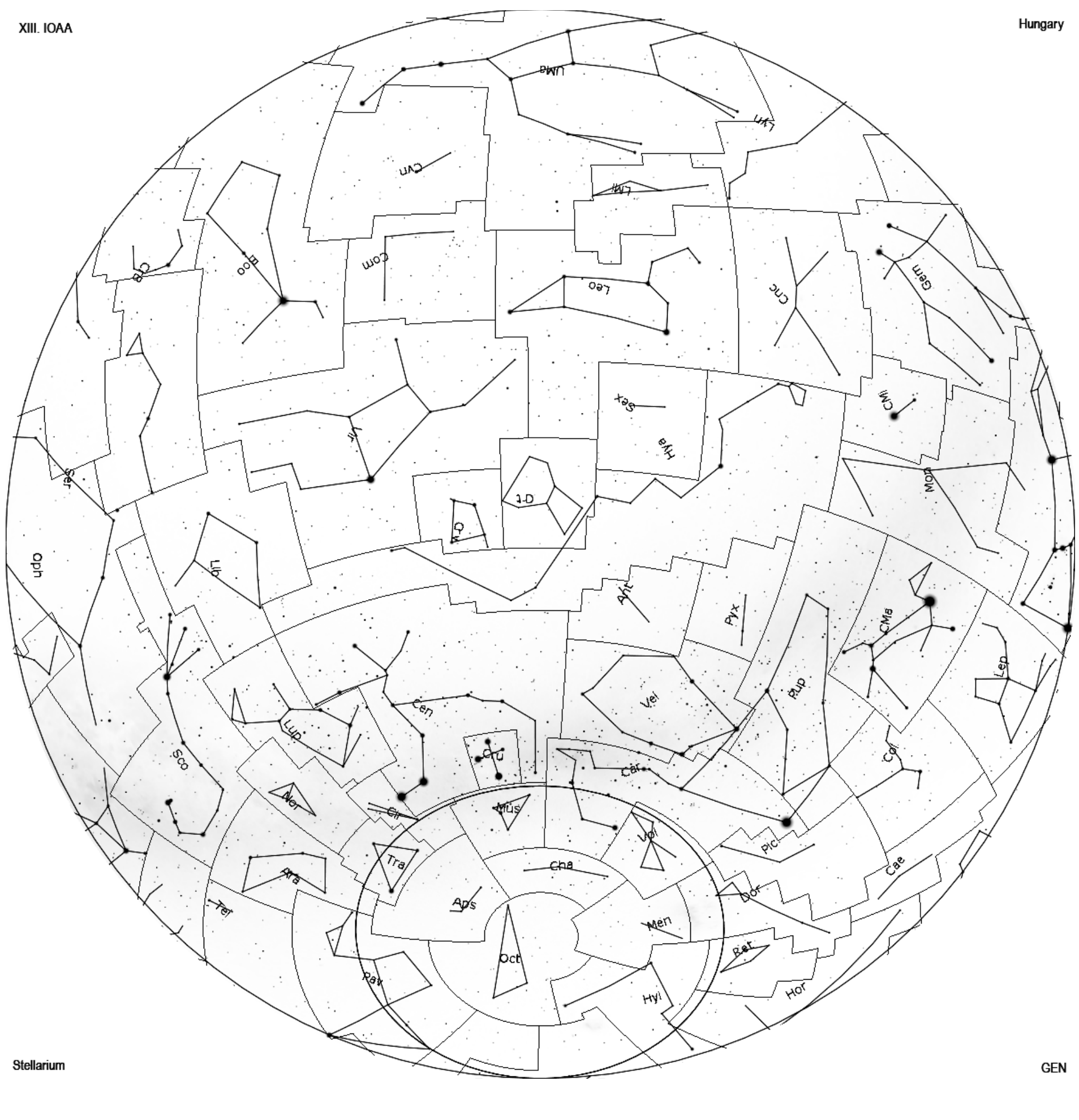
2.4. List nine constellations that contain circumpolar stars seen from the given observing site. (Use the official IAU abbreviations or IAU designation.)
2.5. Mintaka (δ Orionis) is setting at this moment. How many hours earlier did it rise? (To an accuracy of 15 minutes.)
Решение
Planetarium round — problems, solutions, marking
Source-edition difference: the official solution defines azimuth from South towards West, while the question sheet above defines it from North towards East. The official values below retain its printed convention.
2.1.
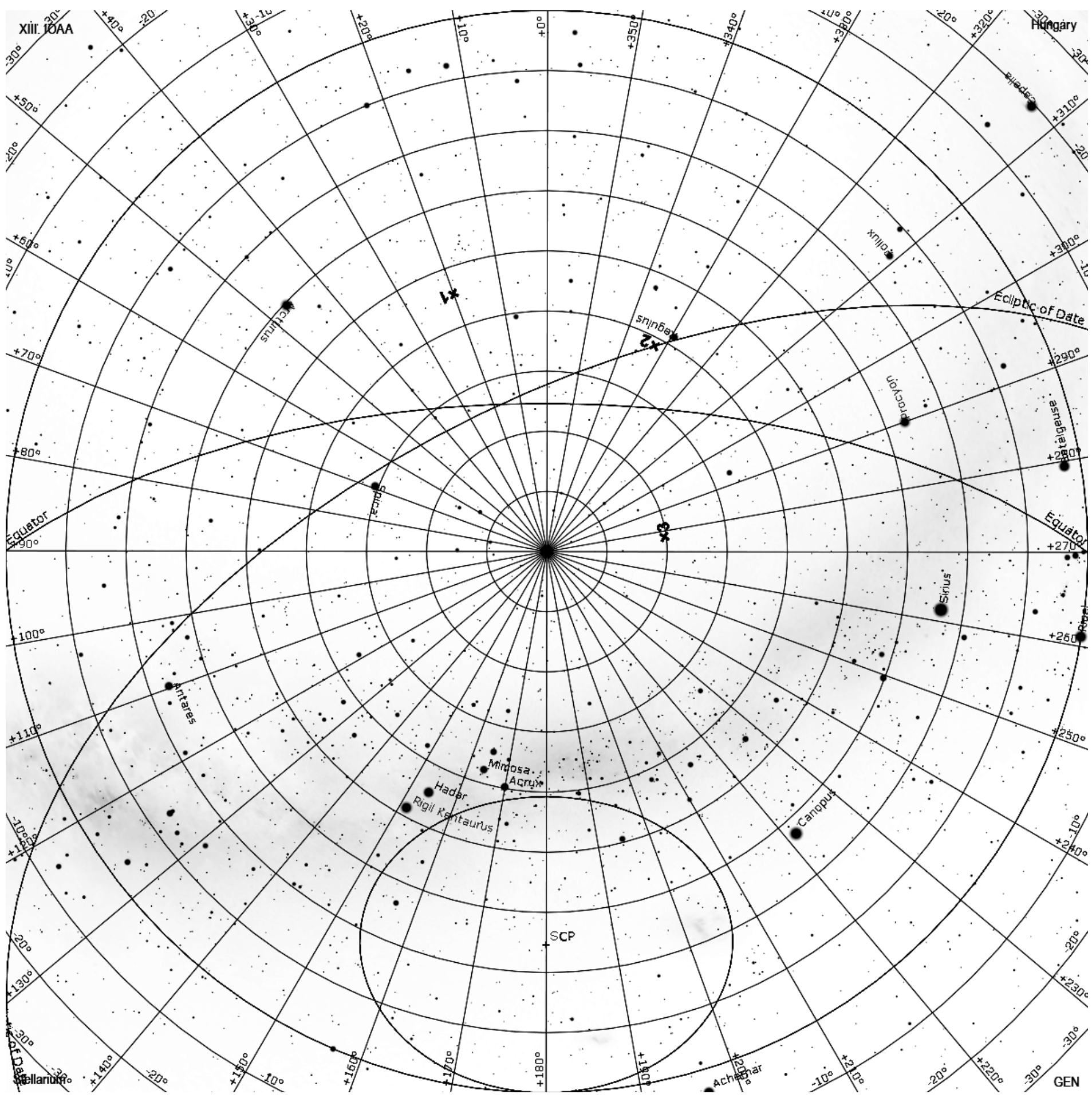
25°, Southern hemisphere. The Southern Cross (Crux) gives the South celestial pole; its altitude gives the latitude. Marking: 24–26°: 2 points; 22°, 23°, 27°, 28°: 1 point; S: 1 point. Maximum: 3 points.
2.2.
Azimuth is measured from South towards West, 0–360°.
| Star | Azimuth | 2 points | 1 point |
|---|---|---|---|
| Sirius (α CMa) | 82° | 74–90° | 64–74° and 90–100° |
| Canopus (α Car) | 42° | 34–50° | 24–34° and 50–66° |
| Toliman (α Cen) | 331° | 324–339° | 314–324° and 339–349° |
| Rank | Visual magnitude (mv) | Proper name | Bayer designation |
|---|---|---|---|
| 1 | −26.74 | Sun | |
| 2 | −1.46 | Sirius | α CMa |
| 3 | −0.74 | Canopus | α Car |
| 4 | −0.27 (0.01 + 1.33) | Rigil Kentaurus & Toliman | α Cen |
| 5 | −0.05 | Arcturus | α Boo |
| 6 | 0.03 (−0.02–0.07 var) | Vega | α Lyr |
| 7 | 0.08 (0.03–0.16 var) | Capella | α Aur |
| 8 | 0.13 (0.05–0.18 var) | Rigel | β Ori |
| 9 | 0.34 | Procyon | α CMi |
| 10 | 0.46 (0.40–0.46 var) | Achernar | α Eri |
Source: https://en.wikipedia.org/wiki/List_of_brightest_stars
Marking: good proper name: 2 points each; azimuth within ±2°: 2 points each, within ±5°: 1 point each; wrong list position: minus 1 point. Maximum: 12 points. The source prints both these tolerance rules and the different bands in the table above.
2.3.
Comet 2 (0°). Comet 1: 20°; comet 3: 30°. Connect Regulus and Spica to find the ecliptic. Marking: 2 points. Maximum: 2 points.
2.4.
Octans (Oct), Mensa (Men), Chamaeleon (Cha), Apus (Aps), Hydrus (Hyi), Volans (Vol), Carina (Car), Musca (Mus), Circinus (Cir), Triangulum Australe (TrA), Pavo (Pav), Indus (Ind), Tucana (Tuc), Horologium (Hor), Ara (Ara). Marking: 1 point each. Maximum: 9 points.
2.5.
12 hours. Mintaka is on the celestial equator (declination −0°18′). Marking: exact answer: 2 points. Maximum: 2 points.
Marking maps
Теми и трудност
Трудност: неоценена.
Небесна сфера и сферична астрономия · Небесни координати · Денонощно движение и видимост
Предпоставки: Гимназиална подготовка
Оригинал в Архива: Observational Problems.pdf · официални решения: NO-solution.pdf · допълнителни данни: PL-solution.pdf · допълнителни данни: PL-problem-final.pdf