IOAA 2019, Теория — Задача 12. Distance to a Near-Earth Asteroid
Theory problem sheet · 25 т.
Условие
Assume that a Near-Earth Asteroid is observed by two astronomers, one from Nagykanizsa, Hungary and one from Windhoek, Namibia. The longitudes of the two cities are exactly 17° east of Greenwich. They observe the asteroid when it crosses their respective meridians. The Nagykanizsa-observer sees the asteroid 25° south of his zenith at this instant, while the Windhoek-observer sees it 45° north of his zenith at the same instant. The latitudes of the two cities are 46°27’ N and 22°34’ S, respectively. The sites of both astronomers are at sea level.
a) Draw a diagram of the geometric configuration. [5 т.]
b) What is the distance of this asteroid from the centre of the Earth, expressed in units of Earth-radii and the average Earth-Moon distance? Provide a solution which makes use of all available information. Neglect the effect of the atmospheric refraction. [20 т.]
Решение
a)
The geometric situation is the following: (5 p)
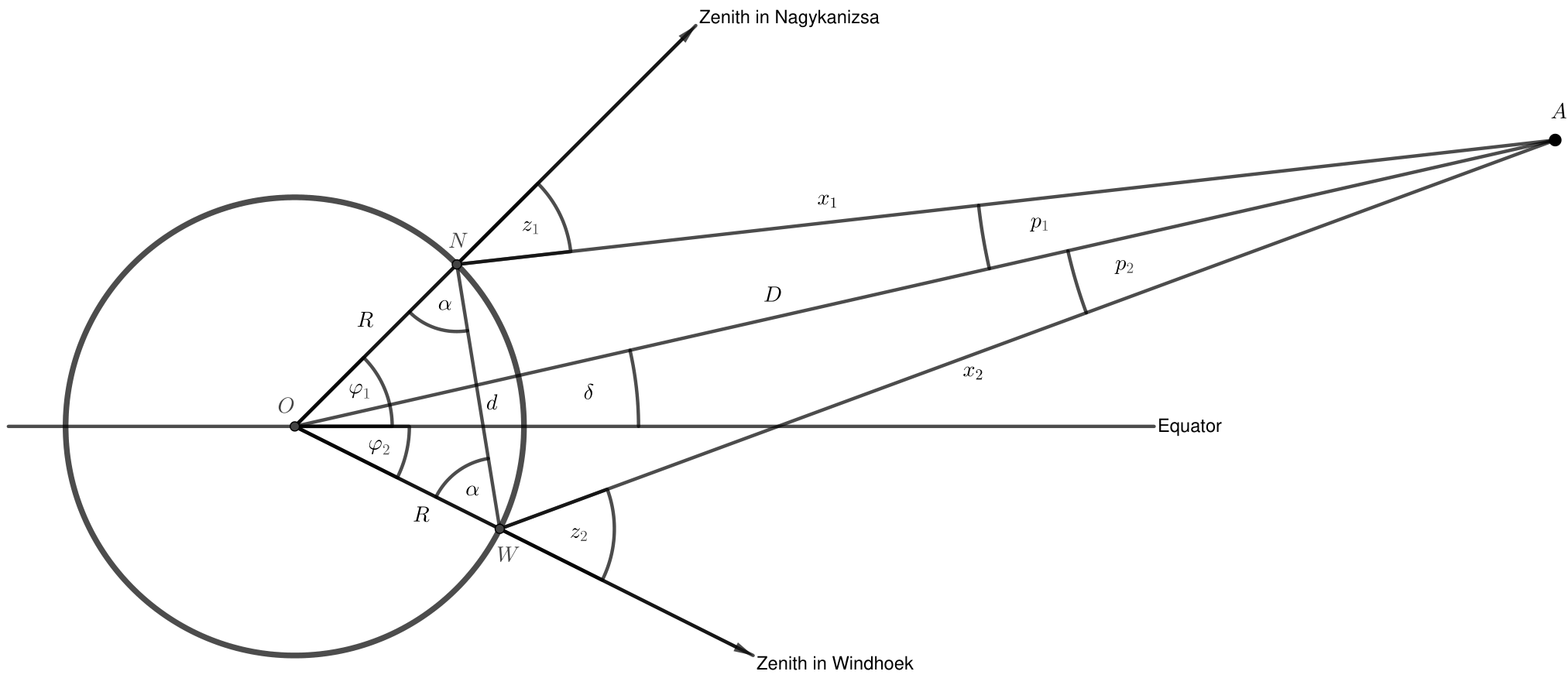
Fig. 12.1: : Nagykanizsa, : Windhoek, : centre of Earth, : asteroid, : distance from the centre of Earth to the asteroid , : radius of the Earth
b)
One can recognize that the triangle is an isosceles triangle, two sides and are equal to each other in length:
(1 p)
Therefore the angles . For the triangle we can write, that:
(1 p)
Let us denote the direct -- i.e. measured through the body of the Earth, not on the surface -- distance between Nagykanizsa and Windhoek by : . This distance can be obtained straightforward by the cosine theorem (one has to take care that the absolute values of the latitudes should be added inside the cosine function):
(2 p)
With numerical values:
(1 p)
Let us use the following notations:
For the quadrilateral we can write that:
(1 p)
and therefore:
(1 p)
For the triangle we can write that:
(2 p)
Thus:
(2 p)
can be obtained either from the triangle or by the cosine theorem:
or
(2 p)
Let us take the sum of them:
(1 p)
where we have used that .
(If someone determines only from one of the two triangles, 1 point can be deducted, because that means, we ignore the error bars of one of the measurements in a significant way.)
After substitution and dividing by two one gets:
(3 p)
This contains only known quantities. After substitution we get (notice that for alpha and we need the absolute values of the geographical latitudes):
(1 p)
(2 p)
So, the asteroid is at 65.8 Earth-radii from the centre of the Earth. This is slightly more than the distance to the Moon.
Оригинал в Архива: TH-problem-final.pdf · официални решения: TH-solution-final.pdf · допълнителни данни: TH-anssheet.pdf