IOAA 2019, theory — Задача 11. Identification of light curves of types of selected variable stars
Автор: Olympiads XYZ · транскрипция на официалните материали
Проверена срещу оригинала на 13.9.2026 от същия модел, който я е транскрибирал (без независима проверка)
Theory problem sheet · 25 т.
Условие
TESS (Transiting Exoplanet Survey Satellite) is NASA's most recent exoplanet hunter mission. It has been surveying the southern sky to locate exoplanets around the brightest and closest stars, along with a large number of time-variable phenomena (pulsating and eclipsing variable stars, supernovae, stellar flares, and asteroids among others).
On the separate sheet you will find graphs with light curve plots of 8 periodic variable stars (intrinsic, eclipsing and rotational; namely FO Eri, RW Dor, 24 Eri, TIC 147272181, ST Pic, UY Eri, VV Ori, AH Col) from the TESS target list, numbered from 1 to 8. The horizontal axis is in days, and the vertical axis is in magnitudes, where BJD is the Barycentric Julian Date, and is the visual brightness.
a) Below is a list of variable star types. Match each light curve of the star with its variability type by writing its number into the rectangle on the answer sheet. (8 p)
• Heart-beat star • RR Lyrae type (RRab subclass) pulsating variable star • Eclipsing binary of Algol type (semi-detached) with a pulsating component • CVn pulsating variable star • W Vir type (Population II) Cepheid pulsating variable star • Detached eclipsing binary with strong reflection effect • Contact eclipsing binary of W UMa type • Rotationally variable (spotted) star [8 т.]
b) Based on the light curve plots, estimate the periods of each variable star in days. Give your answers on the answer sheet up to 2 decimal places. Periods in the range ±5% of the true periods are acceptable. (16 p) [16 т.]
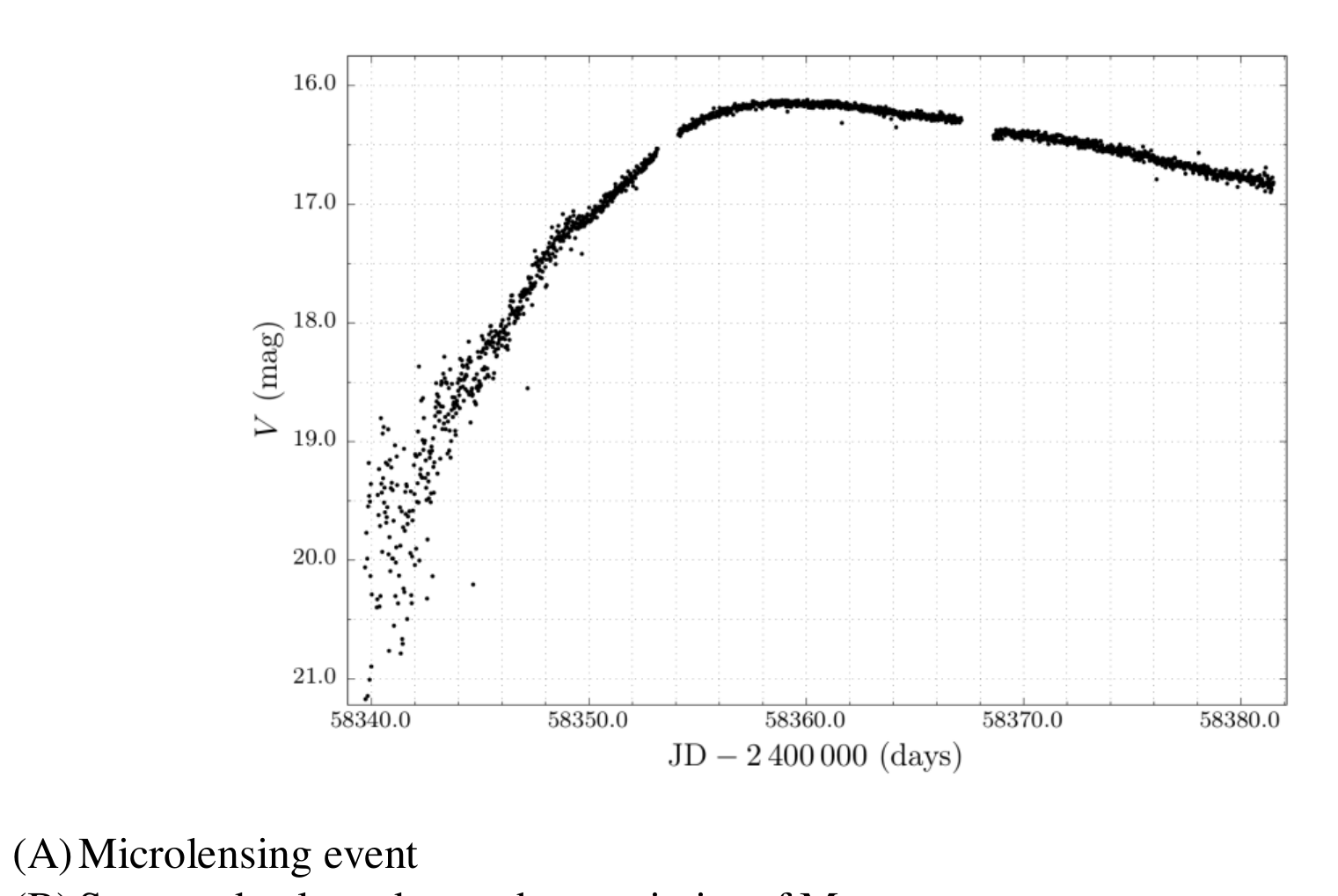
c) What type of astronomical object produced the TESS light curve shown in the figure below? Mark the letter of your answer with × on the answer sheet. (1 p)
(A) Microlensing event (B) Saturated galaxy due to the proximity of Mars (C) Comet's coma close to the edge of the camera field (D) Supernova in a distant galaxy (E) Superflare on a supergiant star [1 т.]
Решение
Покажи официалното решение
Оригинал в Архива: TH-problem-final.pdf · официални решения: TH-solution-final.pdf