IOAA 2021, Теория — Задача 6. Macondo and Melquiades (12 points).
Theory — Q6-1 / Q6-2, English (Official) — Macondo and Melquiades · 12 т.
Standard Table of Constants — values used in this problem
Wien displacement law: . Universal gravitational constant: .
Standard Table of Constants — astronomical units
1 astronomical unit (au): . 1 parsec (pc): .
Standard Table of Constants — solar mass
Sun: mass .
Условие
In 2019, as a part of the NameExoWorlds campaign of the International Astronomical Union, Colombia was granted an opportunity to select a name for the star HD 93083 and its planetary system. HD 93083 is a dwarf star and has one extrasolar planet orbiting it. Today they are officially known as Macondo (star) and Melquiades (planet), from the literary ideas of the Colombian writer Gabriel García Márquez.
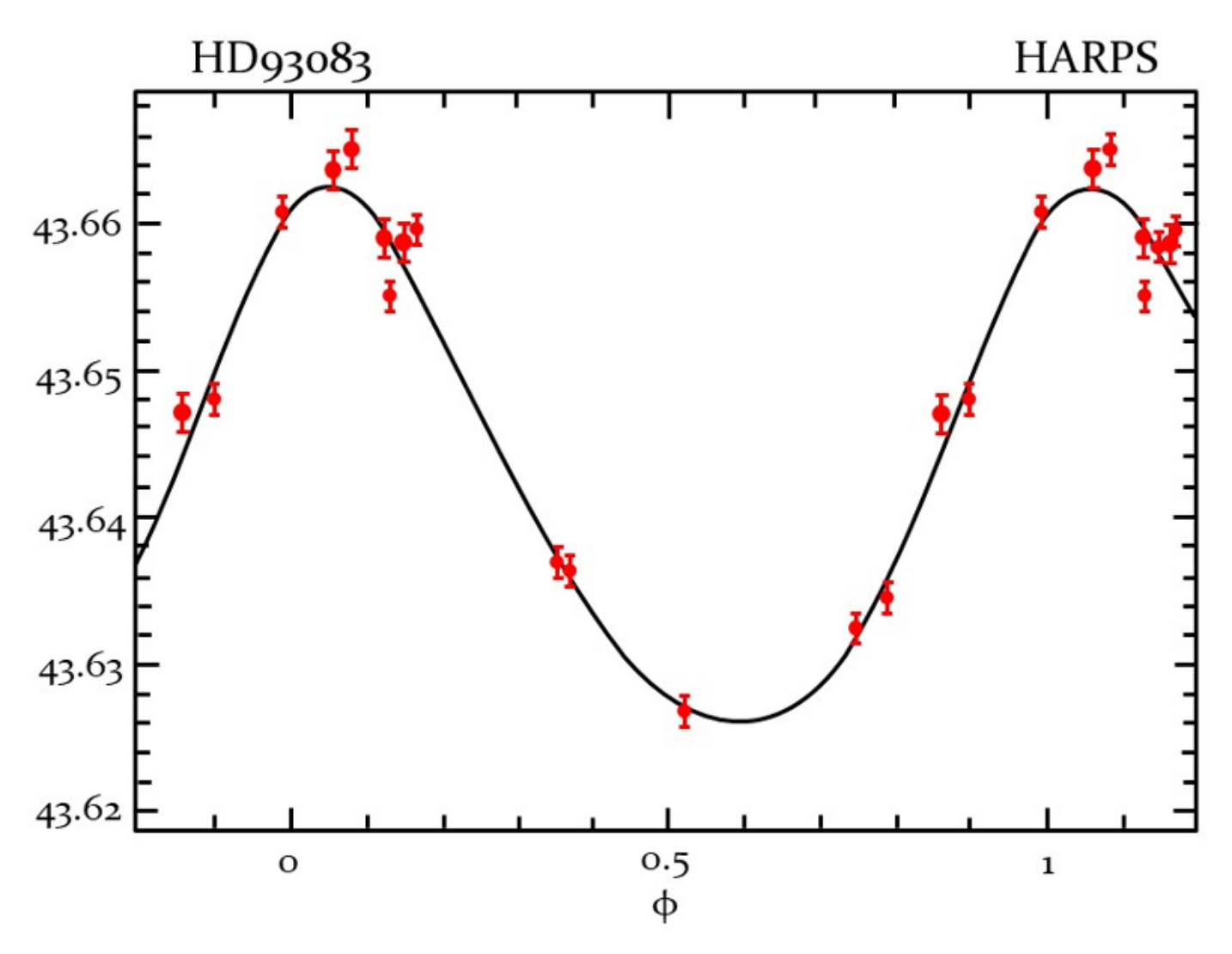
This star has an effective temperature of 4995 K and an apparent visual magnitude of 8.3. As per GAIA DR2, the parallax for Macondo is 35.03 milliarcseconds. You may assume the orbit of Melquiades is perfectly circular. In the figure you can see the plot of radial velocity of Macondo with respect to the phase.
6.1 Find the wavelength of peak emission for Macondo in its rest frame (i.e., ignoring Doppler shifts). [2 т.]
6.2 Find the distance of this system from the Earth (in parsecs) and the absolute visual magnitude () of the star. [2 т.]
6.3 Calculate the mean radial velocity of Macondo (in ). [2 т.]
6.4 Calculate the orbital velocity (in km/s) of Melquiades (), if mass of the star () is and the mass of exoplanet () is . Assume that the orbital plane of the system is edge-on with respect to our line-of-sight. [2 т.]
6.5 Find the orbital radius of Melquiades (in ) and its orbital period (in days). [4 т.]
Отговори
- 6.1 580.2 nm
- 6.2
- 6.3 43.644 km/s
- 6.4 40 km/s
- 6.5
Решение
6.1
From Wien’s law:
[2 point]
6.2
With the parallax doable to find the distance from Earth:
[1 point]
[1 point]
6.3
[2 point]
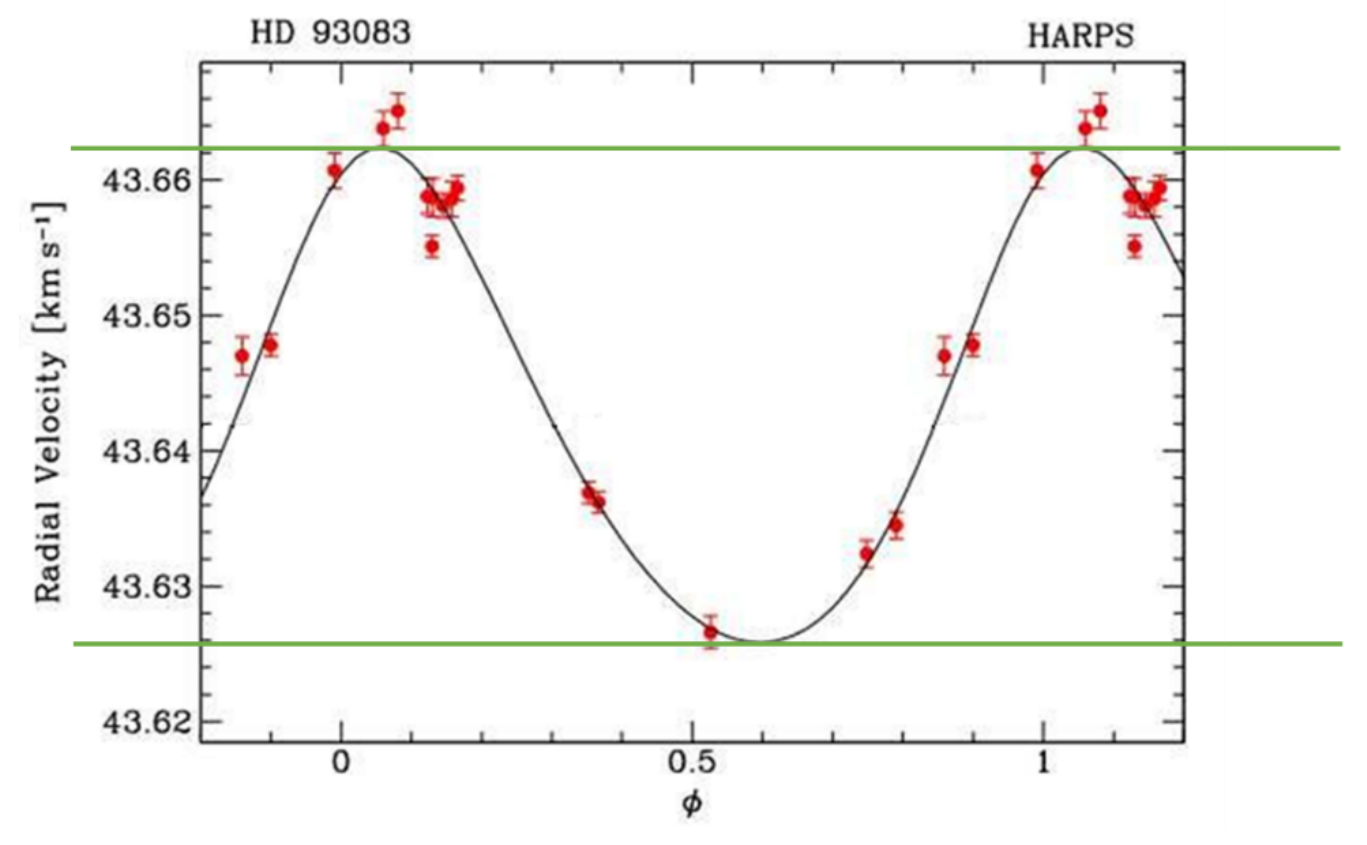
Each division on Y has 0.002 km s⁻¹, so the maximum radial velocity is 43.662 km s⁻¹ and the minimus is 43.626 km s⁻¹. Then, the mean radial velocity of Macondo is .
6.4
The tangential velocity of Macondo, from the plot, is its variation from the mean system velocity
The masses of the star and the planet are known so it is only needed to find orbital velocity of Melquiades. But first it is important to convert the mass of the star to kg.
[1 point]
[1 point]
6.5
As the motion of the planet is circular, the orbital period is:
being the distance to the central star.
With the 3rd Kepler’s law, the orbital period is
Then, combining both expressions of is possible to find
[2 point]
With the previous solution is able to find the orbital period:
[2 point]
Official solution source discrepancy
The supplied key uses 28.55 pc and then 28.57 in 6.2; 0.018 km/s and then 0.02 km/s in 6.4; and 40 km/s, 36000 m/s, 7.25×10¹⁰ m and 7.21×10¹⁰ m across 6.4–6.5. These printed values and the resulting 147 days are retained without recomputation.
Оригинал в Архива: TQ-6-Q.pdf · официални решения: TQ6.pdf · допълнителни данни: TQ-6-A.pdf · допълнителни данни: Standard-Table-of-constants.docx.pdf · допълнителни данни: TQ-G.pdf · допълнителни данни: data.pdf