International Olympiad on Astronomy and Astrophysics 2022 Georgia — Theoretical Competition · 16 август 2022 г. · 50 т.
Условие
The Kardashev scale distinguishes three stages of evolution of civilizations according to the criterion of access to and use of energy.
A type II civilization is capable of harnessing all the energy radiated by its own star. Currently, we are a type zero civilization (we are not even harnessing 100% of the energy that reaches the Earth). One of the ways to become a type II civilization is by building a Dyson Sphere. You can imagine it as a sphere, built around the Sun, having the inner surface covered with solar panels.
We assume that modern solar panels are used to build the sphere. First, let’s find out at what distance from the Sun should it be built.
Emissivity of the back side of solar panels is ϵ=0.8.
(a) Solar panels absorb and transfer about k=30% of the incident radiation into internal heat. Find the temperature of a Dyson Sphere of radius R. Express your answer in terms of k,R,ϵ and L⊙ (solar luminosity). You may consider the Sun to be a black body. Ignore reflections from the solar panels. Ignore any possible effect of the energy not transferred to the internal heat of the solar panels or into electrical energy generated by the panels. [3 т.]
Assume that the highest operational temperature for modern solar panels is about Tmax≈104.5∘C. After that, efficiency drops significantly. To minimize the amount of material used, we should consider building the sphere as small as possible.
(b) Calculate the radius of the sphere for the panels to work properly. Does the Earth stay inside or outside the sphere? Write IN or OUT in the answer sheet. [4 т.]
(c) Find the power harnessed by this Dyson Sphere, if the final power output of modern solar panels is about η=20% of the incident energy. [2 т.]
(d) Currently, the average power usage of the whole world is about 17 Terawatts. If this Dyson sphere collects energy for one second, for how long could that meet our energy needs? [2 т.]
(e) In the case where the Dyson sphere completely blocks out the rays of the Sun, the temperature on Earth will drop significantly. Calculate the change in the average temperature of the Earth in this condition, if current average temperature is about 15∘C. Assume that Earth is also a black body. [5 т.]
(f) Building a rigid spherical object of that size is nearly impossible. Another way of “building” the sphere is by sending individual panels to orbit around the sun (in different inclined orbits) at the radius R found in part b. Calculate the period T of any object orbiting the sun at that radius. [3 т.]
(g) Assume that each solar panel is a thin sheet of silicon, having unit surface mass ρ=1kg/m2. The radiation pressure from the Sun, might interfere with the orbit of the panel. Calculate the ratio α of the gravitational and photon forces for unit surface area of panels at distance R. You assume that all incident light is absorbed. Will this radiation pressure have any measurable effect? Write YES or NO in the Answer Sheet. [13 т.]
Now assume that the Dyson Sphere is a rigid body rotating with the period found in part ‘f’ and having the radius found in part ‘b’.
(h) A major threat to the Dyson Sphere would be an asteroid whose orbit crosses the surface of the sphere. One way to solve this problem is by removing panels from the path of the asteroid. Obviously the size of the hole through which asteroid should pass is much smaller than radius of the sphere.
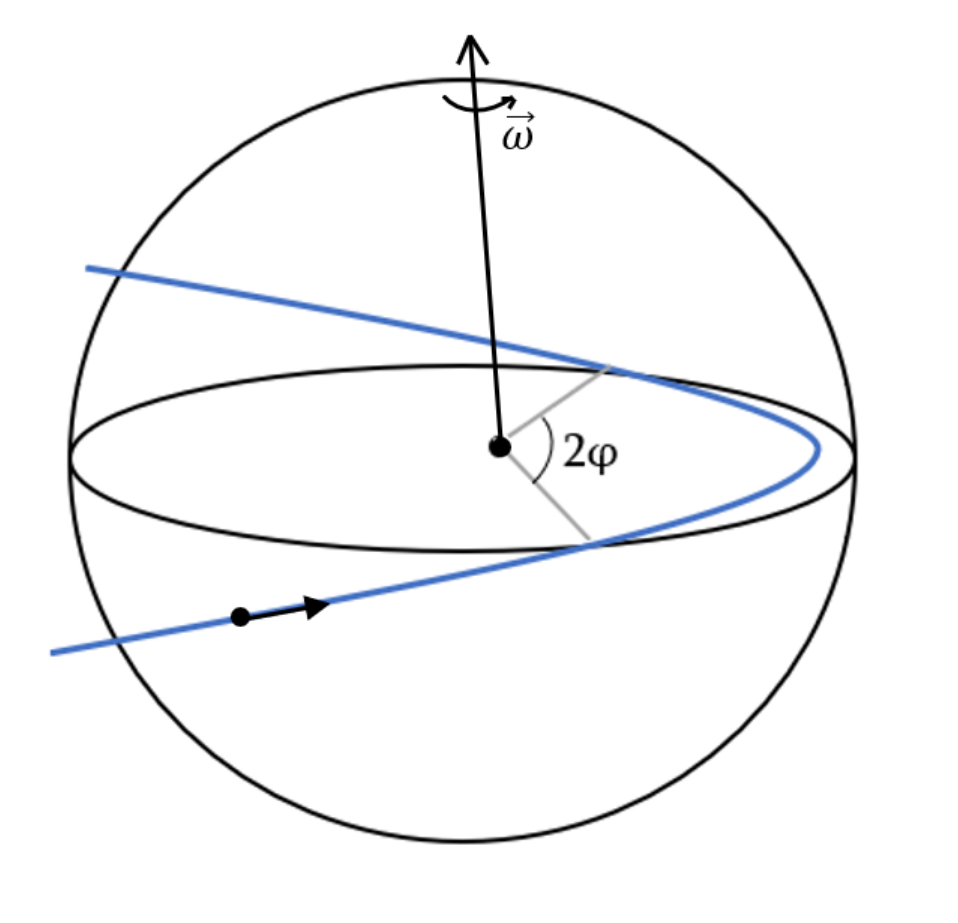
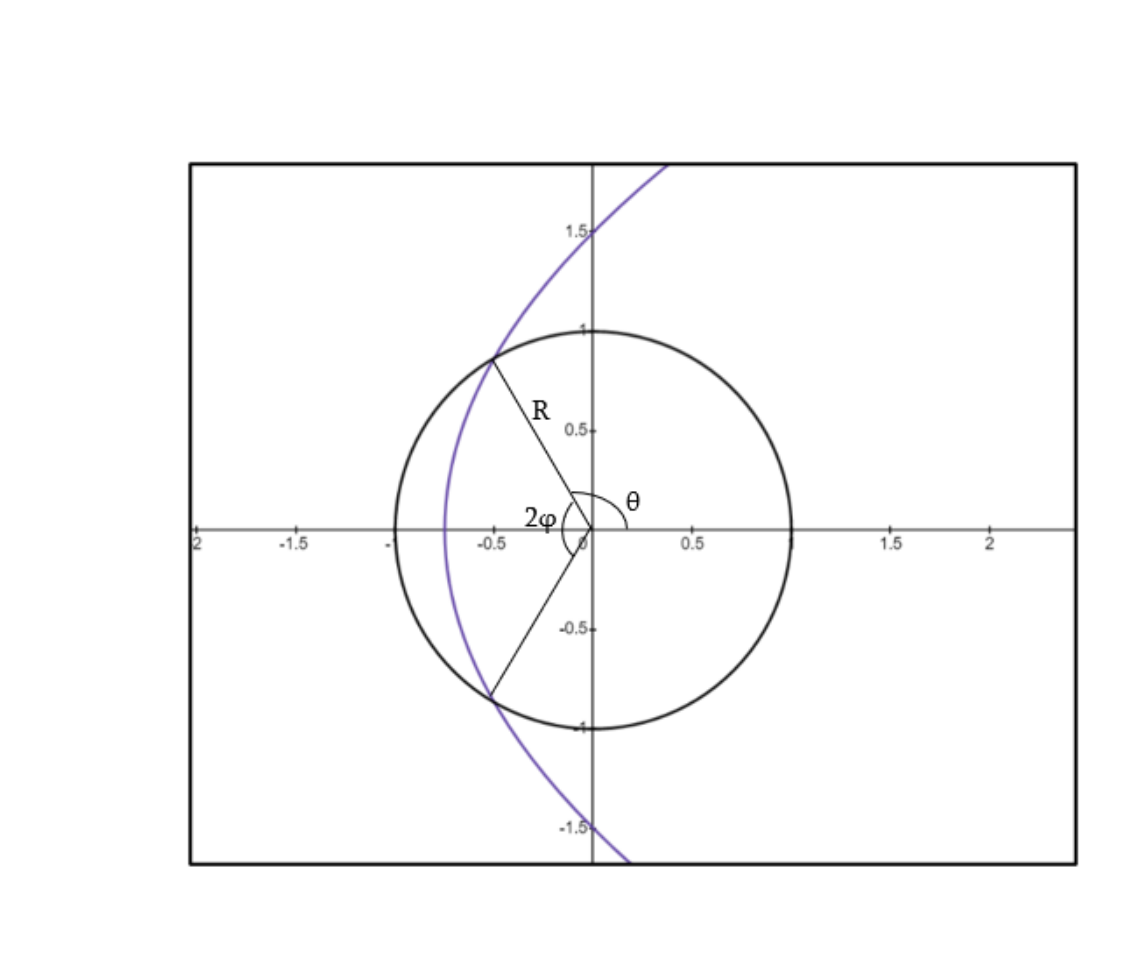
Astronomers discovered an asteroid on an orbit in the ecliptic plane in the same direction as the direction of rotation of the Dyson sphere. They calculated that this asteroid will enter the sphere on 14th of August and leave it on 20th of September. Calculate the angular distance between the two holes in the sphere needed to provide a safe passage for the asteroid.
The trajectory of this asteroid in heliocentric cylindrical coordinate system can be described as
r=1−cosθa
where a=1.00au. [13 т.]
(i) In what range of wavelengths should we be searching for a Dyson sphere created by a type II civilization in a distant galaxy, if its distance from Earth is d and the sphere can operate between temperatures T1 and T2 (T1<T2). Assume only non-relativistic effects. [5 т.]
Отговори
(a)Teq=44πR2ϵσkL⊙
(b)R≈1×10¹¹m=0.665au; Earth stays OUTside the sphere.
(c)7.65×1025 W
(d)τ=4.5×10¹²s≈143000yr
(e) 82 K
Температурата пада от 288 K до около 206 K.
(f)T≈0.542yr=198days
(g)α≈7.65×10⁻⁴; the period changes by ΔT≈1.8h, so YES.
(h)β≈0.91rad=52.3∘
(i)T2b(1+cdH0)<λobs<T1b(1+cdH0)
Решение
(a) Heat absorbed must be fully emitted to maintain the thermal equilibrium
kL⊙∴Teq=4πR2ϵσTeq4=44πR2ϵσkL⊙2.01.0
(b) In this part, we try minimize the radius at the expanse of reaching the highest operational temperature for panels. Again