International Olympiad on Astronomy and Astrophysics 2022 Georgia — Theoretical Competition · 16 август 2022 г. · 50 т.
Условие
This question applies a method of determining the masses of two approximately co-orbital satellites developed by Dermott and Murray in 1981.
Suppose that two small satellites of masses m1 and m2 are approximately co-orbital (moving on very similar orbits) around a large central body of mass M, with m1,m2≪M. At any instant, the orbits of the satellites may be approximated as circular Keplerian orbits with radii r1 and r2 respectively, although r1 and r2 will vary slightly over time due to the mutual gravitational interaction between the satellites.
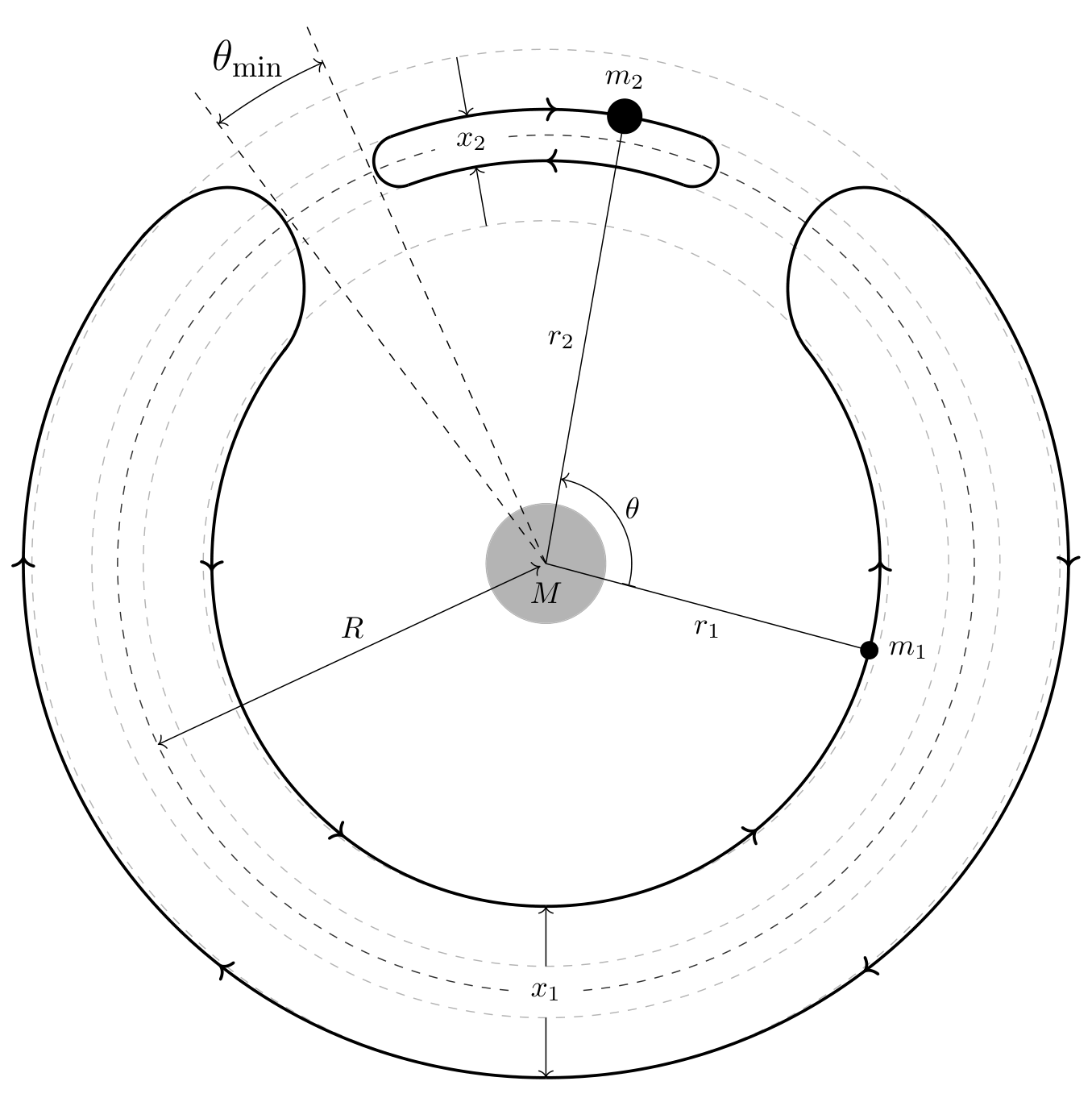
Figure 4 depicts the shapes of the orbits in the rotating reference frame with zero angular momentum, centred on the central body. We denote by θ the angle ∡m1Mm2, while R, x1, and x2 denote the mean orbital radius and radial deviations of the satellites.
Throughout this problem, write all answers in an inertial reference frame.
Hint:(1+x)α≈1+αx for αx≪1
First we will determine the value of m2m1.
(a) Write down the angular momentum Li of the satellite with mass mi when its circular orbit has radius ri. [3 т.]
(b) The satellites total angular momentum L1+L2 is conserved. Let x1,x2≪R be the distances as shown in Figure 4. Find a simple relation between the ratios m2m1 and x2x1. [8 т.]
Now, we will try and determine the value of m1+m2. For next parts, we will use the actual barycenter of the system, which may not be exactly at the center of the planet.
(c) The individual angular momenta of the satellites m1 and m2 will vary over time due to their gravitational interactions. Show that the rate of change of the angular momentum of the second satellite is given by
(e) For the angle θ=∡m1Mm2 as indicated on Figure 4, find an expression for ΔtΔθ[5 т.]
(f) Using the results above, find the relation between Δs and Δθ. [2 т.]
(g) After integrating the expression above, we will obtain the result,
x2≈34R2Mm1+m2(sin(2θmin)1−2cosθmin−3)
where x=2x1+x2.
Epimetheus (m1) and Janus (m2) are two approximately co-orbital moons of Saturn. Detailed observations of their orbits have been performed by the Voyager 1 and Cassini spacecraft, which found that R=150000km, x1=76km and x2=21km. The minimum distance between Janus and Epimetheus is 13000km. The mass of Saturn is known to be 5.7×1026kg. Estimate the masses of Epimetheus and Janus. [6 т.]
Figure 4: This figure schematically depicts the shapes of the orbits in the rotating reference frame, selected such that in this frame the total angular momentum of the two satellites is zero.
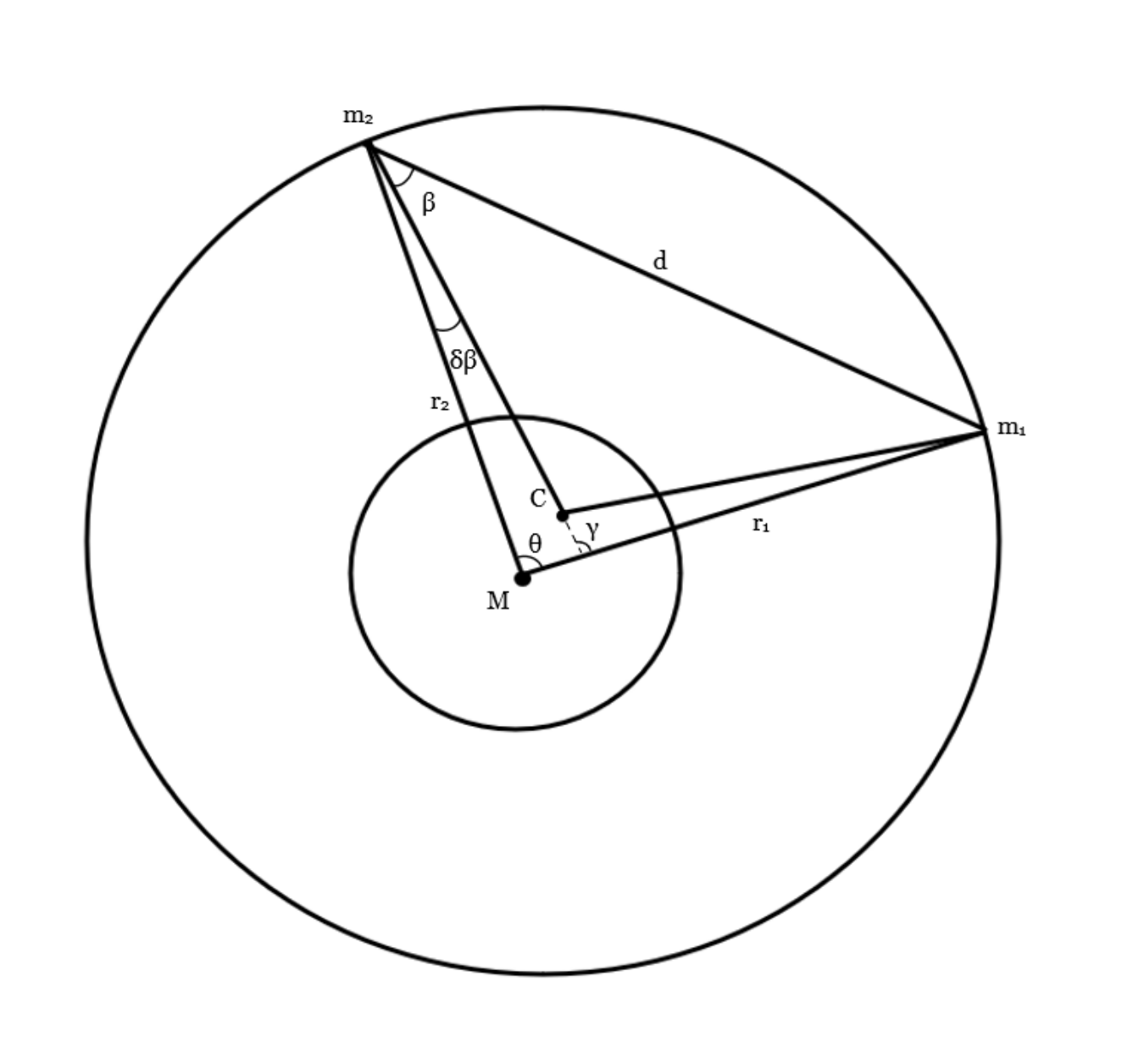
(c) Let the centre of mass of the ternary system be denoted by C. The total gravitational force on satellite m2 due to the primary mass M, and the satellite m1 may be resolved into a radial component, parallel to the line between m2 and C and a tangential component, perpendicular to the line between m2 and C. Only the tangential component of the force will act to change the angular momentum of the satellite m2.
The tangential component of the force is given by
F2⊥=r22GMm2sin(δβ)−d2Gm1m2sinβ2.0
where d=dist(m1,m2), β=∡m1m2C, and δβ=∡Mm2C. There are two ways to simplify this expression.
The first way straightforward. By immediately exploiting the fact that m1,m2≪M and hence δβ→0, we can say,