International Olympiad on Astronomy and Astrophysics 2022 Georgia — Theoretical Competition · 16 август 2022 г. · 50 т.
Consider an isotropic light source of frequency f R f_R f R θ R \theta_R θ R X X X X X X v v v
(a) Find an expression for the frequency f L f_L f L X X X
Hint: In relativistic mechanics, energy E E E p p p
E L c = γ ( E R c + p x R v c ) p x L = γ ( p x R + E R v c 2 ) p y L = p y R p z L = p z R \begin{aligned} \frac{E_L}{c} &= \gamma\left(\frac{E_R}{c} + p_{x_R}\frac{v}{c}\right) \\ p_{x_L} &= \gamma\left(p_{x_R} + \frac{E_R v}{c^2}\right) \\ p_{y_L} &= p_{y_R} \\ p_{z_L} &= p_{z_R} \end{aligned} c E L p x L p y L p z L = γ ( c E R + p x R c v ) = γ ( p x R + c 2 E R v ) = p y R = p z R where:
γ = 1 1 − v 2 c 2 \gamma = \frac{1}{\sqrt{1 - \frac{v^2}{c^2}}} γ = 1 − c 2 v 2 1 [11 т.]
(b) For the following cases:
i) θ R = 0 ∘ \theta_R = 0^{\circ} θ R = 0 ∘
ii) θ R = cos − 1 ( − v / c ) \theta_R = \cos^{-1}(-v/c) θ R = cos − 1 ( − v / c )
iii) θ R = 9 0 ∘ \theta_R = 90^{\circ} θ R = 9 0 ∘
iv) θ L = 18 0 ∘ \theta_L = 180^{\circ} θ L = 18 0 ∘
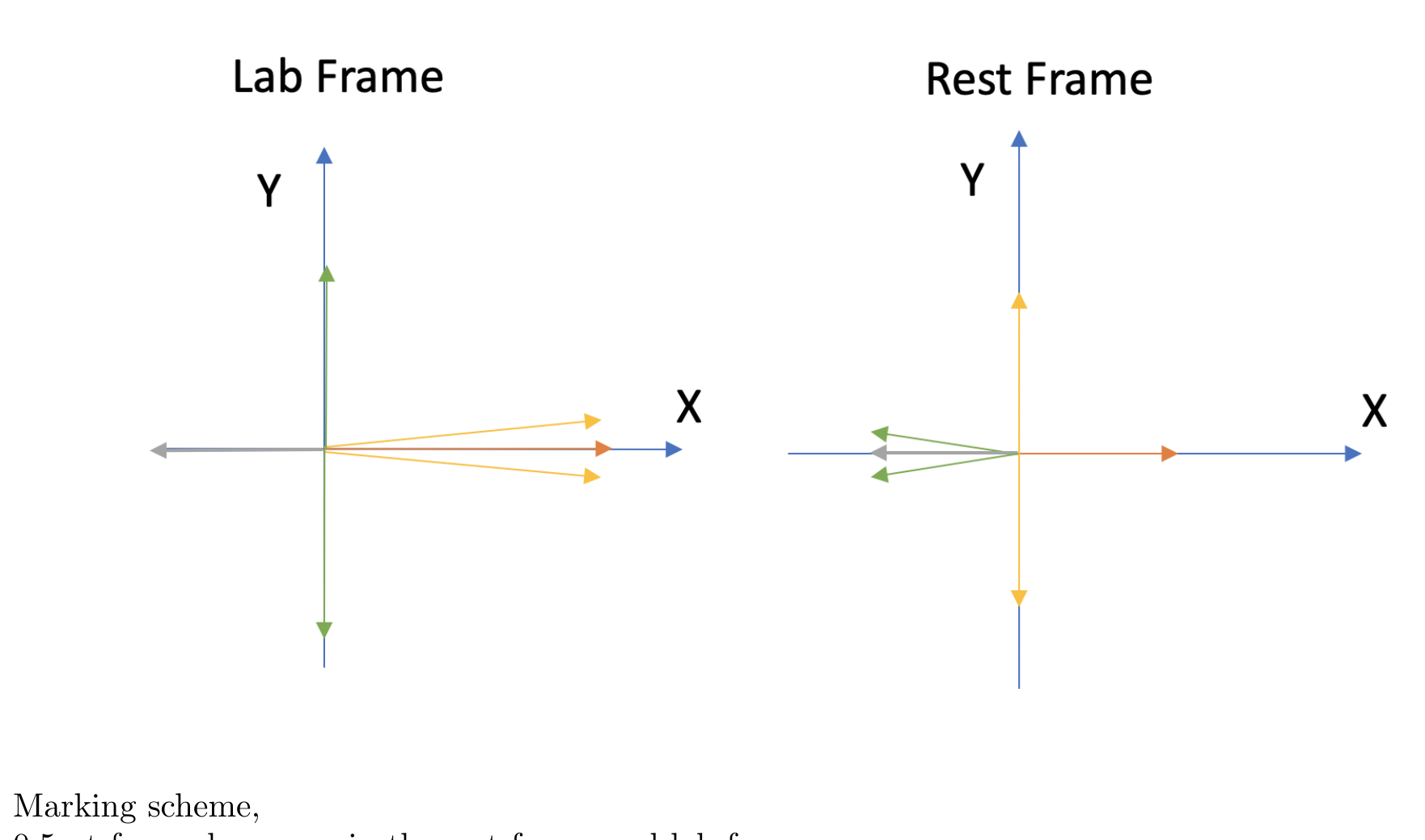
draw direction vectors of the beam in X Y XY X Y X ′ Y ′ X'Y' X ′ Y ′ [4 т.]
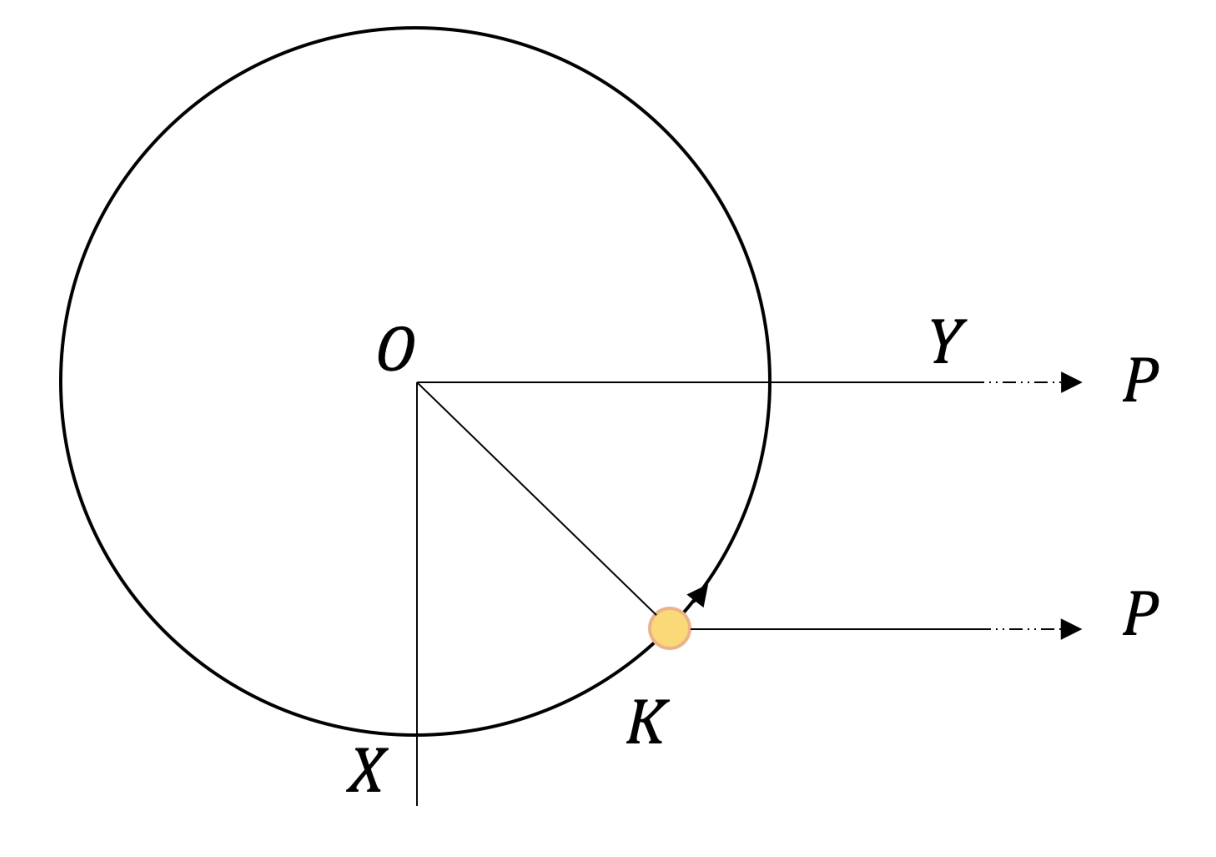
In accretion disks around black holes, the charged particles are orbiting at relativistic speeds and in their rest frames may be considered as isotropic point sources of light. Consider such a particle K K K r r r ω \omega ω O O O
Let us assume that our lab frame is fixed to an observer located at a point P P P O Y OY O Y O O O O P = R ≫ r OP = R \gg r OP = R ≫ r t L 0 = t R 0 = 0 t_{L0} = t_{R0} = 0 t L 0 = t R 0 = 0 K K K Δ t R \Delta t_R Δ t R K K K Δ t L \Delta t_L Δ t L P P P Δ t L = γ Δ t R \Delta t_L = \gamma\Delta t_R Δ t L = γ Δ t R
(c) Derive an expression for f L f_L f L t L t_L t L t L > R / c t_L > R/c t L > R / c [7 т.]
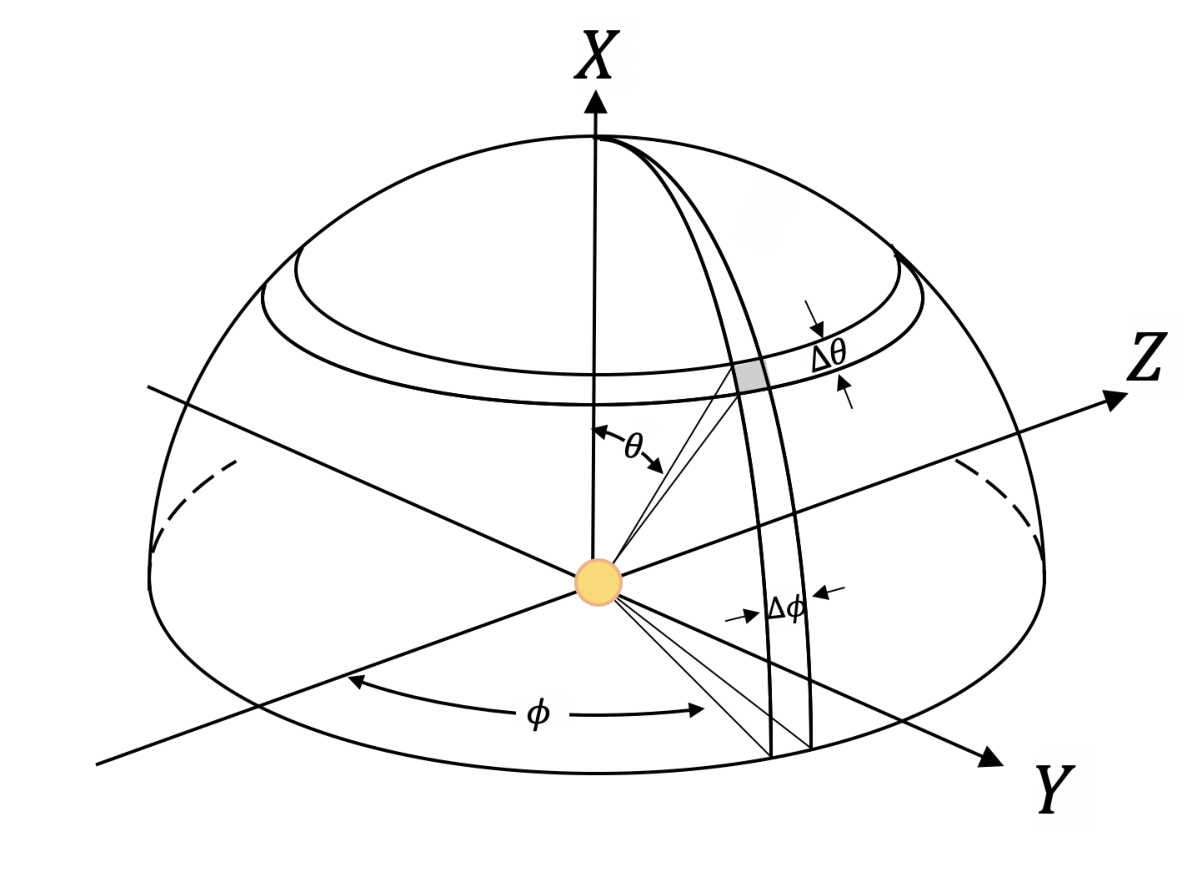
Let us consider a fraction of the light from the source that is emitted in an infinitesimal solid angle Δ Ω R = − Δ ( cos θ R ) ⋅ Δ ϕ \Delta\Omega_R = -\Delta(\cos\theta_R) \cdot \Delta\phi Δ Ω R = − Δ ( cos θ R ) ⋅ Δ ϕ θ R \theta_R θ R X X X
(d) Show that, as measured in the lab frame
Δ Ω L = Δ Ω R γ 2 ( 1 + v c cos θ R ) 2 \Delta\Omega_L = \frac{\Delta\Omega_R}{\gamma^2\left(1 + \frac{v}{c}\cos\theta_R\right)^2} Δ Ω L = γ 2 ( 1 + c v cos θ R ) 2 Δ Ω R [10 т.]
(e) If the intrinsic luminosity of the light source is L L L F L F_L F L P P P t L t_L t L t L > R / c t_L > R/c t L > R / c
Hint: In the rest frame of the source, you may assume N R N_R N R Δ Ω R \Delta\Omega_R Δ Ω R Δ t R \Delta t_R Δ t R [15 т.]
(f) Charged particles in the relativistic beam shot from the supermassive black hole at the centre of the galaxy M87 have speeds up to 0.95 c 0.95c 0.95 c [3 т.]
Покажи отговорите
(a) f L = γ f R ( 1 + v c cos θ R ) f_L = \gamma f_R\left(1 + \frac{v}{c}\cos\theta_R\right) f L = γ f R ( 1 + c v cos θ R ) cos θ L = cos θ R + v c 1 + v c cos θ R \cos\theta_L = \frac{\cos\theta_R + \frac{v}{c}}{1 + \frac{v}{c}\cos\theta_R} cos θ L = 1 + c v c o s θ R c o s θ R + c v
(b) i) cos θ L = 1 \cos\theta_L = 1 cos θ L = 1 cos θ L = 0 \cos\theta_L = 0 cos θ L = 0 cos θ L = v / c \cos\theta_L = v/c cos θ L = v / c cos θ L = − 1 \cos\theta_L = -1 cos θ L = − 1
(c) f L = f R γ ( 1 − v c cos [ ω ( t L − R c ) ] ) f_L = \frac{f_R}{\gamma\left(1 - \frac{v}{c}\cos\left[\omega\left(t_L - \frac{R}{c}\right)\right]\right)} f L = γ ( 1 − c v c o s [ ω ( t L − c R ) ] ) f R
(e) F ( t L ) = L 4 π R 2 γ 4 ( 1 − v c cos [ ω ( t − R c ) ] ) 4 F(t_L) = \frac{L}{4\pi R^2\gamma^4\left(1 - \frac{v}{c}\cos\left[\omega\left(t - \frac{R}{c}\right)\right]\right)^4} F ( t L ) = 4 π R 2 γ 4 ( 1 − c v c o s [ ω ( t − c R ) ] ) 4 L
Както е отпечатано в официалното решение (с t t t t L t_L t L
(f) A m a x ≈ 1.8 × 1 0 9 A_{\mathrm{max}} \approx 1.8 \times 10^9 A max ≈ 1.8 × 1 0 9 A m i n ≈ 770 A_{\mathrm{min}} \approx 770 A min ≈ 770
Покажи официалното решение (a) Energy of a photon:
while the momentum:
p ⃗ = h f c n ⃗ 2.0 \vec{p} = \frac{hf}{c}\vec{n} \qquad \mathbf{2.0} p = c h f n 2.0 where n ⃗ \vec{n} n
h f L c = γ ( h f R c + p x R v c ) p x L = γ ( p x R + h f R v c 2 ) p y L = p y R p z L = p z R 2.0 \begin{aligned} \frac{hf_L}{c} &= \gamma\left(\frac{hf_R}{c} + p_{x_R}\frac{v}{c}\right) \\ p_{x_L} &= \gamma\left(p_{x_R} + \frac{hf_R v}{c^2}\right) \\ p_{y_L} &= p_{y_R} \\ p_{z_L} &= p_{z_R} && \mathbf{2.0} \end{aligned} c h f L p x L p y L p z L = γ ( c h f R + p x R c v ) = γ ( p x R + c 2 h f R v ) = p y R = p z R 2.0 in our case:
p x L = ∣ p L ∣ cos θ L , p y L = ∣ p L ∣ sin θ L , p z L = 0 p x R = ∣ p R ∣ cos θ R , p y R = ∣ p R ∣ sin θ R , p z R = 0 3.0 \begin{array}{lll} p_{x_L} = |p_L|\cos\theta_L, & p_{y_L} = |p_L|\sin\theta_L, & p_{z_L} = 0 \\ p_{x_R} = |p_R|\cos\theta_R, & p_{y_R} = |p_R|\sin\theta_R, & p_{z_R} = 0 \end{array} \qquad \mathbf{3.0} p x L = ∣ p L ∣ cos θ L , p x R = ∣ p R ∣ cos θ R , p y L = ∣ p L ∣ sin θ L , p y R = ∣ p R ∣ sin θ R , p z L = 0 p z R = 0 3.0 where
∣ p ∣ = h f c |p| = \frac{hf}{c} ∣ p ∣ = c h f Thus,
f L = γ ( f R + v h ∣ p R ∣ cos θ R ) = γ ( f R + v h h f R c cos θ R ) ∴ f L = γ f R ( 1 + v c cos θ R ) 2.0 c o s ( θ L ) = p x L ∣ p L ∣ = c p x L h f L = c γ ( p x R + h f R v c 2 ) h γ f R ( 1 + v c cos θ R ) = c ( h f R c cos θ R + h f R v c 2 ) h f R ( 1 + v c cos θ R ) ∴ cos θ L = cos θ R + v c 1 + v c cos θ R 2.0 \begin{aligned} f_L &= \gamma\left(f_R + \frac{v}{h}|p_R|\cos\theta_R\right) \\ &= \gamma\left(f_R + \frac{v}{h}\frac{hf_R}{c}\cos\theta_R\right) \\ \therefore f_L &= \gamma f_R\left(1 + \frac{v}{c}\cos\theta_R\right) && \mathbf{2.0} \\ cos(\theta_L) &= \frac{p_{x_L}}{|p_L|} = \frac{cp_{x_L}}{hf_L} \\ &= \frac{c\gamma\left(p_{x_R} + \frac{hf_R v}{c^2}\right)}{h\gamma f_R\left(1 + \frac{v}{c}\cos\theta_R\right)} \\ &= \frac{c\left(\frac{hf_R}{c}\cos\theta_R + \frac{hf_R v}{c^2}\right)}{hf_R\left(1 + \frac{v}{c}\cos\theta_R\right)} \\ \therefore \cos\theta_L &= \frac{\cos\theta_R + \frac{v}{c}}{1 + \frac{v}{c}\cos\theta_R} && \mathbf{2.0} \end{aligned} f L ∴ f L cos ( θ L ) ∴ cos θ L = γ ( f R + h v ∣ p R ∣ cos θ R ) = γ ( f R + h v c h f R cos θ R ) = γ f R ( 1 + c v cos θ R ) = ∣ p L ∣ p x L = h f L c p x L = hγ f R ( 1 + c v cos θ R ) c γ ( p x R + c 2 h f R v ) = h f R ( 1 + c v cos θ R ) c ( c h f R cos θ R + c 2 h f R v ) = 1 + c v cos θ R cos θ R + c v 2.0 2.0 (b) Now just by plugging in the values of cosine we see that in case (i) (orange arrow) cos θ L = 1 \cos\theta_L = 1 cos θ L = 1 cos θ L = 0 \cos\theta_L = 0 cos θ L = 0 cos θ L = v / c \cos\theta_L = v/c cos θ L = v / c cos θ L = − 1 \cos\theta_L = -1 cos θ L = − 1
Marking scheme,
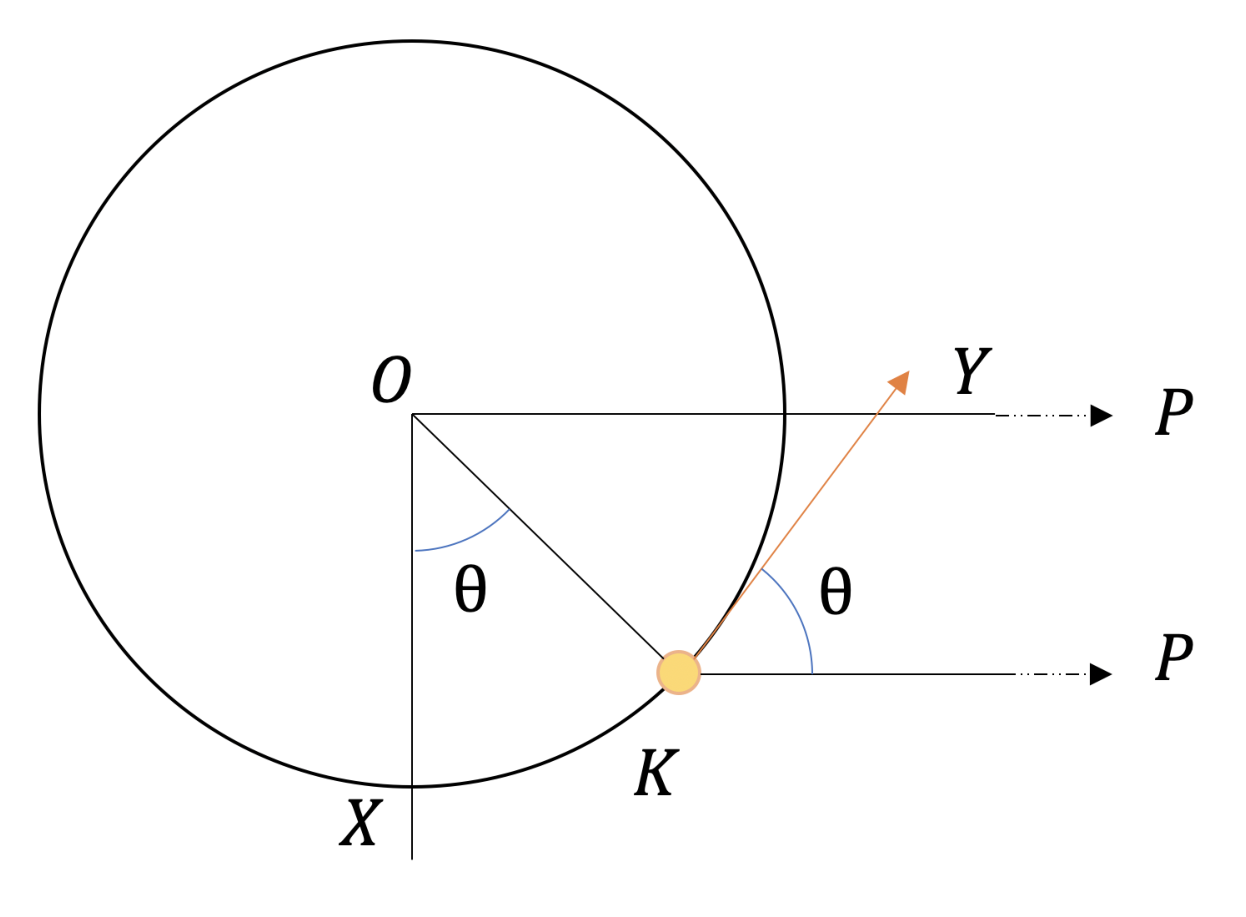
(c) From the figure we see that:
K P = O P − O K sin θ = R − r sin θ 1.0 KP = OP - OK\sin\theta = R - r\sin\theta \qquad \mathbf{1.0} K P = OP − O K sin θ = R − r sin θ 1.0 where θ = ω t \theta = \omega t θ = ω t
Let t L = T t_L = T t L = T P P P K K K t t t
c ( T − t ) = K P = R − r sin θ ≈ R ∴ t = t L − R c 1.0 \begin{aligned} c(T - t) &= KP = R - r\sin\theta \approx R \\ \therefore t &= t_L - \frac{R}{c} && \mathbf{1.0} \end{aligned} c ( T − t ) ∴ t = K P = R − r sin θ ≈ R = t L − c R 1.0 This photon makes angle θ = ω t \theta = \omega t θ = ω t
cos θ L = cos θ R + v c 1 + v c cos θ R cos θ L + v c cos θ R cos θ L = cos θ R + v c cos θ R ( 1 − v c cos θ L ) = cos θ L − v c ∴ cos θ R = cos θ L − v c 1 − v c cos θ L 2.0 f L = γ f R ( 1 + v c cos θ R ) = γ f R ( 1 + v c ( cos θ L − v c ) 1 − v c cos θ L ) = γ f R ( 1 − v c cos θ L + v c cos θ L − ( v c ) 2 1 − v c cos θ L ) = f R γ ( 1 − v c cos θ L ) = f R γ ( 1 − v c cos ( ω t ) ) ∴ f L = f R γ ( 1 − v c cos [ ω ( t L − R c ) ] ) 3.0 \begin{aligned} \cos\theta_L &= \frac{\cos\theta_R + \frac{v}{c}}{1 + \frac{v}{c}\cos\theta_R} \\ \cos\theta_L + \frac{v}{c}\cos\theta_R\cos\theta_L &= \cos\theta_R + \frac{v}{c} \\ \cos\theta_R(1 - \frac{v}{c}\cos\theta_L) &= \cos\theta_L - \frac{v}{c} \\ \therefore \cos\theta_R &= \frac{\cos\theta_L - \frac{v}{c}}{1 - \frac{v}{c}\cos\theta_L} && \mathbf{2.0} \\ f_L &= \gamma f_R\left(1 + \frac{v}{c}\cos\theta_R\right) \\ &= \gamma f_R\left(1 + \frac{\frac{v}{c}\left(\cos\theta_L - \frac{v}{c}\right)}{1 - \frac{v}{c}\cos\theta_L}\right) \\ &= \gamma f_R\left(\frac{1 - \frac{v}{c}\cos\theta_L + \frac{v}{c}\cos\theta_L - \left(\frac{v}{c}\right)^2}{1 - \frac{v}{c}\cos\theta_L}\right) \\ &= \frac{f_R}{\gamma\left(1 - \frac{v}{c}\cos\theta_L\right)} = \frac{f_R}{\gamma\left(1 - \frac{v}{c}\cos(\omega t)\right)} \\ \therefore f_L &= \frac{f_R}{\gamma\left(1 - \frac{v}{c}\cos\left[\omega\left(t_L - \frac{R}{c}\right)\right]\right)} && \mathbf{3.0} \end{aligned} cos θ L cos θ L + c v cos θ R cos θ L cos θ R ( 1 − c v cos θ L ) ∴ cos θ R f L ∴ f L = 1 + c v cos θ R cos θ R + c v = cos θ R + c v = cos θ L − c v = 1 − c v cos θ L cos θ L − c v = γ f R ( 1 + c v cos θ R ) = γ f R ( 1 + 1 − c v cos θ L c v ( cos θ L − c v ) ) = γ f R ( 1 − c v cos θ L 1 − c v cos θ L + c v cos θ L − ( c v ) 2 ) = γ ( 1 − c v cos θ L ) f R = γ ( 1 − c v cos ( ω t ) ) f R = γ ( 1 − c v cos [ ω ( t L − c R ) ] ) f R 2.0 3.0 (d)
Δ Ω R = − Δ ( cos θ R ) ⋅ Δ ϕ = [ cos θ R − cos ( θ R + Δ θ R ) ] ⋅ Δ ϕ = [ cos θ R − cos θ R cos ( Δ θ R ) + sin θ R sin ( Δ θ R ) ] ⋅ Δ ϕ = [ cos θ R − cos θ R ⋅ ( 1 ) + sin θ R ( Δ θ R ) ] ⋅ Δ ϕ Δ Ω R = sin θ R ( Δ θ R ) ( Δ ϕ ) ∴ Δ Ω L = sin θ L ( Δ θ L ) ( Δ ϕ ) 3.0 sin 2 θ L = 1 − cos 2 θ L = 1 − ( cos θ R + v c 1 + v c cos θ R ) 2 = 1 + 2 v c cos θ R + ( v c ) 2 cos 2 θ R − cos 2 θ R − 2 v c cos θ R − ( v c ) 2 ( 1 + v c cos θ R ) 2 = ( 1 − ( v c ) 2 ) ( 1 − cos 2 θ R ) ( 1 + v c cos θ R ) 2 = sin 2 θ R γ 2 ( 1 + v c cos θ R ) 2 sin θ L = sin θ R γ ( 1 + v c cos θ R ) 3.0 \begin{aligned} \Delta\Omega_R &= -\Delta(\cos\theta_R)\cdot\Delta\phi \\ &= [\cos\theta_R - \cos(\theta_R + \Delta\theta_R)]\cdot\Delta\phi \\ &= [\cos\theta_R - \cos\theta_R\cos(\Delta\theta_R) + \sin\theta_R\sin(\Delta\theta_R)]\cdot\Delta\phi \\ &= [\cos\theta_R - \cos\theta_R\cdot(1) + \sin\theta_R(\Delta\theta_R)]\cdot\Delta\phi \\ \Delta\Omega_R &= \sin\theta_R(\Delta\theta_R)(\Delta\phi) \\ \therefore \Delta\Omega_L &= \sin\theta_L(\Delta\theta_L)(\Delta\phi) && \mathbf{3.0} \\ \sin^2\theta_L &= 1 - \cos^2\theta_L \\ &= 1 - \left(\frac{\cos\theta_R + \frac{v}{c}}{1 + \frac{v}{c}\cos\theta_R}\right)^2 \\ &= \frac{1 + 2\frac{v}{c}\cos\theta_R + \left(\frac{v}{c}\right)^2\cos^2\theta_R - \cos^2\theta_R - 2\frac{v}{c}\cos\theta_R - \left(\frac{v}{c}\right)^2}{\left(1 + \frac{v}{c}\cos\theta_R\right)^2} \\ &= \frac{\left(1 - \left(\frac{v}{c}\right)^2\right)\left(1 - \cos^2\theta_R\right)}{\left(1 + \frac{v}{c}\cos\theta_R\right)^2} = \frac{\sin^2\theta_R}{\gamma^2\left(1 + \frac{v}{c}\cos\theta_R\right)^2} \\ \sin\theta_L &= \frac{\sin\theta_R}{\gamma\left(1 + \frac{v}{c}\cos\theta_R\right)} && \mathbf{3.0} \end{aligned} Δ Ω R Δ Ω R ∴ Δ Ω L sin 2 θ L sin θ L = − Δ ( cos θ R ) ⋅ Δ ϕ = [ cos θ R − cos ( θ R + Δ θ R )] ⋅ Δ ϕ = [ cos θ R − cos θ R cos ( Δ θ R ) + sin θ R sin ( Δ θ R )] ⋅ Δ ϕ = [ cos θ R − cos θ R ⋅ ( 1 ) + sin θ R ( Δ θ R )] ⋅ Δ ϕ = sin θ R ( Δ θ R ) ( Δ ϕ ) = sin θ L ( Δ θ L ) ( Δ ϕ ) = 1 − cos 2 θ L = 1 − ( 1 + c v cos θ R cos θ R + c v ) 2 = ( 1 + c v cos θ R ) 2 1 + 2 c v cos θ R + ( c v ) 2 cos 2 θ R − cos 2 θ R − 2 c v cos θ R − ( c v ) 2 = ( 1 + c v cos θ R ) 2 ( 1 − ( c v ) 2 ) ( 1 − cos 2 θ R ) = γ 2 ( 1 + c v cos θ R ) 2 sin 2 θ R = γ ( 1 + c v cos θ R ) sin θ R 3.0 3.0 Also, Δ θ L ≈ sin ( Δ θ L ) = sin ( Δ θ R ) γ ( 1 + v c cos θ R ) Δ θ L ≈ Δ θ R γ ( 1 + v c cos θ R ) 2.0 Δ Ω L Δ Ω R = sin θ L ( Δ θ L ) ( Δ ϕ ) sin θ R ( Δ θ R ) ( Δ ϕ ) = sin θ R ( Δ θ R ) γ 2 ( 1 + v c cos θ R ) 2 ⋅ 1 sin θ R ( Δ θ R ) ∴ Δ Ω L = Δ Ω R γ 2 ( 1 + v c cos θ R ) 2 2.0 \begin{aligned} \text{Also, } \Delta\theta_L \approx \sin(\Delta\theta_L) &= \frac{\sin(\Delta\theta_R)}{\gamma\left(1 + \frac{v}{c}\cos\theta_R\right)} \\ \Delta\theta_L &\approx \frac{\Delta\theta_R}{\gamma\left(1 + \frac{v}{c}\cos\theta_R\right)} && \mathbf{2.0} \\ \frac{\Delta\Omega_L}{\Delta\Omega_R} &= \frac{\sin\theta_L(\Delta\theta_L)(\Delta\phi)}{\sin\theta_R(\Delta\theta_R)(\Delta\phi)} \\ &= \frac{\sin\theta_R(\Delta\theta_R)}{\gamma^2\left(1 + \frac{v}{c}\cos\theta_R\right)^2}\cdot\frac{1}{\sin\theta_R(\Delta\theta_R)} \\ \therefore \Delta\Omega_L &= \frac{\Delta\Omega_R}{\gamma^2\left(1 + \frac{v}{c}\cos\theta_R\right)^2} && \mathbf{2.0} \end{aligned} Also, Δ θ L ≈ sin ( Δ θ L ) Δ θ L Δ Ω R Δ Ω L ∴ Δ Ω L = γ ( 1 + c v cos θ R ) sin ( Δ θ R ) ≈ γ ( 1 + c v cos θ R ) Δ θ R = sin θ R ( Δ θ R ) ( Δ ϕ ) sin θ L ( Δ θ L ) ( Δ ϕ ) = γ 2 ( 1 + c v cos θ R ) 2 sin θ R ( Δ θ R ) ⋅ sin θ R ( Δ θ R ) 1 = γ 2 ( 1 + c v cos θ R ) 2 Δ Ω R 2.0 2.0 (e) Let N ( θ L ) Δ Ω L Δ T N(\theta_L)\Delta\Omega_L\Delta T N ( θ L ) Δ Ω L Δ T P P P Δ Ω L \Delta\Omega_L Δ Ω L T , T + Δ T T, T + \Delta T T , T + Δ T Δ T ≠ Δ t \Delta T \neq \Delta t Δ T = Δ t Δ t \Delta t Δ t K K K Δ Ω \Delta\Omega ΔΩ t 0 R , t 0 R + Δ t 0 R t_{0R}, t_{0R} + \Delta t_{0R} t 0 R , t 0 R + Δ t 0 R
N ( θ L ) Δ Ω L Δ T = N Δ Ω R Δ t 0 R 2.0 N(\theta_L)\Delta\Omega_L\Delta T = N\Delta\Omega_R\Delta t_{0R} \qquad \mathbf{2.0} N ( θ L ) Δ Ω L Δ T = N Δ Ω R Δ t 0 R 2.0 From an earlier part:
c T = c t + R − r sin θ L = c t + R − r sin ( ω t ) ∴ c Δ T = c Δ t − r [ sin ( ω t ) cos ( ω Δ t ) + sin ( ω Δ t ) cos ( ω t ) − s i n ( ω t ) ] c Δ T = c Δ t − r ω cos ( ω t ) Δ t 2.0 Δ T Δ t 0 R = Δ t Δ t 0 R Δ T Δ t = γ ( 1 − v c cos ( ω t ) ) Δ t 0 R Δ T = 1 γ ( 1 − v c cos ( ω t ) ) 3.0 N ( t L ) N R = Δ Ω R Δ t 0 R Δ Ω L Δ T = γ 2 ( 1 + v c cos θ R ) 2 γ ( 1 − v c cos ( ω t ) ) = γ ( 1 + ( v c ) cos θ L − v c 1 − v c cos θ L ) 2 ( 1 − v c cos θ L ) = γ γ 4 ( 1 − v c cos θ L ) 3 N ( t L ) = N R γ 3 ( 1 − v c cos ( t L − R / c ) ) 3 3.0 \begin{aligned} cT &= ct + R - r\sin\theta_L = ct + R - r\sin(\omega t) \\ \therefore c\Delta T &= c\Delta t - r[\sin(\omega t)\cos(\omega\Delta t) + \sin(\omega\Delta t)\cos(\omega t) - sin(\omega t)] \\ c\Delta T &= c\Delta t - r\omega\cos(\omega t)\Delta t && \mathbf{2.0} \\ \frac{\Delta T}{\Delta t_{0R}} &= \frac{\Delta t}{\Delta t_{0R}}\frac{\Delta T}{\Delta t} = \gamma\left(1 - \frac{v}{c}\cos(\omega t)\right) \\ \frac{\Delta t_{0R}}{\Delta T} &= \frac{1}{\gamma\left(1 - \frac{v}{c}\cos(\omega t)\right)} && \mathbf{3.0} \\ \frac{N(t_L)}{N_R} &= \frac{\Delta\Omega_R\Delta t_{0R}}{\Delta\Omega_L\Delta T} \\ &= \frac{\gamma^2\left(1 + \frac{v}{c}\cos\theta_R\right)^2}{\gamma\left(1 - \frac{v}{c}\cos(\omega t)\right)} \\ &= \frac{\gamma\left(1 + \left(\frac{v}{c}\right)\frac{\cos\theta_L - \frac{v}{c}}{1 - \frac{v}{c}\cos\theta_L}\right)^2}{\left(1 - \frac{v}{c}\cos\theta_L\right)} \\ &= \frac{\gamma}{\gamma^4\left(1 - \frac{v}{c}\cos\theta_L\right)^3} \\ N(t_L) &= \frac{N_R}{\gamma^3\left(1 - \frac{v}{c}\cos(t_L - R/c)\right)^3} && \mathbf{3.0} \end{aligned} c T ∴ c Δ T c Δ T Δ t 0 R Δ T Δ T Δ t 0 R N R N ( t L ) N ( t L ) = c t + R − r sin θ L = c t + R − r sin ( ω t ) = c Δ t − r [ sin ( ω t ) cos ( ω Δ t ) + sin ( ω Δ t ) cos ( ω t ) − s in ( ω t )] = c Δ t − r ω cos ( ω t ) Δ t = Δ t 0 R Δ t Δ t Δ T = γ ( 1 − c v cos ( ω t ) ) = γ ( 1 − c v cos ( ω t ) ) 1 = Δ Ω L Δ T Δ Ω R Δ t 0 R = γ ( 1 − c v cos ( ω t ) ) γ 2 ( 1 + c v cos θ R ) 2 = ( 1 − c v cos θ L ) γ ( 1 + ( c v ) 1 − c v c o s θ L c o s θ L − c v ) 2 = γ 4 ( 1 − c v cos θ L ) 3 γ = γ 3 ( 1 − c v cos ( t L − R / c ) ) 3 N R 2.0 3.0 3.0 In terms of energy fluxes
F 0 = h f R N R R 2 = L 4 π R 2 F ( t L ) = h f L N ( t L ) R 2 2.0 F ( t L ) F 0 = h f L N ( t L ) h f R N R = 1 γ 4 ( 1 − v c cos [ ω ( t − R c ) ] ) 4 F ( t L ) = L 4 π R 2 γ 4 ( 1 − v c cos [ ω ( t − R c ) ] ) 4 3.0 \begin{aligned} F_0 &= \frac{hf_R N_R}{R^2} = \frac{L}{4\pi R^2} \\ F(t_L) &= \frac{hf_L N(t_L)}{R^2} && \mathbf{2.0} \\ \frac{F(t_L)}{F_0} &= \frac{hf_L N(t_L)}{hf_R N_R} \\ &= \frac{1}{\gamma^4\left(1 - \frac{v}{c}\cos\left[\omega\left(t - \frac{R}{c}\right)\right]\right)^4} \\ F(t_L) &= \frac{L}{4\pi R^2\gamma^4\left(1 - \frac{v}{c}\cos\left[\omega\left(t - \frac{R}{c}\right)\right]\right)^4} && \mathbf{3.0} \end{aligned} F 0 F ( t L ) F 0 F ( t L ) F ( t L ) = R 2 h f R N R = 4 π R 2 L = R 2 h f L N ( t L ) = h f R N R h f L N ( t L ) = γ 4 ( 1 − c v cos [ ω ( t − c R ) ] ) 4 1 = 4 π R 2 γ 4 ( 1 − c v cos [ ω ( t − c R ) ] ) 4 L 2.0 3.0 The radiation is strongly beamed in the direction of motion of the source so that a remote observer in or near the orbital plane of the source sees strongly pulsed radiation.
(f) The amplification (for a given v v v cos θ L = 1 \cos\theta_L = 1 cos θ L = 1 1.0
F ( t L ) = F 0 [ γ ( 1 − v c ) ] 4 A m a x = 1 [ 0.0975 × 0.05 ] 4 A m a x ≈ 1.8 × 1 0 9 1.0 Similarly, A m i n = 1 [ 0.0975 × 1.95 ] 4 A m i n ≈ 770 1.0 \begin{aligned} F(t_L) &= \frac{F_0}{\left[\gamma\left(1 - \frac{v}{c}\right)\right]^4} \\ A_{\mathrm{max}} &= \frac{1}{[0.0975 \times 0.05]^4} \\ A_{\mathrm{max}} &\approx 1.8 \times 10^9 && \mathbf{1.0} \\ \text{Similarly, } A_{\mathrm{min}} &= \frac{1}{[0.0975 \times 1.95]^4} \\ A_{\mathrm{min}} &\approx 770 && \mathbf{1.0} \end{aligned} F ( t L ) A max A max Similarly, A min A min = [ γ ( 1 − c v ) ] 4 F 0 = [ 0.0975 × 0.05 ] 4 1 ≈ 1.8 × 1 0 9 = [ 0.0975 × 1.95 ] 4 1 ≈ 770 1.0 1.0 Оригинал в Архива: Theory Problems.pdf
· официални решения: Theory Solutions.pdf