IOAA 2022, Теория — Задача 5. Flaring protoplanetary disk
International Olympiad on Astronomy and Astrophysics 2022 Georgia — Theoretical Competition · 16 август 2022 г. · 10 т.
Условие
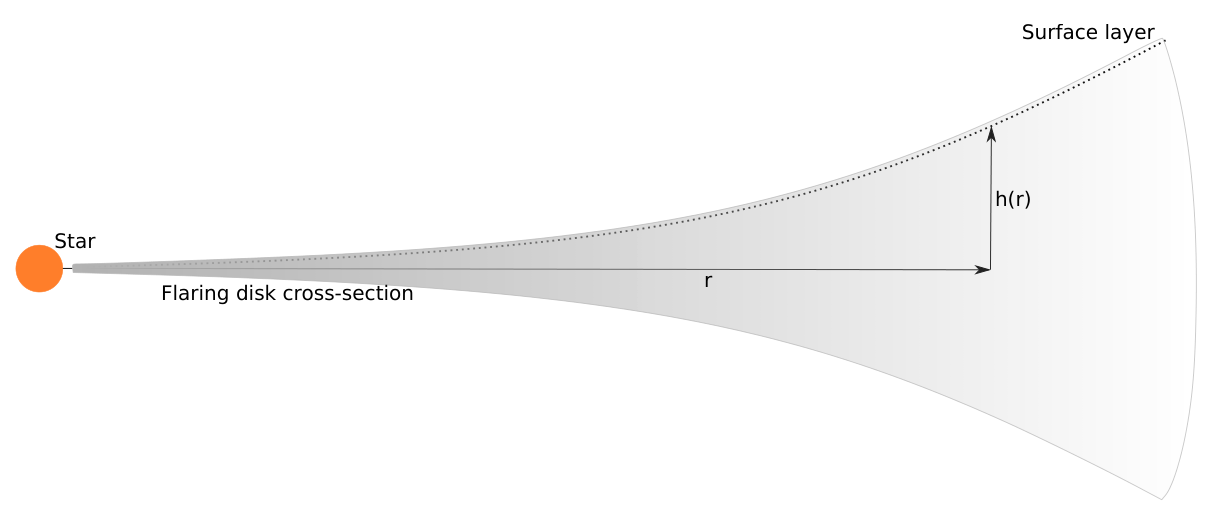
Planets are the products of collapsing clouds forming circumstellar disks around the young stars. In this problem, we examine the thermal structure of a type of protoplanetary disks. We consider radiation from the central star to be the dominant heating process and assume that the disk is optically thick and the radiation can be only absorbed in the surface layers of the disk. This type of disk is called a flaring disk (see figure 1 below). In this case, the star illuminates the surface of the disk directly, and the shallow angle between the light rays and the surface of the disk increases with distance from the star.
(a) Find an expression for as a function of . Assume .
Hint: the expression involves , and [4 т.]
(b) Find an expression for the equilibrium temperature of the disk () as a function of , and luminosity () of the star (Ignore the size of the star). [3 т.]
(c) We parameterize the disc height as , where and are constants. For which values of and is the condition for an isothermal layer (Constant) satisfied? Write your answer for constant in terms of and
Hint: If , then . [3 т.]
Отговори
- (a)
- (b)
- (c)
Решение
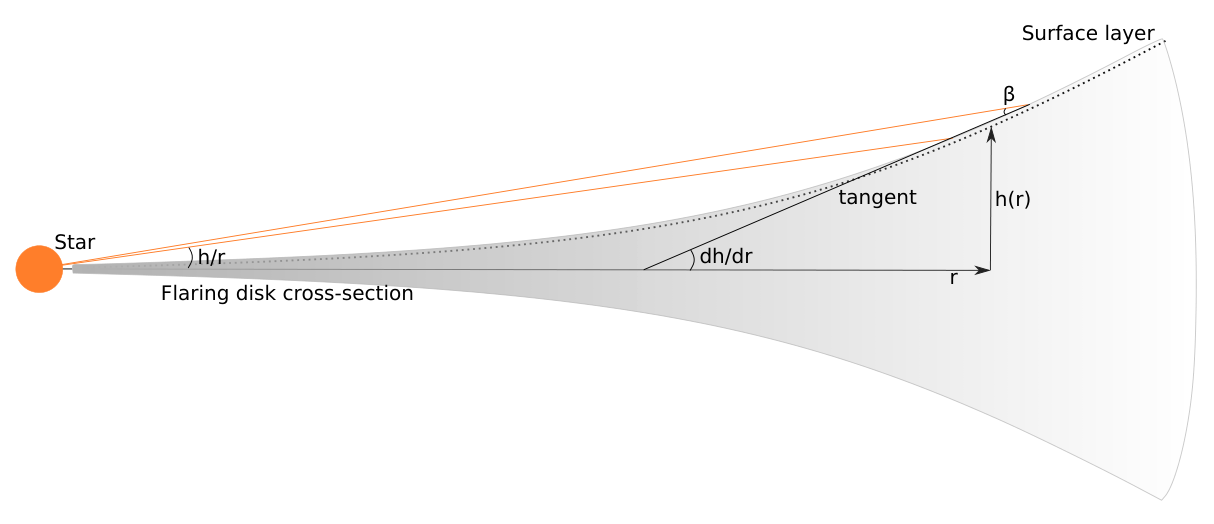
(a) The angle between the light beam and the horizontal plane is
Additionally, a tangent is inclined to the disc plane with an angle of
An exterior angle of a triangle is equal to the sum of its two interior opposite angles. Thus,
(b) The flux from of stellar radiation at distance from the star is , where is the luminosity of the star. However, the irradiation flux is the normal projection of this flux onto the infinitesimal small surface of the disk.
From the Stefan-Boltzmann law, the cooling rate is give by
In the thermal equilibrium
(c) The condition for the isothermal layer can be solved by applying
Finally, one can determine the second constant by
Оригинал в Архива: Theory Problems.pdf · официални решения: Theory Solutions.pdf