International Olympiad on Astronomy and Astrophysics 2022 Georgia — Theoretical Competition · 16 август 2022 г. · 20 т.
Условие
We observe a binary system, at a distance d=89pc, with a circular, edge-on orbit around the common center of mass and period of 100 days. Our space-based telescope is of diameter D=10m and operates at a wavelength λ=364nm. We notice that for a total of 38 days during each full period, the two stars cannot be resolved by this telescope as separate objects. The wavelength of peak emission for star A is λA=500nm and that for star B is λB=600nm.
(a) What are the temperatures of the stars A and B, (TA, TB) [2 т.]
(b) Calculate the distance l between the stars. [6 т.]
(c) Calculate the sum of the masses of the stars (MT). [2 т.]
Combined photometry of the system:
Configuration
U0
(U−B)
(B−V)
BC
1
Stars next to each other
6.39
0.2
0.1
0.1
2
B transiting in front of A
6.86
0.25
0.12
0.175
The interstellar extinction per kpc of U is aU=1.4mag/kpc. The ratio of the densities of the stars ρA/ρB=0.7
note: For Bolometric correction we use convention:
BC=mbol−mV
(d) Calculate the masses of both the stars (MA, MB). [10 т.]
Отговори
(a)TA=5978K, TB=4830K
(b) 1.45 au
(c) 40.7 Msun
(d)MA=29.3M⊙, MB=11.4M⊙
The official solution prints the last line as MB=29.3M⊙, where MA is meant.
Решение
(a) From the Wien’s displacement law the temperature of a black body is related to a peak wavelength of emission by the relation:
λmaxTTATB=b=5978K=4830K1.00.50.5
(b) Due to the diffraction minimal angular separation between two celestial objects to distinguish them:
δ=1.22Dλ=4.44×10⁻⁸rad=9.16mas1.0
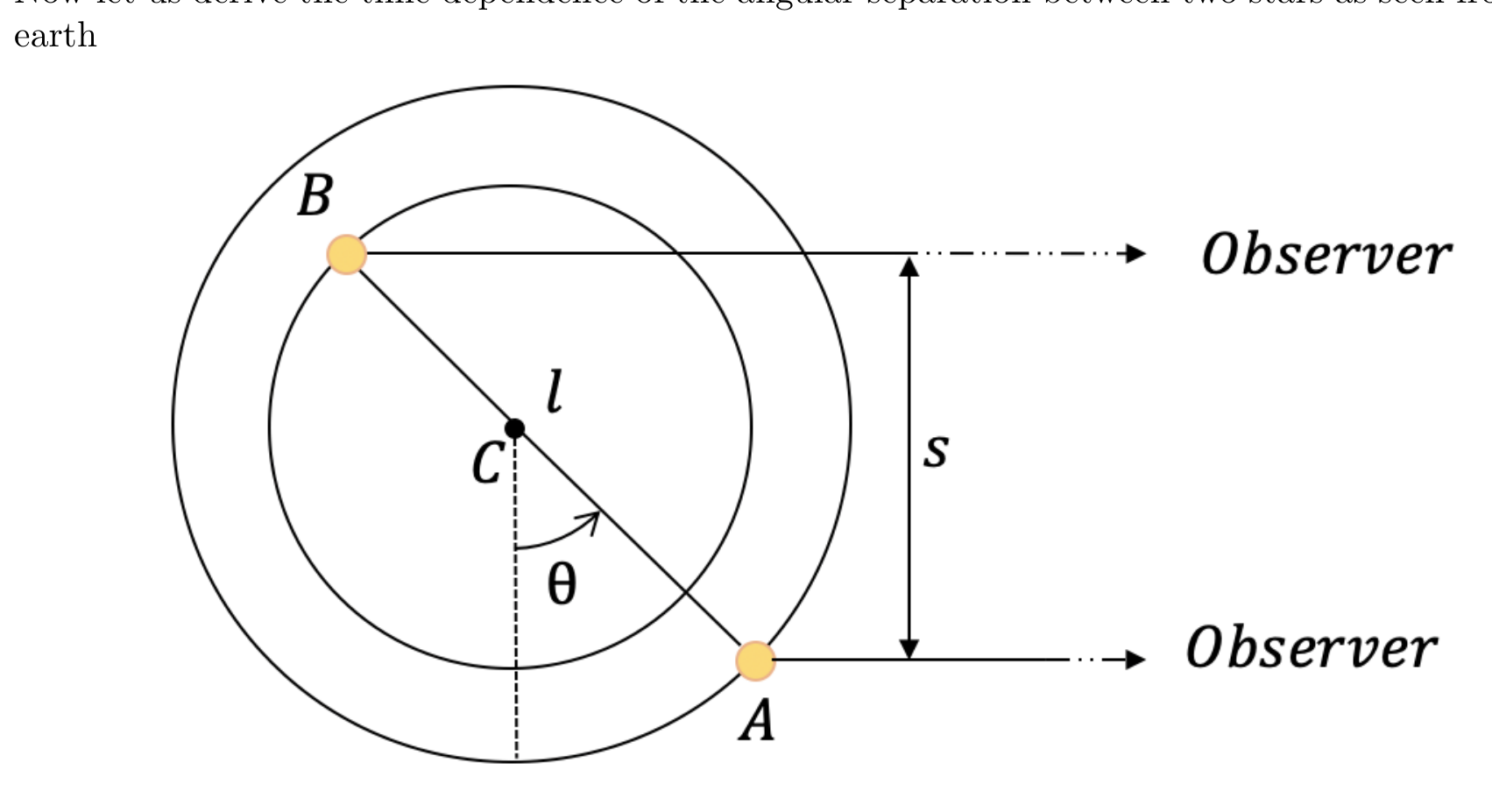
Now let us derive the time dependence of the angular separation between two stars as seen from the earth
As it is seen from the figure, distance s=lcosθ, where l is the distance between stars and θ is the angle of rotation of the stars about their center of mass after the stars are seen with maximum angular separation. The angular separation seen by an observer on the earth:
γ=ds=dlcosθ1.0
The 38 days, during which objects are seen as a one object the system rotates by the angle β=2π10038. 1.0
Thus, the corresponding starting angle θ′ at which stars are no longer distinguishable:
θ′=2π−4β=2π−10019π=10031π1.5
and this is the moment, when stars stop to be distinguishable. Thus, corresponding angular separation on the sky is δ: