IOAA 2023, Анализ на данни — Задача 1. Distance to the Large Magellanic Cloud
Data Analysis · 50 т.
Table of Constants
| Fundamental constants | |||
|---|---|---|---|
| Speed of light in vacuum | |||
| Planck constant | |||
| Boltzmann constant | |||
| Stefan-Boltzmann constant | |||
| Elementary charge | |||
| Universal gravitational constant | |||
| Universal electric constant | |||
| Universal gas constant | |||
| Avogadro constant | |||
| Wien’s displacement constant | |||
| Mass of electron | |||
| Mass of proton | |||
| Mass of neutron | |||
| Mass of Helium nucleus | |||
| Atomic mass unit (a.m.u., Dalton) |
| Astronomical data | |||
|---|---|---|---|
| Hubble constant | |||
| North Ecliptic Pole () | |||
| North Galactic Pole () | |||
| 1 jansky | 1 Jy | ||
| 1 parsec | 1 pc | ||
| au | |||
| ly | |||
| 1 astronomical unit (au) | 1 au | ||
| 1 sidereal day | h | ||
| 1 tropical year | solar days | ||
| 1 sidereal year | solar days |
Approximations
if and
Gauss’s formulae
Spherical law of cosines:
Spherical law of sines:
| The Sun | |||
|---|---|---|---|
| Solar luminosity | |||
| Apparent angular diameter of Sun | 32’ | ||
| Effective temperature of Sun | |||
| Apparent visual magnitude | |||
| Absolute visual magnitude | |||
| Apparent bolometric magnitude | |||
| Absolute bolometric magnitude | |||
| Distance of the Sun from the Galactic centre |
| The Earth and Moon | |||
|---|---|---|---|
| Obliquity of the ecliptic (Earth) | |||
| Platonic year (period of precession of Earth’s axis) | years | ||
| Apparent visual magnitude of full Moon | |||
| Apparent angular diameter of Moon | |||
| Inclination of the lunar orbit to the ecliptic | |||
| Inclination of the lunar equator to its orbital plane | |||
| Lunar sidereal month | d | ||
| h | |||
| Synodic month | d | ||
| Tropical month | d | ||
| Anomalistic month (the average time between two successive Moon’s perigees) | d | ||
| Draconic month (time between two successive transits of the Moon through the same node) | d |
The Solar System
| Object | Mean radius [km] | Mass [kg] | Semimajor axis [au] | Eccentricity |
|---|---|---|---|---|
| Sun | — | — | ||
| Mercury | ||||
| Venus | ||||
| Earth | ||||
| Moon | km | (range ) | ||
| Mars | ||||
| Jupiter | ||||
| Saturn | ||||
| Uranus | ||||
| Neptune |
Data analysis - instructions
- Do not touch envelopes until the start of the examination.
- The data analysis examination lasts for 3 hours and is worth a total of 125 marks.
- There are Answer Sheets for carrying out detailed work and Working Sheets for rough work, which are already marked with your student code and question number.
- Use only the answer sheets for a particular question for your answer. Please write only on the printed side of the sheet. Do not use the reverse side. If you have written something on any sheet which you do not want to be evaluated, cross it out.
- Use as many mathematical expressions as you think may help the evaluator to better understand your solutions. The evaluator may not understand your language. If it is necessary to explain something in words, please use short phrases (if possible in English).
- You are not allowed to leave your work desk without permission. If you need any assistance (malfunctioning calculator, need to visit a restroom, etc.), please draw the attention of the supervisor.
- The beginning and end of the examination will be indicated by the supervisor. The remaining time will be displayed on a clock.
- At the end of the examination you must stop writing immediately. Put everything back in the envelope and leave it on the table.
- Once all envelopes are collected, your student guide will escort you out of the examination room.
- A list of constants and useful relations are included in the envelope.
Условие
In 2019 an international collaboration led by Polish astronomers measured, with very high precision and accuracy, the distance to the Large Magellanic Cloud (LMC), a satellite galaxy of the Milky Way. In this way they set the zero point of the extragalactic distance scale, which allowed for a very precise measurement of the Hubble constant. Their method involved measuring the distances to 20 eclipsing binary stars in the LMC, using the concept of the surface brightness of a star defined as:
where is the magnitude of a star in the optical band and is the angular diameter of the star on the sky in milliarcseconds (mas).
The quantity can be understood as the magnitude of a star with an angular diameter of . An empirical relation has been established between and the colour index , where and are magnitudes in the -band and infrared -band. This is shown in the figure below for giant stars of spectral types G and K.
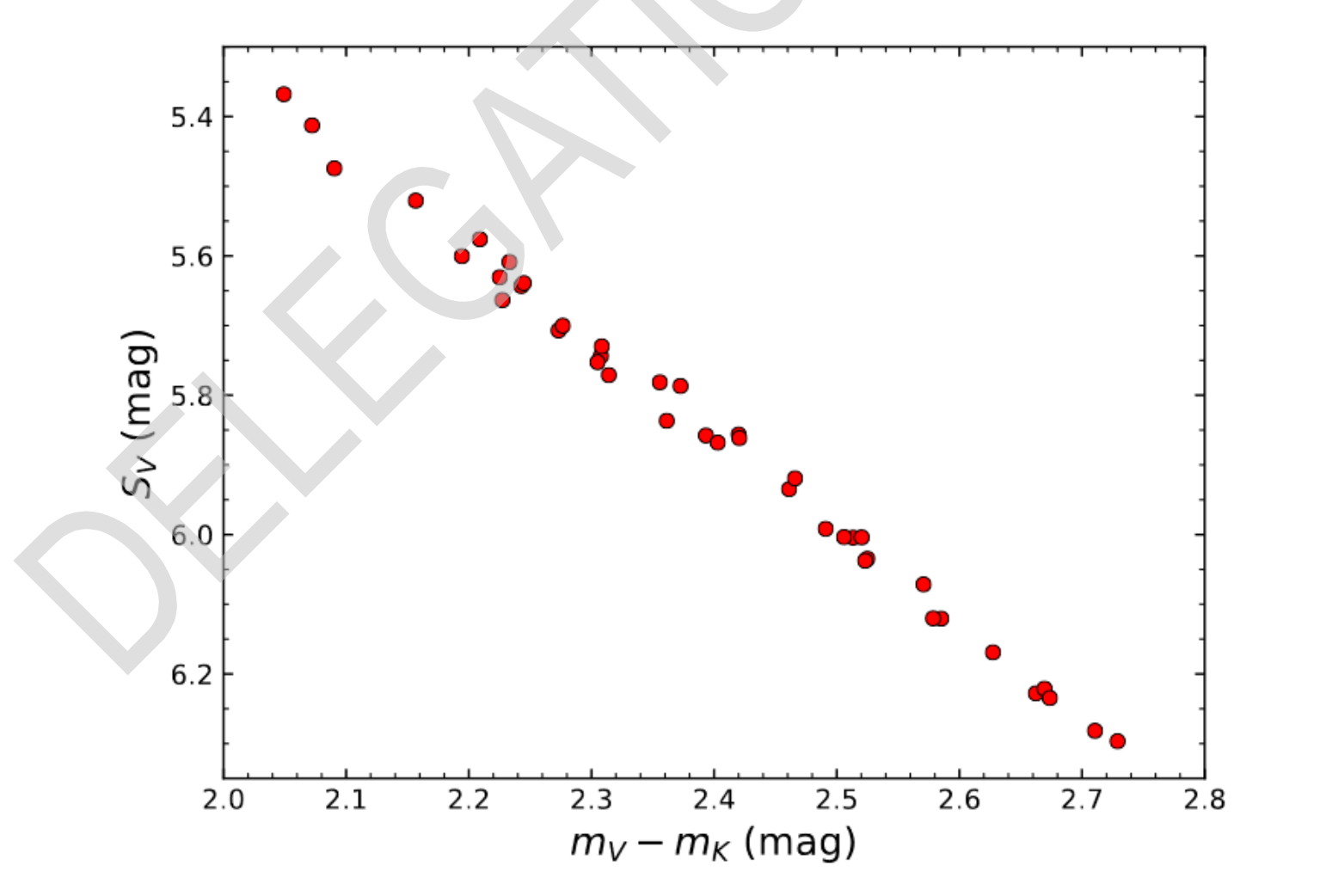
Using this relation, the distance to an eclipsing binary system can be determined by deriving the physical radii of the components (using photometry and spectroscopy), and comparing these with the angular diameters predicted by the relation.
The table below gives the parameters of three eclipsing binary stars. and are the radii of each component, and are the total brightness in magnitudes of the binary in the - and -bands, and is the luminosity ratio of the components in each band.
| source ID | [] | [] | [mag] | [mag] | () | () |
|---|---|---|---|---|---|---|
| OGLE-LMC-ECL-03160 | ||||||
| OGLE-LMC-ECL-10567 | ||||||
| OGLE-LMC-ECL-18365 |
Apply the method outlined above to the three eclipsing binary systems and calculate the distance to the LMC in kiloparsecs. Estimate the total error of the result. Assume that the fitting of the relation contributes to a bias of up to 0.8% in all measurements simultaneously.
Hint: in your calculations keep at least three significant figures and two decimal places. Assume that interstellar extinction is negligible and that the angular size of the LMC is small.
Отговори
49.45 kpc
Official result: the distance is 49.45 ± 0.09 ± 0.40 kpc (statistical and systematic uncertainty).
Решение
Solution
Distance calculation
The information from the table can be used to derive individual magnitudes of both components according to equations:
We will use the third system (OGLE LMC-ECL-18365) as an example to demonstrate the calculations in detail. The values for this system are as follows:
Magnitudes: mag, mag, mag, mag.
Colours: mag, mag.
The second step is to determine the surface brightness for both components using the figure. A least square fit to the data in the figure results in a linear function:
Uncertainties of the coefficients are mag and mag.
For this system, this gives mag and mag.
However, participants will have two other ways of determining .
The first way is a graphical way by using a ruler and a pencil in order to draw the ’best-fit’ line on the figure. Then follows from an intersection of the vertical line and the ’best-fit’ line.
The second way is to determine the coefficients of the best-fit line by using coordinates of two points on the figure. The points should be far from each other.
For example, the coordinates of the second and the penultimate points are: and . This results in:
Using these coefficients we have: mag and mag, so within 0.01 mag of the ’precise’ results.
The third step is to calculate angular diameters of components by using the equation presented in the problem. By modifying the equation defining we obtain:
Subsequently we get: and mas.
The fourth step is to calculate the distance to each target. As components form a physical binary, their distances should be very similar. This is an independent check of the method and calculations. As the angles under which we see stellar discs are very small () we can safely use a linear relation between the angular and physical diameters of an object. We therefore calculate the distance as , where is expressed in mas, in solar radii and is a conversion factor. The conversion factor results from a fraction .
The distances for the third system are kpc and kpc.
We then repeat the calculation following the same scheme for the first and second systems, obtaining for the first system kpc and kpc, and for the second system kpc and kpc. The unweighted mean of all distances is 49.45 kpc.
Uncertainties
’Statistical’ part.
The standard deviation of the sample is kpc. The standard error of the mean is = 0.09 kpc.
OR:
The mean distances to the three eclipsing binaries are: 49.73 kpc, 49.20 kpc and 49.443 kpc. The standard deviation is =0.22 kpc, and the standard error of the mean is =0.13 kpc.
’Systematic’ part.
All distances are inversely proportional to angular diameters derived from the – relation. Thus their accuracy is limited by the precision of the relation. That gives the ’irreducible’ part of the error: kpc.
Finally: the distance is kpc; the uncertainty is completely dominated by the precision of the – relation.
Author’s suggestion of scoring
A full proper solution is scored with 50 points.
Individual scores:
Correct formulas for individual magnitudes: 4 p
Derivation of V and K magnitudes for 6 components: 6 p
Determination of the trend line of Sv from the figure (by line fitting or by ruler): 7 p
Calculation of the SV quantity for 6 components: 6 p
Correct formula for angular diameter: 2 p
Determination of angular diameters of 6 components: 6 p
Correct formula for the distance calculation 4 p
Calculation of distances to 6 components: 6 p
Calculation of the final distance: 3 p
Errors: ’statistical’: 3 p
Errors: ’systematic’: 3 p
Оригинал в Архива: DA.pdf · официални решения: DA_sol.pdf