IOAA 2023, Наблюдения, телескоп — Задача 2. Starlink
Observation Round — Ukrainian (Ukraine) · 15 т.
Внимание: Бележка към темата
The question booklet is Ukrainian (Ukraine), with English instructions. The companion archive booklet contains the English originals and complete English solutions and marking schemes; both question editions are retained within the same four tasks. The observing video for tasks 1–2 and the Saturn screen image for task 3 are absent from these PDFs. The companion includes the two galaxy images for task 4. The occultation key changes Δt to Δx in its mid-time error thresholds, excludes the exact mid-time 23:03:39.7 from its printed intervals and says duration should be to 1 s.f. although the answer is 17 s. The satellite key prints 62°,2 and an extra closing parenthesis. The moon key image uses Polish name variants and four magnitudes differing by 0.1 from the question table. All these source details remain as printed. In the Ukrainian star table, a dropdown icon covers the last magnitude digit for Gaia DR2 1070459408131195776. The companion table shows 10.2003. Conversely the companion obscures the last digit for Gaia DR2 1070144329329069568, which the Ukrainian table shows as 10.0785. Both original table images and these source-supported accessible values are preserved.
General Instructions
Scientists have discovered a crashed alien flying saucer. High up inside the hold, they found several screens transmitting views of the sky and telescopes have been set up to let you see them clearly from the level of the deck. Use your telescope to observe the (simulated) targets on the screens and record your results.
There are 5 screens on the opposite side: the central one will display video for tasks 1 and 2, the other four will display static images for tasks 3 and 4. The two screens closer to the centre will display the (same) image for task 3, and the two outer screens will display the (same) image for task 4. Point your telescope at the screens furthest away from you.
| 4 | 3 | 1, 2 | 3 | 4 |
|---|
You will have a total of 30 minutes to complete the observing tasks, however tasks 1 and 2 will only be displayed once: just as with real observations you will only have one opportunity to collect the data. There will be two clocks visible showing the time remaining in the round.
At the start of the round a clock on the central screen will show the simulated time at the observer’s location. The clock will have the correct orientation when seen through the telescope. The time will be shown for 3 minutes after which it will disappear; use this to set a start time for your observations.
Caution: the scale of the field of view is different between the video and still images.
Procedure
You have 30 minutes to read the questions and plan your observations. Do not talk to other participants. When you are shown the sign to ‘GO NOW’ by the supervisor, follow the directions to the telescope location taking with you the questions, clipboard and pen/pencil (a red light will be provided at the telescope). Keep your distance from other participants and do not talk to them. Show your badge and code to the assistant at your telescope.
You will have a total of 30 minutes to complete the observing tasks, starting when all participants are ready. At the end of 30 minutes take your papers and clipboard (leave the light) and wait until called to leave the observing location.
Follow the directions back to the preparation hall. Keep your distance from other participants and do not talk to them.
You will have another 30 minutes to process your observations and complete the answer sheet (there will be a calculator, geometrical instruments etc.). If you had any technical problems you can write a report for your team leader on the form in the answer sheets. At the end of 30 minutes place your answer sheets and the report in the envelope and wait at your desk until directed to leave the hall.
Условие
В тому ж самому полі зору, що і для запитання 1, ”ланцюжок” супутників Старлінк має з’явитися поруч з меридіаном орієнтовно о 23:05 UT за Всесвітнім часом. Їх проходження триватиме орієнтовно три хвилини.
Ви можете припустити, що центр поля зору знаходиться на висоті та що супутники знаходяться на висоті 400 км над поверхнею Землі, обертаються коловими орбітами та мають однакову відстань між сусідніми супутниками. Також можете вважати, що супутники будуть рухатися вертикально (тобто перпендикулярно до горизонту).
(a) Виміряйте кутову швидкість супутників відносно спостерігача на зсимульованому небі.
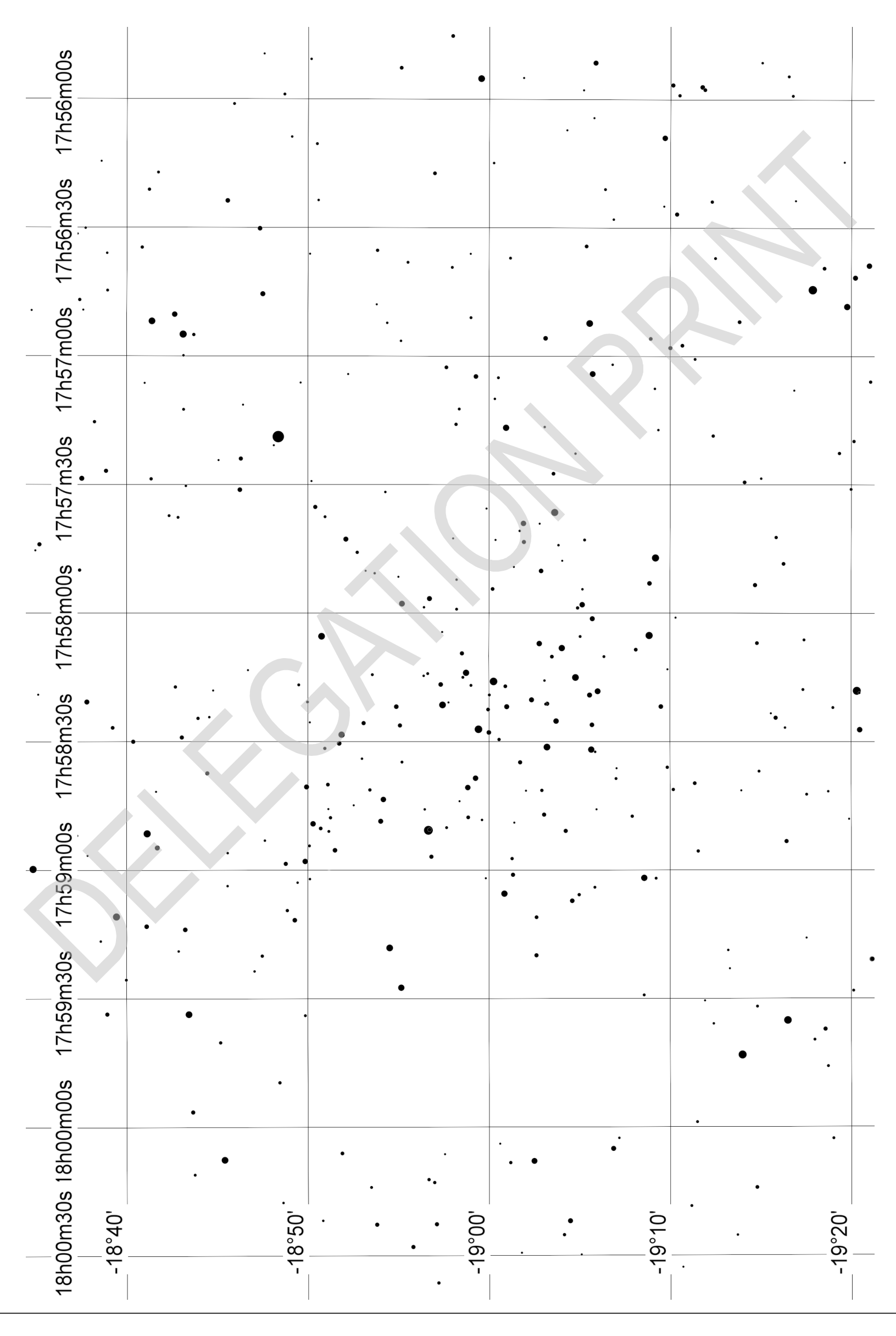
(b) Виміряйте проміжок часу між послідовними проходженнями двох сусідніх супутників та позначте їх шлях на зоряній мапі (Map 1).
(c) Зробіть теоретичні розрахунки кутової швидкості супутників для спостерігача, використовуючи надану вище інформацію.
(d) Визначте відстань в км між двома сусідніми супутниками.
Константи: Н мкг; кг ; = 6378 км.
A.2 (15 pt)
A.2 (cont.)
English — Observation 2: ‘Starlink’
In the same star field as for Question 1, a ‘train’ of Starlink satellites will appear near the meridian of at around 23:05 UT. Their passage will last for around three minutes.
You may assume that the centre of the star field is at an altitude of and that the satellites are 400 km above the Earth’s surface moving on circular orbits with equal distances between them. You may also assume that satellites will move vertically (perpendicular to the horizon).
(a) Measure the angular velocity of the satellites as seen by an observer on the simulated sky.
(b) Measure the time interval between the passes of successive satellites and mark their path on the sky chart (Map 1).
(c) Calculate the theoretical angular velocity of the satellites as seen by the observer, using the information given in the question.
(d) Estimate the distance in km between two consecutive satellites.
Constants: ; ; .
(15 points)
Отговори
(a) 8.5 arcmin/s
Simulated angular velocity 8.5 ′/s (archive companion key).
(b) 2 s
(c) 9 arcmin/s
9.0 ′/s taking the Earth’s curvature into account; 7.6 ′/s in the simplified flat-Earth solution (archive companion key).
(d) 15 km
Alternatively 14 km from the student’s own measured tangential velocity (archive companion key).
Решение
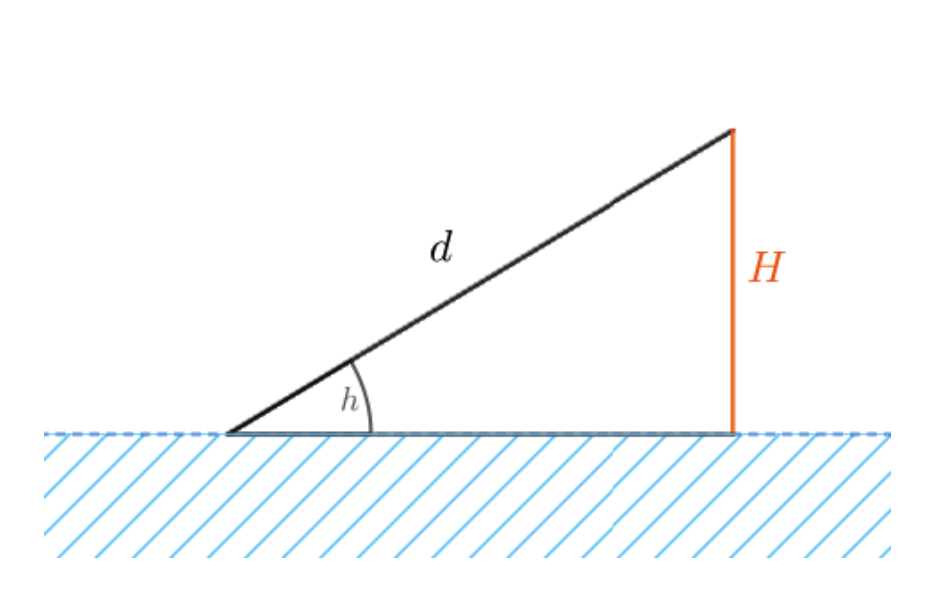
The satellites are at an altitude and their height above the surface of the Earth is km.
- In the (simplified) solution neglecting the Earth’s curvature, the student will assume the distance to the satellites is equal to:
- In the solution taking into account the Earth’s curvature, let us draw the (observer–satellite–center of the Earth) triangle. The angles are: , that we shall denote as , and .
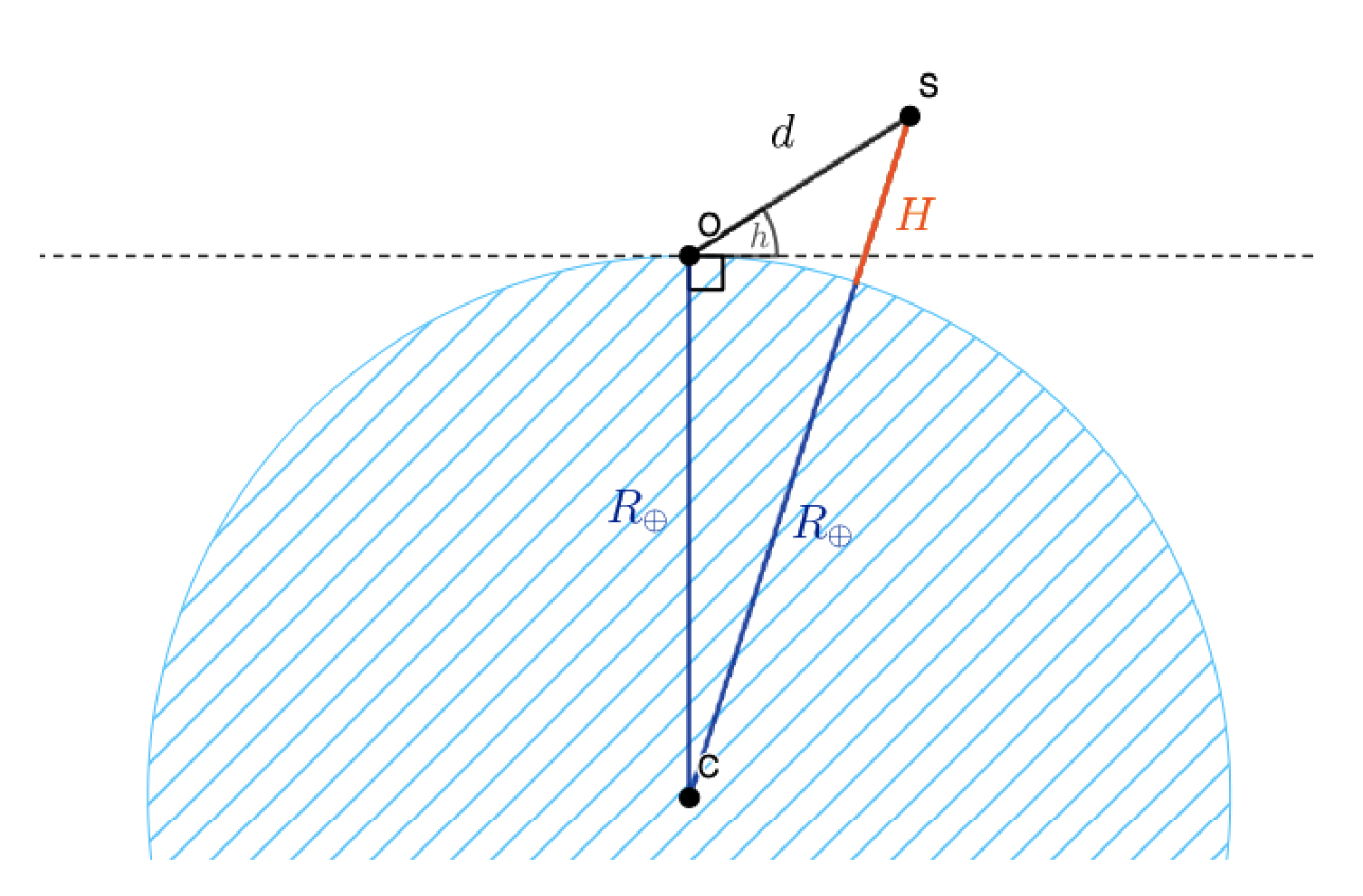
The law of sines can be applied:
We calculate the distance to the satellites:
Knowing the radius of the orbit is , we calculate km/s. The observer can only measure the tangential component of motion .
The student will estimate the angular velocity to be (for the solution neglecting the Earth’s curvature) or (for the solution taking into account the Earth’s curvature).
5 points for predicting the angular velocity:
5 points if within ;
4 points if within );
3 point if within ;
0 points otherwise
The simulated angular velocity is ; the student should conclude this value is similar to their prediction.
4 points for measuring the angular velocity:
4 points if agrees within 5% (8.1 - 8.9 );
2 points if agrees within 10% (7.65 - 9.35 );
0 points otherwise
1 point for correct comparison
The student should then measure the time interval between the passes to be s.
2 points for measuring the time interval:
2 points if agrees within 5% (1.9 - 2.1 s); 0 points otherwise
In such a short time, the path along the orbit can be approximated with a straight line; the distance passed is km, which is the distance between the satellites. (Alternatively, if the student chooses to use their own measurement, km).
2 points for calculating the distance
2 points if within 13.8-15.2 km
1 point if within 12.5-16.5 km
0 points otherwise
Finally, the student should mark the observed satellite path on the sky map.
1 point for correctly marking the satellite trail
or optionally comment it is slightly lower and might imply e.g. the real orbit radius is minimally larger than predicted, but it is not necessary
Оригинал в Архива: telescope_ukr.pdf · решение от архива: telescope_sol.pdf