IOAA 2023, Наблюдения, телескоп — Задача 3. Супутники планети
Observation Round — Ukrainian (Ukraine) · 10 т.
Внимание: Бележка към темата
The question booklet is Ukrainian (Ukraine), with English instructions. The companion archive booklet contains the English originals and complete English solutions and marking schemes; both question editions are retained within the same four tasks. The observing video for tasks 1–2 and the Saturn screen image for task 3 are absent from these PDFs. The companion includes the two galaxy images for task 4. The occultation key changes Δt to Δx in its mid-time error thresholds, excludes the exact mid-time 23:03:39.7 from its printed intervals and says duration should be to 1 s.f. although the answer is 17 s. The satellite key prints 62°,2 and an extra closing parenthesis. The moon key image uses Polish name variants and four magnitudes differing by 0.1 from the question table. All these source details remain as printed. In the Ukrainian star table, a dropdown icon covers the last magnitude digit for Gaia DR2 1070459408131195776. The companion table shows 10.2003. Conversely the companion obscures the last digit for Gaia DR2 1070144329329069568, which the Ukrainian table shows as 10.0785. Both original table images and these source-supported accessible values are preserved.
General Instructions
Scientists have discovered a crashed alien flying saucer. High up inside the hold, they found several screens transmitting views of the sky and telescopes have been set up to let you see them clearly from the level of the deck. Use your telescope to observe the (simulated) targets on the screens and record your results.
There are 5 screens on the opposite side: the central one will display video for tasks 1 and 2, the other four will display static images for tasks 3 and 4. The two screens closer to the centre will display the (same) image for task 3, and the two outer screens will display the (same) image for task 4. Point your telescope at the screens furthest away from you.
| 4 | 3 | 1, 2 | 3 | 4 |
|---|
You will have a total of 30 minutes to complete the observing tasks, however tasks 1 and 2 will only be displayed once: just as with real observations you will only have one opportunity to collect the data. There will be two clocks visible showing the time remaining in the round.
At the start of the round a clock on the central screen will show the simulated time at the observer’s location. The clock will have the correct orientation when seen through the telescope. The time will be shown for 3 minutes after which it will disappear; use this to set a start time for your observations.
Caution: the scale of the field of view is different between the video and still images.
Procedure
You have 30 minutes to read the questions and plan your observations. Do not talk to other participants. When you are shown the sign to ‘GO NOW’ by the supervisor, follow the directions to the telescope location taking with you the questions, clipboard and pen/pencil (a red light will be provided at the telescope). Keep your distance from other participants and do not talk to them. Show your badge and code to the assistant at your telescope.
You will have a total of 30 minutes to complete the observing tasks, starting when all participants are ready. At the end of 30 minutes take your papers and clipboard (leave the light) and wait until called to leave the observing location.
Follow the directions back to the preparation hall. Keep your distance from other participants and do not talk to them.
You will have another 30 minutes to process your observations and complete the answer sheet (there will be a calculator, geometrical instruments etc.). If you had any technical problems you can write a report for your team leader on the form in the answer sheets. At the end of 30 minutes place your answer sheets and the report in the envelope and wait at your desk until directed to leave the hall.
Условие
На екрані з’явиться зображення однієї з планет Сонячної системи станом на 00:00 15 серпня 2023 року за Всесвітнім часом. Ототожніть супутники та позначте їх на Аркушах Відповідей (Ви можете скористатися схемою розташування супутників та таблицею їх яскравостей доданих нижче).
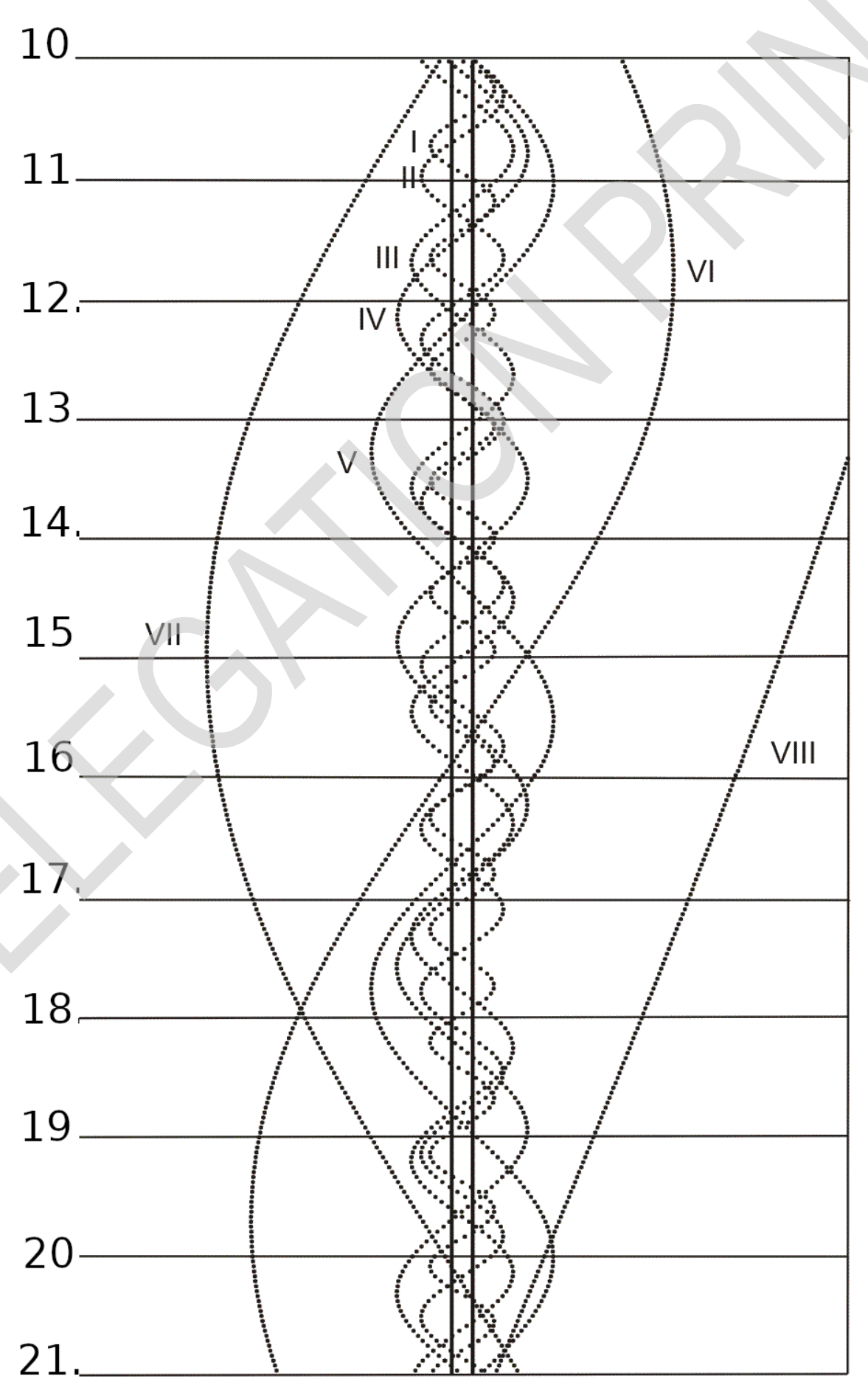
Схема розташування супутників. Числа зліва відповідають дням серпня 2023 року (опівночі за UT Всесвітнім часом).
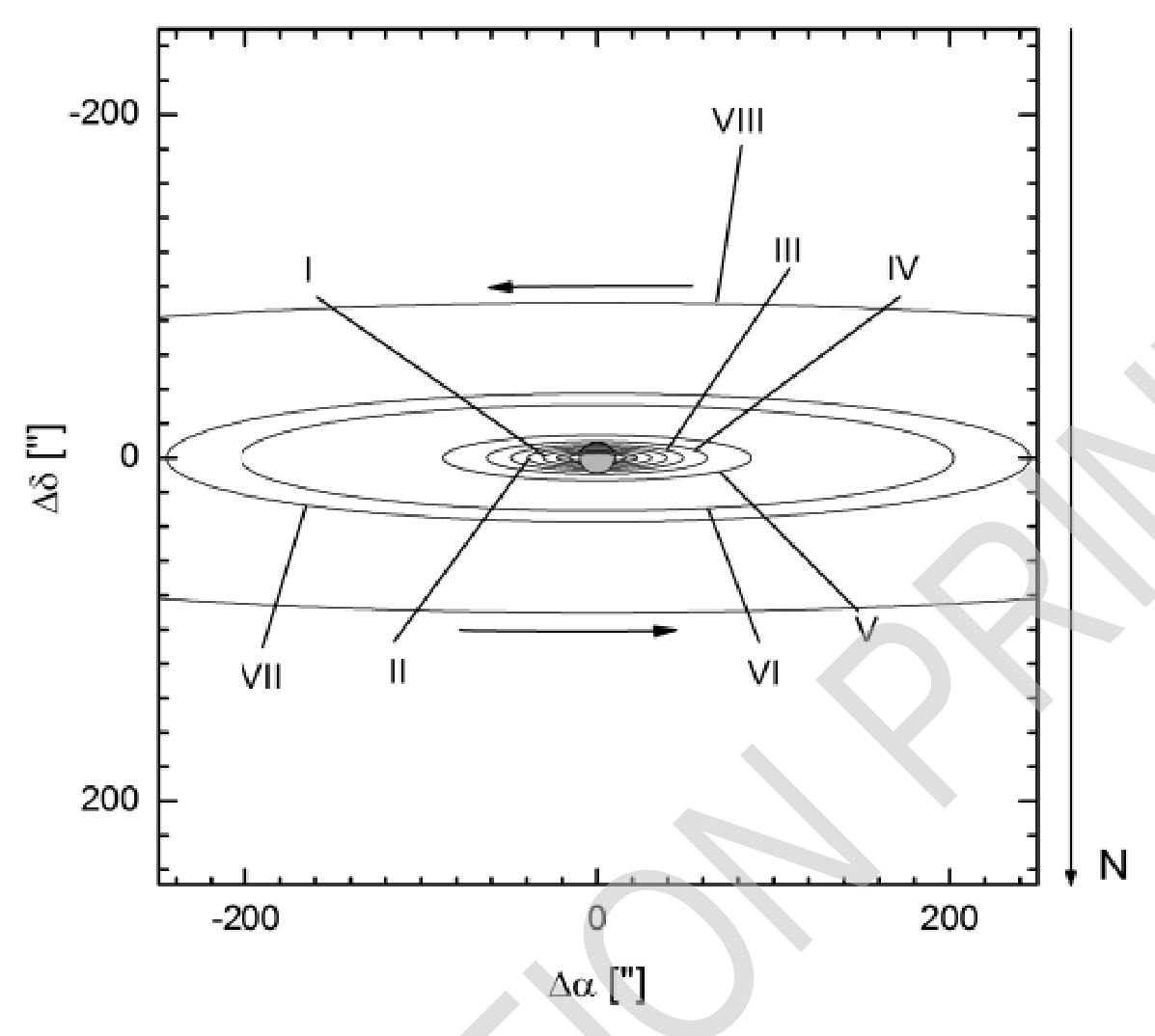
Схема розташування супутників: номери супутників (I, II, ...) як зазначено вище.
| Порядковий номер | Назва | Зоряна величина |
|---|---|---|
| I | Mimas | 13.0 |
| II | Enceladus | 11.8 |
| III | Tethys | 10.4 |
| IV | Dione | 10.6 |
| V | Rhea | 9.9 |
| VI | Titan | 8.5 |
| VII | Hyperion | 14.4 |
| VIII | Japetus | 11.0 |
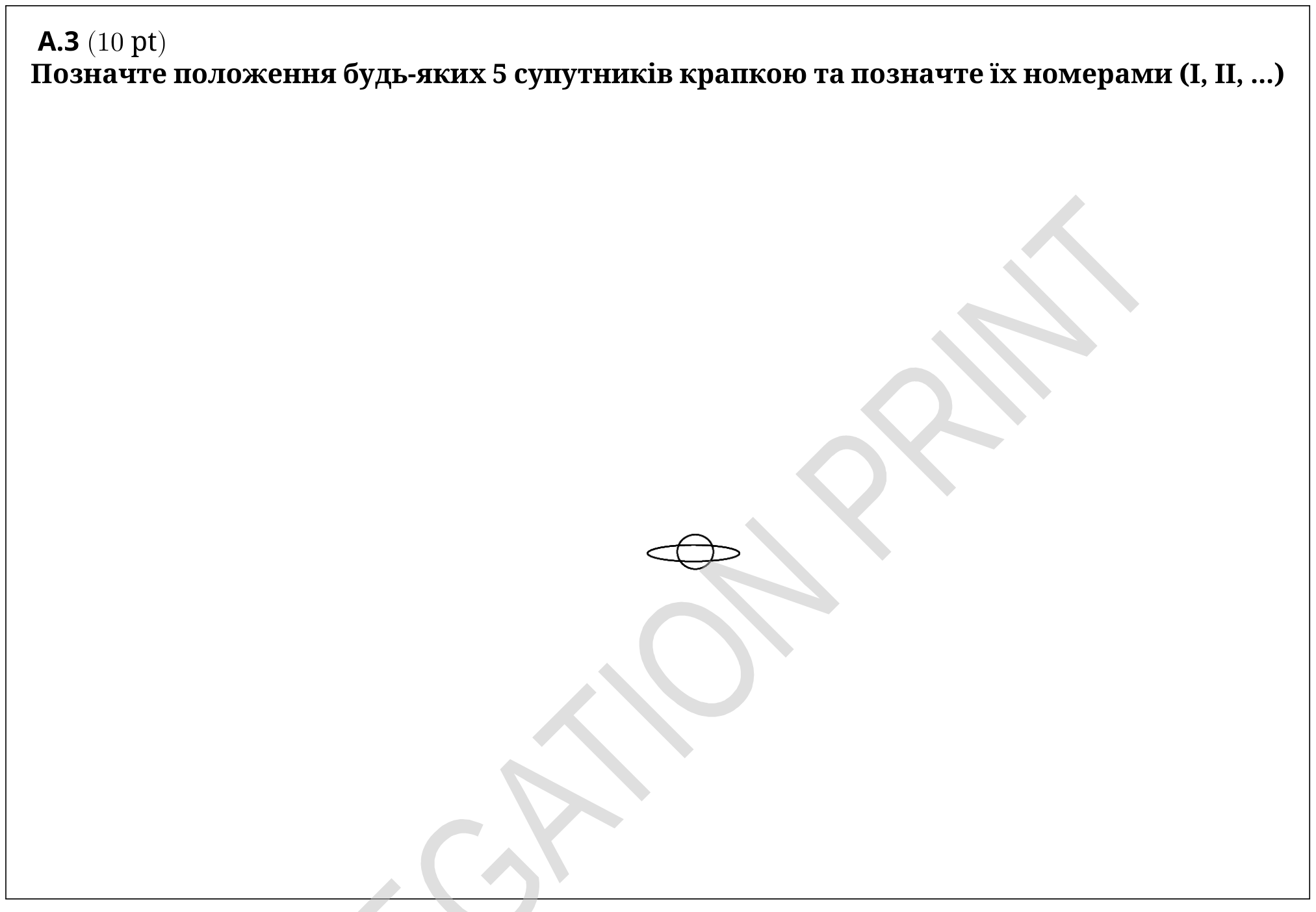
A.3 (10 pt)
Позначте положення будь-яких 5 супутників крапкою та позначте їх номерами (I, II, ...)
English — Observation 3: ‘Planetary Moons’
The screen will display an image of one of the planets of the Solar System as seen on August 15, 2023, at 00:00 UT. Identify any five moons and mark them on the answer sheet (you may use the moon position chart attached below and the table showing their brightness).
(10 points)
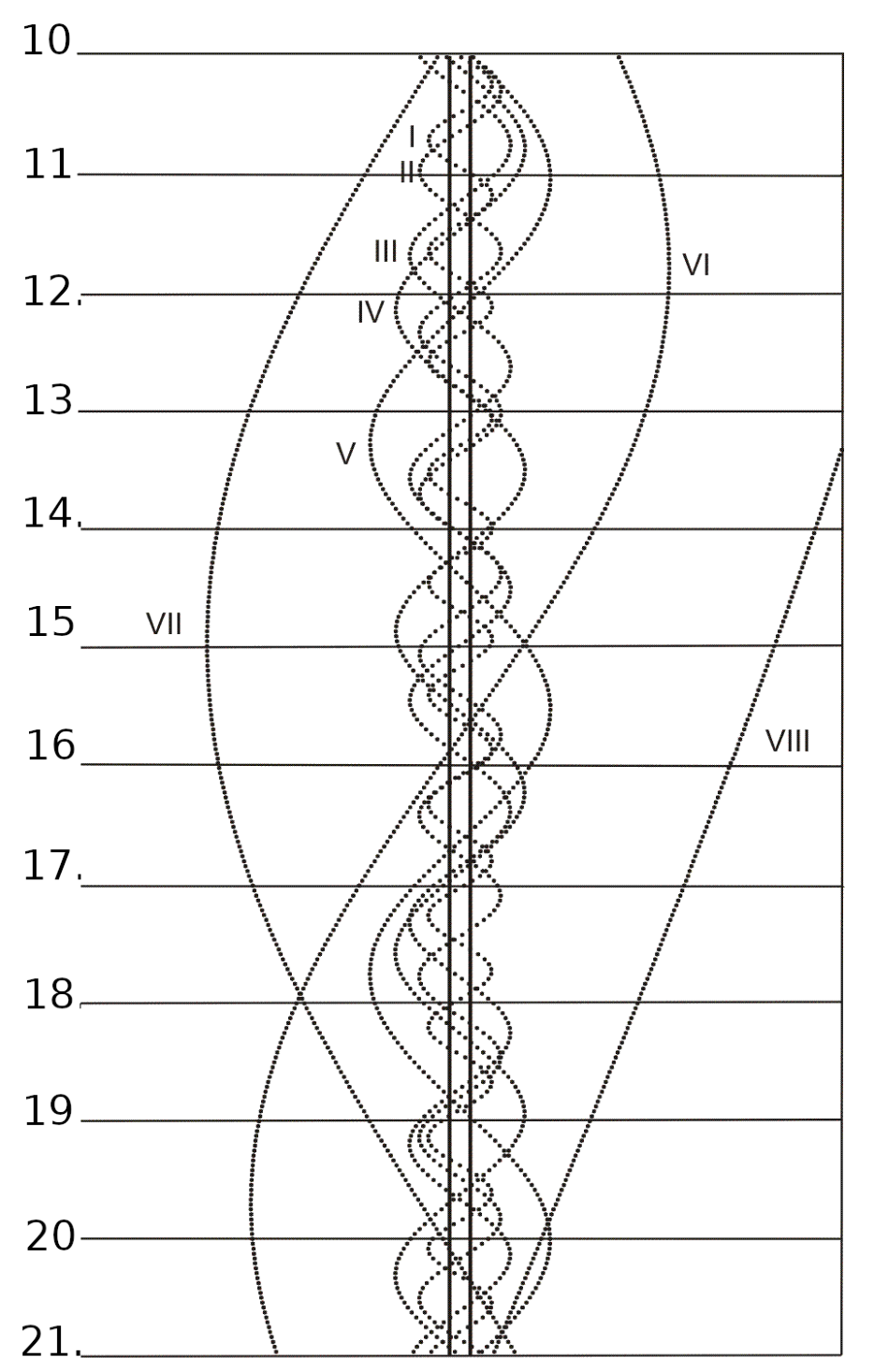
The moon position chart. The numbers on the left indicate the days of August 2023 (at midnight UT).
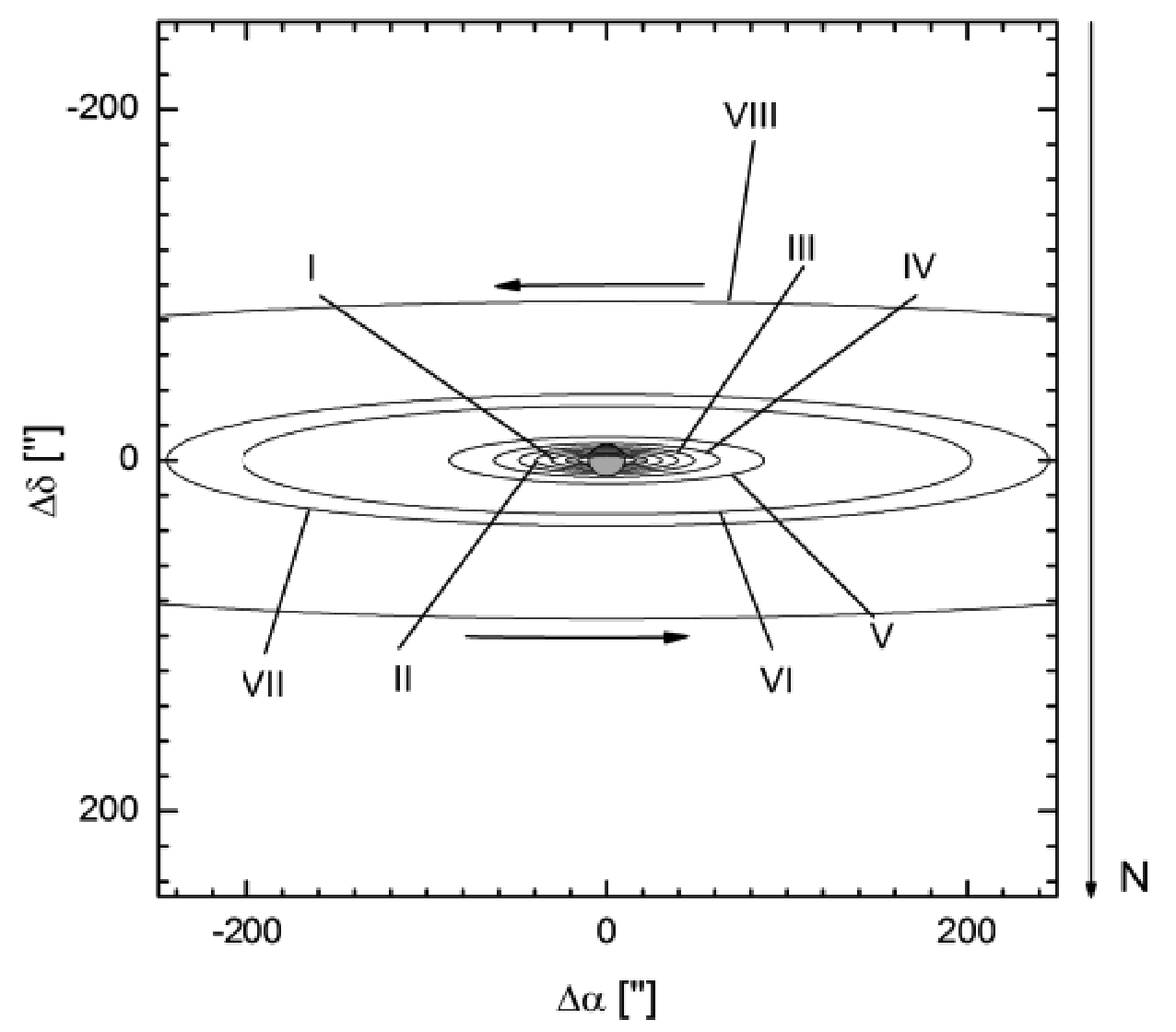
The moon position chart – moon numbers (I, II, ...) as above.
| Number | Name | Magnitude |
|---|---|---|
| I | Mimas | 13.0 |
| II | Enceladus | 11.8 |
| III | Tethys | 10.4 |
| IV | Dione | 10.6 |
| V | Rhea | 9.9 |
| VI | Titan | 8.5 |
| VII | Hyperion | 14.4 |
| VIII | Japetus | 11.0 |
Answer sheet
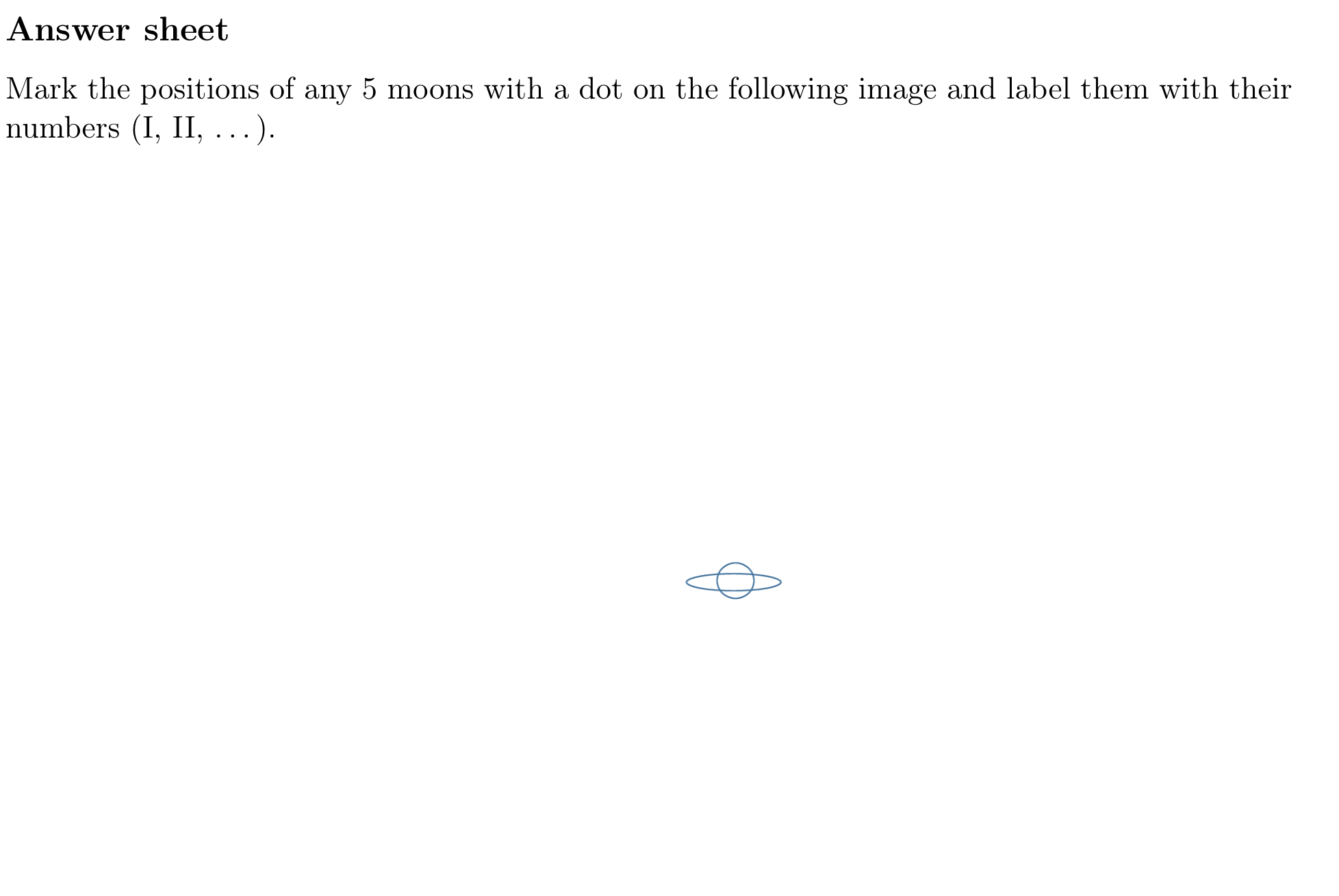
Mark the positions of any 5 moons with a dot on the following image and label them with their numbers (I, II, ...).
Отговори
- The archive companion key shows seven marked moon positions. Native labels and magnitudes in the image are retained, including differences from the question table.
Решение
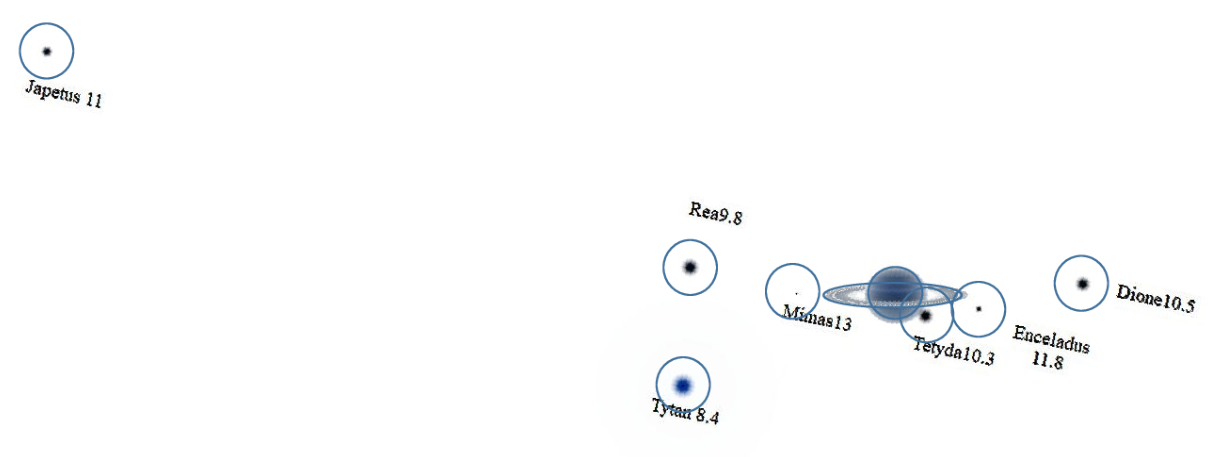
2 points for each moon: position (1 pt) and name (1 pt).
Оригинал в Архива: telescope_ukr.pdf · решение от архива: telescope_sol.pdf