IOAA 2025, Наблюдение · планетариум — OP01. Hypothesized Planet in the Solar System
18th IOAA · Observation Exam: Planetarium · 25 т.
Внимание: Бележка към темата
The original exam uses a timed Digistar dome projection; the accompanying script package is linked separately. The archive supplies the maps, OP02 sky image and full official key. The Summary Answersheet already contains solution arcs for OP02.2; these are presented with the solution, while the unmarked original question diagram is kept in the statement. Printed wording such as “Stereoscopic” in the key and the marking tolerance labels is retained.
Условие
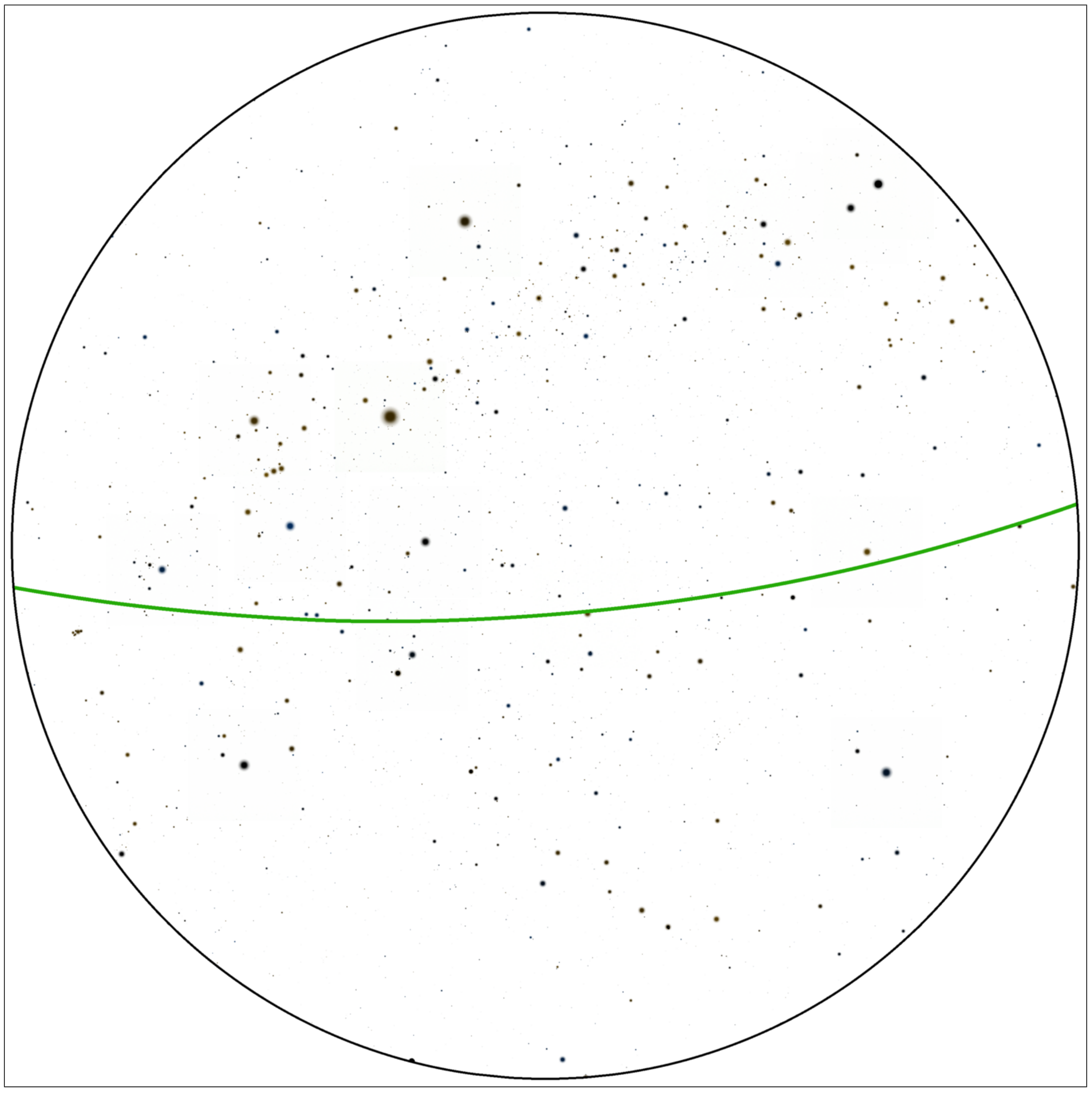
For this question use sky map Map-OP01. This is an angle preserving projection of the sky.
The sky projected on the planetarium dome is as seen from the solar system barycentre. The Earth’s orbit as seen from this position has been marked in green both on the projected sky and in sky map Map-OP01. The first 3 minutes are for dark adaptation and familiarization of the sky.
After first 3 minutes, four Trans-Neptunian Objects (TNOs) labelled O1, O2, O3 and O4 will begin to appear on the dome. The brightness of the TNOs has been enhanced to make them visible. No other solar system object is visible in the projected sky. Time has been sped up to make their movements noticeable.
We will assume that the orbital plane of a hypothesized new planet has an inclination equal to the mean of the inclinations of the orbits of these 4 TNOs.
OP01
OP01.1 Arrange the 4 TNOs in ascending order of the lengths of their semi-major axes and write their names in the appropriate boxes in the Summary Answersheet. Show measurements in the working sheet to justify your answer. [8 т.]
OP01.2 Trace at least 50% of the visible trajectories for each of the 4 TNOs on the map Map-OP01. From these traces find the inclination angles, , of the 4 TNOs, respectively, with respect to the Ecliptic. Hence obtain the best estimate of the inclination, , of the plane of the orbit of the hypothesized planet. [17 т.]
Map-OP01
Summary Answersheet · OP01
Contestant Code: ______. Page No. SA-1 (FRONT).
| Question | Final answers | Marks |
|---|---|---|
| OP01.1 | 8.0 | |
| OP01.2 | Use sky map Map-OP01. ___; ___; ___; ___; ___ | 17.0 |
Total: ______.
End of Summary Answersheet. Page SA-2 (BACK): DO NOT WRITE.
Original examination instructions
At the entrance of the Planetarium Dome the following items were handed over to you:
- An envelope marked B.
- A pouch containing a stopwatch, a head torch and a green pen.
- A writing board.
Please verify the Contestant Code printed on envelope marked B.
The Question Paper, two Sky Maps, and Summary Answersheets are kept inside the smaller envelope S. You are allowed to open this envelope (S) only when the whistle is blown to mark the start of the examination. The exam time (1 hour) starts from this point.
There are two questions in this exam: OP01 and OP02. You will have 15 minutes to read the question paper and make any preliminary plans for your observation. During this time lights in the planetarium dome will be on.
Time for question OP01 is 15 minutes:
- Dark adaptation and familiarisation with the sky: 3 minutes
- Main task: 12 minutes
Time for question OP02 is 10 minutes.
A whistle will be blown at the start and the end of each question. There will be a break of 2 minutes between the questions.
The time remaining for each question will be displayed on the dome at one minute intervals. Please pay attention.
At the end of the projection, lights will be turned on again and you will have 18 minutes to finalise your answers.
If you use a pencil to mark or trace something, please overwrite by the green pen (supplied in your pouch) before submission to improve clarity.
At any time during the examination you may stand up at your place and/or turn around. However, you are not allowed to move out of your place.
You must maintain strict silence throughout the examination.
The flow of the examination is as follows:
| Lighting / time (min:sec) | Duration | Activity |
|---|---|---|
| Lights ON | 15 min | Question reading and observation planning |
| Lights OFF | 27 mins 20 sec | Projection on dome |
| 00:00–00:10 | 10 sec | Question OP01 text message on dome |
| 00:10–15:10 | 15 min | Projection for Question OP01 |
| 15:10–17:10 | 2 min | Break |
| 17:10–17:20 | 10 sec | Question OP02 text message on dome |
| 17:20–27:20 | 10 min | Projection for Question OP02 |
| Lights ON | 18 min | Calculation and finalisation |
At the end of the examination:
- Check that you have correctly written your Contestant Code and page numbers on all used sheets.
- Arrange your sheets in the following order: Summary Answersheet of (OP01), sky map Map-OP01, Working Sheet(s) used for (OP01), Summary Answersheet of (OP02), sky map Map-OP02, Working Sheet(s) used for (OP02).
- Place the bunch of the above sheets inside the smaller envelope S. Both Summary Answersheets must be placed inside the envelope S irrespective of whether you have used them or not.
- Only the contents of the smaller envelope S will be evaluated. Any sheet that is not placed inside this envelope will not be evaluated.
- Place the smaller envelope S inside the bigger envelope B.
- All other sheets, namely, Instruction Sheet(s), Question Paper(s), Data Sheet(s) and unused Working Sheet(s) should be placed directly inside the bigger envelope B.
- Tie the thread seal on the envelope B.
- Place the head torch, stopwatch, and the green pen inside the pouch.
- Carry the envelope B, the writing board, and the pouch to the exit and drop them in the designated boxes.
Original projection resources
The original Digistar planetarium script package is preserved in the archive. It requires a compatible planetarium environment; the static maps and archived OP02 image do not reproduce the timed sky projection.
Решение
OP01.1
The orbits of the 4 TNOs are elliptical, which can be noticed from careful observations of their speed. Hence, to estimate lengths of their semi-major axes it is essential to measure the time period of one complete revolution of each TNO. The time periods of the planets are
O1: 40 sec, O2: 30 sec, O3: 48 sec, O4: 34 sec.
Hence, the correct ascending order is: .
Credit of 1.0 for every pairwise correct order, and 2.0 extra for fully correct order.
| Order | Marks | Order | Marks |
|---|---|---|---|
| O1 < O2 < O3 < O4 | 3.0 | O2 < O1 < O3 < O4 | 4.0 |
| O1 < O2 < O4 < O3 | 4.0 | O2 < O1 < O4 < O3 | 5.0 |
| O1 < O3 < O2 < O4 | 2.0 | O2 < O3 < O1 < O4 | 3.0 |
| O1 < O3 < O4 < O2 | 1.0 | O2 < O3 < O4 < O1 | 4.0 |
| O1 < O4 < O2 < O3 | 3.0 | O2 < O4 < O1 < O3 | 8.0 |
| O1 < O4 < O3 < O2 | 2.0 | O2 < O4 < O3 < O1 | 5.0 |
| O3 < O1 < O2 < O4 | 1.0 | O4 < O1 < O2 < O3 | 4.0 |
| O3 < O2 < O4 < O1 | 3.0 | O4 < O3 < O1 < O2 | 2.0 |
| O3 < O1 < O4 < O2 | 0.0 | O4 < O1 < O3 < O2 | 3.0 |
| O3 < O2 < O1 < O4 | 2.0 | O4 < O2 < O1 < O3 | 5.0 |
| O3 < O4 < O1 < O2 | 1.0 | O4 < O2 < O3 < O1 | 4.0 |
| O3 < O4 < O2 < O1 | 2.0 | O4 < O3 < O2 < O1 | 3.0 |
OP01.2
The orbits of the TNOs can be drawn by marking a few important constellations and noticing the fact that some prominent or important stars lie along the TNOs’ paths. Also the intersection points of each TNO trajectory with respect to the Earth’s orbit (i.e. the Ecliptic) lie near prominent stars.
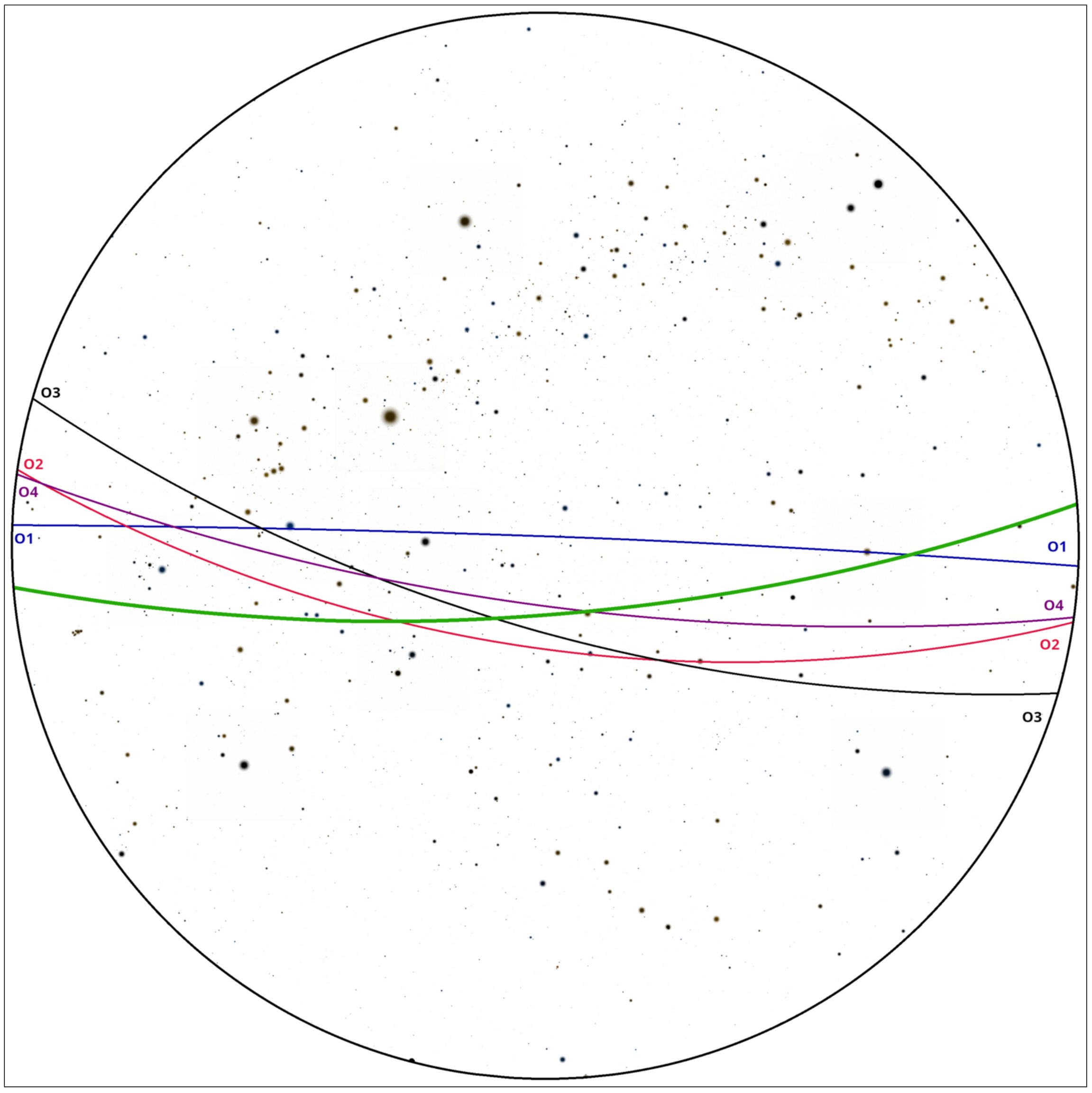
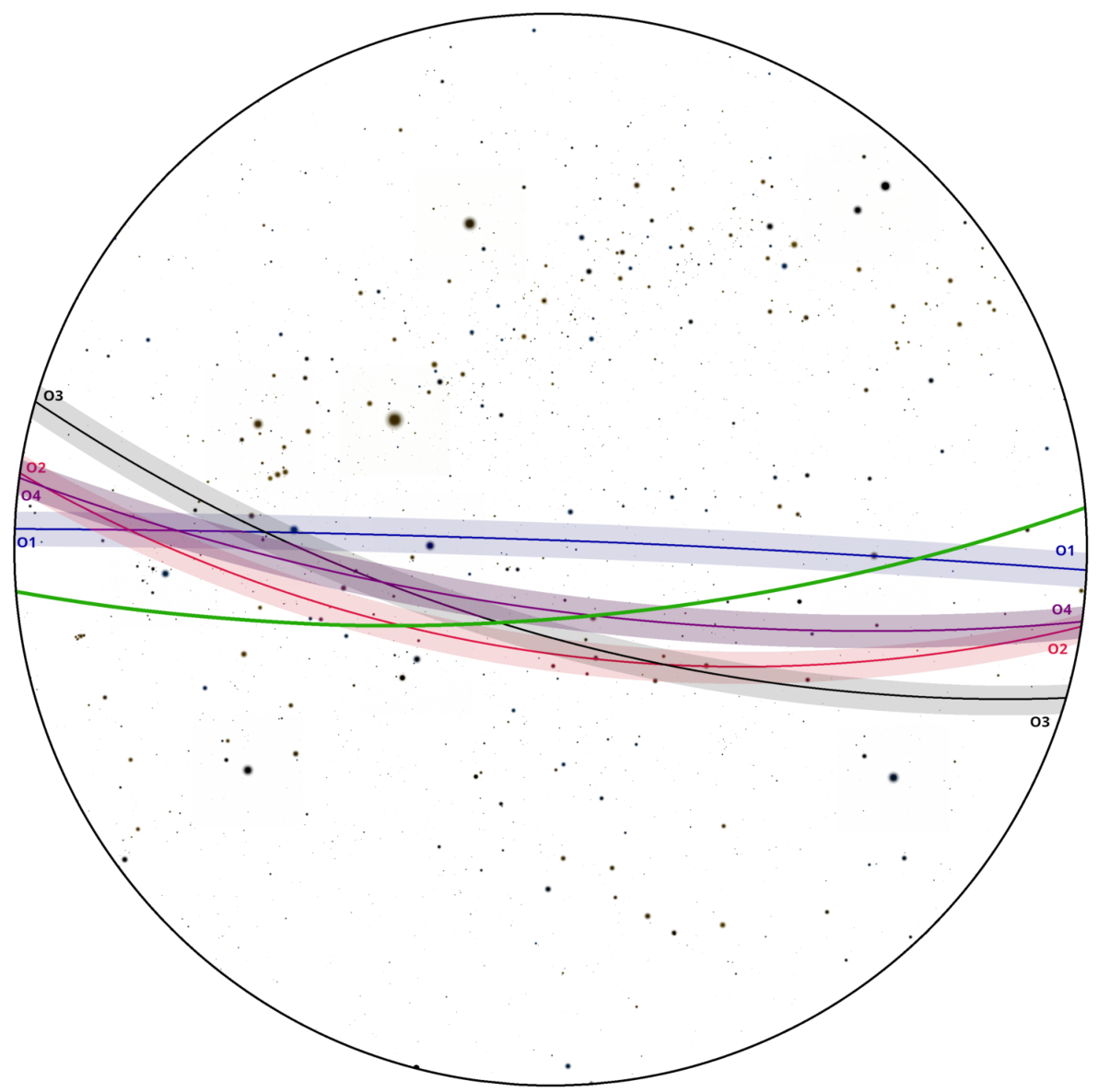
Since this map has an angle preserving (Stereoscopic) projection, measuring the angles directly using a protractor at the intersection points gives the inclination of the orbits with respect to the Ecliptic.
The measured values of inclination are:
The average inclination .
For each TNO:
| Criterion | Marks |
|---|---|
| If more than 50% of the visible orbit is traced at all | 0.5 |
| If more than 50% of the traced orbit lies within the tolerance band | 1.5 |
| Between 25% to 50% | 1.0 |
Marks for the correctness of trace will be given only if 50% of the visible orbit is traced at all.
| Criterion | Marks |
|---|---|
| Measurement of the inclination angles within | 2.0 |
| Measurement of the inclination angles within | 1.0 |
Marks for angle will be given only if more than 25% of the traced orbit lies inside the tolerance band.
| Criterion | Marks |
|---|---|
| Averaging of the angles | 1.0 |
Оригинал в Архива: Observation-Planetarium-Questions.pdf · официални решения: Observation-Planetarium-Solutions.pdf · допълнителни данни: Map-OP01.pdf · допълнителни данни: Map-OP02.pdf · допълнителни данни: Map-OP01-Solutions.pdf · допълнителни данни: Map-OP02-Solutions.pdf · допълнителни данни: OP-Instructions.pdf · допълнителни данни: Observation-Planetarium-Summary-Answersheet.pdf · допълнителни данни: problem2_view.png