IOAA 2025, Наблюдения, телескоп — Задача 1. Discovery of 'Z'
Observation Exam: Telescope · 25 т.
Условие
You are given a sky map “Map-OT01” along with the question paper. This map shows only stars but no diffuse objects.
Four known stars (S1, S2, S3 and S4), which are present in the map above, are given in the table below with their Common names, Bayer designations and Equatorial coordinates.
| Sr. No. | Common Name | Bayer Name | RA | Dec |
|---|---|---|---|---|
| S1 | Alpheratz | Andromedae | 00h 08m 24s | |
| S2 | Markab | Pegasi | 23h 04m 46s | |
| S3 | Scheat | Pegasi | 23h 03m 47s | |
| S4 | Algenib | Pegasi | 00h 13m 14s |
Complete the tasks (OT01.1) and (OT01.2) while you are planning the observations.
The following task is to be performed once you reach the telescope station.
On the screen diagonally opposite to your station, initially a welcome message, followed by a sample sky (sky unrelated to the question) will be displayed along with a countdown timer. You may use this time to orient the telescope towards the screen and familiarize yourself with other equipment provided at the station. At the end of this time a part of the sky given in the map “Map-OT01” will be projected on the screen for the next 6 minutes. Note that the scale of the projection shown on the screen is different from the actual scale seen in the sky.
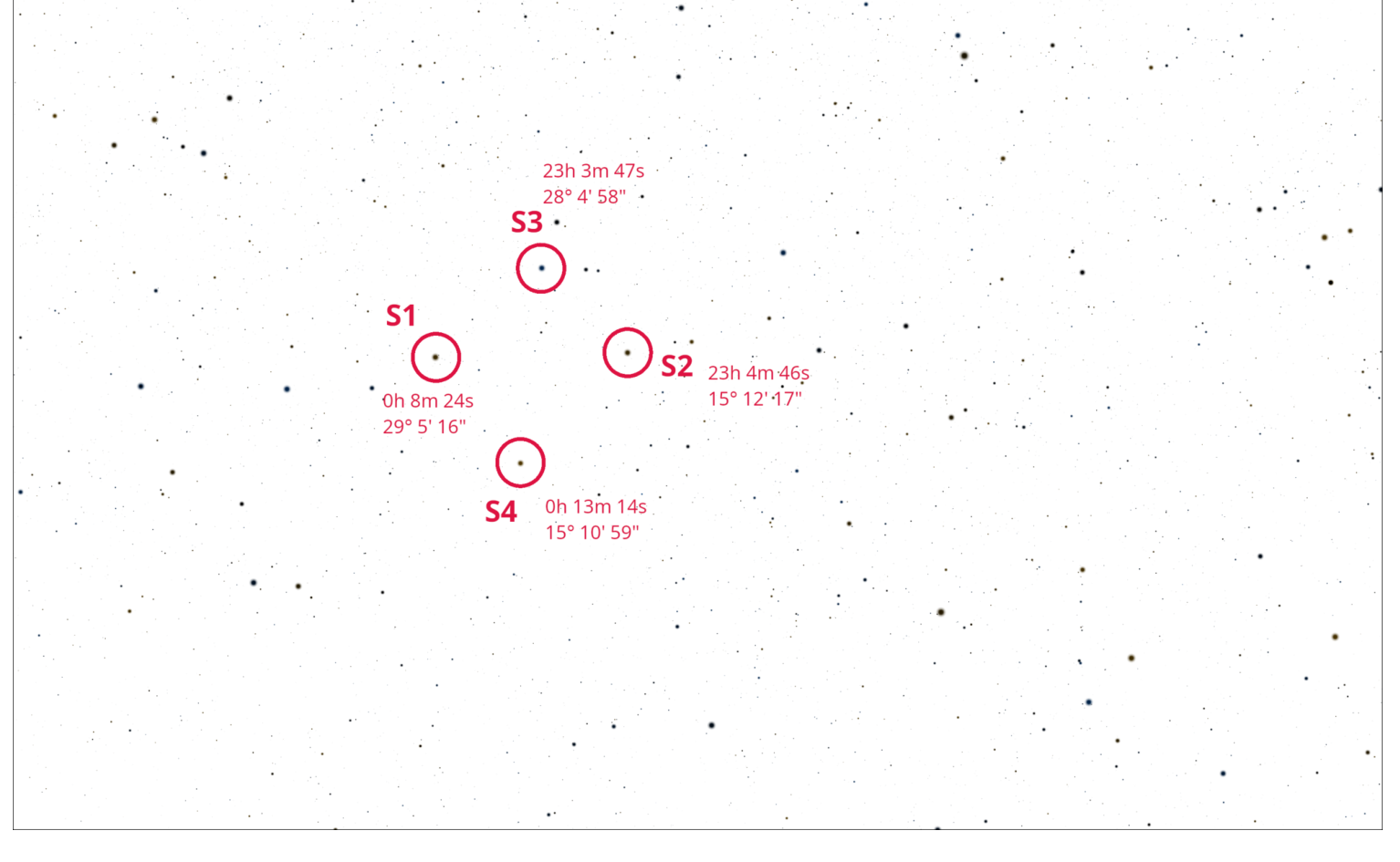
(OT01.1) Your first task is to mark these 4 stars (with a circle around each star) and label them as S1, S2, S3 and S4 on the sky map “Map-OT01” provided to you. [6 т.]
(OT01.2) An astronomer has discovered a new diffuse object ‘Z’ at the following coordinates – RA: 21h 36m 10.6s, Dec:
Mark the position of this diffuse object on the same sky map “Map-OT01” with a sign and label it as ‘Z’. Assume that a linear rectangular grid for equatorial coordinates is valid in the relevant region of the map. [7 т.]
(OT01.3) Find the new object ‘Z’ with the telescope using any appropriate eyepiece. Then centre the object properly in the field of view of the eyepiece with the crosshair, and show it to the examiner at your station.
At the end of 6 minutes, the projection will be blurred for 20 seconds. At this point you must step away from the telescope. The projection will be restored for the examiner to check the view through the telescope. This marks the end of the first task. [12 т.]
Отговори
- (OT01.1) Solution shows all 4 stars circled and correctly labelled S1–S4 on the map; grading: 0.5 per correct circle, 1.0 per correct identification for each star.
- (OT01.2) Realize two stars share nearly the same RA and two share nearly the same Dec; draw lines of constant RA and constant Dec through them, assume a locally linear grid, and mark Z at its coordinates. Grading: 7.0 marks if marked within the inner rectangle, 4.0 if marked between the outer and inner rectangles.
- (OT01.3) Locate the marked new object's position relative to the surrounding star pattern; first find it with the 25mm eyepiece, then fine-adjust into the 10mm crosshair eyepiece and centre it. Grading: 1.0 for pointing towards the screen; if 10mm used: 2.0 correct eyepiece choice, 3.0 object anywhere in FOV, 6.0 object touching crosshair origin; if 25mm used: 3.0 object anywhere in FOV.
Решение
Solution to (OT01.1): [See figure.]
Solution to (OT01.2): Realize that two stars have almost the same RA and two of them have almost the same declination. We draw a line through them indicating constant RA and constant Declination. Given the scale of the map and the separation between the 4 stars and the new object we can assume that the celestial grid will be almost linear. We can thus mark 'Z' at its given coordinates.
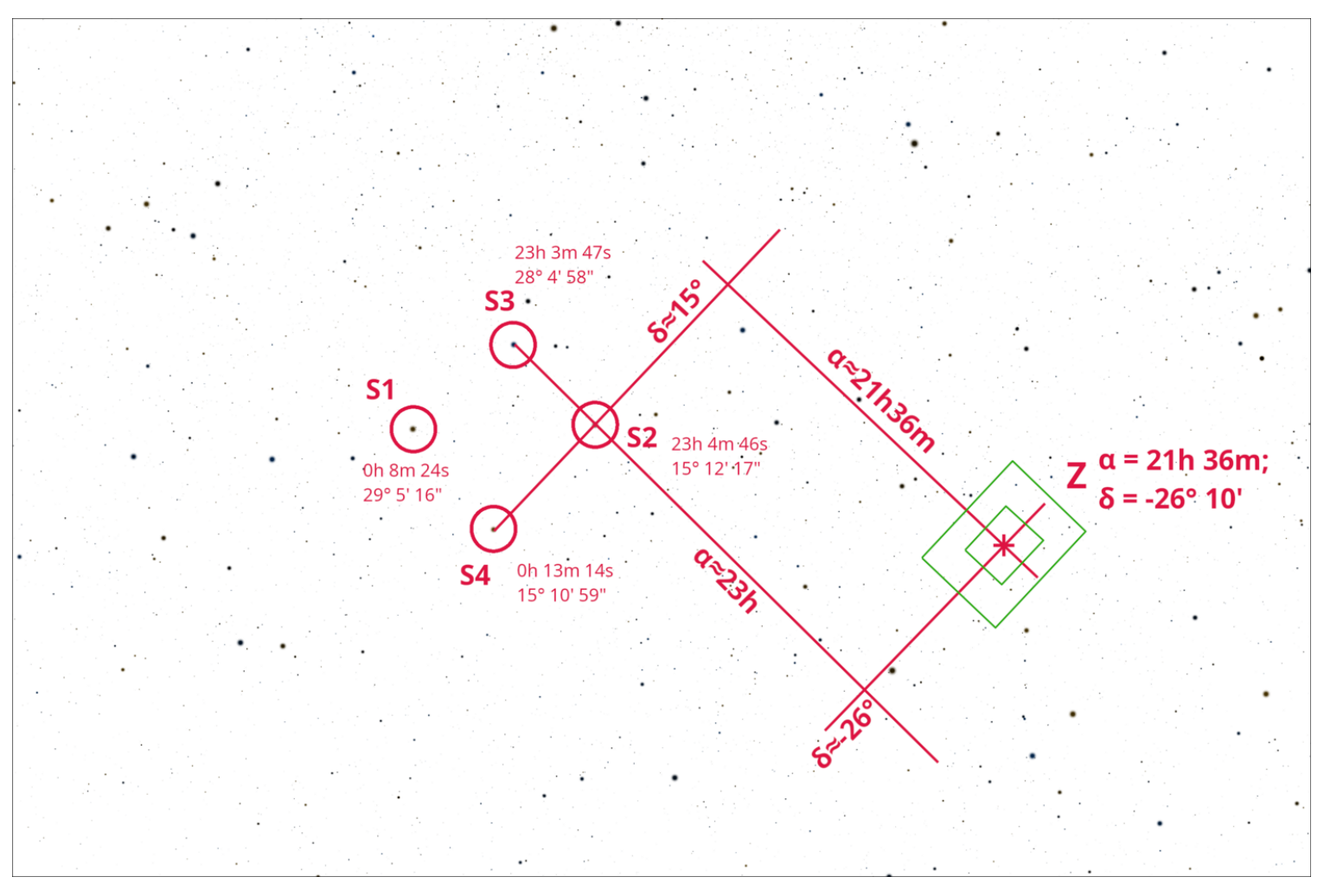
Solution to (OT01.3): After marking the new object on the given sky map, we carefully look at its position and the star pattern surrounding it. Using the 25 mm focal length eyepiece we try to locate it. By doing some fine adjustments, we try to bring the same pattern into the 10 mm focal length eyepiece (which has a crosshair).
Оригинал в Архива: Observation-Telescope-Questions.pdf · официални решения: Observation-Telescope-Solutions.pdf