IOAA 2025, Теория — Задача 8. Shadow of a black hole
IOAA 2025 — Theory Examination · 20 т.
Theory Examination Instructions
You are given an envelope marked B. Please verify the Contestant Code printed on it. Inside you will find:
- This Instruction Sheet and/or This Instruction Sheet in your native language (if applicable)
- Data Sheet and/or Data Sheet in your native language (if applicable)
- A set of Working Sheets
- One envelope marked S (please verify the Contestant Code marked on it).
You are allowed to open the envelope S only when the whistle is blown to mark the start of the examination.
Inside the envelope S you will find the following:
- Question Paper and/or Question Paper in your native language (if applicable)
- A set of Summary Answersheets.
Total duration of this examination is 5 hours.
This examination consists of the following questions:
| Questions | Marks each | Subtotal |
|---|---|---|
| T01 and T02 | 10 | marks |
| T03 and T04 | 15 | marks |
| T05–T08 | 20 | marks |
| T09 and T10 | 35 | marks |
| T11 and T12 | 50 | marks |
| Total | 300 marks |
Writing your answers:
Summary Answersheet:
- For each question a separate Summary Answersheet has been provided. Write your contestant code on each page of the Summary Answersheet.
- Final answer(s) for each question / each part of a question must be written in the corresponding box in the Summary Answersheet.
Working Sheets:
- Your detailed work must be shown on the Working Sheet.
- Write your Contestant Code on both sides of each Working Sheet.
- Start a new question on a fresh Working Sheet. Write the question number in the box provided at the top.
- Both sides of the Working Sheet should be used. Write only inside the boxed area.
- For rough work that you do not want to be evaluated, clearly strike that part out.
- For each question write the page number in the box provided at the top of the Working Sheet, starting with 1 (each sheet has 2 pages). For example, if you use only 1 Working Sheet for T01, the question number and page number should be “T01, 1” and “T01, 2” on the FRONT and BACK of that Working Sheet, respectively. Next, if you use 2 Working Sheets for T02, the question number and page number should be “T02, 1” and “T02, 2” for the first Working Sheet, and “T02, 3” and “T02, 4” on the second Working Sheet.
- You may ask for extra Working Sheets, if required.
- Note that failure to mark the Working Sheets, as instructed above, may result in your answers not being evaluated.
At the end of the examination:
- Check that you have correctly written your Contestant Code and page numbers on all used sheets.
- Arrange your sheets in the following way: Summary Answersheet of each question (starting with T01) followed by Working Sheet(s) used for that question.
- Similarly stack the Summary Answersheet and Working Sheet(s) used for each question, in sequence.
- Place the bunch of all your used sheets arranged in the above manner inside the smaller envelope S. All Summary Answersheets must be placed inside the envelope S irrespective of whether you have used them or not.
- Only the contents of the smaller envelope S will be evaluated. Any sheet that is not placed inside this envelope will not be evaluated.
- Place the smaller envelope S inside the bigger envelope B.
- All other sheets, namely, Instruction Sheet(s), Question Paper(s), Data Sheet(s) and unused Working Sheet(s) should be placed directly inside the bigger envelope B.
- Tie the thread seal on the envelope B.
- Hand over the envelope B to the examiner. Make sure that no sheet is left on the table, except the green and the red card.
General Instructions:
- If you need a visit to the toilet during the examination, please raise your hand holding the green card kept on your table. You will be escorted by a volunteer.
- If you need any other help during the examination, please raise your hand holding the red card kept on your table.
- Use only black or blue pen for writing. For drawing, you may use a pencil.
- Some marks may be deducted if the final answer is given without detailed solution.
- Some marks may be deducted if the final answers have improper number of significant digits, no units or wrong units.
- The necessary values of fundamental and astronomical constants should be taken from the Data Sheet provided to you.
Original IOAA 2025 Data Sheet
Universal constants
| Quantity | Symbol | Value |
|---|---|---|
| Avogadro constant | ||
| Boltzmann constant | ||
| Charge of electron | ||
| Planck constant | ||
| Speed of light in vacuum | ||
| Universal gravitational constant | ||
| Universal gas constant | ||
| Stefan-Boltzmann constant | ||
| Wien’s displacement constant | ||
| Permittivity of free space | ||
| Permeability of free space | ||
| Mass of electron | ||
| Mass of proton | ||
| Mass of neutron | ||
| Mass of deuteron | ||
| Mass of He nucleus |
Astronomical data
| Quantity | Symbol | Value |
|---|---|---|
| Mass of Sun | ||
| Radius of Sun | ||
| Luminosity of Sun | ||
| Effective temperature of Sun | ||
| Apparent magnitude of Sun (in V-band) | ||
| Absolute magnitude of Sun (in V-band) | ||
| Apparent bolometric magnitude of Sun | ||
| Absolute bolometric magnitude of Sun | ||
| Solar constant (above atmosphere of Earth) | ||
| Apparent angular diameter of Sun (from Earth) | ||
| Mass of Earth | ||
| Radius of Earth | ||
| Axial tilt of Earth | ||
| Inclination of the lunar orbit w.r.t. the ecliptic | ||
| Mass of Jupiter | ||
| Radius of Jupiter | ||
| 1 Astronomical Unit | 1 au | |
| 1 parsec | 1 pc | |
| 1 light-year | 1 ly | |
| 1 jansky | 1 Jy | |
| 1 tropical year | solar days ; | |
| 1 sidereal year | solar days ; | |
| Rate of precession of Vernal Equinox | per years |
Calculus related formulas
- .
- .
- .
- .
- .
- ; for .
- ; for .
Условие
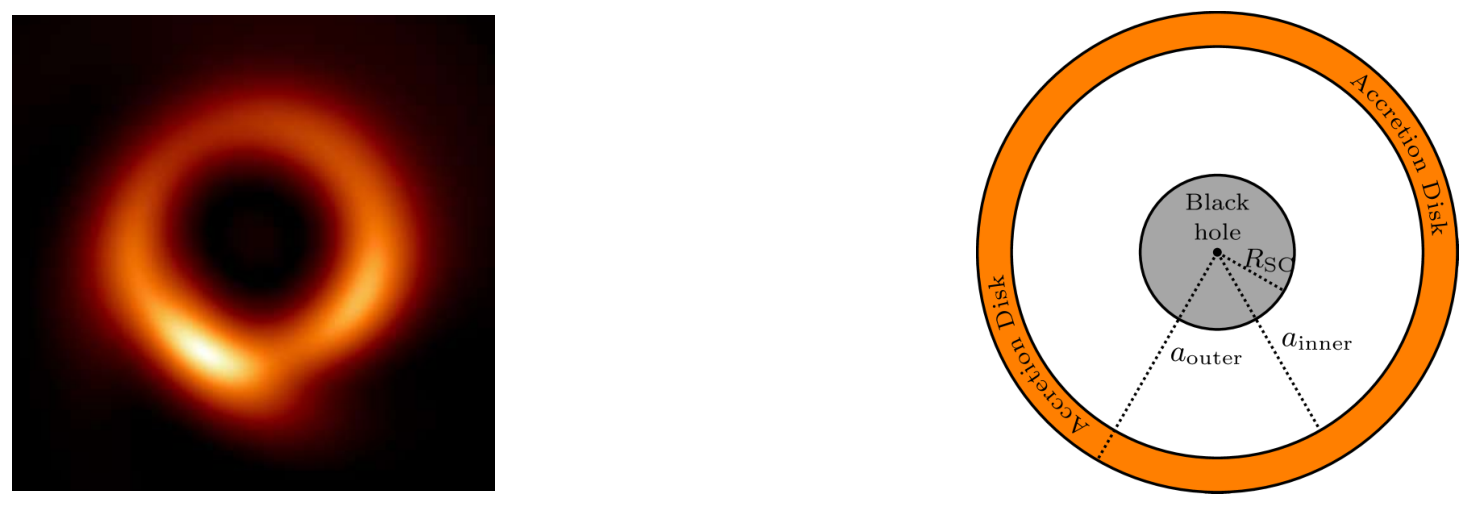
The Event Horizon Telescope (EHT) has released an image of the supermassive black hole at the centre of the M87 galaxy as shown in the left panel of the figure below.
To understand some simple features of this image, we will consider a simplified model of a non-rotating, static, spherically symmetric black hole of mass , surrounded by a massless, thin, planar accretion disk of inner and outer radii, and , respectively, where is the Schwarzschild radius. A face-on view sketch is shown in the right panel of the figure below (figure is not to scale).
We assume that the accretion disk is the only source of light to be considered. Every point on the disk emits light in all directions. This light travels under the influence of the gravitational field of the black hole. The path of the light rays is governed by two equations given below (which are similar to those of an object around the Sun):
where is the radial coordinate, is the azimuthal angle, and and are constants related to the conserved energy and conserved angular momentum, respectively.
Here is the magnitude of the radial velocity, is the magnitude of the tangential velocity, and is the angular velocity. We define the impact parameter for a trajectory as . Time dilation is neglected in this problem.
Another useful equation is obtained by differentiating the first equation:
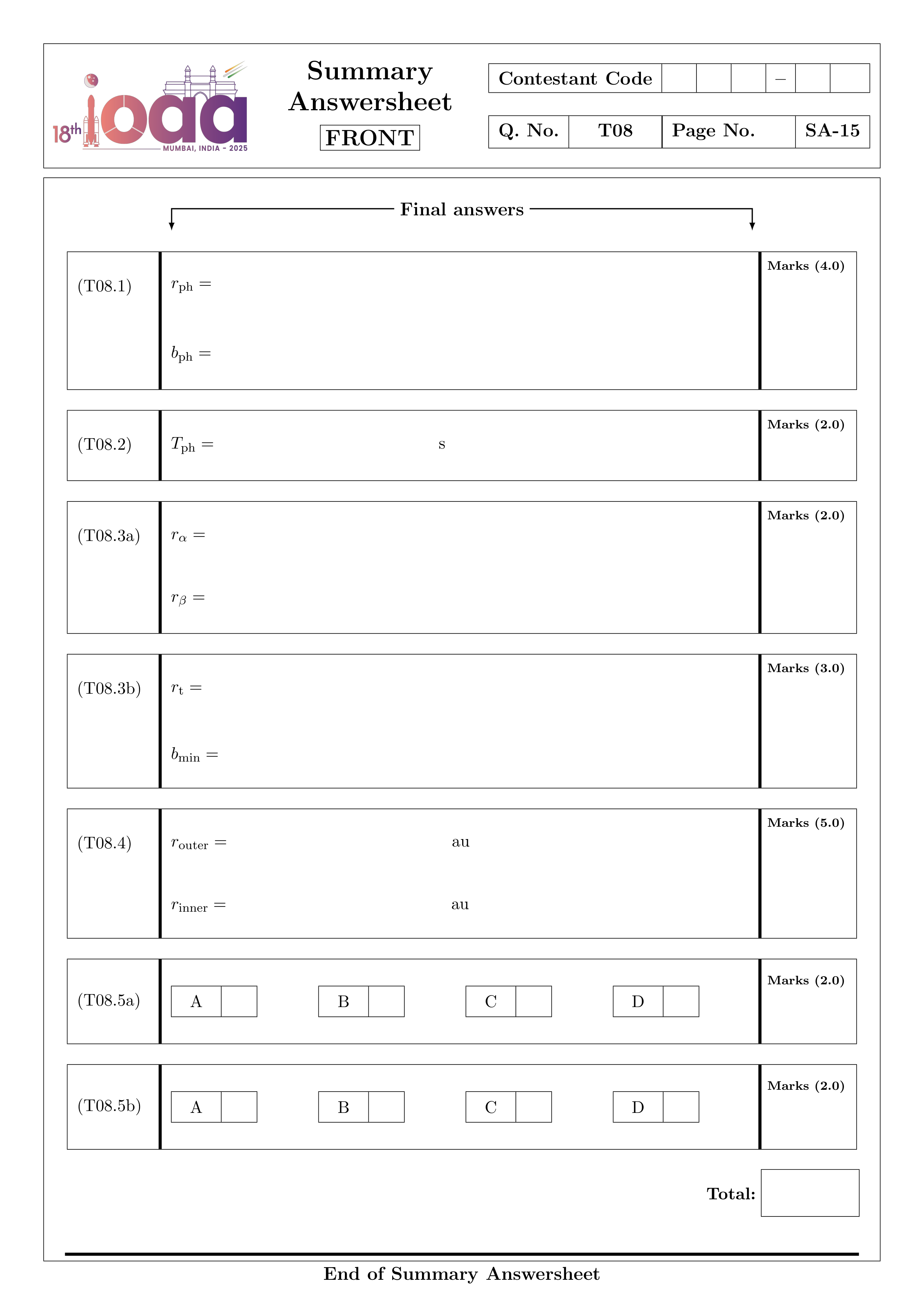
(T08.1) Circular light trajectories can exist around the black hole. Find the radius, , and impact parameter, , for such photon trajectories in terms of and relevant constants. [4 т.]
(T08.2) Calculate the time taken for completing one full orbit of the circular light trajectory in seconds. [2 т.]
(T08.3) The radial velocity equation given above (the first equation in this question) for light trajectories can be compared with an equation of the form . A schematic plot of as a function of is given below.
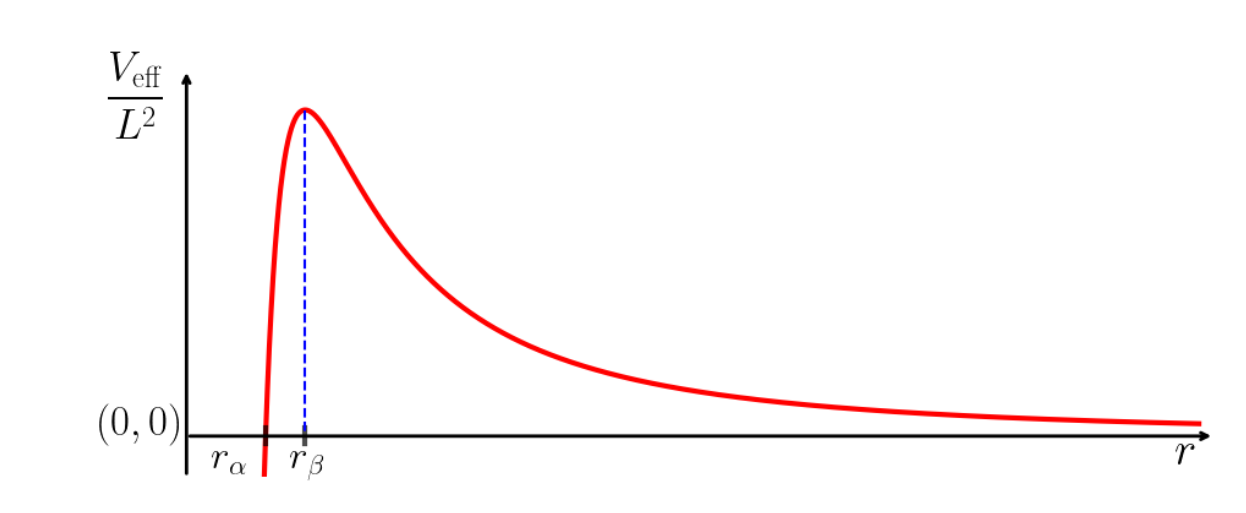
(T08.3a) The plot indicates two special radii, and . Obtain expressions for and in terms of and relevant constants. [2 т.]
(T08.3b) A photon travelling inward from the accretion disk towards the black hole can still escape out to infinity in some cases. Find the expression for the smallest value of the turning point radius, , for such a photon, in terms of and relevant constants. Find the expression for the minimum value of the impact parameter, , for this photon. [3 т.]
(T08.4) A ray of light coming from a radius from the centre of the system in the plane of the sky will suffer strong bending due to the gravity of the black hole, and eventually reach an observer (denoted by an eye) at a large distance from the system, as shown below.
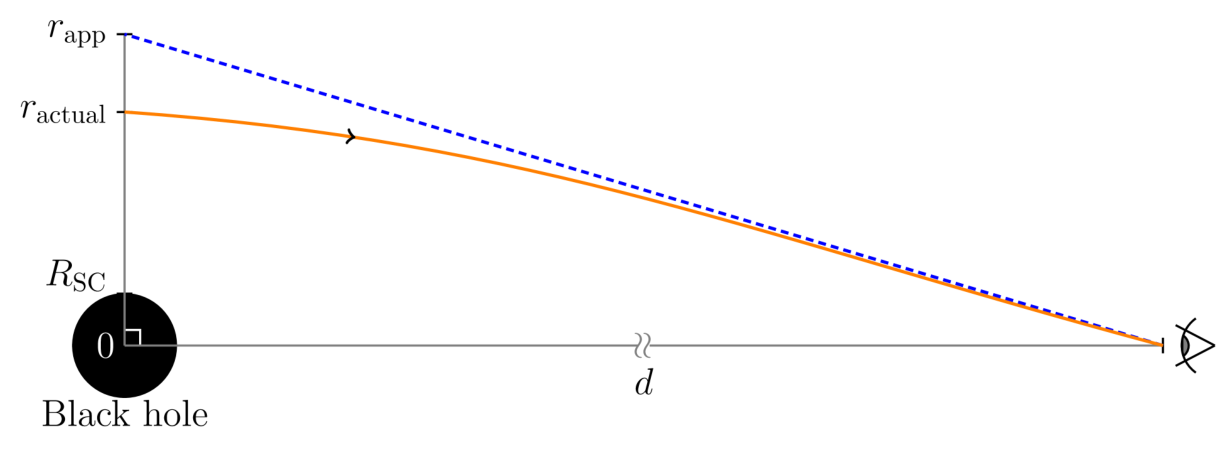
To this observer, the ray would appear to have originated from a different point at a distance from the black hole centre in the plane of the sky, where is the impact parameter for that photon trajectory. For points on the accretion disk at , one may assume the following relation:
For the distant observer, like ourselves, with a face-on view of the accretion disk, the image of the system will appear to be circularly symmetric in the plane of the sky. Determine the outermost apparent radius, , and the innermost apparent radius, , of the image in units of au. [5 т.]
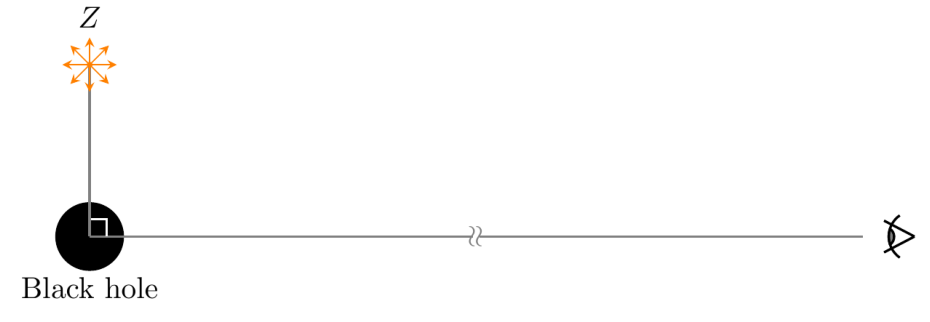
(T08.5) Consider an isolated supermassive black hole of mass without any accretion disk. A brief strong burst of electromagnetic radiation occurs for 5 s at a point Z at a distance, say, from the black hole as shown in the figure. The burst at point Z emits light in all directions. An observer at a point far from the black hole (denoted by an eye in the figure below) takes a long exposure image of the region around the black hole for 60 s.
Choose the correct option for each of the statements below:
(T08.5a) The number of possible paths for light to travel from Z to the observer is
(A) At most one (B) Exactly one (C) Exactly two (D) Greater than two. [2 т.]
(T08.5b) The number of images of the EM burst at Z that will be seen in the long exposure image is
(A) At most one (B) Exactly one (C) Exactly two (D) Greater than two. [2 т.]

Решение
(T08.1)
Circular trajectories have . Hence, the radial velocity (1.0) and rate of change of radial component of velocity (1.0). From the third equation,
we get radius of circular orbits to be (1.0). Then from the first equation, the impact parameter is found to be
(T08.2)
Time taken to complete one circular orbit is
| Half credit lower limit | Full credit range | Half credit upper limit |
|---|---|---|
| to |
(T08.3a)
corresponds to the radius where is equal to zero. Hence (1.0).
Solving for gives (1.0).
(T08.3b)
The radius of the position of peak of is the smallest possible turning point radius for the light trajectory such that it can escape to infinity (1.0). Hence, the least smallest possible turning point radius is same as the radius of the circular orbits. (1.0).
Since is equal to , the corresponding impact parameter is same as calculated in part one (1.0).
(T08.4)
Since it is given that , the apparent radii and are related to the respective impact parameters and of the corresponding light rays.
To figure out the and , one needs to choose the correct corresponding in each case.
The outer ring radius would correspond to the light ray which is emitted from the outer-edge of the accretion disk. Hence the is determined by the formula given (1.0).
Substituting we get (1.0).
| Half credit lower limit | Full credit range | Half credit upper limit |
|---|---|---|
| to |
For the inner ring radius , the light ray corresponding to the smallest turning point is the light ray which goes closest to the BH and returns back to infinity. Thus one should choose the impact parameter to be that of the circular orbit. Then, (2.0).
Hence (1.0).
| Half credit lower limit | Full credit range | Half credit upper limit |
|---|---|---|
| to |
If a student calculates the corresponding to , then only 1.0 mark out of 3.0 marks will be awarded provided the final number is within the range .
(T08.5a)
The source is a point source. For the image, one has to look at all the possible trajectories light that can reach the observer starting from point Z in the same plane as the observer, the black hole and point Z.
The shortest path is the direct path, without orbiting the black hole, connecting Z and the observer. This will be also be bent due to gravity. The next shortest path could be the one which goes half around the black hole in the anti-clockwise sense in the picture. Another one is the one with one and half revolution around the black hole in the anti-clockwise sense in the picture. And so on, paths with additional one more revolution around the black hole than the previous one.
The above is also true for trajectories in clockwise sense of rotation around the black hole. Therefore, number of possible paths for light to travel from Z to the observer is (D) Greater than two (2.0).
(T08.5b)
One has to consider the time difference in the arrival times due to the different path lengths. From Part (T08.2), it takes around sec which is for light to circularly orbit the supermassive black hole of mass . Hence, the difference in the arrival times of light along these trajectories would be at least around half of approximately, that is, around . Each of these signals would last for only the duration of the blast, i.e., 5 s.
Since the long exposure picture is only for 60 s, either one or no image will be captured, depending on whether the exposure time encompasses the short window of the arrival of one of the signals and 5 s thereafter. Therefore, the number of images in a picture would be (A) At most one (2.0).
A correct answer in this question will fetch 2.0 marks if either option (C) or option (D) were marked in 8.5a. If the answer in 8.5a is either of (A) or (B) or is not attempted, then a correct answer in this question fetches 1.0 mark.
General Marking Principles
General Marking Principles
- STRICT adherence to given marking scheme.
- No double penalty – deduction only at the original place of error; no further penalty in consequent steps, if they are otherwise correct – if final answer is physically unviable or dimensionally incorrect, deduct for final answer also.
- Significant figures: one more or one less than appropriate no. of significant figures allowed with full credit.
- Units / dimensions:
- In cases where units are not mentioned in the Summary Answersheet, 0.5 deduction for missing units.
- For missing units on the same kind of quantities in a given part, deduct only once.
- For wrong dimensions in final answer because of some error in earlier steps, no credit for final answer, irrespective of no-double penalty principle.
- If expression is asked in terms of x, y, …: deduction of final part credit if expression is not in terms of appropriate quantities.
- Cumulative part marking: all previous part credits to be added if final expression / number is correct (unless otherwise specified).
- Final answer not in Summary Answersheet, but present inside: if final answer is present on Working Sheet, but not transferred on Summary Answersheet, it is to be credited.
Бележки за изданието
The printed question, key and blank answer sheets contain differing expressions and units. The Balmer key uses different rounded colour excesses; the quasar scale changes its angular unit; the neutron-star key prints differing mass-rate units/values. The black-hole-shadow question prints an unsquared radial speed in its comparison equation, while the repeated key uses a square. Atmospheric Seeing asks for a diameter but its key describes a radius. The nucleosynthesis key changes strict inequalities, has a differently grouped decay exponent, and includes an extra time-arrow field also present on its answer sheet. The stellar-profile key omits a factor in one line that appears in the next. The Hawking key prints a separation step differing from its integral and a horizon volume differing from its prose radius. Its answer sheet labels a temperature field with “s”. These native forms are preserved, including every original blank answer page.
Оригинал в Архива: Theory-Questions.pdf · официални решения: Theory-Solution.pdf · допълнителни данни: Theory-Summary-Answersheet.pdf · допълнителни данни: Theory-Instructions.pdf · допълнителни данни: Data_Sheet.pdf · допълнителни данни: IOAA2025_General_Marking_Scheme.pdf