IOAA 2025, Теория — Задача 9. Atmospheric Seeing
IOAA 2025 — Theory Examination · 35 т.
Theory Examination Instructions
You are given an envelope marked B. Please verify the Contestant Code printed on it. Inside you will find:
- This Instruction Sheet and/or This Instruction Sheet in your native language (if applicable)
- Data Sheet and/or Data Sheet in your native language (if applicable)
- A set of Working Sheets
- One envelope marked S (please verify the Contestant Code marked on it).
You are allowed to open the envelope S only when the whistle is blown to mark the start of the examination.
Inside the envelope S you will find the following:
- Question Paper and/or Question Paper in your native language (if applicable)
- A set of Summary Answersheets.
Total duration of this examination is 5 hours.
This examination consists of the following questions:
| Questions | Marks each | Subtotal |
|---|---|---|
| T01 and T02 | 10 | marks |
| T03 and T04 | 15 | marks |
| T05–T08 | 20 | marks |
| T09 and T10 | 35 | marks |
| T11 and T12 | 50 | marks |
| Total | 300 marks |
Writing your answers:
Summary Answersheet:
- For each question a separate Summary Answersheet has been provided. Write your contestant code on each page of the Summary Answersheet.
- Final answer(s) for each question / each part of a question must be written in the corresponding box in the Summary Answersheet.
Working Sheets:
- Your detailed work must be shown on the Working Sheet.
- Write your Contestant Code on both sides of each Working Sheet.
- Start a new question on a fresh Working Sheet. Write the question number in the box provided at the top.
- Both sides of the Working Sheet should be used. Write only inside the boxed area.
- For rough work that you do not want to be evaluated, clearly strike that part out.
- For each question write the page number in the box provided at the top of the Working Sheet, starting with 1 (each sheet has 2 pages). For example, if you use only 1 Working Sheet for T01, the question number and page number should be “T01, 1” and “T01, 2” on the FRONT and BACK of that Working Sheet, respectively. Next, if you use 2 Working Sheets for T02, the question number and page number should be “T02, 1” and “T02, 2” for the first Working Sheet, and “T02, 3” and “T02, 4” on the second Working Sheet.
- You may ask for extra Working Sheets, if required.
- Note that failure to mark the Working Sheets, as instructed above, may result in your answers not being evaluated.
At the end of the examination:
- Check that you have correctly written your Contestant Code and page numbers on all used sheets.
- Arrange your sheets in the following way: Summary Answersheet of each question (starting with T01) followed by Working Sheet(s) used for that question.
- Similarly stack the Summary Answersheet and Working Sheet(s) used for each question, in sequence.
- Place the bunch of all your used sheets arranged in the above manner inside the smaller envelope S. All Summary Answersheets must be placed inside the envelope S irrespective of whether you have used them or not.
- Only the contents of the smaller envelope S will be evaluated. Any sheet that is not placed inside this envelope will not be evaluated.
- Place the smaller envelope S inside the bigger envelope B.
- All other sheets, namely, Instruction Sheet(s), Question Paper(s), Data Sheet(s) and unused Working Sheet(s) should be placed directly inside the bigger envelope B.
- Tie the thread seal on the envelope B.
- Hand over the envelope B to the examiner. Make sure that no sheet is left on the table, except the green and the red card.
General Instructions:
- If you need a visit to the toilet during the examination, please raise your hand holding the green card kept on your table. You will be escorted by a volunteer.
- If you need any other help during the examination, please raise your hand holding the red card kept on your table.
- Use only black or blue pen for writing. For drawing, you may use a pencil.
- Some marks may be deducted if the final answer is given without detailed solution.
- Some marks may be deducted if the final answers have improper number of significant digits, no units or wrong units.
- The necessary values of fundamental and astronomical constants should be taken from the Data Sheet provided to you.
Original IOAA 2025 Data Sheet
Universal constants
| Quantity | Symbol | Value |
|---|---|---|
| Avogadro constant | ||
| Boltzmann constant | ||
| Charge of electron | ||
| Planck constant | ||
| Speed of light in vacuum | ||
| Universal gravitational constant | ||
| Universal gas constant | ||
| Stefan-Boltzmann constant | ||
| Wien’s displacement constant | ||
| Permittivity of free space | ||
| Permeability of free space | ||
| Mass of electron | ||
| Mass of proton | ||
| Mass of neutron | ||
| Mass of deuteron | ||
| Mass of He nucleus |
Astronomical data
| Quantity | Symbol | Value |
|---|---|---|
| Mass of Sun | ||
| Radius of Sun | ||
| Luminosity of Sun | ||
| Effective temperature of Sun | ||
| Apparent magnitude of Sun (in V-band) | ||
| Absolute magnitude of Sun (in V-band) | ||
| Apparent bolometric magnitude of Sun | ||
| Absolute bolometric magnitude of Sun | ||
| Solar constant (above atmosphere of Earth) | ||
| Apparent angular diameter of Sun (from Earth) | ||
| Mass of Earth | ||
| Radius of Earth | ||
| Axial tilt of Earth | ||
| Inclination of the lunar orbit w.r.t. the ecliptic | ||
| Mass of Jupiter | ||
| Radius of Jupiter | ||
| 1 Astronomical Unit | 1 au | |
| 1 parsec | 1 pc | |
| 1 light-year | 1 ly | |
| 1 jansky | 1 Jy | |
| 1 tropical year | solar days ; | |
| 1 sidereal year | solar days ; | |
| Rate of precession of Vernal Equinox | per years |
Calculus related formulas
- .
- .
- .
- .
- .
- ; for .
- ; for .
Условие
A telescope with an achromatic convex objective lens of diameter and focal length is pointed to a star at the zenith.
(T09.1) Find the diameter (in m), , of the image of a point source as produced by the objective lens at its focal plane for green light (), considering only the effects of diffraction. [1 т.]
The image of an astronomical source is also affected by the so-called “atmospheric seeing”.
The boundaries between the layers in the atmosphere as well as the refractive indices of the layers change continuously due to turbulence, temperature variation and other factors. This leads to tiny changes in the position of the image in the focal plane of the telescope, known as the “twinkling effect”. For rest of the problem, apart from the diffraction limited finite size of the image of the star discussed above, no interference effects will be considered.
The left panel of the figure below shows a vertical cross-section of the atmosphere with multiple layers of different refractive indices (). The right panel shows the zoomed in view of a thin vertical segment of the atmosphere and the boundary between the two lowest atmospheric layers of refractive indices and (). We consider only these two layers and their boundary for this problem. The diagrams are not to scale.
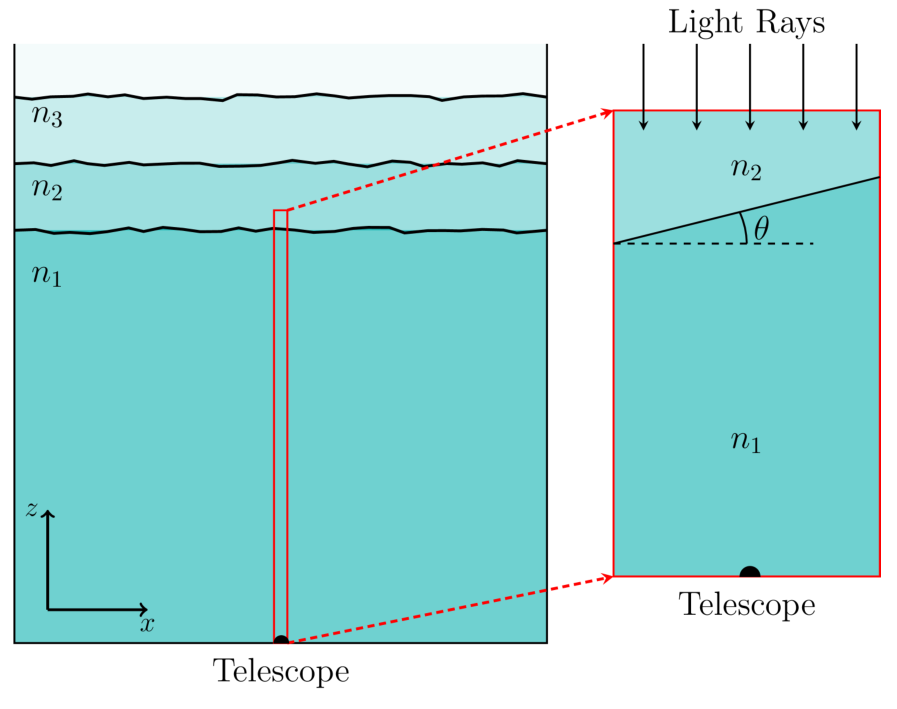
(T09.2) Let the boundary between the two layers be at a height directly above the telescope objective, with a tilt of with respect to the horizontal plane. In all parts of this problem is taken to be positive in the anti-clockwise direction. For a monochromatic light source, and . Let the angular shift in the position of the image at the focal plane of the telescope for a star at the zenith be .
(T09.2a) Draw an appropriately labelled ray-diagram at the boundary showing , , and . [2 т.]
(T09.2b) Find the expression for in terms of , and . Use the small angle approximations: and . [2 т.]
(T09.2c) Calculate the displacement, (in m), in the position of the image if increases by 1% (keeping and fixed). [3 т.]
(T09.2d) Calculate the displacement, (in m), in the position of the image if increases by 0.0001% (keeping and fixed). [3 т.]
(T09.3) For white light coming from a star at the zenith, choose which of the following most closely describes the shape and colour of the image by ticking () the appropriate box (only one) in the Summary Answersheet. Note increases from left to right in the figure.
| Image colour | Image shape | Left edge | Right edge | |
|---|---|---|---|---|
| A | White | Circular | ||
| B | White | Elliptical | ||
| C | Coloured | Circular | Blue | Red |
| D | Coloured | Circular | Red | Blue |
| E | Coloured | Elliptical | Blue | Red |
| F | Coloured | Elliptical | Red | Blue |
[2 т.]
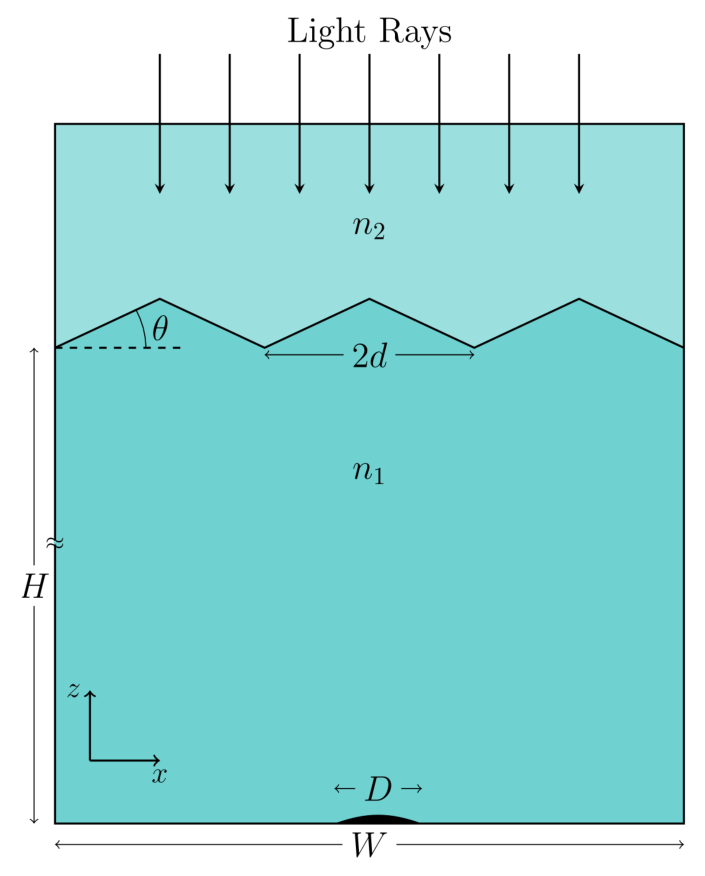
For all remaining parts of this question we consider monochromatic green light with . We model the boundary between the layers as a set of infinite zigzag planes (running perpendicular to the plane of the page) separated by along -axis, with either or .
The figure below (not to scale) shows a cross-section of this model of the atmosphere of width (). For telescopes with large aperture this zigzag nature of the boundary results in formation of speckles in the focal plane.
(T09.4) Consider an atmosphere modelled as above.
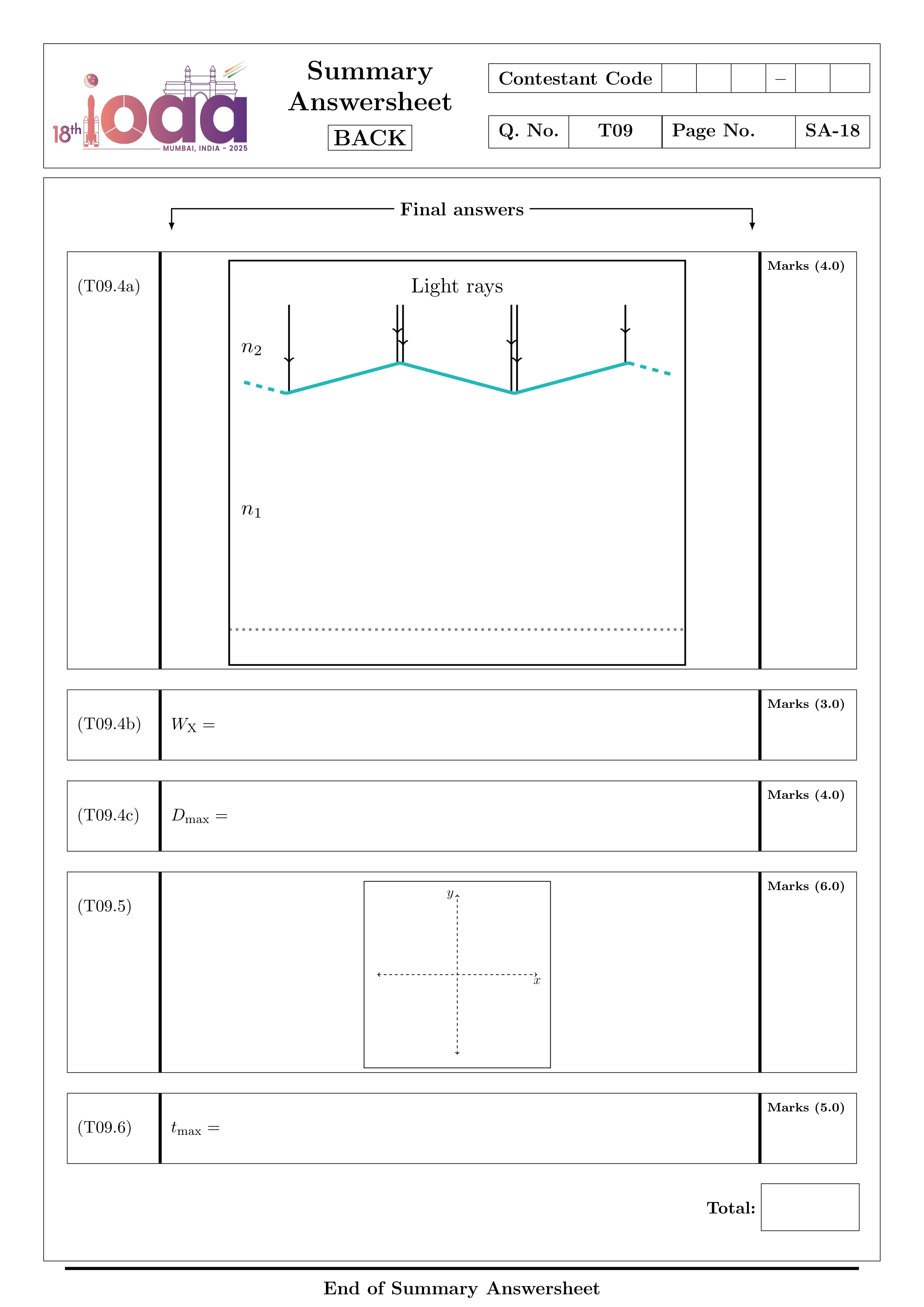
(T09.4a) A section of the atmosphere with consecutive zigzag planes, with same parameters as stated above, is shown in the diagram below (not to scale).
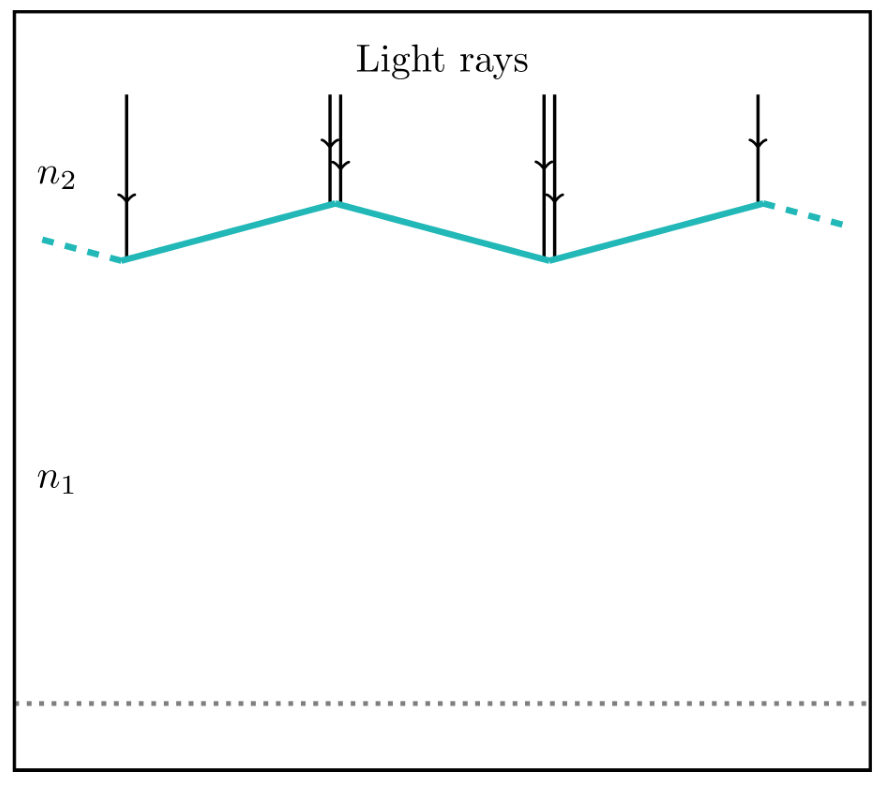
In this diagram, reproduced in the Summary Answersheet, draw the paths of the incident light rays up to the plane where the telescope objective is placed, shown by the gray dotted line.
Mark the region(s), if any, by “X” in the diagram where no light rays will reach. [4 т.]
(T09.4b) Calculate the width of such region(s). [3 т.]
(T09.4c) Find the largest diameter, , of the telescope objective with which it will be possible to obtain a single image of a star, by appropriately choosing the location of the telescope relative to the structure of the boundary. [4 т.]
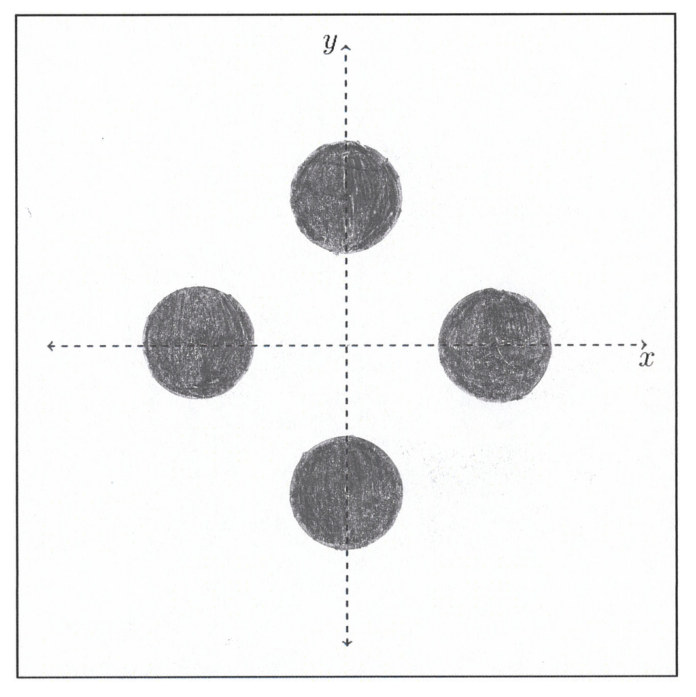
(T09.5) Consider the case when the zigzag shape of the boundary is allowed in both and directions, (like a field of pyramids), and (with ).
Draw the qualitative pattern of the resulting speckles in the box given in the Summary Answersheet. [6 т.]
(T09.6) For a turbulent atmosphere again consider the same parallelly running zigzag shape of the boundary layer only along -direction, but now the angle between two planes are changing at a uniform rate from to in 1.0 s. Assume that this leads to a uniform rate of shift of the position of the image.
Consider a telescope with and . Estimate the longest exposure time allowed for its CCD camera so that one gets only a single image, and any possible deviation in its position remains less than 1% of the diffraction limited diameter of the image. [5 т.]
Решение
(T09.1)
Angular radius of the diffraction disk is given by . The radius of the image is therefore,
We accept (i.e., without the factor of 1.22 in the formula). No other values accepted.
(T09.2a)
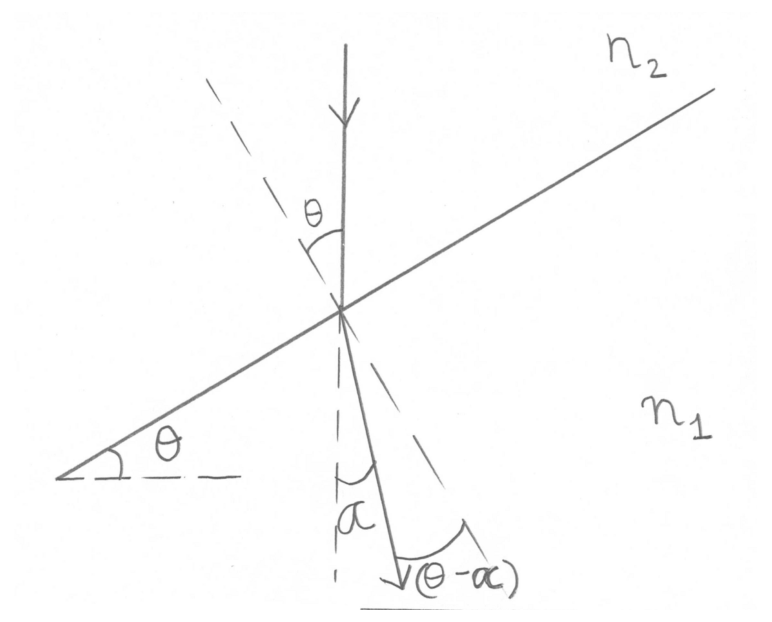
(2.0)
| Marks | |
|---|---|
| Incident, refracted rays with arrows and normal to boundary drawn | 0.5 |
| Angle of incidence shown as | 0.5 |
| Angle of shift in refracted ray shown as | 0.5 |
| Both and shown | 0.5 |
(T09.2b)
Using Snell’s Law,
Using small angle approximation ( and )
(T09.2c)
The shift in position of image due to change in is:
Wrong sign will have penalty of 1.0 mark.
(T09.2d)
Shift in the position of image due to the change in is:
Wrong sign will have penalty of 1.0 mark.
(T09.3)
Blue light has larger refractive index than the red light, hence it will bend more. So incoming light will vary in colour from red to blue towards right. So, the correct answer will be F (2.0).
Note: convex lens inverts image, but does not affect refractive index dependent bending. Options D or E get 1.0 mark.
(T09.4a)
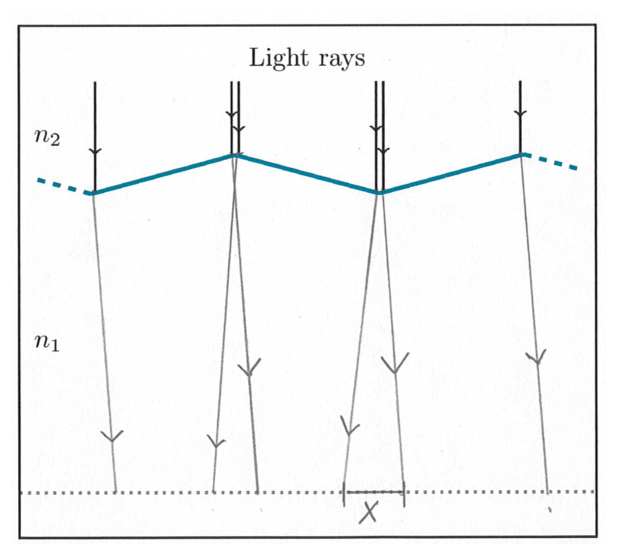
(4.0)
| Marks | |
|---|---|
| All three sets of parallel rays drawn with correct inclinations | 2.0 |
| All rays have arrow marks | 0.5 |
| X-patch marked correctly | 1.5 |
(T09.4b)
Each set of planes, with specific tilt, will lead to one set of stripes of parallel rays. From solution of part (T09.2b),
Two sets of planes with relative angle of will create angular separation of between the stripes (1.0). At a distance of this will create a horizontal separation of . For , , the horizontal shift will be
Just below the point where two planes make upward bend, a patch of this width 0.35 cm will be centred where no light from the star will reach. Hence, (1.0).
(T09.4c)
From the figure one can see that two adjacent planes (with downward bend), will lead to overlapping stripes of rays producing two images. Therefore, the region in which only single image is formed will be 10.0 cm (including the region X). Hence, (4.0).
will get 1.0 mark. will get 2.0 marks.
(T09.5)
For , several stripes will fall on the lens, leading to multiple images. Here, four images will form, two each from the set of planes with zigzag shapes along -axis and -axis respectively.
First consider the zigzag shape of the boundary along the x axis. From solution of (T09.4), angle between these two sets of rays will be . With , the separation between the two images will be .
For , the diffraction peak size . So the images formed by the two sets of planes (with tilts of from horizontal for each set) will form two spots, clearly separated along the -axis. Similarly for the -axis.
The resulting speckles will be as shown below.
| Marks | |
|---|---|
| 4 spots drawn | 3.0 |
| Spots along and axes | 1.0 |
| Circular shape of spots | 1.0 |
| No overlap of spots | 1.0 |
(T09.6)
A single image is formed when only one stripe of rays is allowed to fall on the objective. This is only possible when the objective is placed suitably below the zigzag pattern.
The diffraction-limited image size for a lens is (1.0).
The angle of the atmospheric layer changes from to .
Change in angle of rays is .
Shift in image position (1.0).
Now, shift in the image position allowed is 1% of the image size. Allowed shift (1.0).
Longest exposure time Time taken by the image to shift by .
Image shifts by in 1 s shift occurs in 0.024 s.
General Marking Principles
General Marking Principles
- STRICT adherence to given marking scheme.
- No double penalty – deduction only at the original place of error; no further penalty in consequent steps, if they are otherwise correct – if final answer is physically unviable or dimensionally incorrect, deduct for final answer also.
- Significant figures: one more or one less than appropriate no. of significant figures allowed with full credit.
- Units / dimensions:
- In cases where units are not mentioned in the Summary Answersheet, 0.5 deduction for missing units.
- For missing units on the same kind of quantities in a given part, deduct only once.
- For wrong dimensions in final answer because of some error in earlier steps, no credit for final answer, irrespective of no-double penalty principle.
- If expression is asked in terms of x, y, …: deduction of final part credit if expression is not in terms of appropriate quantities.
- Cumulative part marking: all previous part credits to be added if final expression / number is correct (unless otherwise specified).
- Final answer not in Summary Answersheet, but present inside: if final answer is present on Working Sheet, but not transferred on Summary Answersheet, it is to be credited.
Бележки за изданието
The printed question, key and blank answer sheets contain differing expressions and units. The Balmer key uses different rounded colour excesses; the quasar scale changes its angular unit; the neutron-star key prints differing mass-rate units/values. The black-hole-shadow question prints an unsquared radial speed in its comparison equation, while the repeated key uses a square. Atmospheric Seeing asks for a diameter but its key describes a radius. The nucleosynthesis key changes strict inequalities, has a differently grouped decay exponent, and includes an extra time-arrow field also present on its answer sheet. The stellar-profile key omits a factor in one line that appears in the next. The Hawking key prints a separation step differing from its integral and a horizon volume differing from its prose radius. Its answer sheet labels a temperature field with “s”. These native forms are preserved, including every original blank answer page.
Оригинал в Архива: Theory-Questions.pdf · официални решения: Theory-Solution.pdf · допълнителни данни: Theory-Summary-Answersheet.pdf · допълнителни данни: Theory-Instructions.pdf · допълнителни данни: Data_Sheet.pdf · допълнителни данни: IOAA2025_General_Marking_Scheme.pdf