IOAA Jr. 2022, Теория, тест с избираем отговор — Задача 8. Spaceship to the Sun
International Olympiad of Astronomy and Space Sciences for Juniors — Romania– Câmpulung Moldovenesc — October 31 - November 7 2022 — Theoretical Round — I. Multiple choice problems – 100 points · 31 октомври 2022 г.
I. Multiple choice problems – 100 points
For these problems, you have to choose only one correct answer. Please write your answer on answer-sheet. Don’t forget to write the number of the problem, i.e Grid 1. (c).
Условие
In a future program, NASA plans to launch a spacecraft, aimed directly at the Sun, without a human crew, to gather information, on its way to the Sun, both about all the inner planets and, in particular, about the Sun.
They are known: the distance Earth - Sun, ; the period of the Earth's rotation around the Sun, ; the radius of the Sun, .
If the launch of the spacecraft will be done in such a way that its motion relative to the Sun is a free fall, then the approximate duration of the Earth-Sun flight is:
a)
b)
c)
d)
Отговори
- c)
Решение
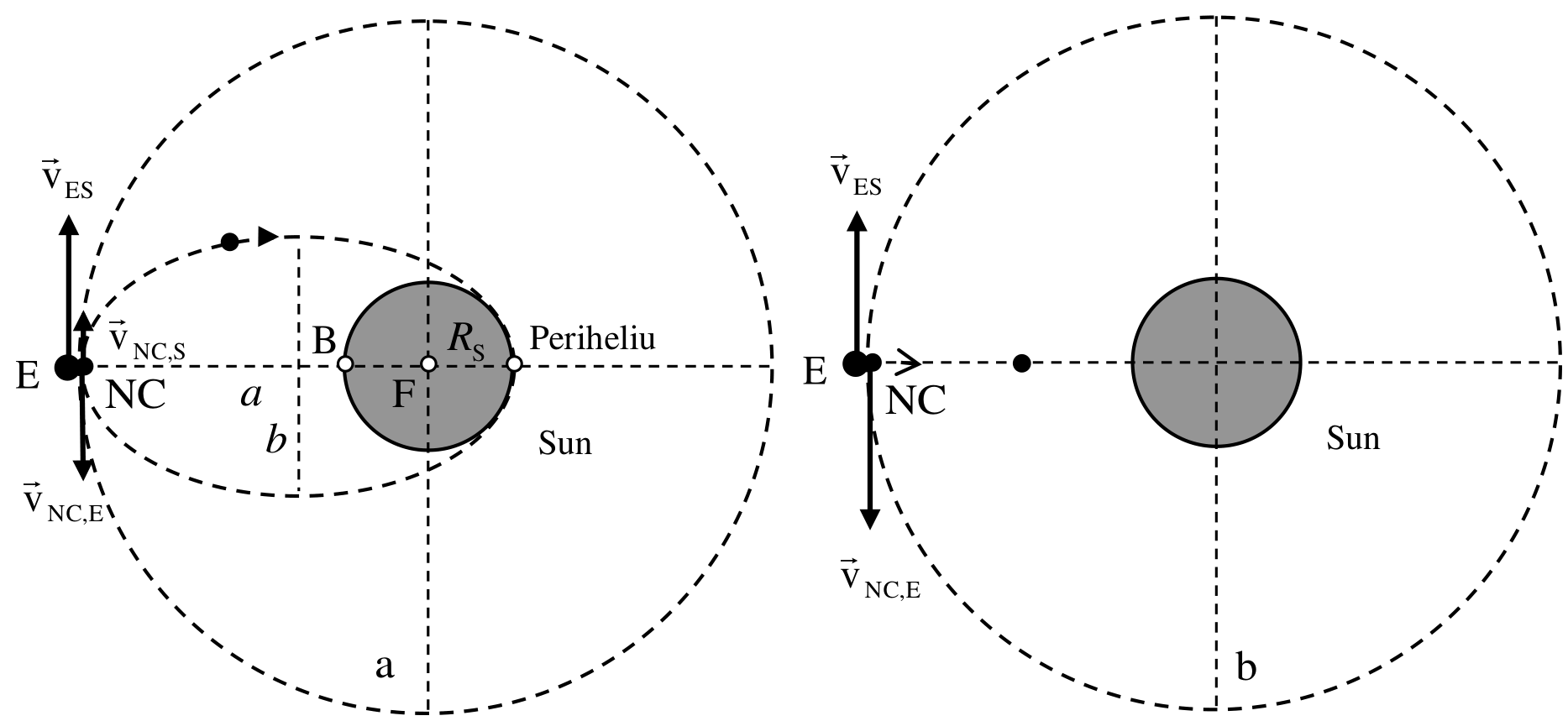
Imagine that a spacecraft is launched from the Earth whose speed in relation to the Sun is slightly lower than the orbital speed of the Earth in relation to the Sun. The ship will evolve around the Sun in an elliptical trajectory, with the Sun in the focus opposite the launch point. The lower this initial speed of the ship, the longer the ellipse on which the spacecraft will evolve around the Sun will be longer. For a certain value of this speed, the spacecraft, in its elliptical motion around the Sun, will touch the surface of the Sun, as shown in Figure 1. In this case, the height of the ship's orbit is equal to the Sun's radius. which we know is:
As a result, the semi-axes of the ship's elliptical orbit, tangent to the Sun's surface, are a and b a, respectively, so that the small half-axis of this elliptical orbit can be neglected . Under these conditions, the trajectory of the ship in relation to the Sun can be estimated to be rectilinear, joining the launching point of the ship with the Sun, so that the ship will reach the surface of the Sun, in point B, after a free fall towards it.
Conclusion: In order for the ship to fall freely on the surface of the Sun, in point B, after a rectilinear course in relation to it, at the initial moment of its launch from the surface of the Earth, the speed of the ship in relation to the Sun must have been zero.
To meet this condition, it is necessary that at the time of launching the ship from the Earth's surface, a speed relative to the Earth be imprinted on the ship, so that the speed of the ship relative to the Sun is zero.
The Earth's launch velocity relative to Earth must be inversely related to the orientation of the Earth's orbital velocity relative to the Sun, as shown in Figure b in Figure 1, and their modulus must be equal:
According to Kepler's third law, it can be written that:
where is the period of the spacecraft's motion on the elongated elliptical trajectory around the Sun;
so that the duration of the free fall of the ship on the surface of the Sun is:
Оригинал в Архива: Multiple_Choice.pdf · официални решения: Grid_1.pdf · допълнителни данни: Grid_2.pdf · допълнителни данни: Grid_3.pdf · допълнителни данни: Grid_4.pdf · допълнителни данни: Grid_5.pdf · допълнителни данни: Grid_6.pdf · допълнителни данни: Grid_7.pdf · допълнителни данни: Grid_8.pdf · допълнителни данни: Grid_9.pdf · допълнителни данни: Grid_10.pdf