IOM 2016, Теория — Задача 3. A Silk Purse out of a Sow’s Ear, or Drugs from Biomass
1st Olympiad of Metropolises — Chemistry, Theoretical Problems, Official English version · 7 септември 2016 г.
Original cover
Country: ______
Name: ______
1st Olympiad of Metropolises
Chemistry
Theoretical Problems
7 September 2016
Moscow, Russia
Chemistry. Theoretical problems. Official English version
Указания
- Begin only when the START command is given. You have 4.5 hours to work on the problems.
- Use only the pen and calculator provided.
- All results must be written in the appropriate boxes within the text. Anything written elsewhere will not be graded. Use the reverse of the problem pages if you need scratch paper.
- Write relevant calculations in the appropriate boxes when necessary. If you provide only correct end results for complicated questions, you will receive no score.
- Raise your hand if you have any questions concerning the text of the problems.
- Raise your hand if you need a restroom break.
- The official English version of this examination is available on request only for clarification.
Original key cover
1st Olympiad of Metropolises
Chemistry
Theoretical Problems with solutions
7 September 2016
Moscow, Russia
Chemistry. Theoretical problems with solutions. Official English version
Условие
Problem 3. A Silk Purse out of a Sow’s Ear, or Drugs from Biomass (12 marks)
| Question | 1 | 2 | 3 | Total |
|---|---|---|---|---|
| Points | 14 | 6 | 10 | 30 |
Dedicated to the blessed memory of Professor A. V. Butin
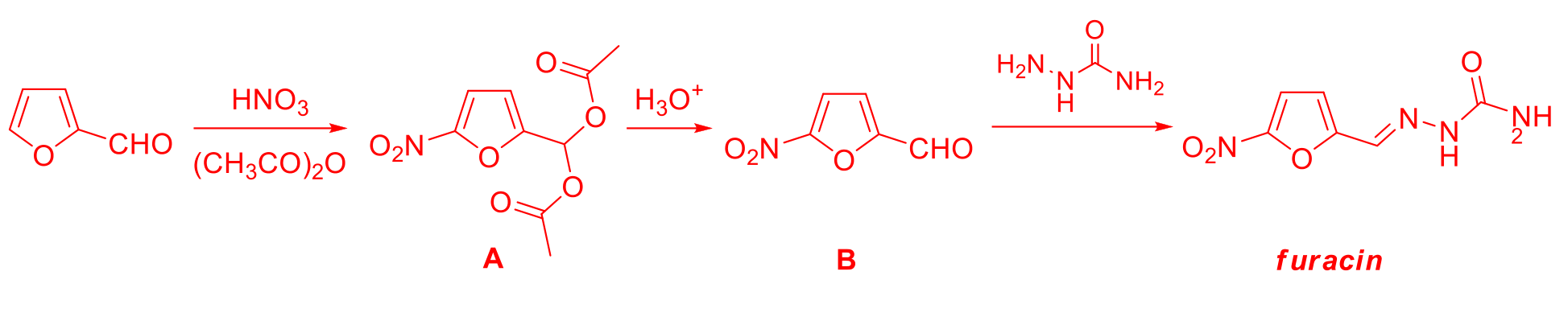
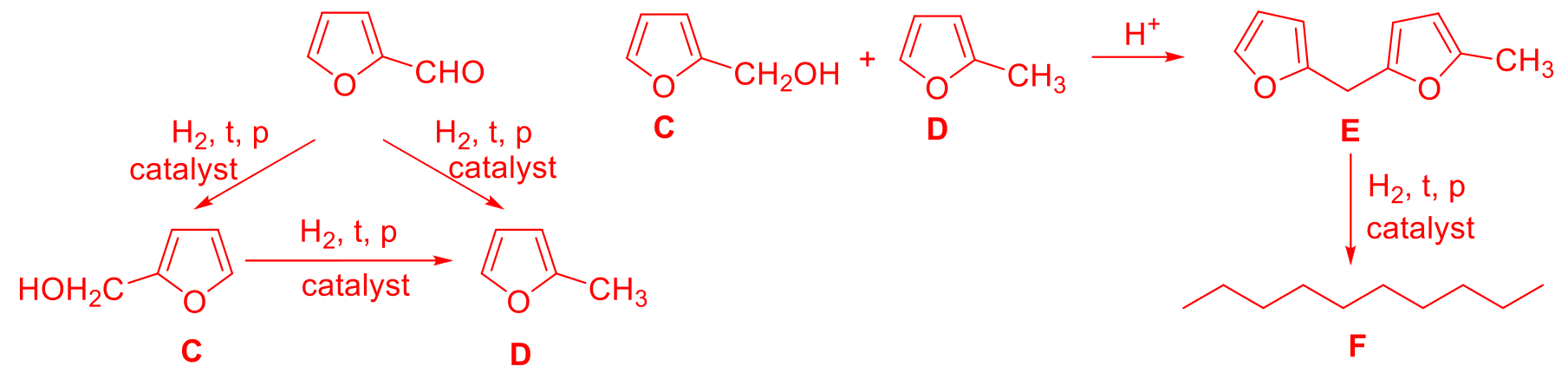
A significant attention is now paid to the use of biomass as a source of organic chemicals. One of the most important products of biomass processing is furfural (furan-2-carbaldehyde). It can be easily transformed into other furan derivatives, including medicines, or linear alkanes which can be used as diesel fuel. One of the methods for furfural transformation into biofuel as well as preparation of bactericidal agent furacin from furfural are given in the scheme below.
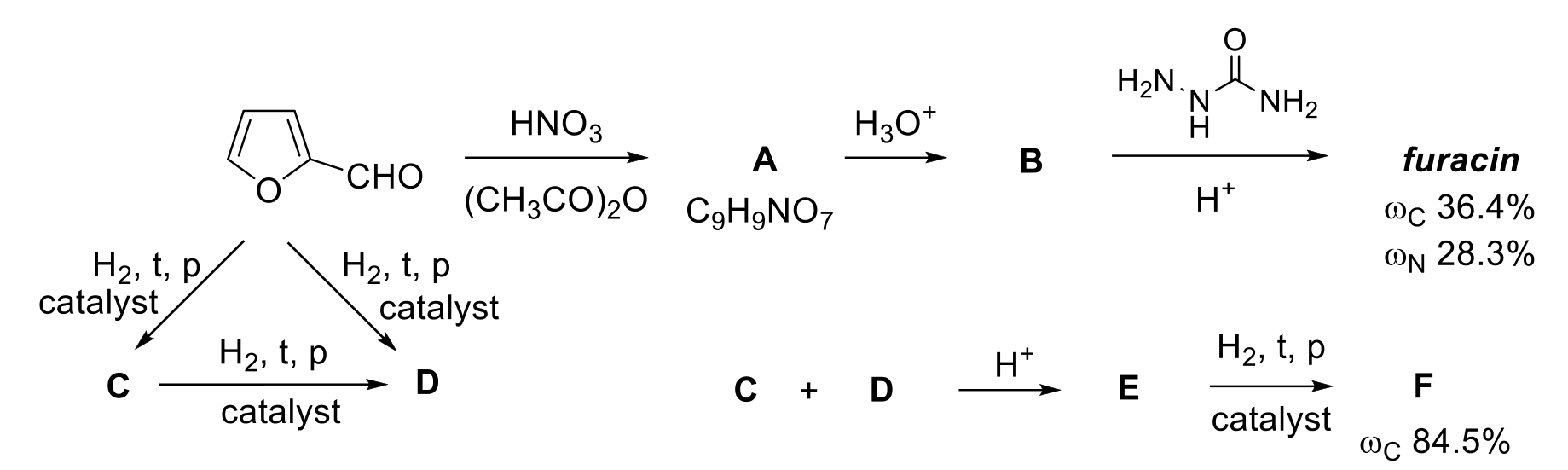
1 Write down the structural formulas of furacin and compounds A–F.
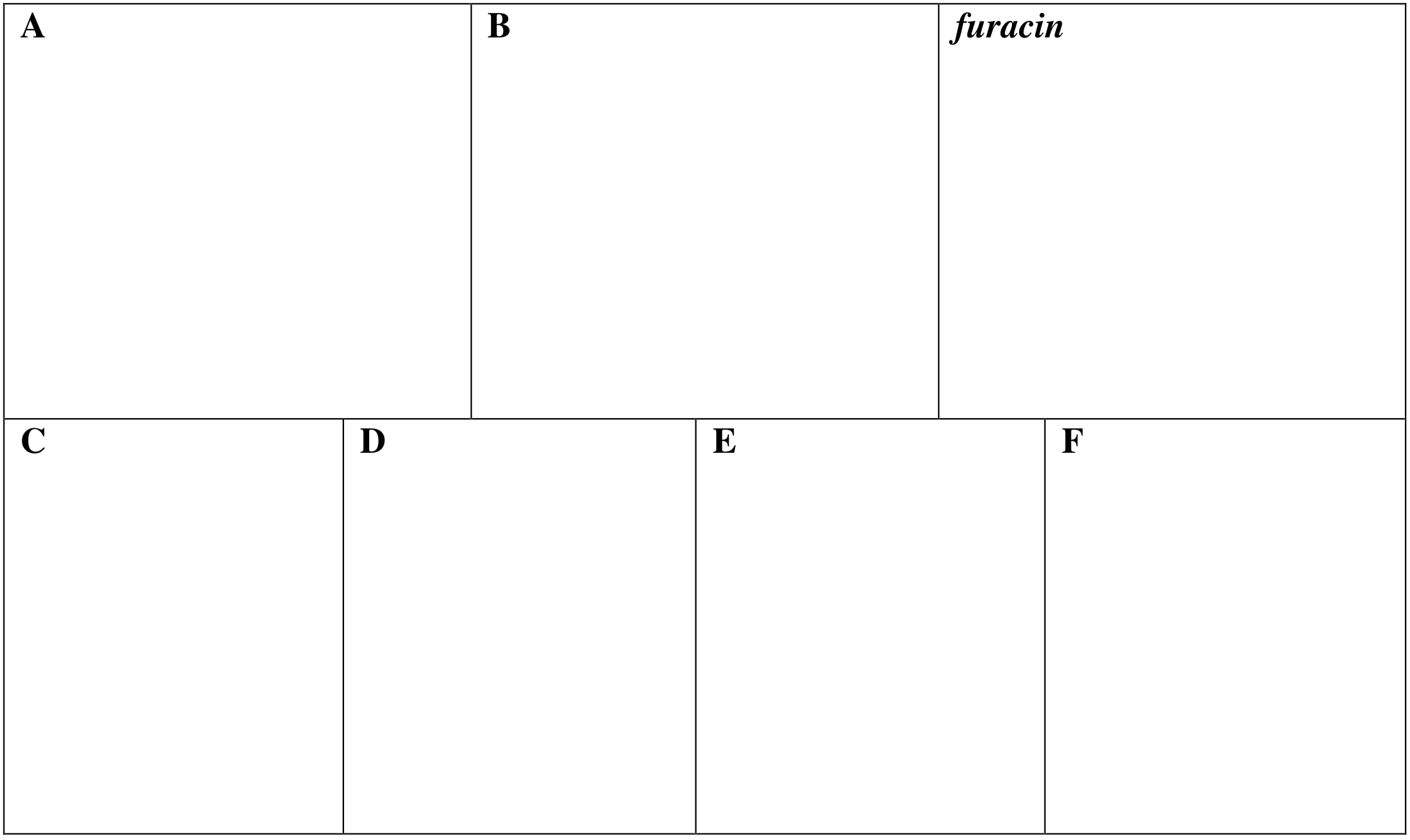
[14 т.]
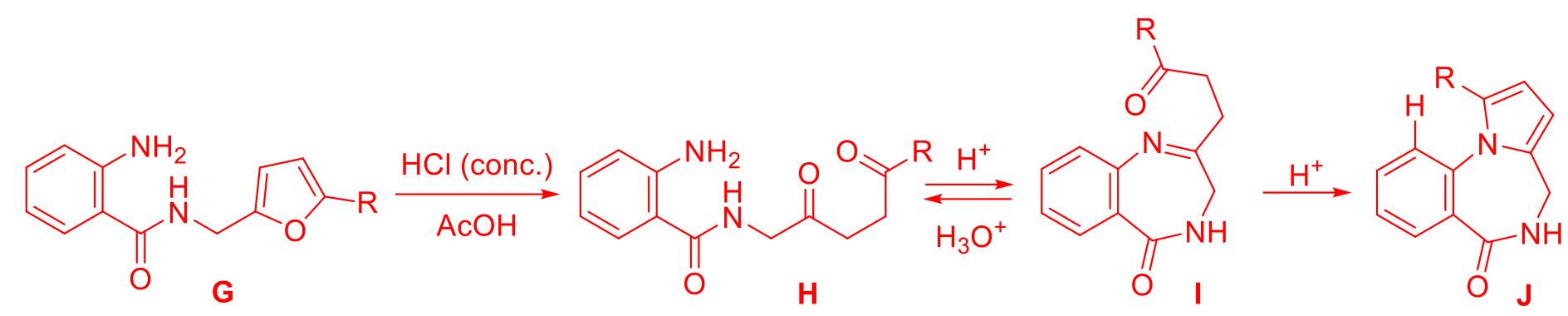
Furan derivatives can be efficiently converted into other heterocycles. Thus, in professor of Moscow State University Yu. K. Yuriev developed industrial transformation of furans into pyrroles under heating of furan with ammonia (amines) above in the presence of alumina. In a laboratory, the sequence of furan hydrolysis followed by Paal-Knorr reaction with ammonia (amine) is used for this transformation. This sequence can be realized as a two-step procedure or as a domino reaction. For example, -(furfuryl)anthranylamide G () under treatment with conc. HCl in acetic acid afforded the new heterocyclic compound J via intermediates H and I. Nevertheless, compound G with under the same conditions produced the corresponding product H only.

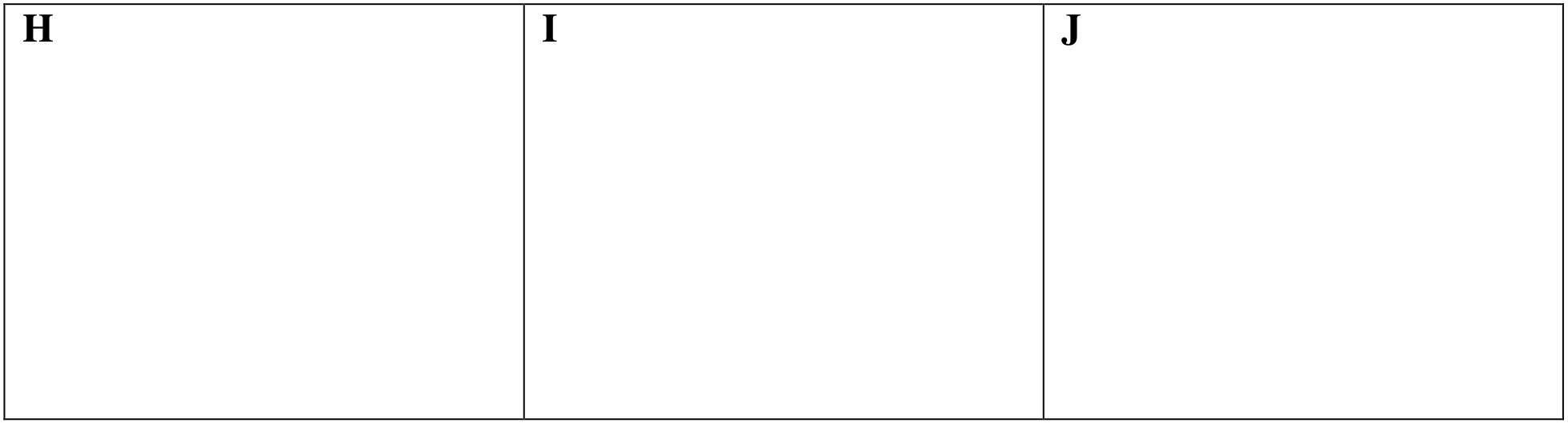
2 Write down the structural formulas of compounds H–J in general form (pointing out the substituent in the furan ring as R) taking into account that I is a bicyclic species.
[6 т.]
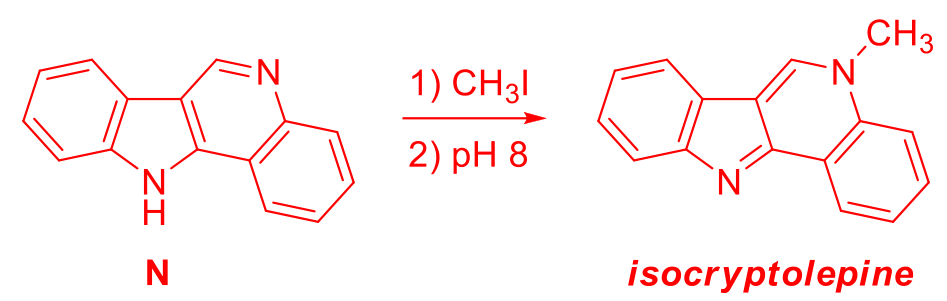
An interesting transformation of simple furan, which is a product of biomass processing, to antimalarial and anticancer alkaloid isocryptolepine was recently reported by A. V. Butin et al.

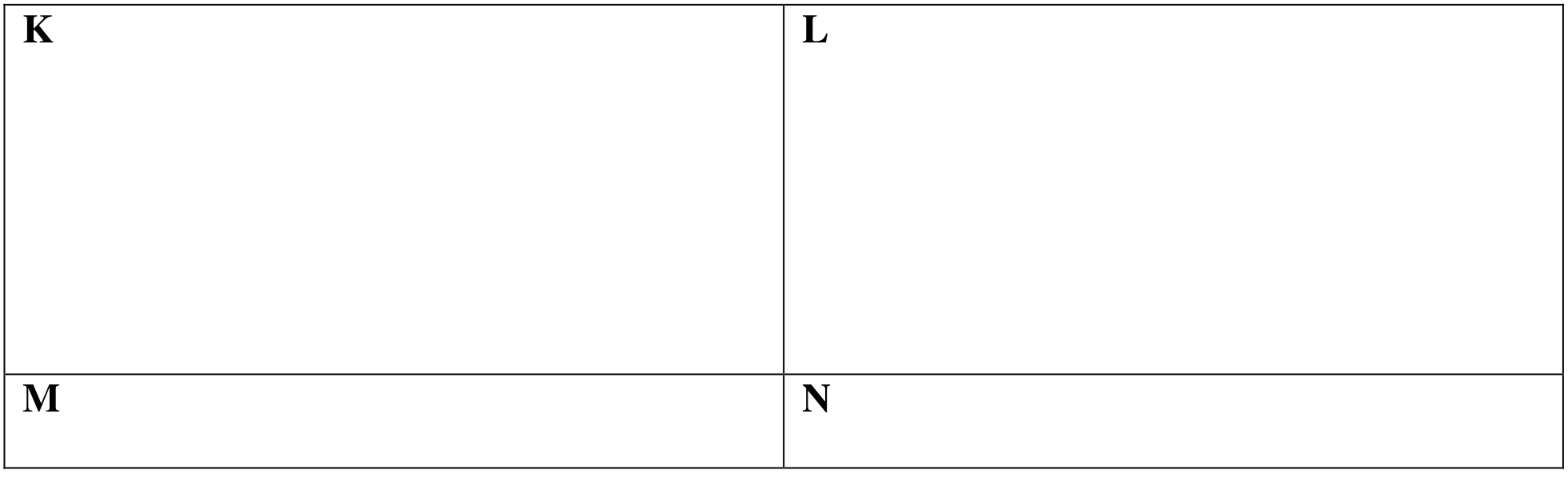
3 Write down the structural formulas of K–N accounting for that M contains the indole ring.
[10 т.]
Решение
Official answers and grading scheme
1 Write down the structural formulas of furacin and compounds A–F.
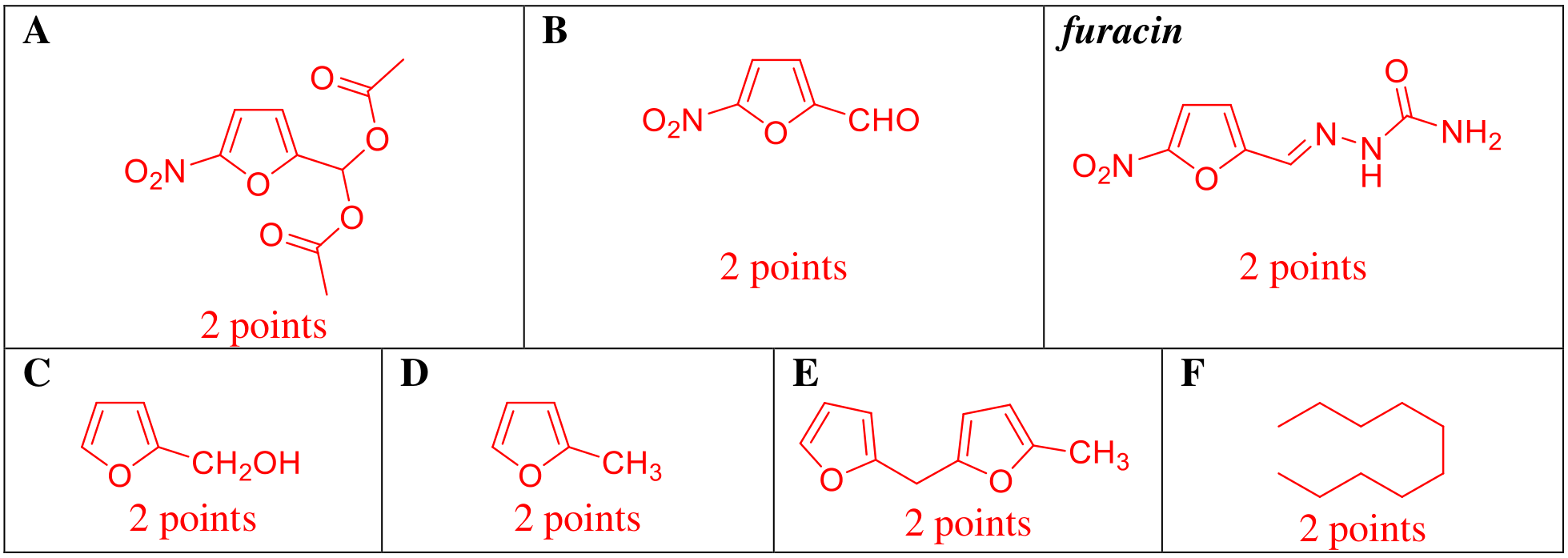
A, B, furacin, C, D, E and F: 2 points each.
2 Write down the structural formulas of compounds H–J in general form (pointing out the substituent in the furan ring as R) taking into account that I is a bicyclic species.
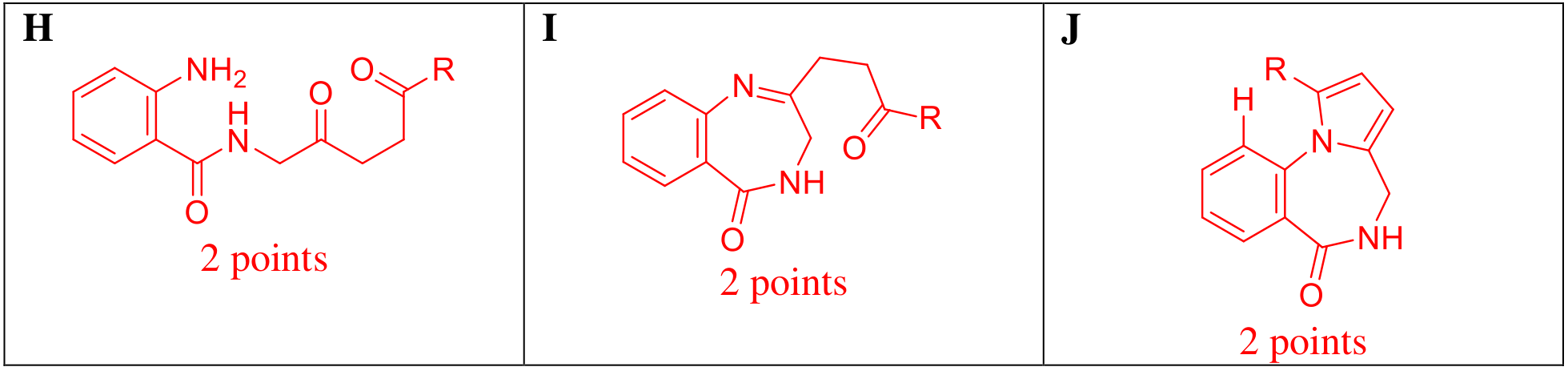
H, I and J: 2 points each.
3 Write down the structural formulas of K–N accounting for that M contains the indole ring.
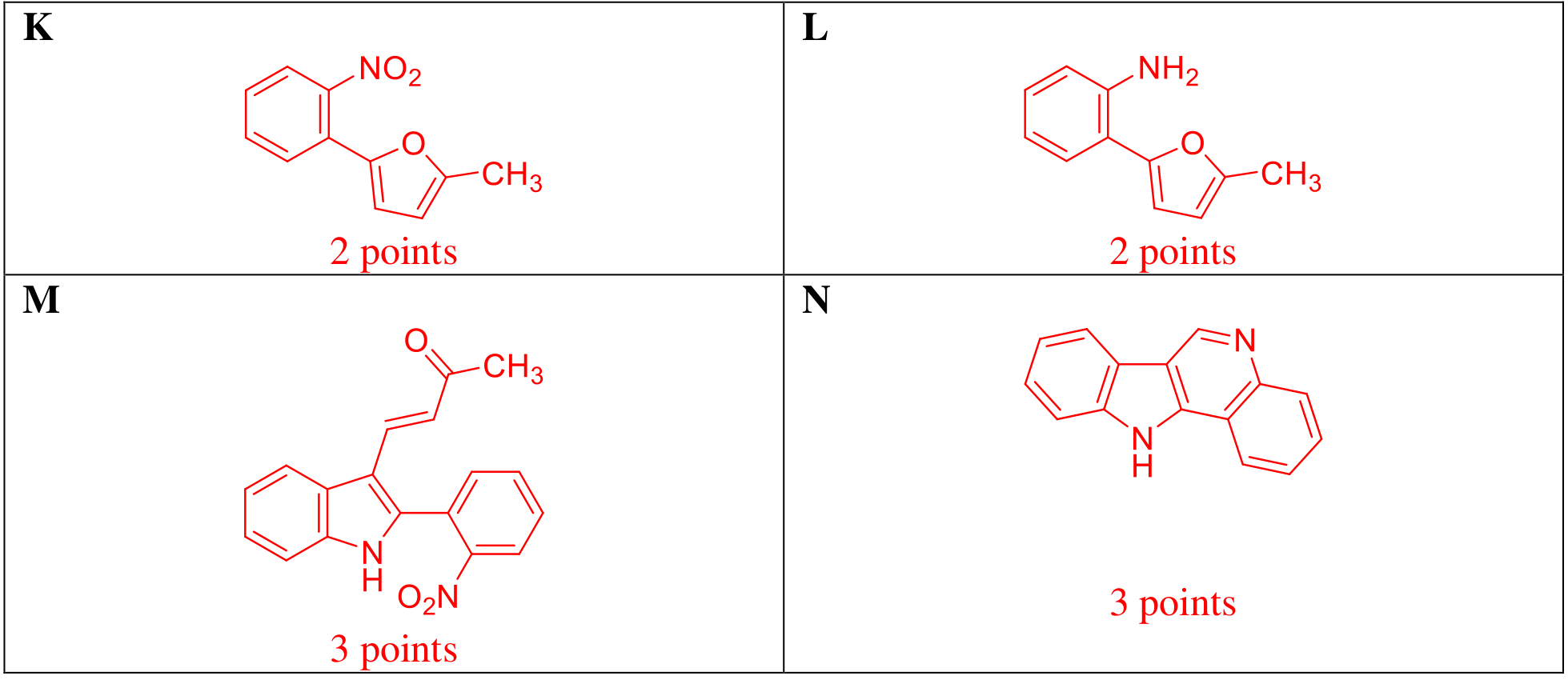
K and L: 2 points each; M and N: 3 points each.
Detailed solution
1 The comparison of molecular formulas of furfural and compound A allows to conclude that at this step furan ring nitration is accompanied by addition of acetic anhydride. The last step in the synthesis of furacin is the reaction with semicarbazide, i.e. furacin has 4 nitrogen atoms (three from semicarbazide and 1 from nitro group). From the mass content of nitrogen and carbon we can determine the molecular formula of furacin as . Therefore, formula of B is , and the transformation of A to B is hydrolysis of diacetyl ketal moiety producing aldehyde function.
According to the text of the problem, compound F is a linear alkane. The content of carbon in F allows to conclude that this is -decane (), i.e., in the formation of F one molecule of C reacts with one molecule of D. This reaction proceeds under acid catalysis. It is possible to suppose that this is Friedel-Crafts alkylation of the furan ring by furan-containing alcohol which is obtained from furfural by catalytic hydrogenation. Evidently, hydrogenation of side chain should proceed faster than hydrogenation of the furan ring itself. So, C is furfuryl alcohol. Hydrogenolysis of C produces then 2-methylfuran (D) which is alkylated by C under Friedel-Crafts conditions affording 5-methyldifurylmethane E. Its hydrogenation is accompanied by C–O bonds hydrogenolysis furnishing linear alkane F.
(7 structures, 2 points for each, 14 points in total).
2 It is clear from the text of the problem, that the first step is hydrolysis of the furan ring. The product then enters the Paal-Knorr synthesis, producing pyrrole ring in J. This ring formation is a stepwise process: initially, nucleophilic amino group attacks the closest carbonyl function affording 7-membered ring in I (bicyclic compound). Then tautomerization of imine to enamine and attack of amino group on the second carbonyl function accomplished the pyrrole ring formation furnishing tricyclic product, pyrrolo[1,2-]benzo[1,4]diazepine. The bulky tert-butyl group prevents cyclization of I to J due to steric repulsions. As a result, the intermediate imine I undergoes hydrolysis to diketone H instead of cyclization.
(3 structures, 2 points for each, 6 points in total).
3 Evidently, the last step of isocryptolepine synthesis is methylation of the nitrogen atom. Therefore, N is the corresponding desmethyl derivative. The fully aromatic indoloquinoline is the most stable tautomer for compound N.
Compound K is formed by diazotization of -nitroaniline (6 carbon atoms) followed by the reaction of the formed diazonium salt with 2-methylfuran D (5 carbon atoms) in the presence of Cu(I) salt. This is Meerwein arylation furnishing 2-aryl-5-methylfuran. The structure can be also determined from the carbon content. Molecular weight of K is a.u. Compound K contains nitro group (46 a.u.) and furan oxygen atom (16 a.u.). Therefore, molecule of K has no more nitrogen atoms and has 9 hydrogen atoms. Furan is known to have excellent -selectivity in both radical and electrophilic reactions. So, 2-nitrophenyl group substitutes -hydrogen atom. From the carbon content in compound L we can find that its molecular weight is 173, i.e. 30 a.u. smaller than that of K. So, this is a result of reduction of nitro group leading to the corresponding aniline.

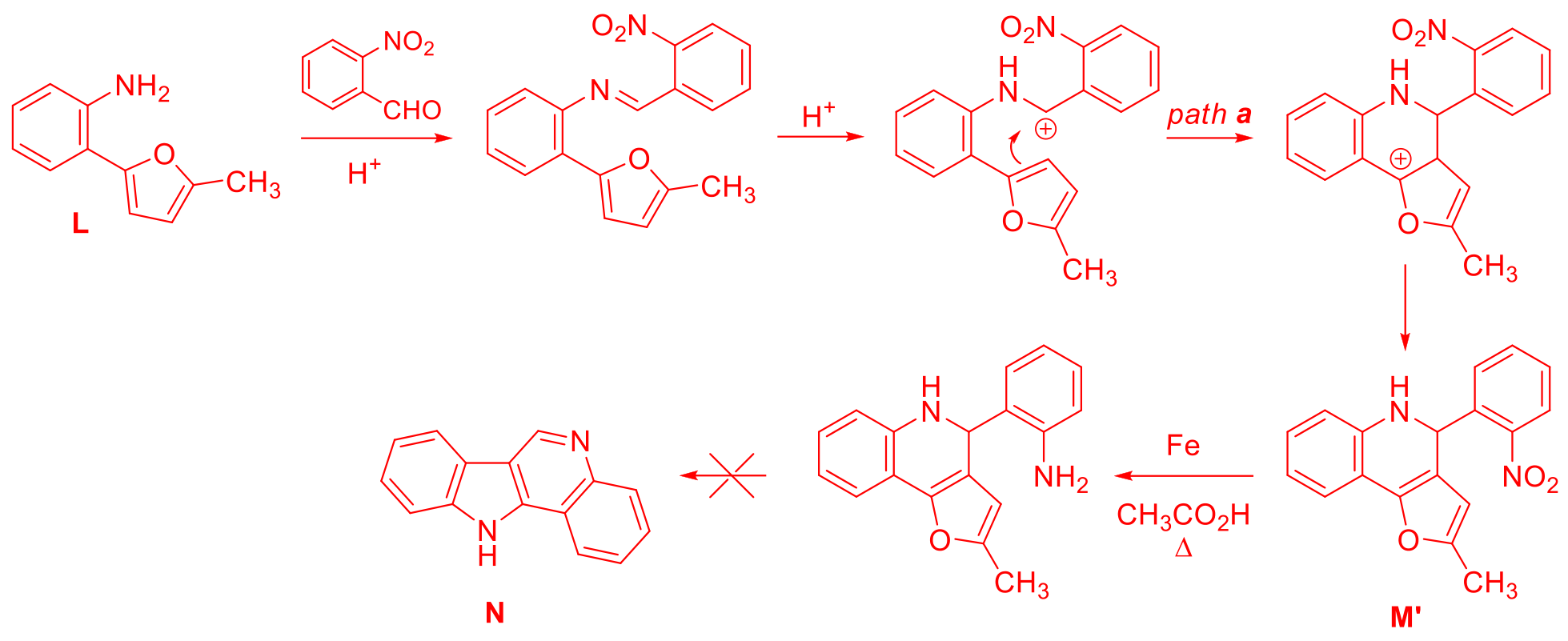
The next step is quite unusual. This is started by acid-catalyzed imine formation via reaction between the aldehyde and amine moieties. The protonation of the imine nitrogen increases electrophilicity of the imine carbon atom and it attacks the furan ring located in close proximity. For other arenes this attack proceeds onto ortho-carbon atom producing six-membered ring. However, if we try to write the corresponding product in this case, we will obtain compound M′ which cannot produce N after reduction with iron and acetic acid.
There is an alternative possibility – electrophilic attack of the protonated imine on the substituted -carbon atom (ipso attack). This attack is provided by the extremely high -selectivity of the furans in the reaction with electrophiles and leads to the spiro-intermediate which undergoes furan ring opening affording 2-(2-nitrophenyl)-3-(3-oxobut-1-en-1-yl)indole M. The reduction of nitro group in M produces the corresponding amino group which adds to -unsaturated ketone moiety (Michael addition) producing tetracyclic intermediate. It undergoes aromatization via elimination of acetone molecule (in its enol form) through the concerted six-membered transition state.
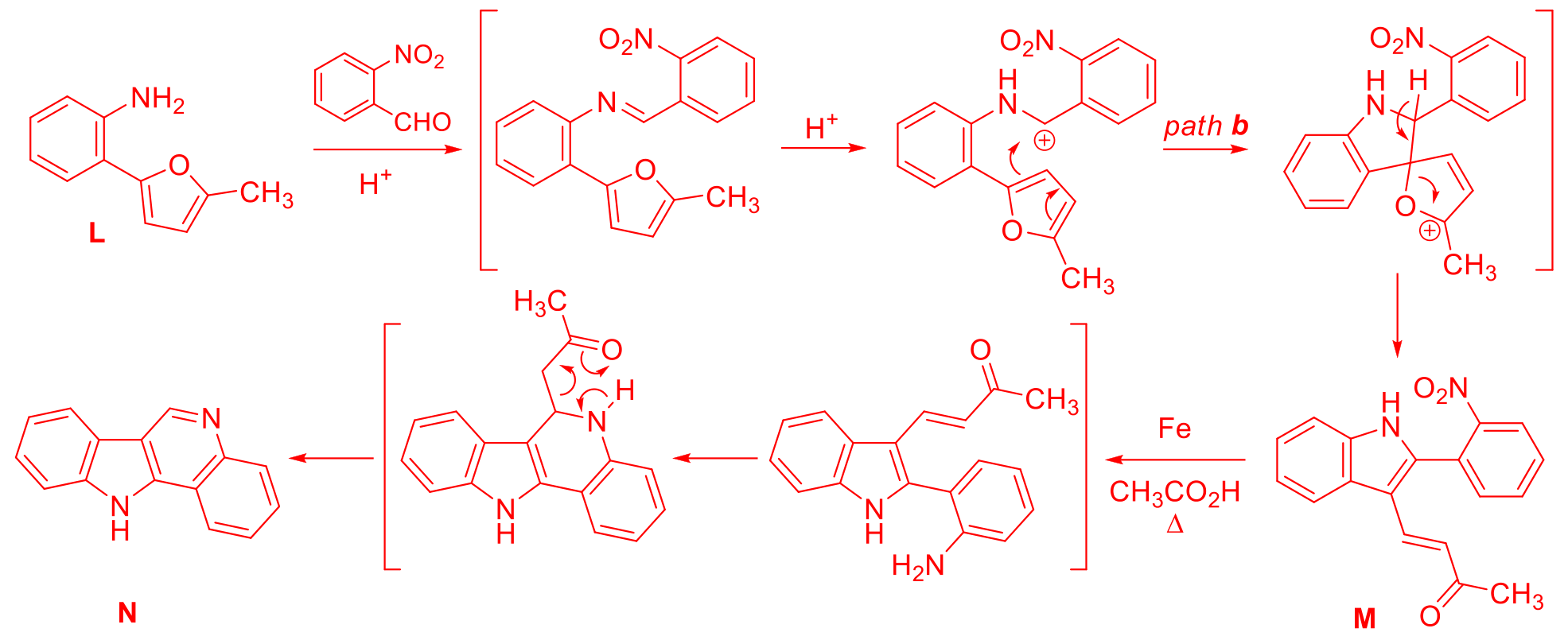
(Structural formulas of K, L, N – 2 points for each. Structural formulae of M – 4 points. 10 points in total).
Determination of the structure of M is a rather complex task. However, this structure contributes only 4 points of 30. Those students who are able to determine this structure will get much pleasure from the unusual transformations leading to M and from M to N as well as from their personal ability to find the solution.
Бележка от източника
The five native whole theoretical problems and all available official keys are retained. Each original problem heading says 12 marks, while its printed score grid totals 20, 24, 30, 59 or 25; these source contradictions remain visible. In Problem 2 the grid gives 3/6 points for requests 4/5, while the actual key gives 2/4. Problem 3 gives M/N 3/3 points in the answer table and 4/2 in the detailed rubric. Problem 5 request 7 prints 1.5, 1.5 and 2 points but states 4 points in total. Native spelling, formulas, a missing radical dot in one blank answer equation, a missing slash in d[CC]dt, and the missing [M] factor in the printed CC-rate result are preserved without scientific correction. Empty calculation workspaces are represented by their printed response labels and blank fields; molecular answer grids, cyclic-form checkbox tables and scientific axes retain exact original crops. Source question page 10 contains only continuing answer cells; solution pages 18–20 contain the blank repeated Sugars assignment, followed by its detailed key on 21–22.
Оригинал в Архива: Problems.pdf · официални решения: Solutions.pdf