IOM 2016, Теория — Задача 4. Radical decomposition
1st Olympiad of Metropolises — Chemistry, Theoretical Problems, Official English version · 7 септември 2016 г.
Original cover
Country: ______
Name: ______
1st Olympiad of Metropolises
Chemistry
Theoretical Problems
7 September 2016
Moscow, Russia
Chemistry. Theoretical problems. Official English version
Указания
- Begin only when the START command is given. You have 4.5 hours to work on the problems.
- Use only the pen and calculator provided.
- All results must be written in the appropriate boxes within the text. Anything written elsewhere will not be graded. Use the reverse of the problem pages if you need scratch paper.
- Write relevant calculations in the appropriate boxes when necessary. If you provide only correct end results for complicated questions, you will receive no score.
- Raise your hand if you have any questions concerning the text of the problems.
- Raise your hand if you need a restroom break.
- The official English version of this examination is available on request only for clarification.
Original key cover
1st Olympiad of Metropolises
Chemistry
Theoretical Problems with solutions
7 September 2016
Moscow, Russia
Chemistry. Theoretical problems with solutions. Official English version
Условие
Problem 4. Radical decomposition (12 marks)
| Question | 1 | 2 | 3 | 4a | 4b | 4c | 5 | Total |
|---|---|---|---|---|---|---|---|---|
| Points | 12 | 3 | 10 | 6 | 4 | 4 | 20 | 59 |
Almost all halogen oxides are endothermic compounds, i.e. they are formed from elements with absorption of heat. Chlorine (I) oxide, a brownish-yellow gas, is not an exception. Upon mild heating it decomposes exothermically into chlorine and oxygen according to the equation
This reaction is not an elementary one. It proceeds through several consecutive elementary steps:
( – are the rate constants, M is any molecule)
1 Using the Hess’ law calculate the reaction enthalpies for all elementary steps and for the overall reaction. For each case note whether the reaction is exothermic (write “”) or endothermic (“”). The necessary data are provided at the end of the problem.
______
______
______
______ [12 т.]
2 Which elementary step would you expect to be the slowest one? Tick the appropriate box.
(1) ☐ (2) ☐ (3) ☐ [3 т.]
3 Derive the expression for the rate of depletion using the steady-state approximation. Do not express [M] in terms of concentrations of specific substances, leave it as it is.
Calculations:
______ [10 т.]
Decomposition of oxygen difluoride, , to fluorine and oxygen proceeds via a similar mechanism with the notable exception: reaction between two radicals yields two fluorine atoms rather than a difluorine molecule. This is due to the fact that the reaction
is highly exothermic, and the amount of heat released is enough to break the F–F bond. The fluorine atoms formed then either dimerize or react with . So, the overall mechanism is as follows:
( – are the rate constants, M is any molecule)
Note that this is a chain reaction: radical produces , then radical produces and the process repeats itself. The radicals and are the carriers of the chain process.
Under the certain conditions exothermic chain reactions can proceed with increasing rates. There are two possible reasons for this: a) self-heating of the reaction mixture as the reaction proceeds causes the increase of the rate constants which makes the reaction go faster and b) over a cycle of chain propagation the number of the chain carriers increases which leads to exponential growth of their concentrations. These two regimes are called thermal mode and chain-branching mode, respectively.
4a Using the law of mass action derive the expression for the change rate of the total concentration of chain carriers, [CC], in the reaction of decomposition. Do not express [M] in terms of concentrations of certain substances. Note that concentrations of radical species are negligible regardless of the reaction mode.
Calculations:
______ [6 т.]
4b Draw a sketch of dependence of on [CC].
[4 т.]
4c Decide whether decomposition is a thermal process or a chain-branching process.
thermal ☐ chain-branching ☐ [4 т.]
5 Using the steady-state approximation, derive the expression for the rate of depletion. Do not express [M] in terms of concentrations of specific substances, leave it as it is.
Calculations:
______ [20 т.]
Standard enthalpies of formation of gaseous compounds and radical species at
| Species | ||||||||
|---|---|---|---|---|---|---|---|---|
| , kJ/mol | 249 | 121 | 101 | 88 | 105 | 79 | 109 | 25 |
Решение
Official answers and grading scheme
1
2 points for each enthalpy, 1 point for each assignment of Q,
Total – 12 points
2 Which elementary step would you expect to be the slowest one? Tick the appropriate box.
(1) [V] (2) ☐ (3) ☐
3 points for the correct answer
3 Calculations:
(2 points)
(2 points)
Therefore
(2 points)
(4 points)
Total – 10 points
4a Calculations:
Total – 6 points
4b Draw a sketch of dependence of on [CC].
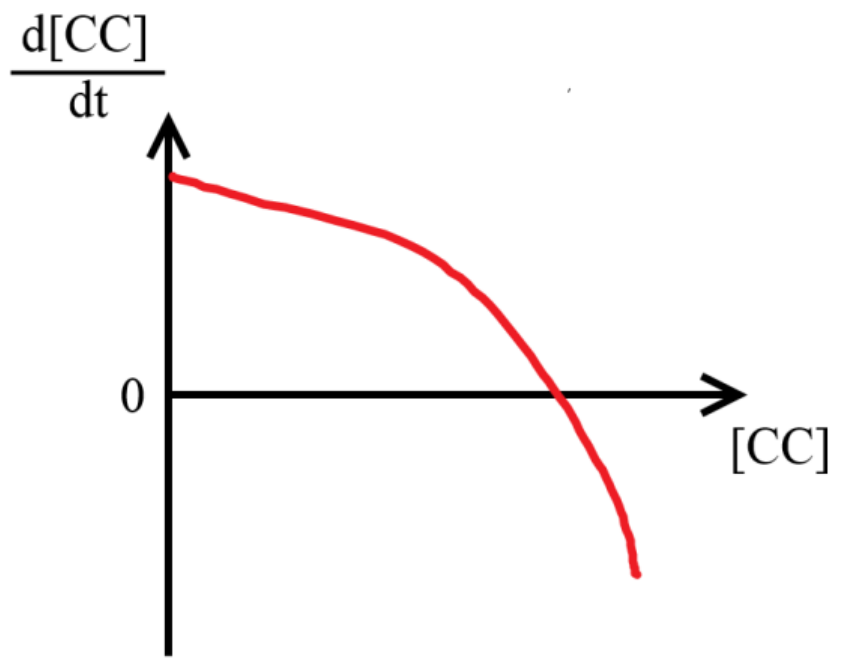
4 points if consistent with (4a)
If there is no (4a): there is no branching in the mechanism hence should decrease with increasing [CC], 4 points for the qualitatively same sketch
4c Decide whether decomposition is a thermal process or a chain-branching process.
thermal [V] chain-branching ☐
4 points if consistent with (4a)/(4b)
5 Calculations:
(3 points)
(3 points)
Therefore
Hence
(6 points)
(2 points)
(6 points)
Total – 20 points
Бележка от източника
The five native whole theoretical problems and all available official keys are retained. Each original problem heading says 12 marks, while its printed score grid totals 20, 24, 30, 59 or 25; these source contradictions remain visible. In Problem 2 the grid gives 3/6 points for requests 4/5, while the actual key gives 2/4. Problem 3 gives M/N 3/3 points in the answer table and 4/2 in the detailed rubric. Problem 5 request 7 prints 1.5, 1.5 and 2 points but states 4 points in total. Native spelling, formulas, a missing radical dot in one blank answer equation, a missing slash in d[CC]dt, and the missing [M] factor in the printed CC-rate result are preserved without scientific correction. Empty calculation workspaces are represented by their printed response labels and blank fields; molecular answer grids, cyclic-form checkbox tables and scientific axes retain exact original crops. Source question page 10 contains only continuing answer cells; solution pages 18–20 contain the blank repeated Sugars assignment, followed by its detailed key on 21–22.
Оригинал в Архива: Problems.pdf · официални решения: Solutions.pdf