IOM 2017, Теория — Задача 2. RADIOGRAPHY
The 2nd International Olympiad of Metropolises — physics, theoretical part, 2017
Внимание: Бележка към темата
Three whole native tasks with ten connected requests each. The archived radiography key contains two full proposed solutions with different flash/wavelength/angle values and scores35/20; both are retained, and question2/paper total points are unspecified. Printed equations, mass ranges, signs and notation defects remain literal with separate archive source notes.
Native source header and key scope
The 2nd International Olympiad of Metropolisesphysics — theoretical part — 2017.
The native question edition contains three problems: CARBONATED WATER, RADIOGRAPHY and Neutrino, each with ten connected numbered requests. Neutrino has three native titled parts. The original header has the concatenated word “Metropolisesphysics”. No examination date, time limit or whole-paper score is printed in this question packet.
The retained matching archived key repeats the questions, supplies full proposed solutions and grading tables, and contains two distinct complete radiography key variants. Carbonated water is graded25, radiography35 in the first table and20 in the second, and Neutrino40. Neither radiography table is designated as the sole scoring authority in these retained sources. Key pages16 and27 are blank. All38 original pages remain retained; the keys are labelled as archive solutions.
Условие
In 1943 there was founded «Laboratory № 2» of the USSR Academy of Sciences, a Soviet physicist Igor Vasilyevich Kurchatov was appointed as its director. The laboratory mostly concentrated on the development of nuclear reactor and nuclear weapons. Since then many years have passed, the laboratory turned into a large research center and its name has changed several times. Now it is called the National Research Centre "Kurchatov Institute", one of the largest Russian scientific centers which does research in a variety of fields. The main area of the institute research includes solid-state physics and materials science.
Industrial radiography is one of the basic modern methods of materials science. A studied object is placed in a coherent monochromatic beam of X-ray photons of high intensity which scattering pattern is then analyzed. Sometimes methods of spectrometry are used, i.e. variation of intensity of the beam passing through a material is measured as a function of radiation wavelength. However, the most common methods of study of atomic structure are diffraction methods. They are based on analysis of the diffraction pattern resulting from elastic scattering of X-rays by atoms of the sample. Notice that radiation wavelength remains constant in elastic scattering. A common source of coherent X-rays of high intensity with a wide wavelength spectrum is synchrotron – a large ring storage of charged particles traveling at a speed close to the speed of light. Such particles are called relativistic because their motion is no longer described by Newtonian laws of classical mechanics, instead one must use the special theory of relativity (STR). The operating principle of synchrotron is based on the fact that a charged particle emits electromagnetic radiation at trajectory turns. Direction of particle velocity is changed by special bending magnets. A particle (e.g. electron) path in the synchrotron ring consists of straight segments, where electrons receive kinetic energy, and segments of almost constant curvature in a strong magnetic field of bending magnets. In the curved segments electron motion is highly accelerated, so they emit electromagnetic radiation in the X-ray range. A powerful synchrotron is operating at the Kurchatov Institute in Moscow.
Relativistic equation of motion of a charged particle in magnetic field is , where the particle momentum . Here is the speed of light in vacuum (), the quantity is the particle invariant mass and is the particle relativistic mass. The energy of relativistic particle . Usually the energy of a microparticle is measured in electronvolts: . The factor is called the «Lorentz factor». If the particle speed is close to , .
1) Evaluate the Lorentz factor for an electron of energy (the invariant mass is , the rest energy is ). By how many percent is the speed of such an electron less than ? The electron charge is . The answer should include formulae and numerical values.
2) Determine the curvature radius of electron trajectory in the field of bending magnet if electron energy in the synchrotron storage ring is maintained at and the induction of the field of bending magnet is . Electrons are traveling in a plane perpendicular to the magnetic field lines. The answer should include the formula and the numerical value (in meters).
Any accelerating charged particle emits electromagnetic radiation. The important feature of synchrotron radiation (i.e. radiation of relativistic particles with traveling along a curved path) is its «searchlight» nature: almost all the energy is radiated «forward» along the particle velocity in a narrow cone with half an aperture of (see Fig.1).
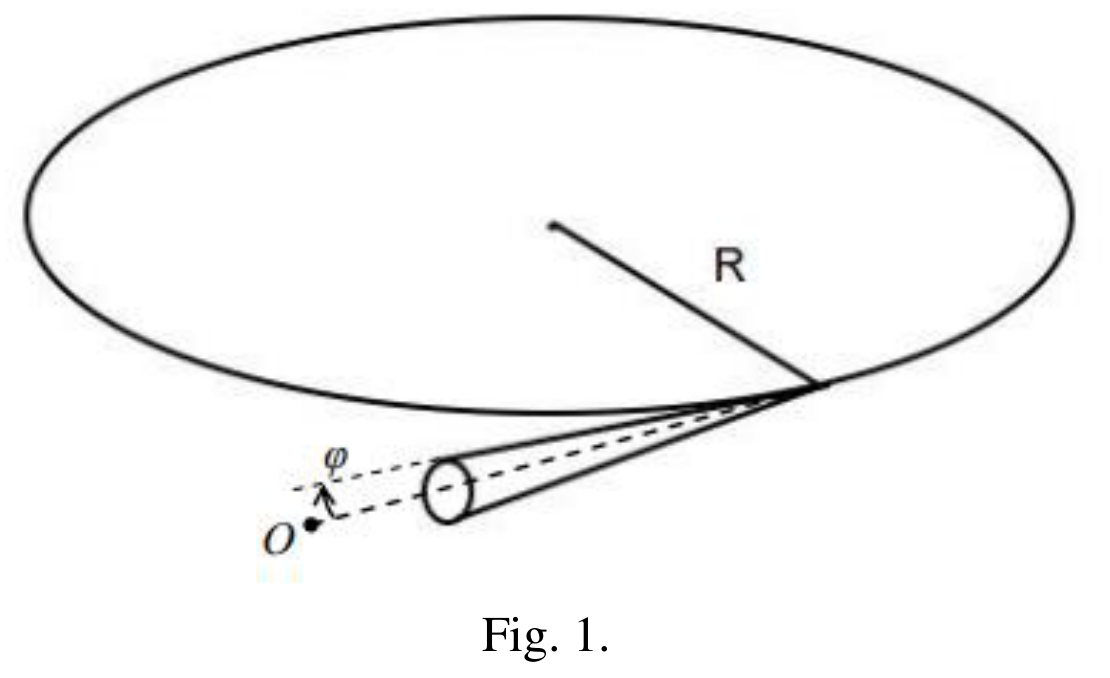
3) Suppose an «observer» resides at the circular orbit plane and can be regarded as a point. In this case he (or she) detects radiation flashes corresponding to the short periods when she is inside the «searchlight» cone of orbiting particle. Determine the length of the arc traversed by electron on the orbit when its radiation is detected by the observer. The electron energy and the magnetic induction are given in 2). The answer should be the equation.
4) Determine duration of the radiation «flash» detected by the observer. It must be taken into account that due to electron relativistic motion it takes different time for the «initial» and «final» portions of the «flash» to reach the observer. The answer should include the equation and the numerical value (in seconds).
Thus, radiation of relativistic particle traveling along a circular path is observed as a bright short flash. The flash spectrum (frequencies and wavelengths) turns out to be very wide: the width of the frequency range corresponds to «characteristic» (or «synchrotron») frequency . A wide range of wavelengths provides a lot of opportunities for using synchrotron radiation in radiography. The characteristic wavelength of a particular source is an important quantity for practical applications.
5) Determine the characteristic wavelength of the source described in 2). The answer must be the equation and the numerical value (in meters).
The main method of deciphering the structure of a crystal material is X-ray diffraction. The radiation is being diffracted (elastically scattered) by atoms of a sample. The crystal serves as a diffraction grid for X-ray beam because its wavelength is of the same order of magnitude as a spacing between atomic planes. When the radiation is incident on the crystal at some angle, the reflected radiation is detected not only in the direction determined be the laws of geometrical optics but also at the angles for which the waves reflected by adjacent planes have optical path difference equal to an integer of radiation wavelength. These reflected waves mutually amplify at a remote detector resulting in a significant rise of intensity in the corresponding direction (diffraction maximum).
6) Using the condition of diffraction maximum derive the explicit formula for the direction at a diffraction maximum of X-rays reflected by a crystal which lattice consists of a single set of parallel planes. The beam is incident at the angle to the planes, the interplane spacing equals (see Fig.2).
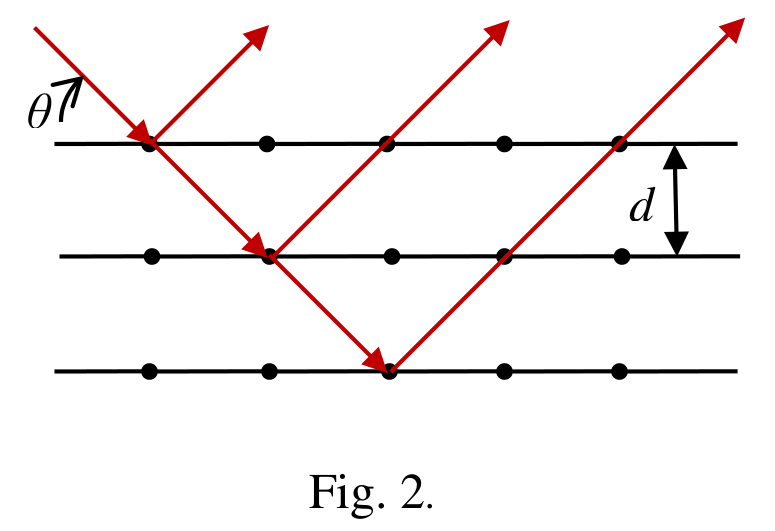
In a real crystal structure it possible to introduce different sets of equidistant parallel planes. Such a set can be defined by a vector perpendicular to the planes while directions at the diffraction maxima defined by the condition derived in 6) can be specified by diffraction angle (the angle between the incident and diffraction beams). In what follows the observed maximum of a given order for a specific set of parallel planes is called «reflex». Any atomic plane necessarily passes through the nodes of crystal lattice, so coordinates of the vector perpendicular to a particular set of parallel planes can be given by integers providing the coordinate axes are aligned with the lattice principal axes (edges) and a distance is measured in lattice constants. Thus, a reflex can be determined by a set of three integers .
Superconductor is a very interesting object for the modern materials science. One of the most common and widely used low temperature superconductor is triniobium-tin Nb3Sn. For instance, this superconductor is used in electrical circuits of the Large Hadron Collider. A unit cell of its lattice structure (i.e. a cell which repetitive translation along principal axes reproduces the whole crystal) is a cube of side ().
7) Find the diffraction angle (the angle between the incident and diffracted beams) for reflex (110) at the first order of diffraction using the value of characteristic wavelength calculated above. The answer should be the formula and the numerical value (in radians).
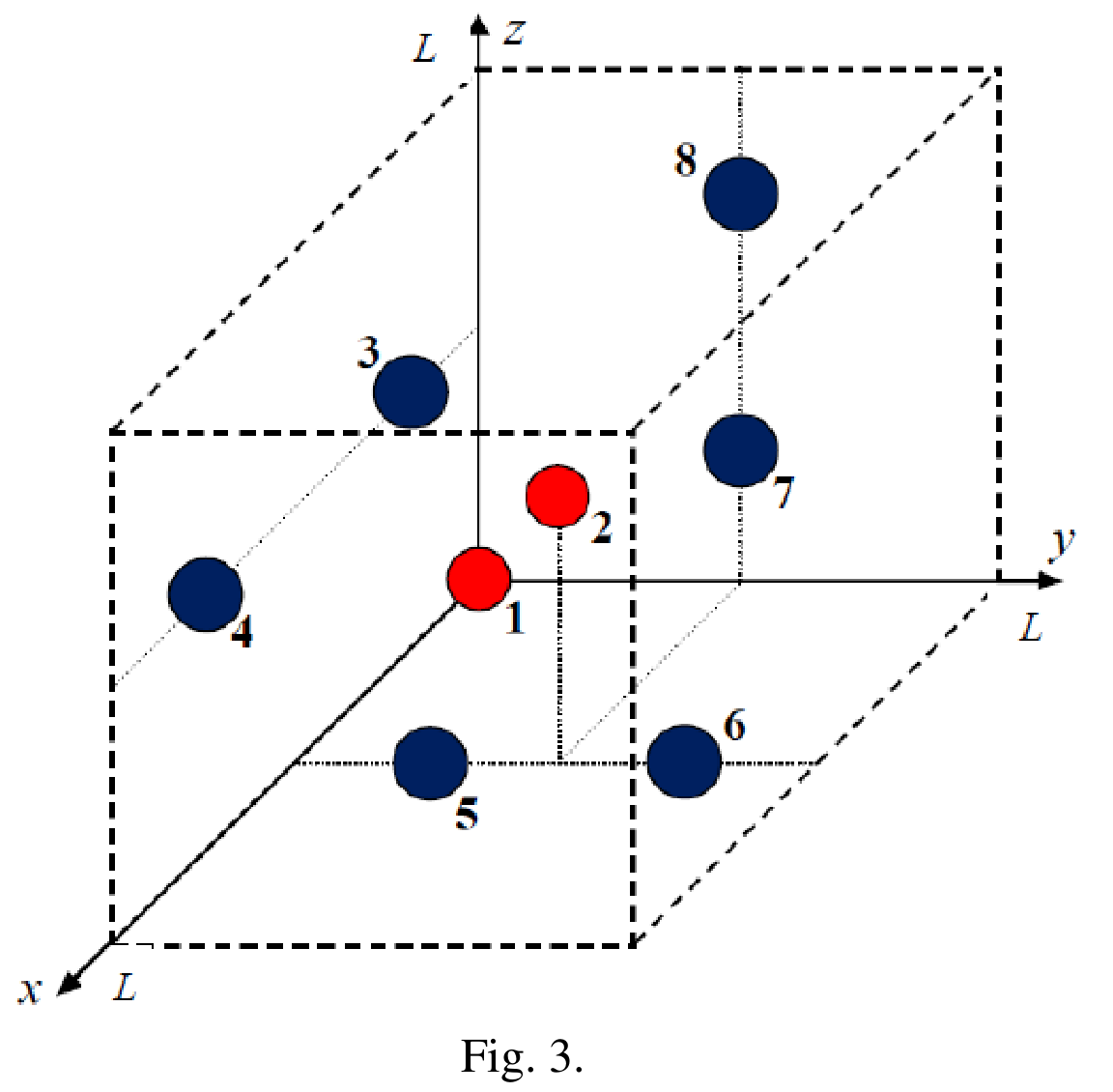
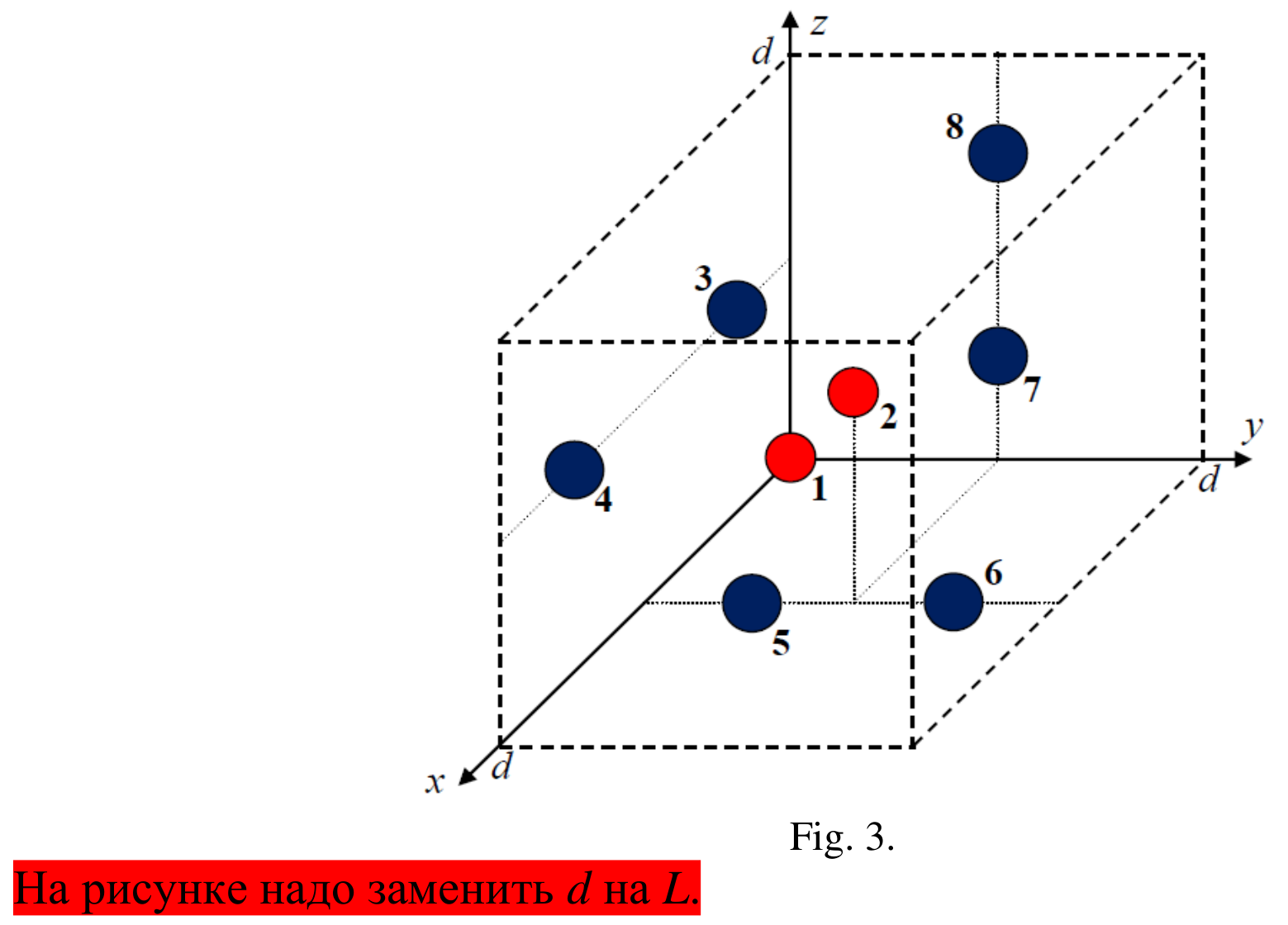
In the Cartesian frame, which coordinate axes are aligned with the edges of crystal lattice, the coordinates of Sn atoms (in the units of ) are: , , and the coordinates of Nb atoms are: , , , , , , (see Fig.3). Atoms in the unit cell are numbered from 1 to 8 in the order they are listed in the text. A pattern of X-ray scattering is determined by the distribution of electrons in a crystal lattice (electrons are so much lighter than atomic nuclei, so they respond much stronger to the electromagnetic field of incident wave), i.e. by distribution of atoms of various elements. The ability of an isolated atom of a certain element to scatter radiation is specified by a quantity called atomic scattering factor. This quantity specifies the difference of wave scattering by electronic shell of a given atom compared to that one by free electrons. Atomic scattering factor is a complex quantity (i.e. , where is imaginary unit) and its absolute value squared determines intensity of scattered radiation of an isolated atom. The intensity of an observed diffraction peak for a crystal lattice is calculated as the squared absolute value of the reflex structure factor , which in turn is evaluated as:
where sum is over all atomic positions in the unit cell. Here are coordinates of atom at the -th position; is the atomic scattering factor of element which atom resides at the -th position, and is occupation of the position by the element. Occupation of a position is the average (over the whole lattice) number of atoms of a certain element at the position. In ideal crystal (i.e. when all atoms of crystal lattice reside at their nodes) each position is occupied exactly by a single atom of a given element and there are no «extra» atoms, i.e. an occupation is either 1 or 0. For example, in the unit cell of Nb3Sn at the 1-st position: and . However, a real crystal structure has defects distorting ideal lattice, so occupations can be different. One of the most common defect of this sort is the so-called antinode disordering when atoms switch their positions. For instance, if in some cells atoms of Sn at position 1 switch to position 3, and atoms Nb in these cells switch from 3 to 1, occupation becomes less than 1 and becomes non-zero. Nevertheless, the gross occupation of any position remains equal to 1, i.e. any atom leaving its position switches to position of another atom and vice versa.
8) Suppose there is an antinode disordering in the considered structure, so the occupation of Nb positions by atoms of Sn becomes equal to , i.e. . Determine other occupations in the structure. Occupations of atoms of any element at positions and are the same, as it is the case for positions . Express the occupations via .
9) Assuming and to be known evaluate structure factor of reflex (110), using the occupations calculated in 8). The answer should be given as equation.
Hint: according to Euler’s formula complex exponential is evaluated as .
10) Determine the condition of quenching the reflex (110) (when its intensity vanishes) for the same structure. The answer should be given as a numerical value of .
Решение
Archive source scope: The retained matching key contains two consecutive complete proposed solutions. Both are reproduced below under their native heading, distinguished here by their PDF page ranges. Neither is selected as the exclusive answer or score. The key's repeated question omits the primary edition's Kurchatov-history paragraph and some unit/observer wording. It uses in Fig.3 and in its coordinate-unit description, with the red correction “На рисунке надо заменить d на L.” (In the figure d should be replaced by L.) The primary question figure already labels ; that edition governs the statement above. The key's sum is printed with a lower and no upper 8; the primary question prints both limits.
PROPOSED SOLUTION AND ANSWERS — first block, PDF pages9–12
According to the given equations , i.e. . Using the definition of the Lorentz factor one finds: , whence . Therefore, the speed of electrons in this machine is less than the speed of light by approximately 0,000002%.
In the field of bending magnet electrons are subjected to the Lorentz force which is perpendicular to particle velocity and does no work. Therefore, the absolute value of electron velocity (and the momentum) remains constant. The Lorentz factor remains constant as well and the equations of motion coincide with the corresponding equations of Newtonian mechanics in which mass is replaced with relativistic mass . Hence, the curvature radius of electron path (called «Larmor radius») can be found from the equation . Since the electron speed is practically the same as the speed of light one obtains: , or
- If the «observer» of X-ray beam resides at the orbital plane, the detected radiation is produced by electrons traveling along the arc subtending the angle equal to the beam aperture (the cone aperture), see the figure. The corresponding arc length . Equivalent answers are and .
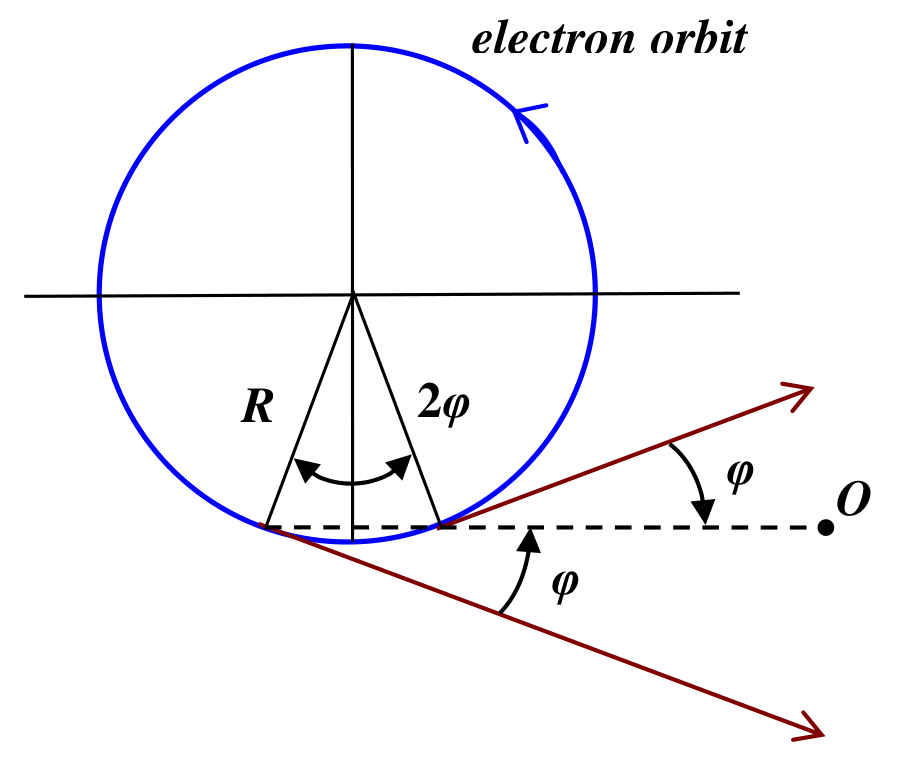
- The time required for an electron to cover a distance is , however, the duration of the flash is less due to the finiteness of the speed of light. To understand what is going on in detail, let us introduce the detector reference frame and consider two events: 1) emission of light by the electron at the beginning and 2) at the end of a flash. Let in the detector frame. Let the axis be directed from the detector to the electron (since is small we can think of electron going along this axis during all the flash). Let electron coordinate (in electron frame) at be . The event 2 in electron frame then happens at at the point (the electron approaches the detector). Now consider events: 3) detection of the beginning and 4) the end of flash by the detector. Obviously, the corresponding times are и . Thus, the flash duration registered by the detector is
- According to the above analysis the corresponding characteristic frequency is and the corresponding wavelength is
- Let us calculate the optical path for the waves reflected from adjacent planes (see the figure):
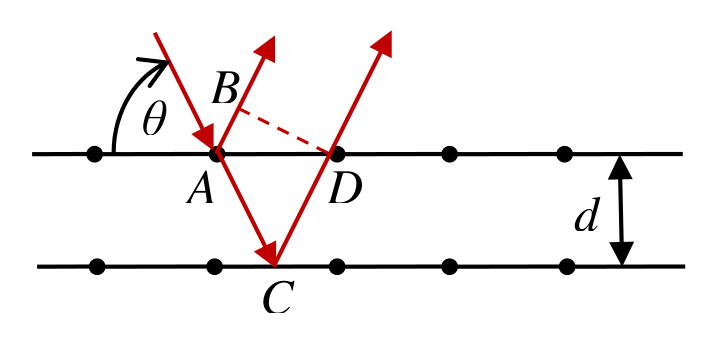
Constructive interference (amplification) is observed when the optical path difference for these two waves equals an integer of wavelengths. Hence, the condition of diffraction maximum is: , where is an integer (Bragg’s law). The absolute value of is called the order of diffraction maximum.
- The diagram below shows the projection of a unit cell on the XY-plane. The red arrow is the vector perpendicular to the planes of set (110).
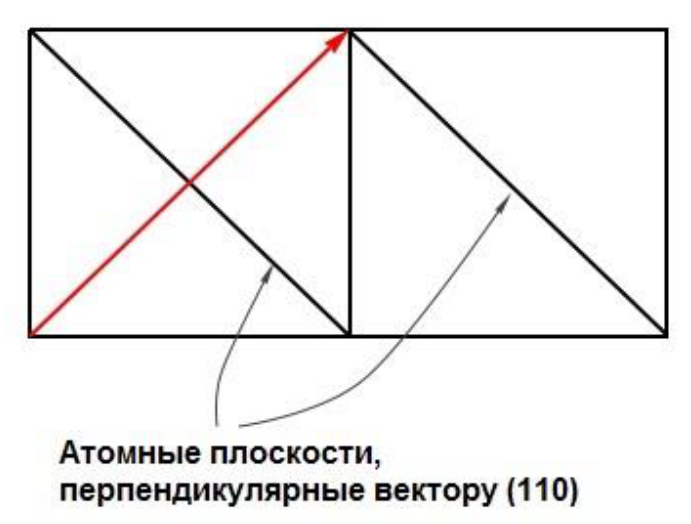
Atomic planes perpendicular to vector (110).
Using the diagram and the fact that the cell is a cube one evaluates the interplanar spacing for the set of planes (110): . Then the diffraction angle for the maximum of first order (for reflex (110)) follows from Bragg’s law: . The angle between the incident and diffracted beams equals , i.e. .
- Since the net occupation of the niobium positions (3-8) must remain equal to 1 the occupation of the positions by Nb atoms is
If is the total amount of Sn atoms (and the net number of positions 1 and 2 as well) in the structure, the number of Nb atoms (and positions 3-8) equals (according to the chemical formula). For a given the number of atoms Sn switching to Nb positions equals ; the same amount of Nb atoms move to Sn positions. Thus, the occupation of positions 1 and 2 by Nb atoms equals . Accordingly, .
- Since the sum in the formula for the structure factor is quite cumbersome, it is easier to compute it by separating contributions of six Nb positions (3-8) and two positions (1-2) of Sn. According to equation given in 9) the contribution to the reflex structure factor of an arbitrary reflex due to positions 3-8, which occupations by atoms of a single element with atomic factor are the same, is
(here coordinates of every position are used). The contribution of positions 1 and 2 is
For the reflex (110) this gives:
and .
Now let us compute using occupations calculated in 8) by summing the contributions of all eight positions:
- The reflex intensity equals , it vanishes when . Notice, that it is for this particular value of all occupations of atoms of a given element are equal: for any position occupations and . No wonder, this corresponds to the chemical composition of the material (25% of tin and 75% of niobium) because average occupations must satisfy this property for any .
TABLE OF ANSWERS
| № | Answer | Maximum score |
|---|---|---|
| 1 | ; . | 1+1=2 |
| 2 | . | 3 (equation) + 1 (number) = 4 |
| 3 | (any variant). | 1 |
| 4 | . | 3 (equation) + 1 (number) = 4 |
| 5 | . | 1 (equation) + 1 (number) = 2 |
| 6 | , where is an integer. | 5 |
| 7 | . | 3 (equation) + 1 (number) = 4 |
| 8 | ; ; . | 1+1,5+1,5=4 |
| 9 | ; ; . | 1,5+1,5+3=6 |
| 10 | . | 3 |
| Всего | 35 |
PROPOSED SOLUTION AND ANSWERS — second block, PDF pages13–15
According to the given equations , i.e. . Using the definition of the Lorentz factor one finds: , whence . Therefore, the speed of electrons in this machine is less than the speed of light by approximately 0,000002%.
In the field of bending magnet electrons are subjected to the Lorentz force which is perpendicular to particle velocity and does no work. Therefore, the absolute value of electron velocity (and the momentum) remains constant. The Lorentz factor remains constant as well and the equations of motion coincide with the corresponding equations of Newtonian mechanics in which mass is replaced with relativistic mass . Hence, the curvature radius of electron path (called «Larmor radius») can be found from the equation . Since the electron speed is practically the same as the speed of light one obtains: , or
- If the «observer» of X-ray beam resides at the orbital plane, the detected radiation is produced by electrons traveling along the arc subtending the angle equal to the beam aperture (the cone aperture), see the figure. The corresponding arc length . Equivalent answers are and .
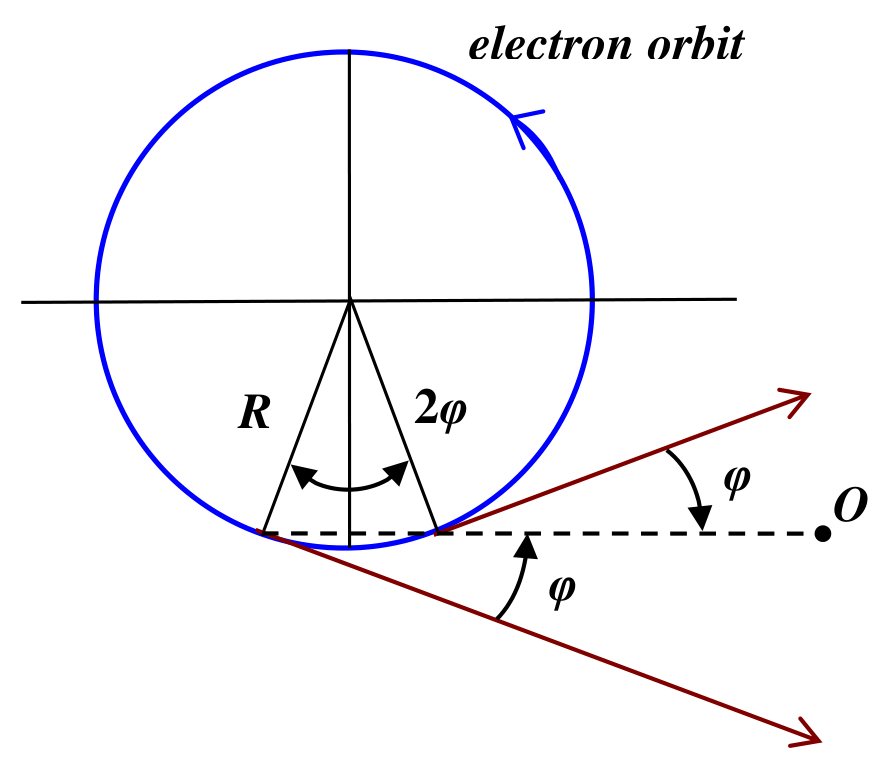
- The time required for an electron to cover a distance is , however, the duration of the flash is less due to the finiteness of the speed of light. To understand what is going on in detail, let us introduce the detector reference frame and consider two events: 1) emission of light by the electron at the beginning and 2) at the end of a flash. Let in the detector frame. Let the axis be directed from the detector to the electron (since is small we can think of electron going along this axis during all the flash). Let electron coordinate (in electron frame) at be . The event 2 in electron frame then happens at at the point (the electron approaches the detector). Now consider events: 3) detection of the beginning and 4) the end of flash by the detector. Obviously, the corresponding times are , ,
Thus, the flash duration registered by the detector is
- According to the above analysis the corresponding characteristic frequency is and the corresponding wavelength is
- Let us calculate the optical path for the waves reflected from adjacent planes (see the figure):
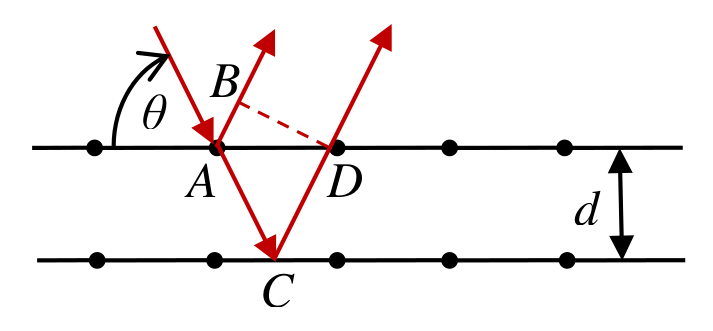
Constructive interference (amplification) is observed when the optical path difference for these two waves equals an integer of wavelengths. Hence, the condition of diffraction maximum is: , where is an integer (Bragg’s law). The absolute value of is called the order of diffraction maximum.
- The diagram below shows the projection of a unit cell on the XY-plane. The red arrow is the vector perpendicular to the planes of set (110).
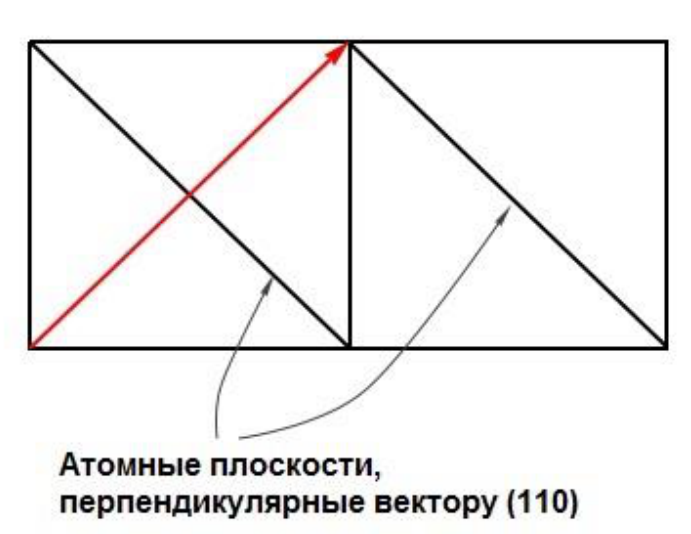
Atomic planes perpendicular to vector (110).
Using the diagram and the fact that the cell is a cube one evaluates the interplanar spacing for the set of planes (110): . Then the diffraction angle for the maximum of first order (for reflex (110)) follows from Bragg’s law: . The angle between the incident and diffracted beams equals , i.e. .
- Since the net occupation of the niobium positions (3-8) must remain equal to 1 the occupation of the positions by Nb atoms is
If is the total amount of Sn atoms (and the net number of positions 1 and 2 as well) in the structure, the number of Nb atoms (and positions 3-8) equals (according to the chemical formula). For a given the number of atoms Sn switching to Nb positions equals ; the same amount of Nb atoms move to Sn positions. Thus, the occupation of positions 1 and 2 by Nb atoms equals . Accordingly, .
- Since the sum in the formula for the structure factor is quite cumbersome, it is easier to compute it by separating contributions of six Nb positions (3-8) and two positions (1-2) of Sn. According to equation given in 9) the contribution to the reflex structure factor of an arbitrary reflex due to positions 3-8, which occupations by atoms of a single element with atomic factor are the same, is
(here coordinates of every position are used). The contribution of positions 1 and 2 is
For the reflex (110) this gives:
and .
Now let us compute using occupations calculated in 8) by summing the contributions of all eight positions:
- The reflex intensity equals , it vanishes when . Notice, that it is for this particular value of all occupations of atoms of a given element are equal: for any position occupations and . No wonder, this corresponds to the chemical composition of the material (25% of tin and 75% of niobium) because average occupations must satisfy this property for any .
TABLE OF ANSWERS
| № | Answer | Maximum score |
|---|---|---|
| 1 | ; . | 0,5+0,5=1 |
| 2 | . | 2 (equation) + 0,5 (number) = 2,5 |
| 3 | (any variant). | 1 |
| 4 | . | 2 (equation) + 0,5 (number) = 2,5 |
| 5 | . | 1 (equation) + 0,5 (number) = 1,5 |
| 6 | , where is an integer. | 2 |
| 7 | . | 1 (equation) + 0,5 (number) = 1,5 |
| 8 | ; ; . | 1+1+1=3 |
| 9 | ; ; . | 1+1+1,5=3,5 |
| 10 | . | 1,5 |
| Всего | 20 |
Archive source notes: The first block neglects the arc/chord correction used by the second; their flash durations, characteristic wavelengths and diffraction angles therefore differ. The first table totals 35, the second 20, so question2 and paper total points are left unspecified. Both wavelength chains print in their last numerator even though the preceding algebra would give ; the printed forms are retained. Both blocks call the coordinates “in electron frame” despite first introducing the detector frame. The second block repeats in the arrival-event line at the page boundary; this repetition is retained. The native phrase “antinode disordering” and the Russian unit/marking labels are preserved.
Оригинал в Архива: theoretical.pdf · решение от архива: theoretical-solutions.pdf