IOM 2017, Теория — Задача 3. Neutrino
The 2nd International Olympiad of Metropolises — physics, theoretical part, 2017 · 40 т.
Внимание: Бележка към темата
Three whole native tasks with ten connected requests each. The archived radiography key contains two full proposed solutions with different flash/wavelength/angle values and scores35/20; both are retained, and question2/paper total points are unspecified. Printed equations, mass ranges, signs and notation defects remain literal with separate archive source notes.
Native source header and key scope
The 2nd International Olympiad of Metropolisesphysics — theoretical part — 2017.
The native question edition contains three problems: CARBONATED WATER, RADIOGRAPHY and Neutrino, each with ten connected numbered requests. Neutrino has three native titled parts. The original header has the concatenated word “Metropolisesphysics”. No examination date, time limit or whole-paper score is printed in this question packet.
The retained matching archived key repeats the questions, supplies full proposed solutions and grading tables, and contains two distinct complete radiography key variants. Carbonated water is graded25, radiography35 in the first table and20 in the second, and Neutrino40. Neither radiography table is designated as the sole scoring authority in these retained sources. Key pages16 and27 are blank. All38 original pages remain retained; the keys are labelled as archive solutions.
Условие
Neutrino is one of the most peculiar elementary particles. It has no electric charge and does not participate in the strong interactions (which are responsible for stability of atomic nuclei). Physicists use the word «flavor» to specify a neutrino type. There are three neutrino flavors known to date: electron neutrino , muon neutrino , and tau-neutrino . A neutrino of each flavor has its antiparticle (antineutrino). The symbols used for the latter are the same as for neutrinos but with an upper bar: , , and .
Neutrino participates only in the weak interactions, the most famous process mediated by the weak interaction is -decay. In this process a single neutron in atomic nucleus decays into a proton, an electron, and an electron antineutrino: (however, it would be a mistake to think than neutron is composed of these particles, there is also a process !).
A neutrino is always created together with its antineutrino or a charged antilepton (positron (an electron antiparticle), antimuon , or antitau-lepton ). An antineutrino, in turn, is always created together with its neutrino or the corresponding charged lepton.
Neutrinos are extremely lightweight, their masses are several orders of magnitude less than masses of other matter particles. The precise values of neutrino masses are still unknown. Due to their small masses all neutrinos participating in nuclear reactions are ultrarelativistic, i.e. their velocities are very close to the speed of light in vacuum. The energy of such a neutrino of mass and momentum is almost independent of its mass:
A neutrino, like many other elementary particles, has spin, i.e. the proper angular momentum, which is non-zero even in the neutrino rest frame. A specific feature of all detected neutrinos (antineutrinos) is the negative (positive) sign of its spin component projected on the direction of neutrino (antineutrino) momentum. Loosely speaking, a neutrino does not have a «mirror reflection». Other elementary matter particles can have both signs of the spin component. Physicists explain this fact by saying that neutrinos with other spin component either do not exist, or do not participate even in the weak interactions (so they cannot be detected).
Physical constants and data (can be used in any part of the problem)
- speed of light in vacuum ;
- gravitational constant ;
- Planck constant ;
- proton radius ;
- Avogadro constant ;
- hydrogen molar mass ;
- Solar mass ;
- Solar radius ;
- mean radius of Earth’s orbit ;
- eccentricity of Earth’s orbit ;
- radius of «active» solar core where nuclear fusion proceeds and neutrinos are created ;
- range of electron density inside the Sun from the active core to outer layers: from to ;
- parsec (pc), an astronomical unit of length, .
- electronvolt (eV) is the unit of energy equal to the work done by electrostatic force moving a single electron across potential difference of 1 V.
Part I: neutrino masses and oscillations.
The Nobel Prize of 2015 was awarded for the «discovery of neutrino oscillations indicating that neutrinos are massive». Neutrino oscillations is a process of interconversion of neutrino flavors. According to modern theoretical models the possibility of neutrino oscillations is indeed closely related to their masses (massless neutrinos cannot oscillate).
It should be noted that neutrinos like other elementary particles are not some «immutable» entities, rather they are quanta of a neutrino field (similarly to photons which are quanta of electromagnetic field). Therefore, in different physical situations they can appear in the states with different properties. For instance, neutrino state of a certain flavor (a state in which neutrino is created or annihilated in nuclear reactions) does not coincide with neutrino state of a certain mass.
To be specific, consider oscillation (i.e. we neglect the third neutrino flavor). An intensive flow of neutrinos can be regarded as «almost classical» radiation of a given wavelength (here the analogy with electromagnetic wave, an «almost classical» flow of a large number of photons, applies again).
The existence of several neutrino states can be described by introducing a «polarization»:
The quotation mark indicates that this polarization is not a polarization in the «regular» space, this is polarization in the «space of neutrino states» although for our purposes this is almost insignificant. The flux of neutrinos is proportional to . Notice that the frequency and wavevector of the wave are related to the energy and momentum of neutrinos by the common quantum formulae: and , where is Planck constant.
The difference of frequencies is due to difference in masses: for the same momentum . Obviously, an orthogonal «polarization» corresponds to the neutrino state of certain mass . Notice, that states of definite flavor ( and ) correspond to another pair of orthogonal «polarizations» which do not coincide with .
The polarizations corresponding to certain masses and polarizations corresponding to certain flavors are related as:
Angle is called the «mixing angle» of and . In this case and indeed do not have «certain» masses and do not have a certain energy for a given momentum. For instance, a measurement of the energy of electron neutrino would «on average» yield the value
where is the mean neutrino energy and . Such an outcome could be interpreted as being due to interaction of the states and , where the interaction energy is .
The quantities introduced above can be expressed in terms of energy and parameters , , and . It has been already mentioned that accurate values of these parameters are not known yet but to solve the problem it would suffice to adopt the following approximate values: , , and .
1) Evaluate «mean» masses of electron and muon neutrinos for the given values of the parameters. The answer can be given either in kg or eV/c².
Now consider neutrinos radiated from some small region and propagating along -axis. Let the energy of a neutrino created in this region be , all created neutrinos are electron neutrinos and have the same certain momentum (this means that neutrinos are created with different masses and, therefore, energies). Clearly, the neutrino wave propagating along -axis is a mixture of neutrino waves corresponding to neutrinos of different masses (hence, a mixture of waves with certain frequencies at a given wavelength). The phase shift of the waves varies with distance . Since the phase shift varies the contributions to the resulting wave due to electron and muon component would vary as well. Therefore, at any particular position one would detect not only electron neutrinos but muon neutrinos as well. The intensities of the corresponding neutrino fluxes vary periodically in space. This phenomenon is called neutrino oscillations. [6 т.]
2) Determine the oscillation length, i.e. the period of spatial variation of the time averaged flux of muon neutrinos. The answer should be given as the formula and the numerical value (in meters). [5 т.]
Part II: neutrinos and the Sun.
Oscillations described in Part I occur in vacuum. At first glance, it would be reasonable to assume that matter does not alter the picture significantly since neutrinos very weakly interact with any matter which density is much less than the density of atomic nucleus. There is a powerful neutrino source close to the Earth. It is the Sun. Nuclear reactions proceed in the central region of the Sun suppling it with energy and creating neutrinos and antineutrinos, mostly, electron ones. However, the observed flux of electron neutrinos turned out to be only a half of the flux predicted from the Solar luminosity. Is it possible to explain this «deficit» by partial conversion of electron neutrinos to neutrinos of other flavors on their way from the Sun to the Earth (vacuum oscillations)?
3) Try to give a justified answer by using the data and the results from Part I of the problem. Do necessary calculations to support your judgement. In particular, it is reasonable to assume that energies of neutrinos created in nuclear reactions in the Sun are not very different from 2 MeV. Take into account the fact that a neutrino detector accumulates data for a long period of time, up to 2-3 months. The answer should be given as «+» (yes) or «–» (no).
A detailed analysis must take into account that the neutrinos travel a part of their path inside the solar substance. It turns out, absorption of the neutrinos by the substance does not change much the estimate for the flux of electron neutrinos but there is some additional circumstance which is quite essential. The solar substance contains a lot of electrons (see the problem data) and electron neutrinos interact with them much stronger than muon neutrinos do. Due to this fact the «mean» energy of electron neutrinos increases by , the quantity which is proportional to the electron density: . At the same time the «mean» energy of muon neutrinos and the energy of interaction between the states and remain practically the same. [2 т.]
4) Evaluate «new» value of mixing angle (by taking into account the solar electrons). The answer should be the equation. [5 т.]
5) By how many percent can the solar electrons change the expected «deficit» of the electron neutrino flux? Evaluate in percent (%) the maximum increment of the flux of muon neutrinos due to oscillations (compared to the flux in the absence of matter). [4 т.]
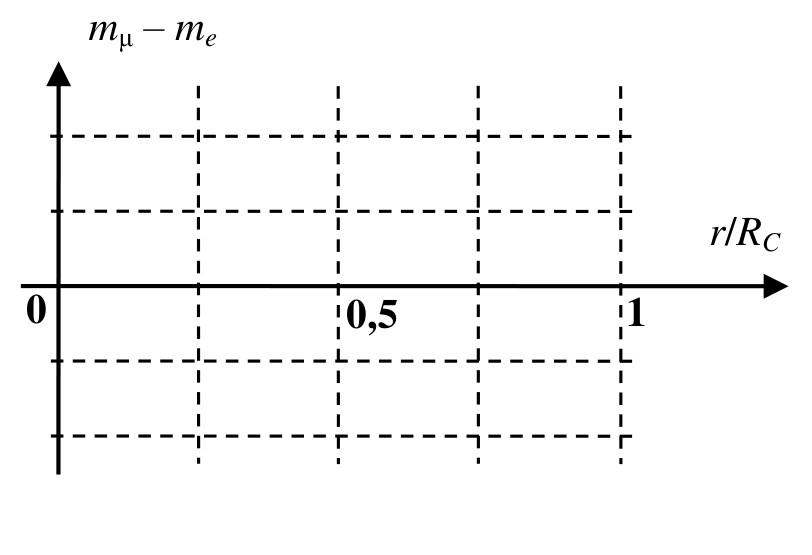
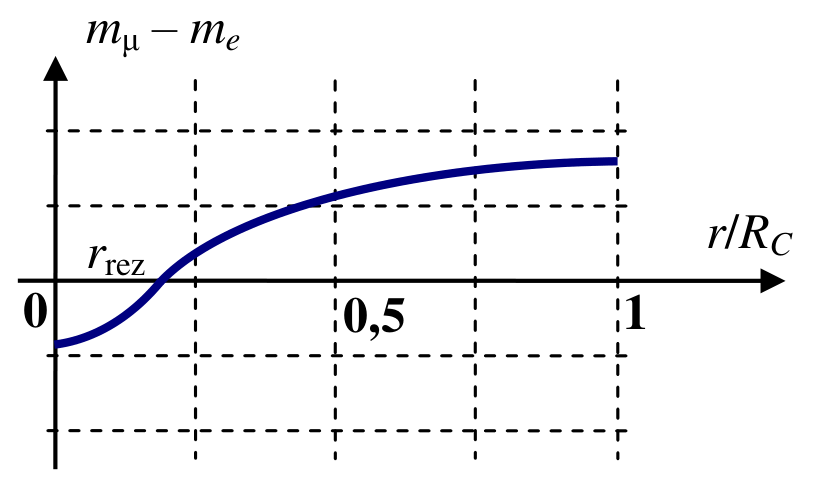
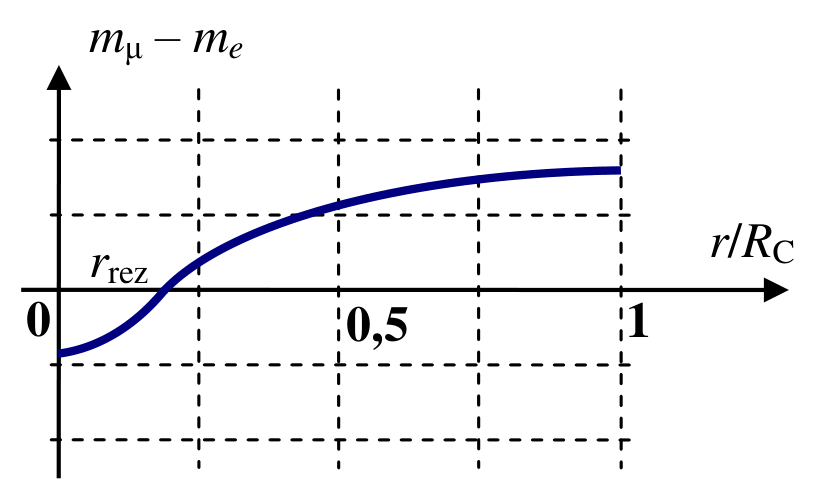
6) Plot an approximate dependence (i.e. show only the main features) of the mass difference of and as a function of the distance traveled inside the Sun from the center outwards.
[3 т.]
Part III: neutrino and Supernova explosion.
After an «ordinary» star has exhausted its nuclear fuel the star cools down and its internal pressure cannot withstand gravitational compression anymore. As a result, the star is contracting until its substance undergoes transition to a new phase in which all electrons are «shared», all nuclei «float» in the electron «gas», and only the pressure of this gas halts further collapse.
The star can exist in this state for a long time; however, if the mass of its dense core gradually increases and exceeds the core becomes unstable and collapses. At the onset of collapse such a core usually has a radius about 10000 km with approximately equal numbers of protons and neutrons. Soon after the contraction starts the rate of electron-nuclear collisions becomes high, which results in neutronization of the star substance due to reaction of «inverse -decay» (). Electron disappearance reduces the pressure of electron gas accelerating the neutronization even more. The whole process is essentially the tremendous explosion leaving in the aftermath a neutron star and an «outer envelope» flying outwards. Astronomers call such an explosion «Supernova explosion» or simply «Supernova». A neutron star is indeed composed mostly of tightly packed neutrons, so its density is approximately equal to the density of atomic nuclei.
7) Estimate an order of magnitude of the energy released due to compression of the stellar core from the initial radius to the neutron star. Calculate the numerical answer in Joules.
The released energy converts to kinetic energy of the star remnants (the flying outer layers and rotation of the neutron star) and to the energy of electromagnetic radiation and neutrinos. Supernova explosion is one of the most powerful source of neutrinos (sometimes it is called «neutrino bombs»), calculations show that more than half of the released energy converts to the energy of radiated neutrinos. Neutrinos are radiated both at the neutronization stage and after formation of the neutron star which is initially extremely hot and subsequently cools down mostly by radiating neutrinos. The neutronization and cooling take just several seconds. Notice that only electron neutrinos are created during neutronization, and the neutrino-antineutrino pairs of various flavors are created during the cooling. [4 т.]
8) Estimate the number of neutrinos created by a Supernova explosion assuming that the mass of the initial stellar core is approximately (the stellar substance does not «go away» with outer layers), the energy of radiated neutrinos is 80% of the released energy, and the mean energy of radiated neutrinos and antineutrinos is approximately 10 MeV. You could assume that neutron mass and radius are approximately the same as those of proton. Calculate the numerical values. [4 т.]
9) Supernova SN1987А exploded at the distance of from the Earth (in the Large Magellanic Cloud). What is the total number of neutrinos and antineutrinos passed through an Earth based detector of the cross-sectional area ? Estimate the expected number of detected neutrinos and antineutrinos assuming that the detector on average registers of neutrinos of any flavor in the corresponding energy range. Calculate the numerical values.
It is important that neutrino radiation is asymmetric with respect to the star magnetic axis due to «peculiar» neutrino behavior under mirror reflection: the power radiated in the infinitesimal solid angle is , where , is the angle of neutrino emission to the axis, and is the angle of rotation around the axis. [2 т.]
10) Estimate the speed gained by the star due to neutronization and cooling. Calculate the numerical answer (in km/s). [5 т.]
Решение
PROPOSED SOLUTION AND ANSWERS
Part I.
- The particle mass in STR (rest mass) is determined from the relation between the particle energy and momentum. For ultrarelativistic particle
Therefore,
and the «mean» mass of electron neutrino in vacuum
The numerical value .
Similarly, for muon neutrino, and .
- An electron neutrino created at and is a superposition of states of certain masses: . Each state propagates at a distance as a wave of certain frequency and wavevector, i.e.
Substituting expressions for in this formula one finds that at any point the wave contains two «flavor polarizations»:
The wave of muon neutrinos (the second term) equals to the expression
corresponding to a propagating wave of the «mean» frequency and «amplitude» modulated by the harmonic factor of the half-difference frequency. Neutrinos travel a distance from the point of emission for a time and the half-difference frequency is . It is important to note that small corrections due to neutrino masses can be neglected when calculating the mean energy () and must be taken into account when calculating the energy difference:
hence . Obviously, , so the «amplitude» factor can be regarded as almost constant during the oscillation period corresponding to the «mean» frequency. Therefore, the flux of muon neutrinos as a function of obtained by averaging over the period corresponding to the «mean» frequency is:
Here is the initial flux of neutrinos. Therefore, the oscillation length corresponding to the spatial period of the second factor in equals .
ANSWERS-1: the «mean» mass of equals , the «mean» mass of equals , and the oscillation length in vacuum is .
Note: the contesters could estimate the «mean» masses somewhat differently, e.g. by following this line of argument: «The particle mass is proportional to its energy at zero momentum, therefore, the «mean» mass of electron neutrino in vacuum is . Then . Similarly, for muon neutrino
and ».
This approach is not logical from the STR perspective since these «masses» are not invariant under Lorentz transformations, the correct mass must be defined via the invariant . However, the numerical values turn out to be quite reasonable. That is why such an approach should be given a partial credit.
Part II.
To estimate the impact of vacuum oscillations on the flux of electron neutrinos detected on the Earth, notice, that neutrinos entering the detector traveled various distances: they have been created at different points of active solar core of size . Besides, during the data accumulation the Earth changes its position with respect to the Sun (the distance between the Sun and the Earth varies by ). Therefore, the flux must be averaged over variations of which significantly exceed the oscillation length. Since , the flux of muon neutrinos corresponding to the decrement of the flux of electron neutrinos which is less than 6% of the initial value! Thus, vacuum oscillations cannot explain the significant decrease of the flux.
Proceeding to description of the oscillations in matter, notice, that although the energy of neutrino interaction with solar electrons is very small compared to the neutrino energy (even for the maximum electron density in the core ), it is of the same order as ! Therefore, this interaction cannot have a significant impact on the neutrino propagation and/or the total flux but it can noticeably affect the oscillations.
Thus, taking into account the interaction of neutrinos with matter, the mean energy of electron neutrino becomes
where the «tilde» over a quantity corresponds to that one in matter. The mean energy of muon neutrinos and the energy of interaction of electron and muon neutrinos remain unaltered:
Using the first two equations one finds that and . Combing this and the third equation yields the remaining parameters:
(the minus sign in the expression for corresponds to ).
- First of all, let us look at the new value of the mixing angle: if , the angle turns out to be ! This situation is called «maximal mixing» because the fractions of muon and electron neutrinos in the flow change periodically in antiphase between 0 и 100%. The phenomenon of sharp amplification of the oscillations in matter is called «Mikheyev–Smirnov–Wolfenstein effect» or MSW-effect. The condition of MSW-effect for neutrino with our parameters reads , i.e. . Notice, that the mixing angle away from the resonance remains small (the oscillations in these regions do not significantly affect the flux). One can also see that there is a layer outside the active solar core where electron density takes the «resonance» value. The width of the region in which the density differs from the resonant one by less than 1% is
which exceeds the oscillation length by more than order of magnitude. Therefore, a neutrino passing through this layer undergoes many oscillation cycles in which the fraction of muon neutrinos changes harmonically from 0% to 100%. The initial phase of the waves from different points in the solar core varies in a wide range. When evaluating the flux of at the exit of resonance region one should average over these variations as well. Hence, the flux of muon neutrinos can be as large as 50% of the total flux (compare to 6% in vacuum). Thus, the solar matter increases the flux of 8.5 times, or approximately by 750%!
- Another interesting observation concerns neutrino masses. It follows from the equations for and that the difference of energies of muon and electron neutrinos with the same momentum becomes negative for (i.e. when the electron density is higher than the resonant value)! Thus, in the solar core below the resonant layer the mass of is less than the mass of . Outside the resonant layer and the mass of exceeds the mass of . Obviously, the mass difference tends to its «vacuum» value when the density is small. Therefore, the plot looks approximately as:
Note: An accurate calculation yields the same result. Using the expression for mean energy (see 1)) , one obtains for parameters (and similarly for ):
(the quantity is introduced to simplify the calculation). Similarly, using the expression for (see 1)) and the formula for derived in 4), one obtains:
(here is another shorthand notation).
Solving the set of these two equations allows one to determine and . Mass is positive, therefore, and
The quantity reaches its minimum at the resonant density (the second term under the radical in the expression for vanishes) while changes monotonically (slowly decreases with density since is proportional to the electron density and other terms in the expression for remain constant). One can see that decreases when approaching the resonant density. Besides, at the resonance. Therefore, the difference of masses of and vanishes. It is obvious that switches sign when crossing the resonant layer. When the density exceeds the resonant value the sign is negative, i.e. electron neutrino «on average» is heavier than the muon neutrino. When the density is below the resonant value, is lighter than and the masses tend to their vacuum values when the density decreases. Clearly, the accurate analysis leads to the same conclusion as the proposed solution although the information obtained and the amount of calculations have significantly grown. Since the difference of mean masses of and in matter is expressed via , , and one could write down the explicit formula for the mass difference as a function of electron density (it turns out to be quite cumbersome).
ANSWERS-2: , solar matter enhances the flux of approximately by 750%, the mass difference of and at small electron density corresponds to the vacuum value, decreases when approaching the resonant density, goes through zero and changes sign when passing through the resonance layer, and then increases as the density grows.
Part III
- Firstly, it is necessary to estimate the energy scale of the phenomenon, i.e. to determine the energy released during the collapse. The «binding energy» of a gravitating sphere of mass and radius equals . To estimate the radius of neutron star let us equate its density to the density of nuclear matter equal to the ratio of proton mass to its volume. The mass of (1 mole) of protons approximately equals one half of molar mass of molecular hydrogen (), hence and . For a neutron star of mass one obtains . The initial radius of the stellar core is greater by three orders of magnitude, so the released energy is .
Actually, this number is an overestimation because it has been assumed that the core mass does not change during the collapse. However, according to STR a decrease of energy is equivalent to the decrease of mass, i.e. one should actually write . Since , this effect is not too small. Solving the quadratic equation yields:
So, the better estimate of the released energy gives . In any case, by the order of magnitude.
- According to the problem statement the total energy carried away by neutrinos and antineutrinos . Since the average energy of emitted neutrinos and antineutrinos equals , their total number is . The number of proton-electron pairs in the initial stellar core is , while in the final state almost only neutrons are left. Therefore, the number of neutrinos emitted during neutronization is , and the rest are emitted during the cooling. Thus, the total number of emitted antineutrinos and neutrinos is:
The number of neutrinos and antineutrinos from SN1987A passing through the detector on Earth is proportional to the ratio of the detector cross-section to the area of a sphere of radius : . Respectively, and . Since only the fraction is detected, the expected number of detected antineutrinos and neutrinos is estimated to be and .
Since all emitted neutrinos and antineutrinos are ultrarelativistic, the momentum carried by them per small solid angle is . Therefore, the component of the momentum carried by the radiation projected on the magnetic axis of the star is:
Since and , one obtains . The recoil velocity is opposite to the magnetic axis and its value , where is the mass of the created neutron star. Taking into account the mass defect , one finally obtains . This speed is already noticeable against the background motion of stars in galaxies (a typical velocity of this motion is several hundred km/s).
ANSWERS-3: the total number of neutrinos and antineutrinos emitted by supernova is and ; the number of neutrinos and antineutrinos passing through the detector is and ; and the expected number of detected neutrinos and antineutrinos is and . The recoil speed of neutron star is .
TABLE OF ANSWERS
| № | Answer | Maximum score |
|---|---|---|
| 1 | or . or . | (if inside the «doubled» interval: ) |
| 2 | Explicit expression for via «flavor polarization» or the amplitude of muon neutrino wave is written down. . | (2 for the equation + 1 for the value) = 5 |
| 3 | «–» (no) full credit is given if there is any reasonable justification supported by calculations. | 2 |
| 4 | The correct set of equations for , , and is written down. . | |
| 5 | The effect of «resonance» is discovered. Matter increases the flux of by approximately 750%. | |
| 6 | Any plot with a finite negative value for and a finite positive value for . The original grading plot is retained below. | 3 (if it is not indicated that the corresponds to : −0,5 points) |
| 7 | Equation is used (the factor 3/5 can be omitted). . | (factor 3/5 is absent, or mass defect is not taken into account: −0,5 points for each) |
| 8 | Neutrinos emitted at the neutronization stage are taken into account: about . , . | (mass defect is neglected: 3, the error greater than 25% and less than 60%: 2) |
| 9 | and ; и . | (the error greater than 20% and less than 50%: 1) |
| 10 | Integral expression for the momentum component is written down. Momentum carried away, . . | (mass defect is neglected: 4, the error is greater than 25% and less than 50%: 3) |
| Total | 40 |
Archive source notes: The final grading table prints for the mass ranges, whereas the worked solution and ANSWERS-1 print . Its muon kilogram range prints a second ; both native defects remain literal above. The grading row2 has the native “2+3 (2 for the equation +1 for the value)=5” wording. Worked item6 prints , although item4's energy difference has ; no factor 2 is silently inserted. The accurate-calculation note says “slowly decreases with density” although its displayed defining expression increases with positive . The question uses solar radius and active-core radius , while the key also uses and ; the graph labels are retained. The key explains the stated 2 g/mole hydrogen value as molecular hydrogen. The grading table's item10 momentum numerator uses Latin , while the worked solution and question use . The two key graphs retain their actual native bytes. Blank native PDF pages16 and27 remain in the retained original.
Оригинал в Архива: theoretical.pdf · решение от архива: theoretical-solutions.pdf