IOM 2017, Теория — Задача 2. Big adventure of a small alkyl
2nd Olympiad of Metropolises — Chemistry, Theoretical Problems, Official English version · 6 септември 2017 г.
Original cover
Country ______
Name ______
2nd Olympiad of Metropolises
Chemistry
Theoretical Problems
6 September 2017
Moscow, Russia
Chemistry. Theoretical problems. Official English version
Указания
- Begin only when the START command is given. You have 4.5 hours to work on the problems.
- Use only the pen and calculator provided.
- All results must be written in the appropriate boxes within the text. Anything written elsewhere will not be graded. Use the reverse of the problem pages if you need scratch paper.
- Write relevant calculations in the appropriate boxes when necessary. If you provide only correct end results for complicated questions, you will receive no score.
- Raise your hand if you have any questions concerning the text of the problems.
- Raise your hand if you need a restroom break.
- The official English version of this examination is available on request only for clarification.
Original key cover
2nd Olympiad of Metropolises
Chemistry
Theoretical Problems
with solutions
6 September 2017
Moscow,Russia
Chemistry. Theoretical problems with solutions. Official English version
Условие
Problem 2. Big adventure of a small alkyl (10 marks)
| Question | 1 | 2 | 3 | 4 | Total |
|---|---|---|---|---|---|
| Points | 6 | 3 | 2 | 5 | 16 |
| Result |
The prolonged heating of benzene (1.56 g) with alkyl bromide (A, 6.54 g) in the presence of (0.001 mol) affords a mixture of alkylbenzenes with the compound B as the major component. The stepwise character of the process was proved by periodic sampling and analysis of the reaction mixture content. The major components in the samples were found as follows: benzene, A, and the compound C in the first sample, the compound D in the second sample, and the compound E in the third sample.
Once the reaction completed (qualitative and quantitative composition did not change with time), the reaction mixture was neutralized with aqueous . From this mixture, the compound B was isolated with a 90% yield (with respect to benzene consumed); other alkylbenzenes were obtained as side products and were not isolated. Heating of B with an excess of in the presence of produced the acid F as a single organic product. It was found that the neutralization of 0.63 g of F required 6.84 mL of 5.00% NaOH solution ().
1 Draw the structural formula of the compound F accounting for the fact that the molecule of F contains 3 types of carbon atoms. Draw the structures of the compounds A and B. Write down all other alkyl bromides which allow synthesizing the acid F as a single organic product of B oxidation. Prove by calculations that other alkyl bromides do not satisfy the problem conditions.
Other alkyl bromides which allow for the synthesizing F as a single oxidation product: ______
Calculations proving that only A satisfies the problem conditions: ______ [6 т.]
2 Draw the structures of the compounds C, D and E if these are not isomers.
[3 т.]
3 When the reaction mixture obtained after alkylation was poured into water, an acidic solution was formed. How many grams of should be added to this solution to achieve pH 7.00? Neglect the solubility of carbon dioxide in water.
Calculations
______ [2 т.]
Treatment of B with an excess of bromine in the presence of followed by UV-irradiation of the reaction mixture yielded the mixture of products with the compound G as the major component. Slow hydrolysis of G with diluted aq. NaOH solution led to the compound H; NMR spectra of both G and H contain one signal only (i.e. in both compounds all hydrogen atoms are identical). Further transformations of H into a compound used in organic electronics is shown in the scheme below.
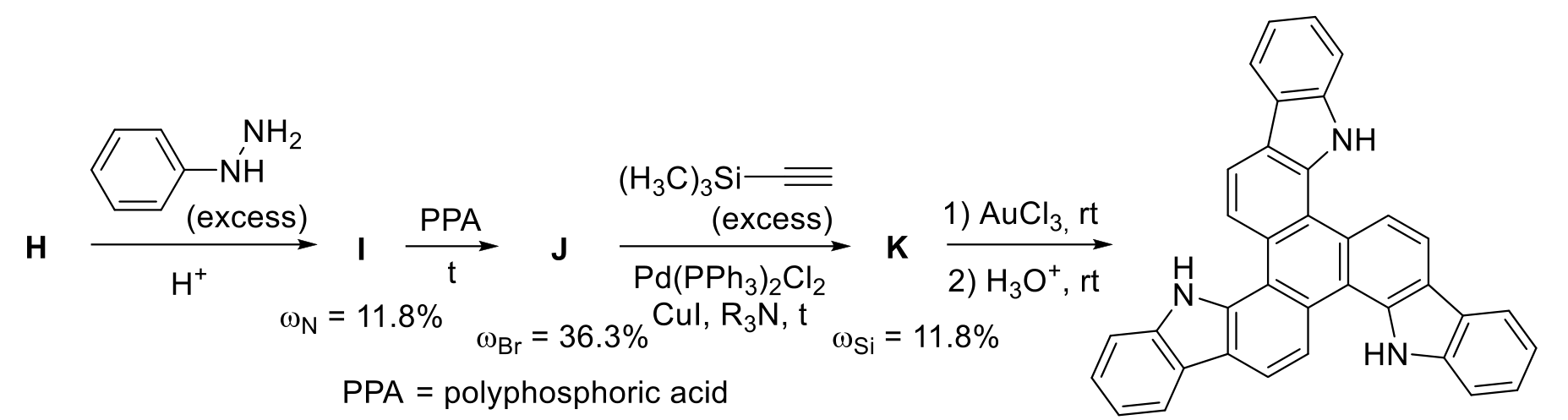
4 Draw the structures of the compounds G-K.

[5 т.]
Решение
Solutions
1
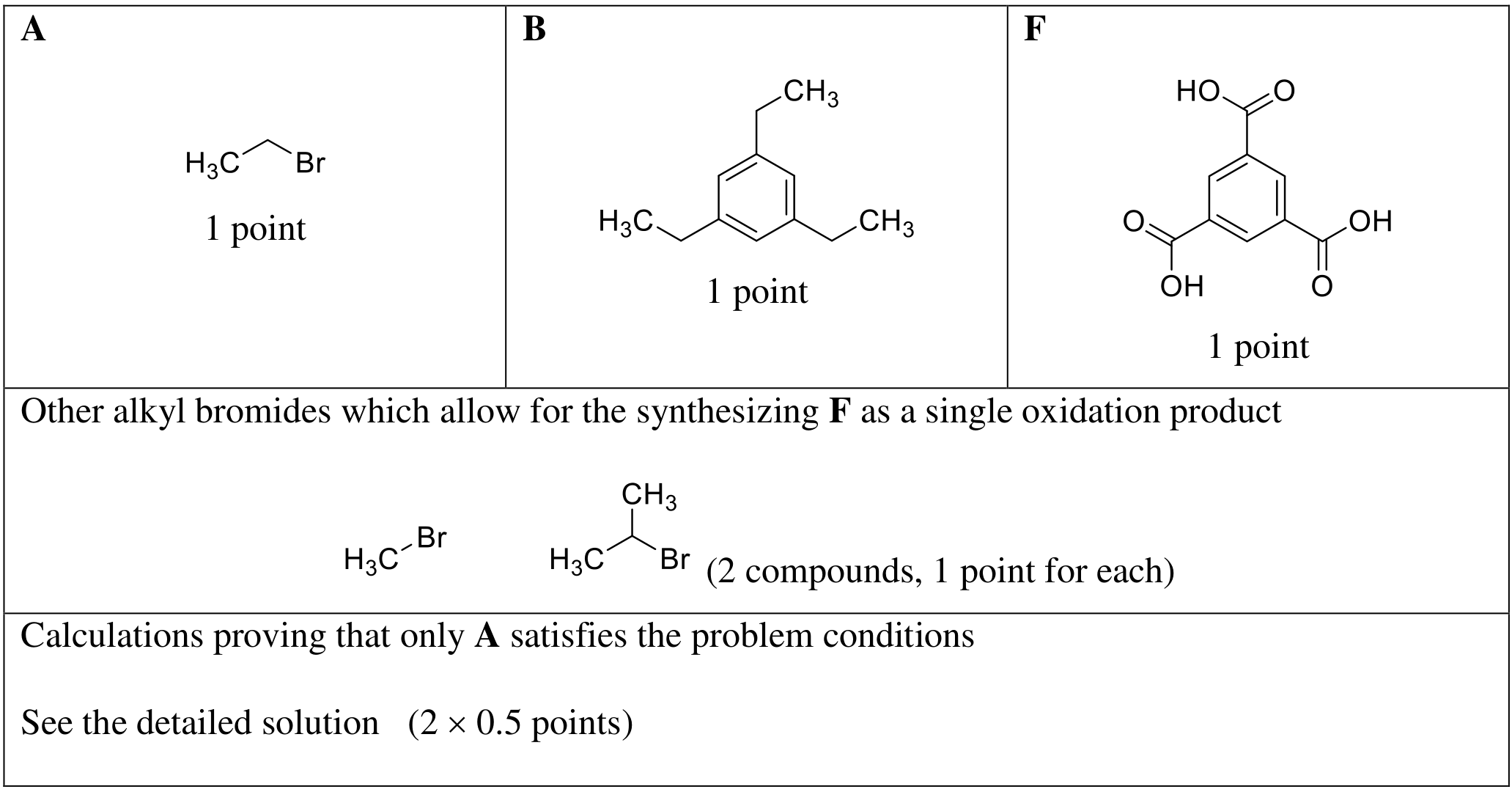
A, B and F: 1 point for each structure.
Other alkyl bromides which allow for the synthesizing F as a single oxidation product: 2 compounds, 1 point for each.
Calculations proving that only A satisfies the problem conditions: See the detailed solution. (2 × 0.5 points) [6 т.]
2
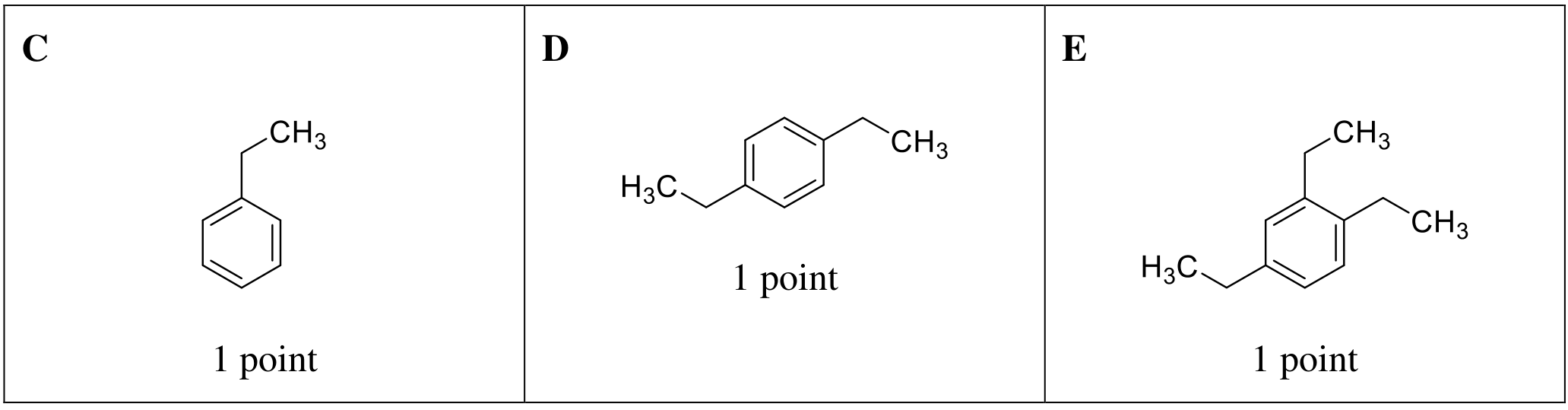
C, D and E: 1 point for each structure. [3 т.]
3 Calculations. According to the problem conditions, the final mixture contains alkylbenzenes only as organic compounds. Therefore, mol of benzene reacted with 0.06 mol of ethyl bromide producing 0.02 mol of B and 0.06 mol of HBr. Moreover, 0.001 mol of AlBr₃ is present in the reaction mixture.
To achieve pH 7.00 it is required to add mol of NaHCO₃. This corresponds to 5.29 g.
— 2 points
(1 point if AlBr₃ is not taken into account) [2 т.]
4
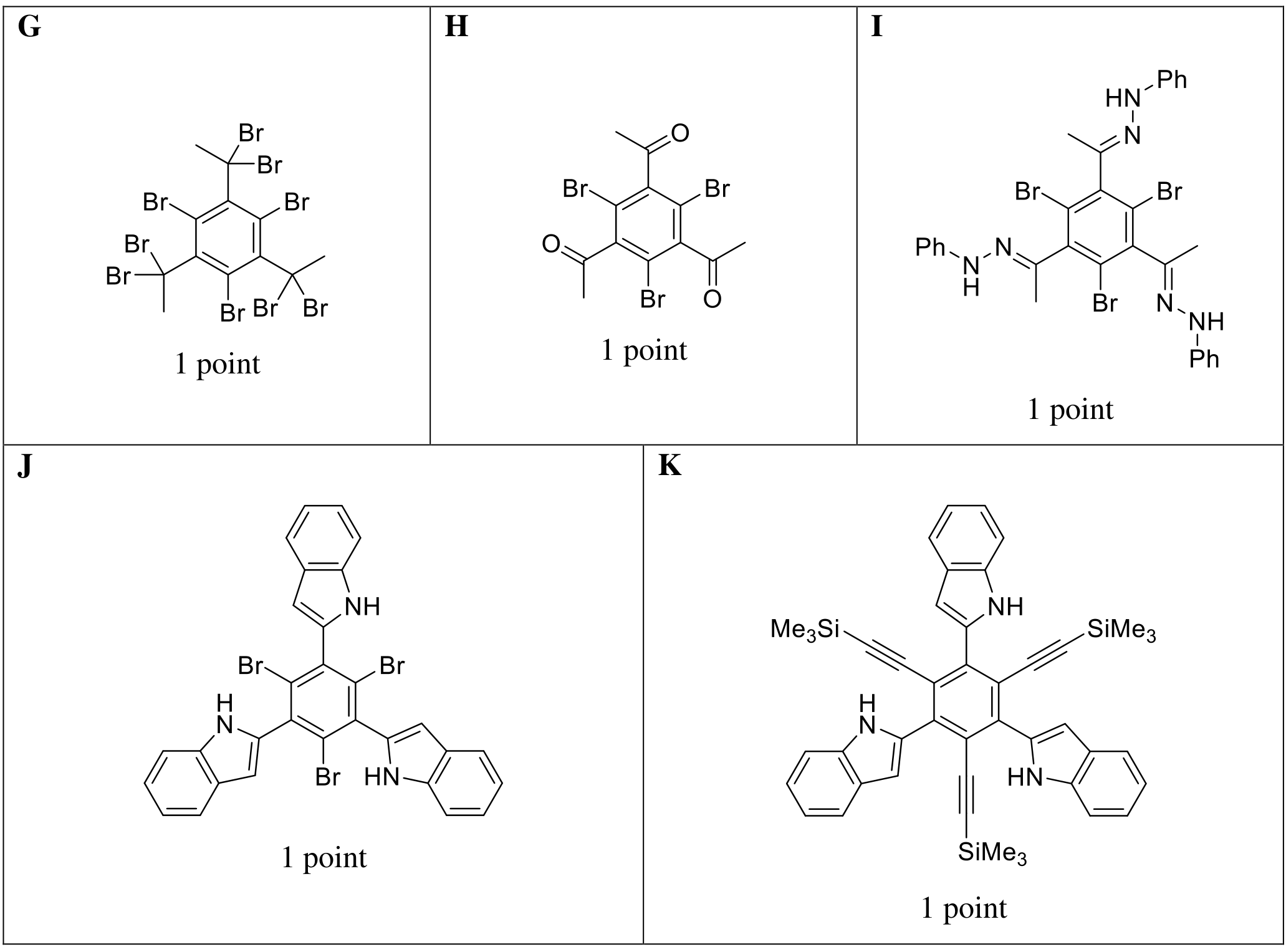
G–K: 1 point for each structure. [5 т.]
Detailed solution
1 It is clear that compound B belongs to the class of alkylbenzenes which has the general formula of . Heating of alkylbenzenes with KMnO₄ in the presence of acid leads to the oxidation of side alkyl chain to the corresponding carboxylic acid. So, the product of the oxidation of F can be described as . The neutralization of 0.63 g F requires g of 5% aq. NaOH solution. This corresponds to 9 mmol of NaOH. If F is monoacid (), its molecular weight should be equals to . This is impossible. Only tricarboxylic acid () satisfies the problem conditions. As compound F has three types of carbon atoms, this can be only benzene-1,3,5-tricarboxylic acid. Therefore, B is 1,3,5-trialkylbenzene. The formation of F as a single organic product of the oxidation of B is possible for 1,3,5-trimethylbenzene,1,3,5-triethylbenzene,1,3,5-triisopropylbenzene. So, possible alkyl bromides are ethyl bromide (A), methyl bromide (A′) and isopropyl bromide (A″).
mol of benzene were introduced into the reaction. Weight of alkyl bromide (6.54 g) corresponds to 0.0688 mol of CH₃Br,0.06 mol of C₂H₅Br and 0.053 mol of isopropyl bromide. If methyl bromide was a started alkylation agent,0.06 mol of CH₃Br is consumed for the formation of 0.02 mol of trialkylbenzene; after that 0.0088 mol of CH₃Br should further react with trialkylbenzenes producing the mixture of 0.0112 mol of trimethylbenzenes and 0.0088 mol of tetramethylbenzenes (in the reaction mixture some quantities of di- and pentamethylbenzenes can also be present but this does not affect the general conclusion). Evidently, it is impossible to isolate 1,3,5-trimethylbenzene in 90% yield from this mixture. In the case of isopropyl bromide,0.04 mol of alkyl halide is consumed for the formation of dialkylbenzenes; after that 0.013 mol of isopropyl bromide should react with dialkylbenzenes producing trialkylbenzenes. In other words, after the reaction will finished it should contain approximately 65% () of trialkylbenzene and 35% of trialkylbenzene. Again, this is impossible to isolate 1,3,5-triisopropylbenzene in 90% yield from this mixture. On the contrary, ethyl bromide is the ideal substrate from this point of view as in this case the theoretical yield of triethylbenzene is 100%. Evidently, in this case it is possible to isolate 1,3,5-triethylbenzene in 90% yield. Therefore, B is 1,3,5-triethylbenzene, A is ethyl bromide.
2 Compounds C, D and E are not isomers. Therefore, they are products of the sequential alkylation of benzene with ethyl bromide Therefore, C is ethylbenzene. Compound D is diethylbenzene. Ethyl group is electron-donating substituent and directs electrophilic attack to ortho- and para-positions. Steric demands prevent ortho-attack. Therefore, the major product in the second probe should be 1,4-diethylbenzene (compound D). Minor product is 1,2-diethylbenzene (D′). Compound E is the product of D alkylation. This is 1,2,4-triethylbenzene (the same compound is formed from D′). Under the prolonged keeping in the presence of Lewis acid and HBr evolved during the previous alkylation steps, E undergoes isomerization to the more stable isomer (1,3,5-triethylbenzene).
4 Compound B has three types of hydrogen atoms (aromatic CH, methylene protons and methyl groups protons) while in compound G all protons are identical. This shows that during bromination only protons of methyl groups left intact. On the contrary, other protons were substituted by bromine atoms (aromatic protons via aromatic electrophilic substitution catalyzed by FeBr₃; methylene protons via radical bromination which demonstrate high selectivity in regard to benzylic C-H bonds. Therefore, G is 1,3,5-tribromo-2,4,6-(1,1-dibromoethyl)benzene. Diluted alkali solution hydrolyzed selectively Ar–C–Br but not Ar-Br bonds. As a result, every CBr₂ moiety is transformed into C=O group. The reaction of H with phenylhydrazine is the formation of hydrazone. All three carbonyl groups are transformed in hydrazones, this is supported by nitrogen content in I. Under heating in polyphosphoric acid, phenylhydrazones are transformed into indoles (Fischer reaction). This is supported by both bromine content in J and (this is more important and conclusive) structure of the final product which has three indole fragments. The comparison of J with the final product shows that J has bromine atoms in the central benzene ring and hydrogen atoms at the C(3) position of indole moieties but in the target product these atoms are substituted by CH=CH fragments. Despite school students do not know reactions used for these transformations (Sonogashira coupling and Au-catalyzed alkyne cyclization), it is possible to understand that the source of two carbon atoms is alkyne used at the J-to-K step. So, during this step it is needed to substituted bromines with Me₃SiCC fragments (Si content supports this conclusion), the last two steps are Au-induced cyclization and hydrolysis for removal of silyl groups.
Бележка от източника
Native source has six whole tasks and 34 scored flat request labels; catalogue 30 parts is provisional. Each native heading says 10 marks while grids total 20,16,20,30,88,20. Original key 2 repeats trialkylbenzene for both 65% and 35%. Original Stickland scheme prints Pi=HPO3(2−). Copper key 5 gives 0.0025 M then uses 0.025 in ion-product expressions. Thermal key 2/4 prints 20/607.74=0.0987 mol for lithium silicide; its product heating uses 27/61/83 while supplied heat-capacity table gives 25/68/74 forFe/FeO/KCl. Original expressions/results/marking values remain literal. Scientific molecular drawings, stereochemistry, reaction schemes, photos, periodic table and blank molecular response grids are original exact crops. Plain calculation rectangles preserve printed labels and blank fields. Full original official keys and detailed uncredited comments retained; no author name inferred. The native key comment for problem 4 request 6 prints Mowing backwards; that spelling is retained.
Оригинал в Архива: Problems.pdf · официални решения: Solutions.pdf