IOM 2017, Теория — Задача 6. Reserve battery
2nd Olympiad of Metropolises — Chemistry, Theoretical Problems, Official English version · 6 септември 2017 г.
Original cover
Country ______
Name ______
2nd Olympiad of Metropolises
Chemistry
Theoretical Problems
6 September 2017
Moscow, Russia
Chemistry. Theoretical problems. Official English version
Указания
- Begin only when the START command is given. You have 4.5 hours to work on the problems.
- Use only the pen and calculator provided.
- All results must be written in the appropriate boxes within the text. Anything written elsewhere will not be graded. Use the reverse of the problem pages if you need scratch paper.
- Write relevant calculations in the appropriate boxes when necessary. If you provide only correct end results for complicated questions, you will receive no score.
- Raise your hand if you have any questions concerning the text of the problems.
- Raise your hand if you need a restroom break.
- The official English version of this examination is available on request only for clarification.
Original key cover
2nd Olympiad of Metropolises
Chemistry
Theoretical Problems
with solutions
6 September 2017
Moscow,Russia
Chemistry. Theoretical problems with solutions. Official English version
Условие
Problem 6. Reserve battery (10 marks)
| Question | 1a | 1b | 1c | 2 | 3 | 4 | 5 | Total |
|---|---|---|---|---|---|---|---|---|
| Points | 2 | 2 | 2 | 2 | 4 | 4 | 4 | 20 |
| Result |
Reserve batteries are electrochemical cells which can be stored for decades without discharge but can be promptly activated when needed. This is achieved by isolating the cell components (cathode, anode and electrolyte) from one another prior to activation. One example of such a cell is the magnesium-silver chloride battery which is used in seaborne devices. During storage, the space between electrodes is empty but once the device is in water, chemical reaction starts.
Another type of reserve batteries is a so-called thermal battery. In this type of batteries an electrolyte is a solid ionic compound which melts upon activation due to ignition of a pyrolant (heat-producing mixture). When melted, electrolyte conducts electricity. In this problem, we consider a specific thermal battery with the following composition:
The products of the discharge reaction in the cell are lithium silicide and lithium-manganese spinel . –conducting electrolyte is a relatively low-melting (melting point ) eutectic¹ mixture of LiCl and KCl with molar fractions of the salts 56 and 44%, respectively. Pyrolant which heats the battery during activation is a mixture of iron and potassium perchlorate with mass ratio 86 : 14. The scheme of the battery and the masses of the electrodes and the electrolyte are provided in the picture below. Ignition device for iron-perchlorate mixture is not shown. The working temperature of the battery is . It can be maintained for a sufficient time due to heat insulation.
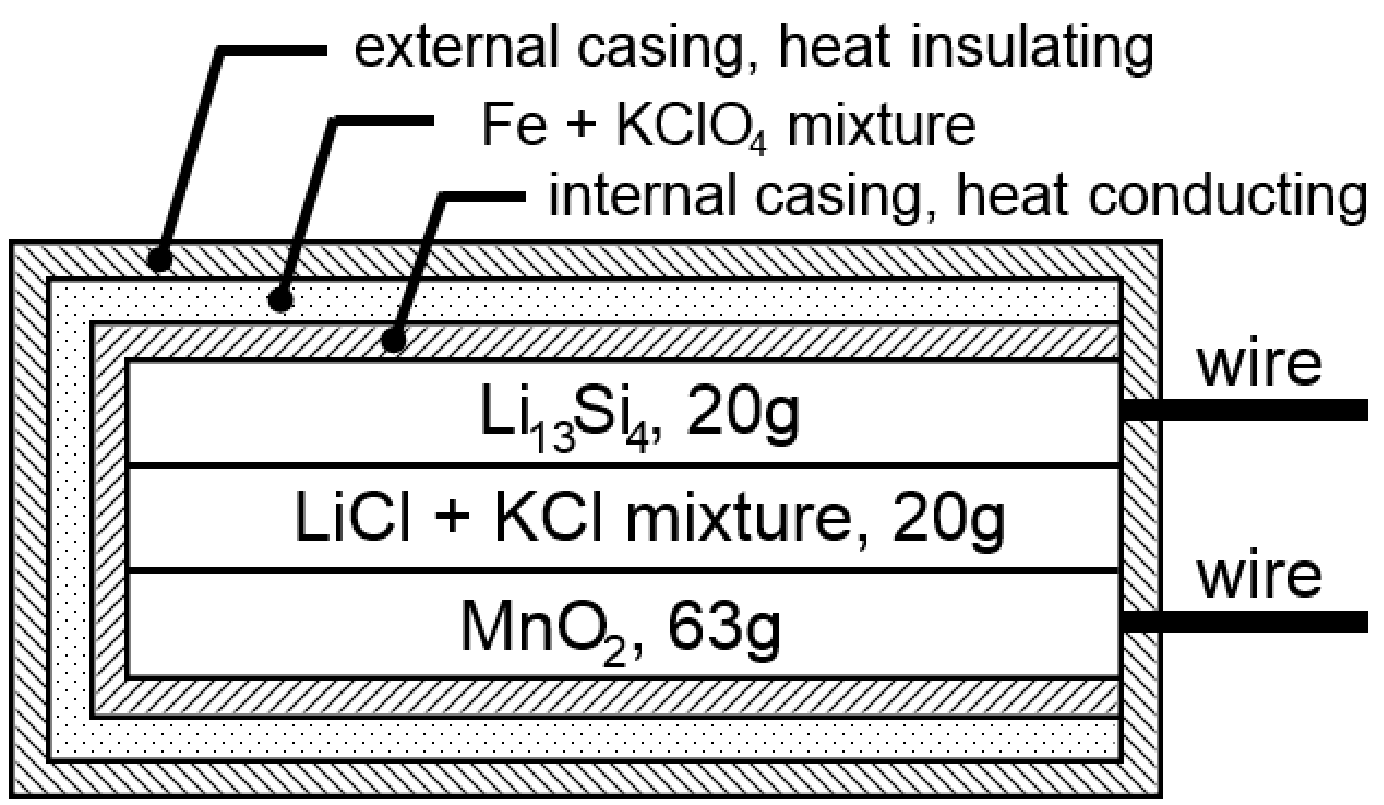
¹ Eutectic mixture has the lowest melting point among all mixtures with the same qualitative composition.
1a Write the balanced equation for the discharge reaction of this battery. Note that silicon does not leave anode at all times.
Equation: ______ [2 т.]
1b Write the balanced equation for the burn reaction of the Fe/KClO₄ mixture. Note that iron is in large excess thus the oxide of iron in the lowest oxidation state is formed.
Equation: ______ [2 т.]
1c Large excess of iron in the pyrolant is used for two reasons: a) with this particular composition the linear burn rate is the largest and b) excess of iron prevents another reaction in which a gas is produced which can mechanically destroy the battery. Write the reaction equation.
Equation: ______ [2 т.]
Use the data and formulae below for the questions that follow:
| Substance | Li₁₃Si₄ | Li₇Si₃ | MnO₂ | LiMn₂O₄ | Fe | FeO | KCl | KClO₄ |
|---|---|---|---|---|---|---|---|---|
| , kJ/mol | −517 | −294 | −520 | −1404 | 0 | −272 | −436 | −430 |
| , J/(mol·K) | 370 | 225 | 53 | 165 | 27 | 61 | 83 | 151 |
| Substance | Li₁₃Si₄ | MnO₂ | Fe | FeO | KCl | KClO₄ |
|---|---|---|---|---|---|---|
| , J/(mol·K) | 372 | 54 | 25 | 68 | 74 | 111 |
Properties of the LiCl + KCl mixture:
Heat of fusion:230 J/g
Heat capacity(solid):0.90 J/(g·K)
Heat capacity(liquid):1.27 J/(g·K)
Relation between electric charge , current , and time : .
Assume that all heat capacities are constant, the pressure is constant (1 bar), and for all reactions do not depend on temperature.
2 Calculate the capacity of the battery in mA·h. Note that SI units for charge, current, and time are coulomb, ampere and second, respectively.
Calculations
Capacity = ______ mA·h [2 т.]
3 Calculate the electromotive force of the battery at .
Calculations
Electromotive force = ______ [4 т.]
4 What mass of the iron-perchlorate mixture is required to heat the battery from the temperature to the working temperature ? Neglect the heat capacity of the battery casing.
Calculations
Mass of the mixture = ______ [4 т.]
The maximum current density (electric current per surface area of the electrode) is the parameter of a battery which is no less important than its capacity or electromotive force. In electrochemical cells, the current density is usually limited by kinetic parameters such as rate of diffusion of ions in the electrolyte or the rate of their discharge on the electrodes. In this particular battery, another factor is also important. You’ll have to deduce it from the description of a certain phenomenon that takes place in the battery and answer the question.
As long as the current density does not exceed the certain threshold, the battery functions as intended until the cathode or anode material runs out. Gradual increase of the current density leads to formation of a white precipitate near cathode. A larger increase in the current density leads to formation of a white precipitate near anode also. The larger the current density, the more crystals are formed. At some point the amount of crystals becomes so large that they block the surface of one of the electrodes and the reaction stops. This phenomenon is reversible – disconnecting the battery from the electric load causes gradual dissolution of the precipitates (if the battery has not cooled down in the meantime) and the cell becomes functional again.
5 Write down the formulas of the crystals that precipitate near cathode and anode. Note that the reactions in the battery do not depend on the current density.
| Cathode | Anode |
|---|---|
| ______ | ______ |
[4 т.]
Решение
Solutions
1a
[2 т.]
1b
[2 т.]
1c
[2 т.]
2 Calculations
– stoichiometric relation
Capacity=9710 mA·h [2 т.]
3 Calculations
emf=3.69 V [4 т.]
4 Calculations
The general scheme:
Isothermal reaction at 298 K with heat removal – return of heat to the battery with heating of electrodes, electrolyte and combustion products.
1 kg om mixture contains:860 g Fe=15.4 mol,140 g KClO₄=1.01 mol
The heat released from 1 kg of mixture=
Products of combustion of 1 kg of mixture:11.36 mol Fe,4.04 mol FeO,1.01 mol KCl
The heat required for heating the products
LiCl-KCl:
Denote the mass of Fe+KClO₄ mixture as kg. Then the heat balance is as follows:
Mass of the mixture=43 g [4 т.]
5
| Electrode | Crystals |
|---|---|
| Cathode | KCl |
| Anode | LiCl |
[4 т.]
Бележка от източника
Native source has six whole tasks and 34 scored flat request labels; catalogue 30 parts is provisional. Each native heading says 10 marks while grids total 20,16,20,30,88,20. Original key 2 repeats trialkylbenzene for both 65% and 35%. Original Stickland scheme prints Pi=HPO3(2−). Copper key 5 gives 0.0025 M then uses 0.025 in ion-product expressions. Thermal key 2/4 prints 20/607.74=0.0987 mol for lithium silicide; its product heating uses 27/61/83 while supplied heat-capacity table gives 25/68/74 forFe/FeO/KCl. Original expressions/results/marking values remain literal. Scientific molecular drawings, stereochemistry, reaction schemes, photos, periodic table and blank molecular response grids are original exact crops. Plain calculation rectangles preserve printed labels and blank fields. Full original official keys and detailed uncredited comments retained; no author name inferred. The native key comment for problem 4 request 6 prints Mowing backwards; that spelling is retained.
Оригинал в Архива: Problems.pdf · официални решения: Solutions.pdf