IOM 2017, Теория — Задача 5. Equilibrium between the copper minerals
2nd Olympiad of Metropolises — Chemistry, Theoretical Problems, Official English version · 6 септември 2017 г.
Original cover
Country ______
Name ______
2nd Olympiad of Metropolises
Chemistry
Theoretical Problems
6 September 2017
Moscow, Russia
Chemistry. Theoretical problems. Official English version
Указания
- Begin only when the START command is given. You have 4.5 hours to work on the problems.
- Use only the pen and calculator provided.
- All results must be written in the appropriate boxes within the text. Anything written elsewhere will not be graded. Use the reverse of the problem pages if you need scratch paper.
- Write relevant calculations in the appropriate boxes when necessary. If you provide only correct end results for complicated questions, you will receive no score.
- Raise your hand if you have any questions concerning the text of the problems.
- Raise your hand if you need a restroom break.
- The official English version of this examination is available on request only for clarification.
Original key cover
2nd Olympiad of Metropolises
Chemistry
Theoretical Problems
with solutions
6 September 2017
Moscow,Russia
Chemistry. Theoretical problems with solutions. Official English version
Условие
Problem 5. Equilibrium between the copper minerals (10 marks)
| Question | 1 | 2 | 3 | 4 | 5 | Total |
|---|---|---|---|---|---|---|
| Points | 8 | 10 | 16 | 20 | 34 | 88 |
| Result |
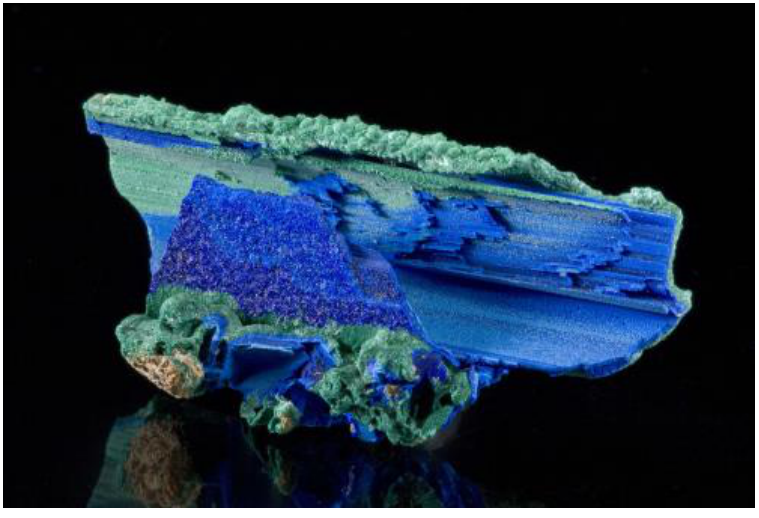
The Ural mountains, dividing Europe and Asia, have long been a source of a large number of minerals. The glory of the Urals was brought by deposits of "gems" – precious, semiprecious and ornamental stones. Among them, malachite stands out – a beautiful patterned dark green mineral. It was used for a long time not only as an ornamental stone, but also as a copper ore, which led to the almost complete exhaustion of the Ural deposits.
1 2.21 g of malachite (hereinafter M) was heated at to constant weight, yielding 1.59 g of black powder. The evolved gases were successively passed through the tubes with phosphorus (V) oxide and calcium oxide, the mass of the first tube being increased by 0.18 g and the second by 0.44 g. With stronger heating, above in the nitrogen flow, the black powder loses up to 10.06% of its weight. Determine the composition of M, write down the equations of all these reactions.
Calculations
Formula of M: ______
Reaction equations: ______ [8 т.]
2 Azurite (hereinafter A) is a mineral of blue color with the same qualitative composition as M, but other quantitative. Upon heating to , A loses 30.77% of its mass. Determine the formula of A.
Calculations
Formula of A: ______ [10 т.]
3 In copper ores, A is often found together with M. One of them is able to replace the other while maintaining the shape of the original mineral, forming pseudomorphs, as in the image above. Estimate the carbon dioxide pressure at which both minerals can coexist at room temperature.
Calculations
______ [16 т.]
4 At a low carbon dioxide pressure, both minerals can be converted to tenorite (hereinafter T), a mineral identical in composition to the black powder formed by the thermal decomposition of M. Atmospheric air contains 400 ppm (parts per million) of carbon dioxide. Which of the copper minerals – M, A or T – is the most stable under the given conditions (temperature )? Confirm your answer by calculations and estimates.
Thermodynamic data:
| Substance | Malachite | Azurite | Tenorite | ||
|---|---|---|---|---|---|
| , kJ/mol | −883 | −1389 | −130 | −237 | −394 |
Calculations and estimates
The most stable mineral – ______ [20 т.]
5 M can be precipitated from the solutions under mild conditions using baking soda as a source of carbonate ions.
a) Determine whether a precipitate will be formed when 1 drop of 1.00 M copper sulfate solution is added to 20.0 ml of 0.100 M sodium hydrogen carbonate solution. 1 ml contains about 20 drops.
b) Is it possible to assert with confidence that the precipitate contains an individual mineral? If so, which one? If not, why?
Solubility products : for azurite and for malachite.
Acidity constants for carbonic acid: , .
Calculations
a) The precipitate ☐ is formed ☐ is not formed
b) Answer (yes (formula), no): ______ [34 т.]
Решение
Solutions
1 Calculations
, ,
Each substance – 0.5 points, each quantity – 0.5 point
Formula of M: — 2 points
Reaction equations:
— 1 point
— 0.5 points
— 0.5 points
— 1 point [8 т.]
2 Calculations
Suppose, azurite is a basic copper carbonate — 2 points
mass balance:
charge balance:
— 4 points
The simplest solution in natural numbers is:.
Formula of A: — 4 points [10 т.]
3 Calculations
— 2 points
— 6 points
— 8 points [16 т.]
4 Calculations and estimates
From the previous answer it follows that at low pressure malachite is more stable than azurite. So, we need to decide which mineral is more stable tenorite(CuO) or malachite — 4 points
Consider transformation of tenorite to malachite:
— 2 points
— 4 points
— 4 points
The partial pressure of CO₂ in the atmosphere: — 2 points
tenorite is more stable — 4 points
The most stable mineral – tenorite
(Answer without calculations – 0 points) [20 т.]
5 Calculations
a)
— 4 points(2×2)
Determine the concentrations of ions in the solution:
(dilution of the solution can be neglected) — 2 points
Hydrogen carbonate is an ampholyte, so we can use a well-known approximate formula for H⁺ concentration: — 8 points
— 2 points
Neglecting the dilution of the solution calculate the carbonate concentration at a given pH:
— 8 points
Compare with :
malachite: precipitates — 2 points
azurite: precipitates — 2 points
b) The freshly precipitated substance contains a mixture of basic carbonates, because both solubility products are much less than the product of concentrations. Upon long standing, the formation of the most thermodynamically stable mineral is possible, i.e., malachite.
Both answers can be correct with the corresponding justification. — 6 points
a) The precipitate is formed
b) Answer(yes(formula),no): No [34 т.]
Бележка от източника
Native source has six whole tasks and 34 scored flat request labels; catalogue 30 parts is provisional. Each native heading says 10 marks while grids total 20,16,20,30,88,20. Original key 2 repeats trialkylbenzene for both 65% and 35%. Original Stickland scheme prints Pi=HPO3(2−). Copper key 5 gives 0.0025 M then uses 0.025 in ion-product expressions. Thermal key 2/4 prints 20/607.74=0.0987 mol for lithium silicide; its product heating uses 27/61/83 while supplied heat-capacity table gives 25/68/74 forFe/FeO/KCl. Original expressions/results/marking values remain literal. Scientific molecular drawings, stereochemistry, reaction schemes, photos, periodic table and blank molecular response grids are original exact crops. Plain calculation rectangles preserve printed labels and blank fields. Full original official keys and detailed uncredited comments retained; no author name inferred. The native key comment for problem 4 request 6 prints Mowing backwards; that spelling is retained.
Оригинал в Архива: Problems.pdf · официални решения: Solutions.pdf