IOM 2018, Теория — Задача 5. Methane pyrolysis
3rd Olympiad of Metropolises — Chemistry, Theoretical Problems, Official English version · 5 септември 2018 г.
Original cover
Country ______
Participant code ______
3rd Olympiad of Metropolises
Chemistry
Theoretical Problems
September 5, 2018
Moscow, Russia
Chemistry. Theoretical problems. Official English version
Указания
- Begin only when the START command is given. You have 4 hours to work on the problems.
- Use only the pen and calculator provided.
- All results must be written in the appropriate boxes within the text. Anything written elsewhere will not be graded. Use the reverse of the problem pages if you need scratch paper.
- Write relevant calculations in the appropriate boxes when necessary. If you provide only correct end results for complicated questions, you will receive no score.
- Raise your hand if you have any questions concerning the text of the problems.
- Raise your hand if you need a restroom break.
- The official English version of this examination is available on request only for clarification.
Recommendations
- Read the text carefully. Try to understand properly: a) what is given to you, b) what is required from you.
- All the problems contain questions of various complexity including very simple ones. Try to answer as many questions as you can. Try to leave as few empty spaces in the answer sheets as you can.
- In the calculations, use the atomic masses from the Periodic table given to you.
Good luck!
Original key cover
3rd Olympiad of Metropolises
Chemistry
Theoretical Problems
Answers, solutions, and grading scheme
September5,2018
Moscow,Russia
Chemistry. Theoretical problems. Official English version
Условие
Problem 5. Methane pyrolysis (12 marks)
| Question | 1 | 2 | 3 | Total |
|---|---|---|---|---|
| Points | 10 | 10 | 10 | 30 |
| Result |
One of the ways to produce hydrogen on an industrial scale is by thermal decomposition of methane according to the reversible reaction
The raw material for the process is relatively cheap (it is natural gas) but the reaction is highly endothermic and requires high temperatures to proceed at a substantial rate. Luckily, methane can be also used as a fuel. When combusted in oxygen according to the equation
it produces a lot of heat: the enthalpy of this reaction is . This heat can be used to convert methane into hydrogen and coke.
Note: throughout the problem assume that enthalpies and entropies of all reactions and heat capacities of all compounds do not depend on temperature.
1 Question 1: The equilibrium and the yield of methane pyrolysis
Under isobaric conditions (), 47% of methane is converted into hydrogen and carbon at and 61% – at . What is the yield of the reaction at under the same constant pressure?
Calculation
Yield = ______ % [10 т.]
If you failed to answer this question, use the following values for subsequent calculations: yield of methane is 70%, standard enthalpy of formation of methane is .
2 Question 2: Heat balance
Assume that methane pyrolysis proceeds at constant pressure () and constant temperature () in the setup schematically shown below.
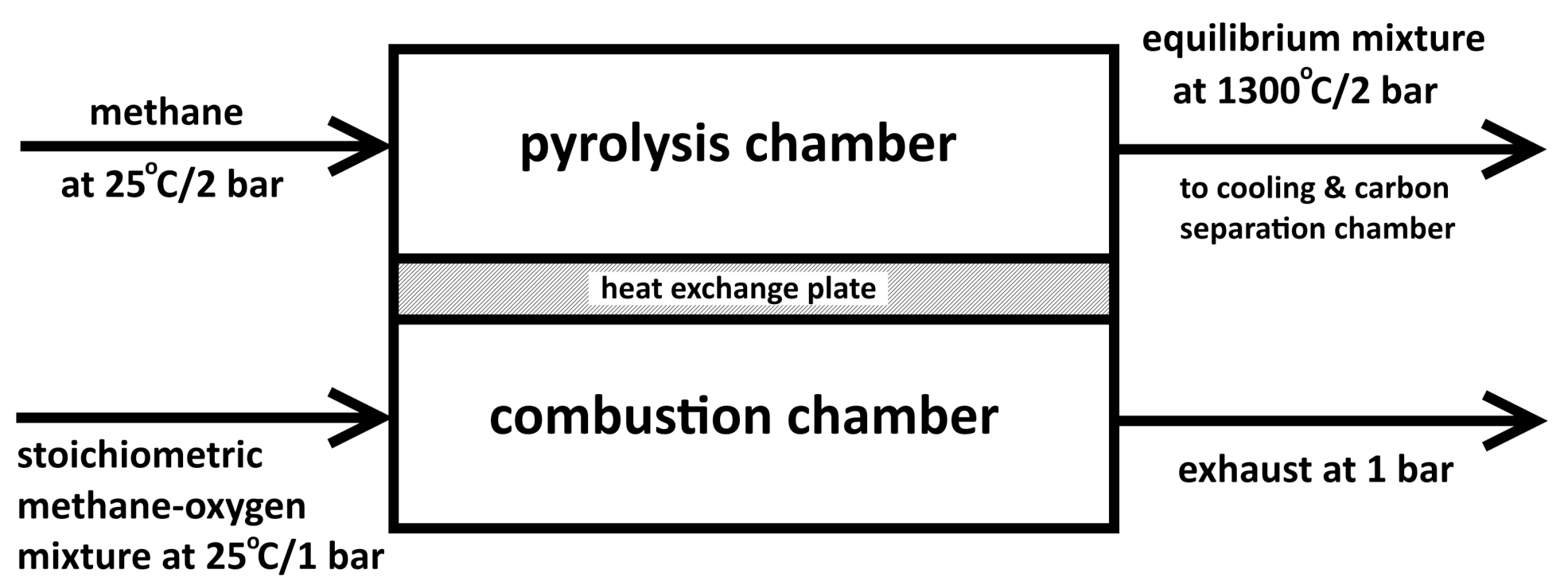
Calculate the total quantities (in moles) of methane and oxygen required to produce one mole of hydrogen using the results from question 1 and assuming that a) thermal equilibrium is established between the combustion chamber and the pyrolysis chamber, b) no heat is dissipated into environment. The isobaric heat capacities of methane and oxygen are 36 and , respectively.
Calculation
______ mol
______ mol [10 т.]
If you failed to answer this question, use the following values for subsequent calculations: , .
3 Question 3: Bookkeeping
Cost planning is vital for industrial processes. In the question above we assumed that oxygen is used to burn methane but what if we use air? Pure oxygen comes at a cost of 1.50$ per kilogram while air is free. However, air contains only 21 mol.% of oxygen, thus some heat produced by combustion will be spent for heating inert air components.
Using the same assumptions as in Question 2, calculate the price of one kilogram of hydrogen in two cases: a) pure oxygen is used for combustion, b) air is used for combustion ( ratio is stoichiometric). Assume that mole fraction of nitrogen in air is 79% (neglect argon) and its isobaric heat capacity is . Methane price is 0.70$ per kilogram.
a) oxygen is used for combustion
Price() = ______ $/kg
b) air is used for combustion
Price() = ______ $/kg [10 т.]
Hint. Thermodynamic equations
Relation between equilibrium constant and thermodynamic functions:
Enthalpy change during isobaric heating:
Решение
Official answers and grading scheme
1 Calculation
Denote the yield as . For each mole of reactant, the resulting quantities of substances at equilibrium are:
| = | + | |
|---|---|---|
1 pt.
The total quantity of gases is .
If the total pressure is 2 bar, then the partial pressures of the gases are:
: 2 pts.
Expression for the equilibrium constant:
: 1 pt.
At 1273 K, , : 1 pt.
At 1373 K, , : 1 pt.
: 1 pt.
: 1 pt.
At 1573 K, : 1 pt.
Therefore, : 1 pt.
Yield = 81 % [10 т.]
2 Calculation
Quantity of methane required to produce 1 mol of :
: 1 pt.
Heat required to heat methane to :
: 1 pt.
Heat required to decompose 0.5 mol of methane at :
: 1 pt.
Total : 1 pt.
Heat released per mole of methane in a two-step process: heating methane-oxygen mixture to , then burning it isothermically:
: 3 pts.
(1 pt for total heat capacity of gas mixture, 1 point for each heat contribution)
Quantity of methane required to get the heat for pyrolysis:
: 1 pt.
Quantity of oxygen
: 1 pt.
Total quantity of methane both for pyrolysis and combustion
: 1 pt.
[10 т.]
3 Methane price is 0.70$ per kilogram.
a) oxygen is used for combustion
Per 1 mol of hydrogen:
: 0.5 pts.
: 0.5 pts.
Per 1 kg of hydrogen:
: 0.5 pts.
: 0.5 pts.
$/kg: 1 pt.
Price() = 9.94 $/kg
b) air is used for combustion
Heat released per mole of methane in a two-step process: heating methane-air mixture to , then burning it isothermically:
: 3 pts.
(1 pt for total heat capacity of gas mixture, 1 point for each heat contribution)
Quantity of methane needed to burn to get the heat for pyrolysis:
: 1 pt.
Total quantity of methane both for pyrolysis and combustion
: 1 pt.
Per one mole of hydrogen:
: 0.5 pts.
Per 1 kg of hydrogen:
: 0.5 pts.
$/kg: 1 pt.
Price() = 4.62 $/kg [10 т.]
Бележка от източника
Each native problem heading says 12 marks, while its printed score grid totals 65, 30, 18, 50 or 30. Problem1 request3 is 10 points in the grid but5 in the key; its printed permanganate equation and sodium-containing answer to request2 remain literal. Problem3 first Claus-stage equation prints2H2O. Problem4 requests Fischer projections A–C and Haworth D–G, while its key shows the opposite projection types; request2 awards2points for each of three structures despite its4-point grid. Problem5 methane price is0.75/kg in the repeated key request and calculations. These original inconsistencies are retained. Molecular drawings, reaction schemes, reference tables and answer grids reproduce the native originals. Empty calculation spaces retain their printed labels and blank response fields.
Оригинал в Архива: Problems.pdf · официални решения: Solutions.pdf