IOM 2020, Теория — Задача 1. So different friction
Problem 1: «So different friction» · Problem 2: «To the Sun!» · Problem 3: «PLANETARY NEBULA»
Условие
Part 1: Impossible friction.
A dumb-bell made of two small massive spheres connected by a light rigid rod is held in vertical position so that the low (the lighter sphere) is on a horizontal rough surface. The masses of the spheres differ by the factor of 1.5. The dumb-bell is then carefully released and starts falling. There is no air drug. The low sphere begins to slide on the surface when the angle between the rod and the vertical becomes equal to . Determine the coefficient of dry friction between the low sphere and the surface. What must the friction coefficients ( and ) be in order for the sliding to begin at the angles between the rod and the vertical equal to and ? All answers must be up to hundredths. Determine (in degrees, up to tenths) the largest possible angle of deflection from the vertical at which the low sphere can still start sliding (i.e. if the sphere did not start sliding before this angle had been reached, it would not slide until the upper sphere hit the surface).
Part 2: Friction on kink
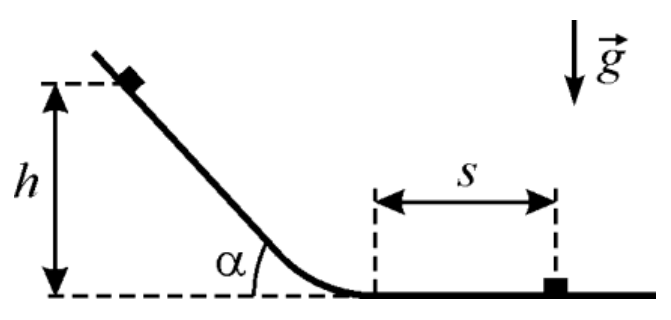
Let us imagine an experiment when a small heavy puck is sliding downward a plastic chute from a height with no initial velocity. The chute consists of three parts: a straight incline, a straight horizontal, and a junction connecting smoothly the first two. The junction is a cylindrical surface (see the Figure). The curvature radius of the surface is much less than , much greater than the puck, and is independent of . It turns out the puck remains at rest on the incline if . If the puck is released from some initial height and , its braking distance on the horizontal part equals cm. Determine the braking distance of the puck released from the height at (the answer should be in centimeters). Estimate (in percent) the accuracy of the result if the curvature radius of the junction equals 7 cm. The coefficient of dry friction between the puck and the chute is assumed to be the same everywhere.
Part 3: Crossing «by friction».
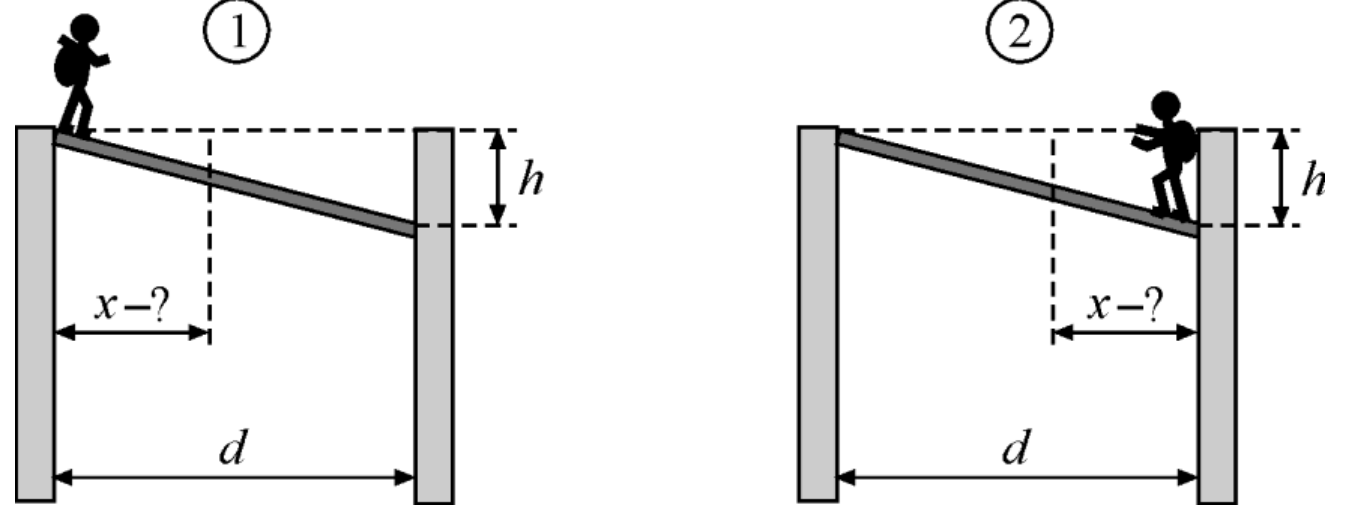
A straight uniform log got stuck in a deep rocky crevice with parallel vertical walls and a width m, the log is being held by friction. One butt of the log is at the upper edge of the crevice, the other one is lower by m. The log lies in a vertical plane perpendicular to the crevice walls. The log mass equals kg. The friction coefficient between the log butts and the walls equals . Consider two different situations.
A tourist 1 whose mass (the backpack included) is kg, decided to cross the crevice by walking on the log. When he had stand on the upper end of the log, it slipped downward just a bit but the log held on.
A tourist 2, whose mass (the backpack included) is kg, decided to cross the crevice by another log with the same parameters. When she carefully descended the crevice edge and stepped on the lower end of the log, it slipped downward just a bit but the log held on.
Let us assume that a log bend is negligible in both cases. Which tourist will be able to reach the end of the log (write down 1 or 2 as an answer)? For the tourist who should have not walked the log, determine the distance (from the wall where he/she started) at the moment the log starts falling in the crevice. As an answer, write down the formula that includes only the quantities given in the problem statement and the numerical value in meters, up to hundredths.
In a more realistic model the log is allowed to bend. Consider the tourist crossing that was a success. Estimate the average radius of the log bend at the moment the tourist is precisely at the log midpoint (as an answer, write down the formula that includes only the quantities given in the problem statement and the numerical value in meters). How does the log bend affect the chances to fall (increases – 1, decreases – 2, does not affect – 0)? A wood density is kg/m, a Young modulus for log compression along the grain is Pa, the shear deformations are negligible, the log diameter is almost constant, and the free fall acceleration is m/s.
Отговори
Part 1: μ₁ ≈ 0,252; μ₂ ≈ 0,114 (impossible: the value at α₂ = 45° lies in the domain of «impossible» angles); μ₃ ≈ 1,039; largest angle αII ≈ 79,5°. Part 2: s′ ≈ 175 cm; relative error about 3 %. Part 3: tourist 2; x₀ = [(2M + m)(μd − h)/(μd + h) − m]·d/(2M) ≈ 1,87 m; R = Em²/(2π(M + m)gρ²d(d² + h²)) ≈ 190 m; the bend increases the danger of falling (1).
Values from the official proposed solution.
Решение
Proposed solution:
1. Before the lower sphere starts sliding, the upper sphere follows a circle. The forces exerted on the upper sphere are the gravity force and the reaction force by the rod. Let us write down the equation of motion for upper sphere in projection on the rod: (here is the mass of lighter sphere, is a velocity of the lighter sphere, is the rod length, and is the angle between the rod and the vertical). According to the law of conservation of mechanical energy, .
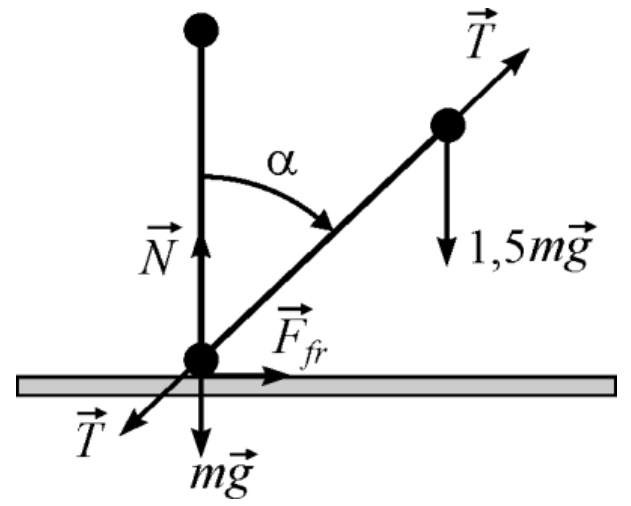
Using these relations one can find the dependence of the rod reaction force and the inclination angle: .
Forces being exerted on the lower sphere are: the gravity force, the rod reaction force, a normal force of reaction of the surface , and a friction force . The condition of equilibrium of the lower sphere yields:
The friction force prevents the sphere from sliding until . Therefore, the angle at which the sliding starts and the friction coefficient are related as
Substitution of the given angles into this formula yields the coefficients , , and . It should be noted though, that the value at is impossible (it is less than at )! Actually, for the sliding starts at an angle less than 30° (at ). It is all about the non-monotonic nature of the obtained dependence . Introducing the function , one can find that the condition gives an equation . Therefore, the function has maxima at and . The function vanishes at . Therefore, there are values of which are «impossible» for any and the angle belongs exactly to the domain of «impossible» values. Besides, we discovered that the maximum possible angle for the sliding to start is : if the rod has tilted at this angle and the lower sphere did not start sliding, it will not slide until the upper sphere hits the surface.
2. Obviously, the coefficient of friction between the puck and the chute equals . Let be the curvature radius of the junction. When the puck had slid down the incline, it gathered a speed determined by the law of conservation of mechanical energy:
The friction force on the incline is , and the work it has done is negative (). Taking into account that , we obtain: . When analyzing the puck motion on the junction it is convenient to introduce a new variable – an angular coordinate counted from the beginning of the junction (this angle varies from 0 to ). The puck does not stop, therefore the friction force is a kinetic friction and equations for the tangential and centripetal accelerations are ( is the normal reaction force of the chute):
(the angle between a tangent to the junction and the horizontal equals ). A small increment of the angle per a time increment is , so . Therefore, . Again, we neglect terms of the order of and obtain . The function which derivative is proportional to itself is exponent, so . Since , then . Thus, the puck velocity at the beginning of the horizontal satisfies to the relation . Hence, up to corrections of the order of , the square of the velocity at the beginning of the horizontal is . The braking distance on the horizontal part, where the puck acceleration is , equals: . For the values given we obtain: and . Therefore, cm.
The terms discarded from the formulae for and are of the order of . Thus, discarding these terms contributes a relative error of the order of , i.e. about 3 %.
3. Let us examine the conditions for both butts of the log to do not slip at the moment the tourist 1 is at a distance from the «left» edge of the crevice. Let us write down the conditions of the log equilibrium at this moment.
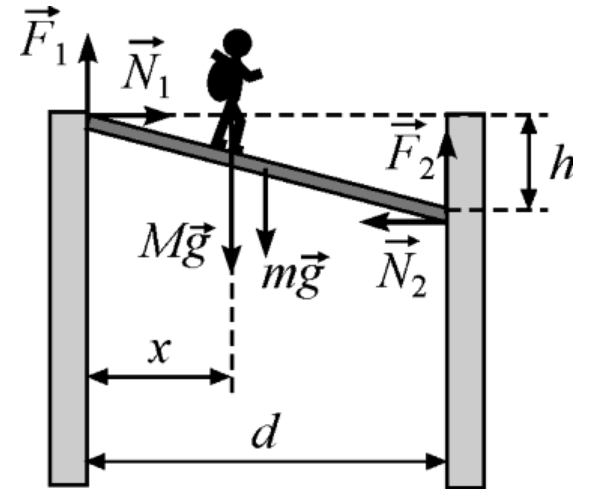
Balancing horizontal components of the forces yields the condition of equality of the forces of normal reaction: . The balance of the vertical components of the forces means that the sum of the friction forces exerted on the log butts balances the sum of the gravity forces: . Balancing the torques evaluated with respect to the upper end of the log gives the equation: , which results in . Similarly, . The log butts do not slip if . Thus, the log does not fall if the forces of normal reaction of the crevice walls balance the horizontal component of the log elastic force (due to log compression when being «pushed» in the crevice) satisfies:
On the diagram below one can see the region (shaded grey) of the values of , for which the log does not slip, as a function of .
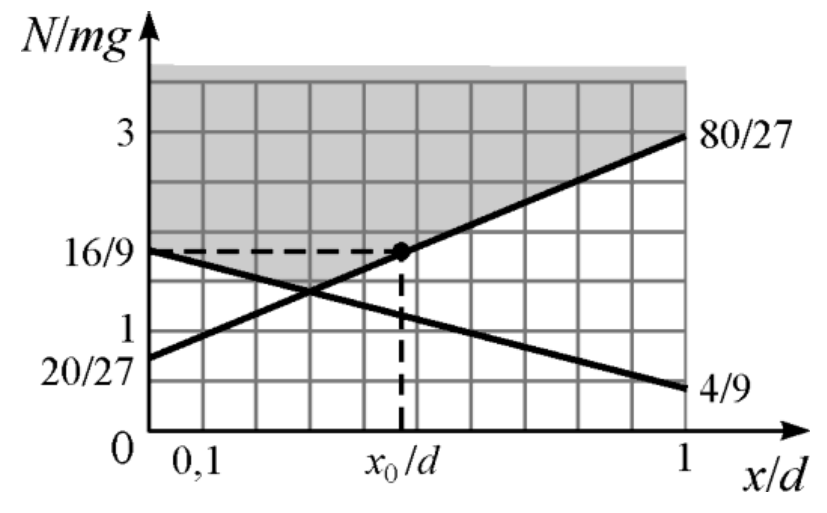
The value of corresponding to the first situation is determined by the condition that the upper log butt at «slipped down just a little bit» but held on. Thus, at , i.e. . It is evident that for this value of the normal force a further increase of will inevitably violate the condition of not sliding at the lower end and this will happen when , i.e. at m. Thus, the tourist will fall into the crevice together with the log: if he dares to walk on it, he will even not reach the log midpoint!
In the situation 2, the value of is determined by the condition at , and . Now, according to the diagram, the sliding does not begin at any , so the tourist 2 will safely reach the opposite edge of the crevice.
To estimate the average curvature radius of the log axis let us assume that this radius is much larger than the log length m and is constant at any point of the log. An equilibrium bend corresponds to the situation when the torque of elastic force balances the torque of external bending force in any log cross section. As long as the log remains at rest the points where it touches the walls can be regarded as the log «fixed» points and attribute the log bend to the action of gravity force exerted on the log and the tourist. To do an estimate, let us assume that the gravity force is applied to the log center, so the torque due to these forces with respect to a «fixed» point equals . Let the log radius be . Consider a cross section of the log which midline has bent with a curvature radius with its length maintained. The log layers closer to the center of curvature than this line will be compressed and those which are further will be stretched.
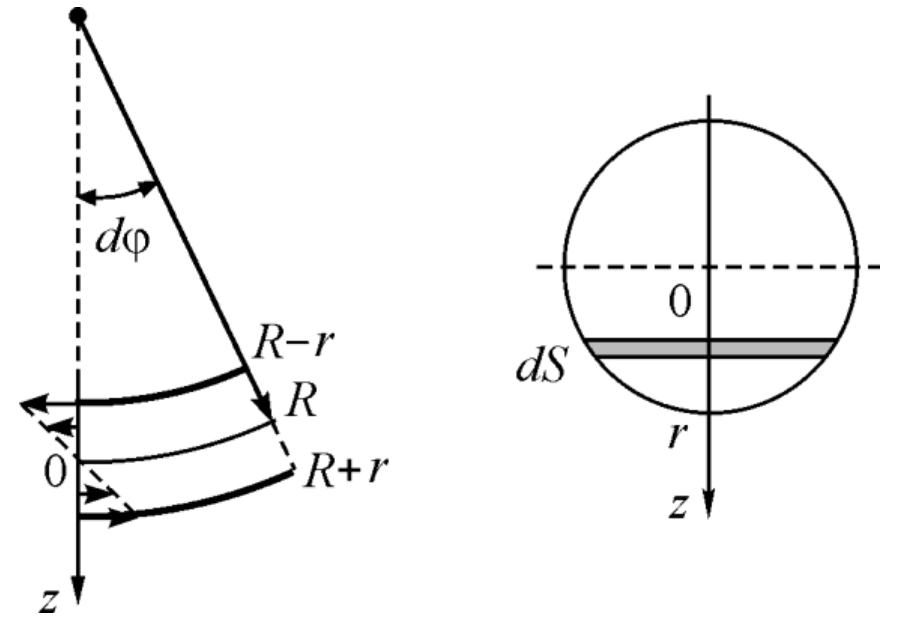
Let us introduce a layer coordinate with respect to the midline (see the Figure). The log element of a length in the non-deformed state will have an angular size . Therefore, the deformation of this element in a layer of coordinate equals . The elastic coefficient of the layer is ( is the layer cross section area), so the elastic force equals and its contribution to the total torque in a given cross section is . Thus, the total torque of elastic force is . Evaluating the integral (e.g. by using the substitution : ), we obtain: . Here, we used that . Therefore, the equation results in a relation , which gives m. One can see that the assumption is good enough. However, it is clear that the bend is actually not uniform and the gravity force is distributed over the log, so our calculations are indeed just an estimate.
The bend increases the length of the log axis (relative to the unloaded log), i.e. decreases its longitudinal deformation. Therefore, it decreases the force the compressed log exerts on the crevice walls and, accordingly, the normal reaction force of the walls. As it is clear from the diagram this increases the danger of falling (it turns out, quite essentially, so the second tourist should not walk the log as well).
Note. An approximate calculation admits simplifications which do not significantly alter the result. For instance, the log can be replaced with a beam of square cross section of the same area . The integral becomes much simpler to evaluate: , but the result is almost the same: m. It is also possible to estimate the torque by replacing the continuously distributed elastic forces by a pair of «average» forces with an absolute value and the distance between the moment arms equal to . Then the torque turns out to be the same as in the above calculation! Other reasonable estimates are also possible.
Оригинал в Архива: th.pdf