IOM 2020, Теория — Задача 2. To the Sun!
Problem 1: «So different friction» · Problem 2: «To the Sun!» · Problem 3: «PLANETARY NEBULA»
Условие
The spacecraft launched into a low circular orbit at an altitude of h = 300 km above the Earth’s surface had to perform two short-term acceleration maneuvers. As a result of these maneuvers the ship was supposed to be in a geostationary orbit (GSO) - this is a circular orbit lying in the plane of the Earth’s equator, in which the object is always above the same point on the Earth’s surface.
The first maneuver was successfully accomplished and the ship reached an intermediate elliptical orbit with the maximum distance between the ship and the Earth’s center equal to the GSO radius while the minimum distance to the Earth’s center remained equal to the radius of the initial orbit.
The second maneuver was designed so that the rocket engine would turn on only once and for a short time and use up one third of the fuel and oxidizer remained after the first maneuver. However, the engine did not start at the right moment. Although the technical crew was able to determine the cause of failure and regain control of the ship, the latter could not manage to get to the desired point at the GSO and its mission failed.
Then they decided to try another maneuver: sending a part of the spacecraft from the intermediate orbit to an orbit heading to the Sun. Before this maneuver the ship had to be split in two parts in such a way that a part with the engine went to the Sun and the second (as unnecessary) part was left in space. It turned out, the orbit parameters allowed one to choose a moment for the engine to start so that the part sent to the Sun had the maximum possible mass.
The following facts are considered known.
In polar coordinates the equation of motion of a body moving in the gravitational field of a massive spherical object is (the origin is placed at the object center). Here is the orbit parameter and is its eccentricity.
The distance between Earth and the Sun varies between Mkm (at aphelion passing in July) and Mkm (at perihelion passing in January). The Solar radius equals Mkm. The period of Earth revolution around the Sun is s. Both Earth and the Sun can be regarded as spherical bodies.
The Earth’s radius is km. The duration of Earth’s day is = 24 × 3600 с = 86400 s. The free fall acceleration at the Earth’s surface equals m/s. Rotation of Earth and the Sun around their axes is in the same direction. The ship discussed in this problem was launched in the direction of Earth’s rotation as the majority of spacecraft.
The exhaust velocity of combustion products from the engine nozzle is km/s (relative to the ship). According to rocket equation, when rocket velocity increases by the rocket mass decreases from to .
Please, answer the following questions.
3) Calculate the parameter and the eccentricity of the intermediate orbit (write down the expressions for and in terms of the quantities given in the problem and compute their numerical values with at least 1% accuracy). How much does the absolute value of the ship total mechanical energy differ for the original circular orbit and the intermediate orbit? To answer this question, calculate the numerical value of the ratio (up to hundredths). To define potential energy of gravitational interaction between the ship and Earth use the standard assumption that the potential energy vanishes at infinite separation between them.
4) Think at which short section of the intermediate orbit the engine should had been turned on to accomplish the originally planned maneuver of transition from the intermediate orbit to GSO (you are not required to answer this question). What velocity increment would be achieved as a result of the maneuver (in km/s, up to hundredths)? What would the ship mass be after the maneuver (the answer should be given as the percentage of the original ship mass on the circular orbit with an accuracy of 1%).
Note: when calculating the numerical values to answer the questions below, keep no less than four significant digits in the intermediate results.
5) In which season (in the northern hemisphere) and at which approximate time of day should the engine be started in order to send the maximum (by mass) part of the ship to the Sun? An answer to this question must contain the season (winter / spring / summer / autumn) and the time of day (sunrise / noon / sunset / midnight). What is a required velocity of the ship part heading toward the Sun in the Copernicus frame (in which the Sun is at rest) at the moment when the distance between the ship and Earth sufficiently exceeds and is much less than ? What is the velocity of this part of the ship relative to Earth right after the engine is turned off? Write down both velocities in km/s up to hundredths.
6) What part of the ship mass (in percentage of its mass on the original circular orbit with an accuracy of 1%) should be detached as “unnecessary” in order to perform the maneuver? What is the mass (in percentage of the ship mass on the original circular orbit with an accuracy of 1%) of the part that will arrive to the Sun?
7) In what time after turning off the engine will the accelerated ship part reach the Sun? Write down the formula for the time in terms of the quantities given in the problem and calculate the numerical value (in Earth’s days, up to tenths).
8) “Gravity assist maneuver” is a change of spacecraft velocity caused by its passing close to a very massive celestial object. Suppose we are going to perform such a maneuver near Venus. If a ship is set to an orbit which perihelion is close to the perihelion of Venus orbit and both the ship and Venus arrive to their perihelia simultaneously, the correct maneuver will send the ship passing close to Venus toward the Sun. Evaluate the maximum possible angle the ship velocity vector can be turned as a result of the gravity assist maneuver near Venus. The answer should be given in degrees with an accuracy of one degree. The distance between Venus and the Sun in perihelion equals Mkm, the velocity of Venus at the perihelion is km/s, and the first cosmic velocity (the velocity on the low circular orbit near the surface) is km/s. Venus can be regarded as a spherical body. Is it possible to deliver to the Sun a substantially greater part of the ship by using this maneuver rather than using the maneuver described in 3 and 4 (respond “yes” or “no”)?
Отговори
3) p = 2r(RE + h)/(r + RE + h) ≈ 11522 km; ε = (r − RE − h)/(r + RE + h) ≈ 0,727; |E₀/E₁| ≈ 5,49
r ≈ 42222 km is the GSO radius (official solution).
4) Δv₂ ≈ 1,47 km/s (1,4665 km/s); m₂ ≈ 0,52260·m₀, i.e. about 52 %
5) summer, noon; vA ≈ 2,83 km/s (2,8273 km/s); ṽ₂ ≈ 28,73 km/s (28,7267 km/s)
6) Δm ≈ 0,21264·m₀ (about 21 %); m̃₂ ≈ 0,02·m₀ (about 2 %)
7) ≈ days
Official solution: t ≈ 66,7 days.
8) αmax ≈ 4°; no
Решение
Problem 2 (proposed solution)
- Let us determine the radius of GSO and the ship velocity in this orbit ( and , respectively). To do this we use the equation for the centripetal component of the ship acceleration in the GSO: , hence . On the other hand, the orbital period of the ship must be the same as the period of Earth’s rotation around its axis, i.e. , therefore km and km/s. According to the orbit equation, one has for the intermediate orbit and . These equations yield: km and .
Below the symbols and stand for the quantities related to aphelion and perihelion of a ship orbit around Earth and symbols and relate to aphelion and perihelion of an orbit around the Sun. For an elliptical orbit of the ship both the total mechanical energy and angular momentum are conserved and can be expressed via the given distances from the Earth’s center to the aphelion and the perihelion. Therefore, and . Solving these equations for velocities, one obtains and . This gives for the total mechanical energy: . Using this result, one finds that , where and are the ship masses in the initial and the intermediate orbits.
Since the radius of initial orbit equals the distance to the perihelion of intermediate orbit, the transition was performed by increasing the ship velocity from km/s to km/s for a short period of time (according to the problem statement the maneuver was «short-term»). Therefore, it is reasonable to neglect both the curvature of ship trajectory and a gravity force and to consider the ship acceleration as being completely due to the engine thrust. Hence, one can use the Tsiolkovsky rocket equation: , where km/s. Thus, and . Note that both energies are negative, i.e. actually .
All ship orbits under consideration (with its engine turned off) near Earth are closed. Therefore, the short-term acceleration for the transition from the intermediate orbit into the GSO must be done immediately before the aphelion of intermediate orbit. To do this, it suffices to increase the ship velocity from at the aphelion to the velocity in the GSO (it is important that both at the aphelion of intermediate orbit and in the GSO the velocity is perpendicular to the radius). Note that km/s. Therefore, the velocity increment required to switch into the GSO must be km/s. Again, use the rocket equation: . The mass increment is the mass of the fuel and oxidizer which has to be consumed to switch into the GSO from the intermediate orbit. According to the problem, it was one third of the total supply. Hence, the mass of fuel and oxidizer in the intermediate orbit was . Since the ship mass in the intermediate orbit was , the «useful» mass (the engine, the fuel tanks, and the hull) was equal to .
In order to send the ship to the Sun it is necessary to reduce significantly the ship velocity with respect to the Sun. To do this in a most efficient way, the engine must be started when the ship is closest to the point where its velocity in the intermediate orbit is minimal with respect to the Sun. Obviously, it would be the best to choose the point at which the Earth’s velocity with respect to the Sun is minimum (i.e. the aphelion of the Earth’s orbit) and the ship velocity relative to Earth is maximum and opposite to . Therefore, the second maneuver must be performed when the ship approaches the perihelion of its orbit during the summer of the northern hemisphere, i.e. when Earth is at the aphelion, and at noon of the Earth’s time at the point below the ship.
In order to reach the Sun, the ship after leaving Earth must follow an orbit around the Sun for which the distance to the aphelion is approximately equal to the distance to aphelion of the Earth’s orbit and the distance to perihelion is less or equal to the Solar radius. Then the ship velocity relative to the Sun after the it has receded from Earth to a distance sufficiently greater than the Earths’ radius (though much less than Mkm) must not exceed .
The Solar mass can be estimated by using the orbital period of Earth and the mean radius of the Earth’s orbit: . Thus, the required velocity is km/s. The Earth’s velocity at the aphelion is km/s, so the ship velocity relative to Earth at the moment of its passage into the orbit leading to the Sun must be km/s. It is important to keep in mind the following. After turning off the engine, the ship must move somewhat faster than to overcome the gravitational pull of receding Earth. This effect can be accounted for by means of the energy conservation law: the velocity of the part of the ship (of the mass ) being sent to the Sun relative to the Earth’s center at the moment right after the engine was turned off is determined by the equation km/s.
During the maneuver of transition into the orbit leading to the Sun the increment of the ship velocity is km/s. Before the acceleration the ship got rid of some of its mass (), so the mass which will eventually reach the Sun is . To send the maximum mass to the Sun, the ship had to use up all the fuel and oxidizer supply, therefore . This calculation shows that the mass of the ship left after the second maneuver is . Thus, no more than 2% of the ship mass in the initial orbit can be delivered to the Sun!
According to the third Kepler’s law, a ratio of the squares of orbital periods equals to the cube of the ratio of the semi-major axes of the orbits. Therefore, the orbital period of the accelerated part of the ship in the new orbit is days. The trip to the Sun will take a half of this period, i.e. days.
Detailed analysis of the gravity assisted maneuver requires a more general study of trajectories of a body moving in the gravitational field of a massive spherically uniform object. Let us again turn to the laws of conservation of mechanical energy and angular momentum. A ship following the orbit has the total mechanical energy and the angular momentum , where the dot means differentiation with respect to time (the polar coordinates are employed). From the second relation one gets and substituting into the first equation obtains: . The distances to aphelion and perihelion, and , are the roots of the equation . Therefore ( is the Venus’s mass):
When the part of the ship approaches Venus in the region of the orbits’ closing, in the Venus’s frame it comes to Venus from «a large distance» at non-zero velocity , i.e. its total mechanical energy and the orbit eccentricity . In this case the orbit is hyperbolic, one can see that at the radius . Thus, the velocity relative to Venus rotates at the angle . In this case, where (see the Figure) is called the «impact parameter».
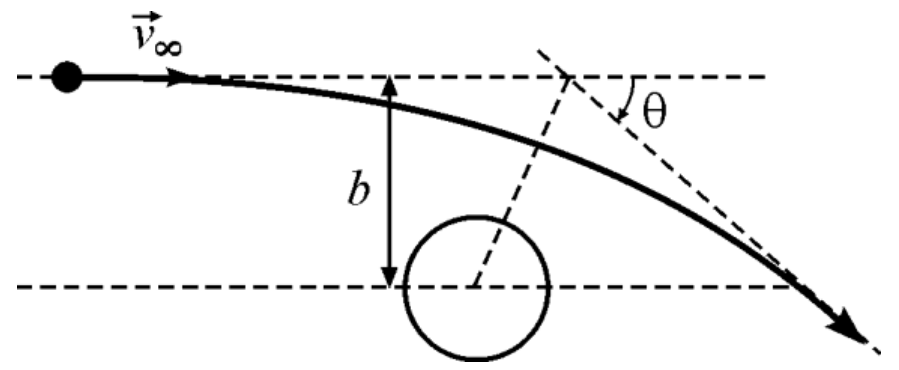
One can see that the maximum rotation angle is achieved at the minimum eccentricity. According to the formula for eccentricity, , and the minimum value of the impact parameter is determined by the requirement that the distance between the orbit perihelion and the Venus’s center cannot be less than the planet radius : . Thus, , and the maximum rotation angle achieved during the flyby around Venus is . The ship velocity relative to the Sun after the gravity assist maneuver is a vector sum of velocity rotated by the angle and the velocity of the massive object relative to the Sun. Thus, the maximum angle the ship velocity vector can rotate toward the Sun during the maneuver can be found by means of the law of sines: . Finally,
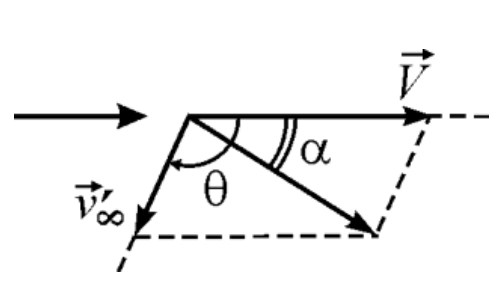
Let us determine the velocity of the part of ship at the perihelion of its orbit: , or km/s (recall that the aphelion of the orbit leading from Earth to Venus coincides with the aphelion of the Earth’s orbit and the perihelion with the perihelion of the Venus’s orbit.). So, km/s, km/s, and . Therefore . However, to hit the Sun at this velocity the angle rotation must be close to 90°. Thus, the gravity assisted maneuver near Venus cannot help in delivering a substantially larger ship mass to the Sun.
Оригинал в Архива: th.pdf