IOM 2020, Теория — Задача 3. PLANETARY NEBULA
Problem 1: «So different friction» · Problem 2: «To the Sun!» · Problem 3: «PLANETARY NEBULA»
Условие
Planetary nebula is a cloud of gas bound by gravity of its «core» (typically a massive star). If the cloud is large enough we do not see the star itself because the light emitted by the star undergoes multiple scattering by the gas particles, is absorbed by them, and then reemitted. Thus, in our telescopes we observe only a shining nebula. In this problem you are suggested to study a relation between the nebula radiation seen by a distant observer and the original radiation of the core star. In reality such a nebula consists of many gases though hydrogen prevails. Therefore we consider a nebula composed only of atomic hydrogen with an average density of g/cm, an external radius of cm, and an internal radius of cm (of course, it is equal to the radius of the core star). Here you can find physical constants which will be useful for solving this problem:
speed of light in vacuum m/s;
elementary charge C;
electron mass kg;
Planck constant J·s;
permittivity of free space F/m;
Avogadro constant mole;
Boltzmann constant J/K.
The following integrals can be useful:
When the following approximations are valid:
with a relative error of about ;
with a relative error of about .
Part I: Star radiation and gas temperature in the nebula.
In spite of high brightness, a star can be quite accurately regarded as «blackbody», the term referring to an object absorbing almost all incident electromagnetic radiation. A hot blackbody emits electromagnetic radiation itself, its spectrum was first originally derived by M.Planck who introduced a postulate of quantization of radiation energy. According to this postulate the electromagnetic radiation interacts with atoms and molecules as a stream of photons in which the energy of a photon is related to the wave frequency as . Planck proved that if a radiation with a frequency in a narrow range is in equilibrium with a blackbody at a constant temperature the energy density of the radiation equals , where is the spectral density of the radiation aka the Planck distribution. The total intensity of the blackbody radiation (the energy emitted from a unit area per a unit of time) is called the total energy flux and can be determined from the Stefan-Boltzmann law: . Here W/(m·K) is the Stefan-Boltzmann constant.
1) Express the Stefan-Boltzmann constant in terms of the speed of light in vacuum , the Planck constant , and the Boltzmann constant .
2) Suppose that the whole gas cloud is in thermal equilibrium with the gas of photons emitted by the star. In this case, find the dependence of gas temperature on the distance to the star center for . Write down the answer as a ratio , where is the temperature on the star surface.
Part II: Hydrogen atom.
Interaction of hydrogen atom and photons is described according to the Bohr model. Among the states of electron orbiting a nucleus there are stationary states, in such a state electron does not exchange energy with a radiation field. Absorption and emission of photons occurs during electron transition between stationary states. According to the Bohr model the energies of stationary «bound» states (electron energy levels in hydrogen atom) can be determined by employing «wave properties» of electron: the classical electron orbit corresponding to the stationary state must contain an integer number of de Broglie wavelengths , where is the electron momentum. All other energies of electron are completely forbidden: an electron with a «forbidden» energy will interact with the nucleus and pass into a stationary state by exchanging energy with another objects, e.g. by emitting a photon.
3) Consider circular orbits of electron in hydrogen atom which contain of de Broglie wavelengths and calculate the energy of -th level (write down the equation as an answer; the potential energy of interaction of the electron and the nucleus tends to zero at infinity).
4) What is the minimal energy of a photon which is able to ionize a hydrogen atom in the lowest energy state? This quantity is also called the ionization energy (threshold). Write down the answer in electronvolts (eV). 1 eV is the unit of energy equal to the work done by electrostatic force by moving elementary charge between two points with potential difference of 1V.
It is well known that the Bohr model describes quantum systems only approximately. However, for the energy levels of hydrogen it provides (by chance) the precise answer which can be proven in the framework of the modern quantum theory. This answer is in good agreement with experimental data. The state of the lowest energy () is called the ground state, and a state with is called the excited state. The lifetime of atom in an excited state (i.e. the time electron spends in the stationary state with ) does not exceed s. Then the electron passes into a stationary state with a lower energy and emits a photon. The transition to a neighboring energy level () has the highest probability, transitions with are less probable.
5) Suppose the hydrogen gas is in equilibrium with the radiation of a star which surface temperature is about = 30 000 K. What is the most likely energy level (indicate its number) of hydrogen atoms at a distance from the star? Estimate the fraction of atoms (in percent, rounded to an integer) in excited states at .
6) What is an approximate fraction of the star radiation energy flux consisting of photons with energies sufficient to ionize hydrogen atoms of the nebula if the temperature of the core star equals = 30 000 K? The answer should be in percent.
Part III. Radiation of nebula.
Actually, even in a stationary nebula the hydrogen is not in equilibrium with the star radiation, it «reprocesses» the radiation. The main «reprocessing» mechanism is absorption of photons with an energy exceeding the ionization threshold. As a result, the nebula has an admixture of free electrons and protons (ions H). Proton-electron collisions result in formation of neutral hydrogen atoms although in excited states. The rate of electron-ion collisions per unit of time is proportional to the product of their densities. Usually such a collision produces a hydrogen atom with a large (an electron is seldom «captured» in a state with ). Electrons from these states will pass in several «steps» to the ground state by emitting photons of the hydrogen spectrum. Obviously, the corresponding frequencies will be less than the frequency of the photon absorbed by atom during ionization. Similarly, a hydrogen atom can absorb photons and pass to an excited state (for this to happen the photon energy must be very close the energy difference of the corresponding states) and then gradually return to the ground state.
Thus, the nebula absorbs a high energy photon and «converts» it into several photons of lower energies. Note that the dispersion of photon frequencies emitted during the same transition is very small: for a typical planetary nebula it is less than a hundredth of percent of the transition frequency . For further notice that photons emitted during transitions from a level with to a level with are called «Lyman’s» (the corresponding spectral lines comprise the so-called Lyman series) and the photons emitted from a level with to a level with are «Balmer’s» (the corresponding spectral lines belong to the Balmer series). Photons with energies below the ionization threshold and not equal to an energy difference of two stationary states are usually elastically scattered by hydrogen atoms, their frequency almost does not change.
7) Probability of ionization of hydrogen atom in the ground state by a photon with an energy exceeding the ionization threshold is specified by the photoionization cross section. This quantity has the dimension of area and is defined as a ratio of the number of photons absorbed by an atom per unit of time to the flux density of incoming photons (i.e. to the number of photons crossing a unit area of the wave front per unit of time). Let this quantity be equal to cm for the photons with energies near the ionization threshold. Estimate the mean free path of a photon with an energy exceeding the ionization threshold (i.e. the distance it travels in the nebula before being absorbed) assuming that the hydrogen density equals the mean density . Write down the answer in centimeters.
8) What part of the photons emitted by the star with energies exceeding the ionization threshold of hydrogen (in the ground state) is going to be «reprocessed» by the nebula into photons of lower energies? Give the answer in percent rounded to an integer.
9) Let be the number of photons with energies exceeding the ionization threshold of hydrogen (in the ground state) emitted by the star per a time interval , be the number of photons with frequencies corresponding to the transition (the «main» line of the Lyman series) and leaving the nebula for the same time , and be the total number of the «Balmer» photons leaving the nebula for the same time . Estimate the ratio .
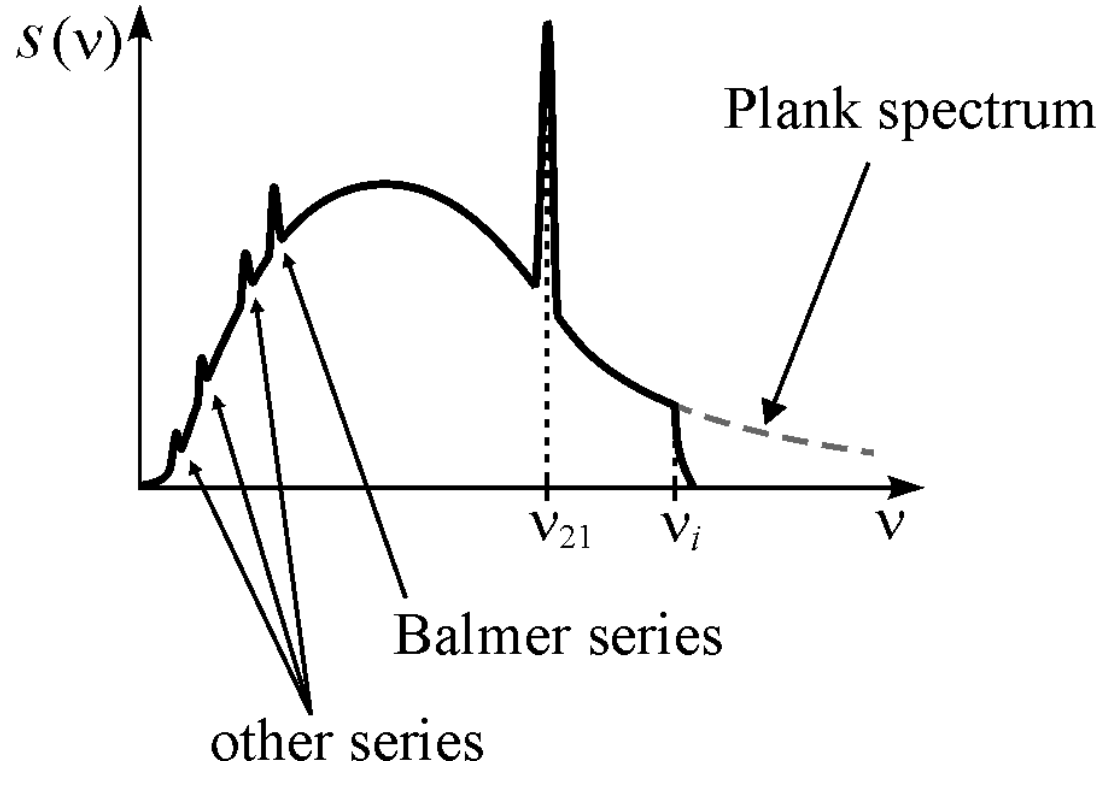
10) An external observer studies the emission spectrum of the nebula being considered. Sketch the observed spectrum, i.e. plot the dependence , where is the detected radiation intensity per a unit frequency interval . Indicate the main features of the dependence.
11) The observer found that the intensity of nebula radiation at the frequency of the main line of the Lyman series is 10 % of the intensity of the nebula radiation in the frequency range (the intensity of the main line in this range is not counted). What is the surface temperature of the core star in the nebula? The first answer should be the equation for (it must be an algebraic equation which does not contain other unknowns except ). The second answer should be the numerical value of in Kelvin obtained by a numerical solution of this equation with an error not exceeding 500 K.
Now one can see that hydrogen in the nebula is partially ionized. It is interesting to find out how the degree of ionization (the ratio of the number of ionized atoms to the total number of atoms) depends on the distance to the star surface. To simplify the analysis, you may use the model based on two assumptions valid in a region of noticeable ionization:
a flux of photons with energies exceeding the hydrogen ionization threshold decreases mainly due to absorption of the photons by neutral atoms (rather than due to the increase of an area they spread over which);
hydrogen density varies (with the distance) much slower that the ionization degree, so the density can be considered approximately equal to the average density of the nebula.
Use also the information from the introduction to Part III.
12) Suppose that the degree of hydrogen ionization near the star surface is very high and equals 99 %. Find the distance from the star surface where the degree of ionization becomes 90 % (the first answer is ), 50 % (the second answer is ), and 10 % (the third answer is )? Write down all three values in cm.
Отговори
Part I: Star radiation and gas temperature in the nebula., 1)
Part I: Star radiation and gas temperature in the nebula., 2)
Part II: Hydrogen atom., 3)
Part II: Hydrogen atom., 4) 13.6 eV
Part II: Hydrogen atom., 5) n = 1 (the ground state); practically no excited atoms: 0 %
Official solution: T(r) ≈ 95 K, the probability of excitation is of the order of e^(−ΔE₂₁/kT) ≈ 10⁻⁵⁴¹.
Part II: Hydrogen atom., 6) 20 %
Official solution: δ ≈ 0,194 ± 0,015; a reasonable answer is δ ~ 20 %.
Part III. Radiation of nebula., 7) cm
Part III. Radiation of nebula., 8) 100 %
Part III. Radiation of nebula., 9) ΔN₂₁ : ΔNB : ΔN ≈ 1 : 1 : 1
Part III. Radiation of nebula., 10) Official sketch: the Planck spectrum of the star cut off at νi = Ei/h, a strong line of the main Lyman series at ν₂₁, weaker Balmer lines and lines of other series at lower frequencies.
Part III. Radiation of nebula., 11) ≈ K
Official solution: z ≈ 4,1, Tx ≈ 19250 K.
Part III. Radiation of nebula., 12) l₁ ≈ 1,6·10¹⁵ cm; l₂ ≈ 1,8·10¹⁵ cm; l₃ ≈ 1,9·10¹⁵ cm
Решение
Proposed solution and answers
The total density of radiation being in equilibrium with a surface of hot body is calculated by integrating over the whole spectrum: . Here the integral given in problem statement is used. To determine the energy flux being emitted by the surface note that «equilibrium» radiation propagates at the speed of light from every point uniformly in all directions. Therefore, any element of solid angle emits the energy flux of . Let be an angle counted from a surface normal. The outgoing radiation is emitted into the angular interval and an infinitesimal solid angle between conic surfaces with apex angles of and equals . Then the total energy flux perpendicular to the surface is . Comparing this equation with the Stefan-Boltzmann law one obtains: .
In equilibrium nebula the energy flux emitted by the star is constant and equals to the flux from the star surface. If a gas layer at a distance from the star were in thermal equilibrium with the radiation it would emit to «outside» the same flux as received from the «inside». According to the Stefan-Boltzmann law the flux temperature would be determined by the equation: . Hence, .
For a circular orbit the Bohr model requires , so . Writing down the classical equation of motion of electron in a circular orbit of a radius at a velocity , one obtains for hydrogen atom: , then and . Therefore, the velocity and the radius of electron orbit are , and the energy of electron in a stationary orbit is .
To ionize atom, its electron must be moved far away from the nucleus, where , i.e. to move the electron from the state with to a state with . Therefore, the ionization threshold of hydrogen atom is eV.
According to 2), the «equilibrium» gas temperature at turns out to be K. The energy of chaotic thermal motion of hydrogen atoms at this temperature is eV. The energy required to move electron to the lowest excited state (with = 2) is eV, i.e. a thousand times more! It should be obvious that a probability of transition to an excited state is very small, practically vanishing – evidently less than one percent! The contestants familiar with the Boltzmann distribution can evaluate this probability more precisely: it is of the order of . That is, there would be practically no excited atoms at a given distance from the star.
The photons able to ionize hydrogen atoms must have an energy of eV. For K this yields . The energy distribution of photons is given by the Planck distribution; therefore, the desired photon fraction is . Using the information from the problem statement yields: . A reasonable answer is %.
Density of hydrogen atoms at a mean mass density is , where is the mass of a single atom. This mass can be expressed via the Avogadro constant: obviously, g. Thus, см. To get an estimate one can assume that every atom creates a photon «trap» with a cross section . Then the mean free path of a photon is determined by the requirement that these «traps» overlap the entire flux cross section: , whence cm.
One can see that the nebula radius is about 6 thousand times greater than the «mean» free path of a photon. This means that practically all photons (all 100%, when rounded to an integer) with an energy exceeding the ionization threshold will be absorbed by the atoms and converted into photons of lower energies. (Note that according to 6), , i.e. the ionization energy is higher than the maximum of the photon energy distribution. So, as the energy of the photons grows, their contribution to the total flux rapidly decreases and the energy dependence of the ionization cross section could not significantly affect the result of the estimate.)
According to 8), almost all photons with energies exceeding the ionization threshold are being absorbed by the nebula. Each of the absorbed photons triggers a chain of transitions. If the first transition occurred to the state , then a photon of Lyman series was emitted, and this photon almost certainly would be absorbed by another hydrogen atom (the majority of hydrogen atoms of the nebula are in the ground state, i.e. the energy of a Lyman photon corresponds to an allowed transition for them and the mean free path is much less than the nebula radius). The atom that had absorbed this photon would return in the same excited state. This would continue until a transition to state with occurs. If the first transition after the capture occurred in a state with , then a Balmer series photon would be emitted which would be inevitably followed by emission of a photon of the main Lyman series with a frequency . Balmer photons are practically not absorbed (since a fraction of hydrogen atoms in a state with is extremely low in the nebula) and leave the nebula after many elastic scattering events. Photons of the main Lyman series are absorbed and reemitted many times before leaving the nebula as well. If the first transition occured to a level with the situation is «repeated»: there is again a «highly excited» state of atom which would follow a transition in the state , or in a state with , or in a state with . Therefore, every absorbed photon of high energy necessarily will «parent» a single Balmer photon and a single photon of the main Lyman series (plus several photons of other series of lesser energies). The contribution of Balmer photons and photons of the main Lyman series «originally» emitted by the star is very small due to a small width of the line and a finite density of thermal radiation. Thus, .
The spectrum of nebula radiation observed by an external observer is the spectrum of star radiation practically coinciding with the Planck spectrum corresponding to its temperature and «reprocessed» by the nebula. According to 8 and 9, the thermal spectrum will be practically «cut» from above at the frequency due to the almost complete absorption of the photons with energies above the ionization threshold. The energy emitted by this part of the spectrum is mostly transformed into the energy of photons of the main Lyman series (the energy of this photon is up to 75% of the energy of the «processed» photon), less energy goes to photons of Balmer series, and even less to low energy photons of other series. Therefore, the typical spectrum will have the approximate shape shown in the Figure.
- In the given frequency interval there are no spectral lines of hydrogen (except for the Lyman line which contribution to the intensity is not counted), so the intensity in this frequency interval is determined by the «unprocessed» star radiation.
Here , and the numerical factor was written down by taking into account that the power radiated from a unit area is related to the spectral density as (see 1). Note that an accurate evaluation of the factor is not necessary since it cancels out anyway. The radiation intensity at the frequency is determined by the condition that the number of photons with this frequency coming out of the nebula equals the number of photons with energies above the ionization threshold. Therefore,
This calculation takes into account that . According to the observer’s data, . This is the equation for , whence .
This equation has to be numerically solved by evaluating the values of for various and comparing with 0.1 (it would me more effective to use the method of dichotomy or, if available, to use Excel or a programmable calculator and simply look at the values of in the «expected» range):
| z | f(z) |
|---|---|
| 3,7 | 0,1623462 |
| 3,8 | 0,1437476 |
| 3,9 | 0,1275049 |
| 4,0 | 0,1132782 |
| 4,1 | 0,1007847 |
| 4,2 | 0,0897873 |
| 4,3 | 0,0800860 |
| 4,4 | 0,0715114 |
One can see, the «appropriate» value is . Therefore, K.
- The equilibrium degree of ionization is achieved when the number of ionization events in a «thin layer» of gas per unit of time (equal to the number of absorbed photons with energies above the ionization threshold) equals the number of «captures» of electrons by protons (recombinations). The flux of such photons decreases as the distance from the star increases not only because the surface area grows but also because of absorption: . Here is the density of hydrogen atoms absorbing such photons (not ionized). Thus, , in accordance with the assumptions of the model used. Integration of this equation yields: . The number of photons absorbed per unit time is proportional to . The number of captures is proportional to the product of electron density and the density of hydrogen ions which are equal because the ionized layer remains neutral. Thus, . If the ionization degree is , then . According to the problem statement the ionization degree varies significantly faster than the concentration of atoms, so , where is the mean free path of photons evaluated in 7. Taking the logarithm of this equation and differentiating the result, one obtains: , i.e. . Integrating the latter from the star surface to a given radius, one obtains: . Here is the given degree of ionization near the star surface. Using this formula, we find: cm, cm, and cm. One can see that the ionization degree becomes less than 1% at a distance of cm! That is, the degree of ionization remains very high at a distance of about ~1 % of the nebula radius ( cm), and drops almost to zero at a distance of ~2 %. Such a behavior confirms the assumption used in our model that the degree of ionization varies much faster than the area of the spherical surface grows and the density of the cloud decreases. Actually, it is pretty obvious that the concentration of atoms near the star is still higher than in the nebula periphery, so in the region with m the mean free path of photons is less than the «average» value used in our calculations. Therefore, in reality the region of high ionization is even stronger «pressed» against the star.
Оригинал в Архива: th.pdf