IPhO 1970, Теория и експеримент — Задача 4. Problem 4.
Problems of the IV International Olympiad, Moscow, 1970
The publication is prepared by Prof. S. Kozel & Prof. V.Orlov (Moscow Institute of Physics and Technology)
The IV International Olympiad in Physics for schoolchildren took place in Moscow (USSR) in July 1970 on the basis of Moscow State University. Teams from 8 countries participated in the competition, namely Bulgaria, Hungary, Poland, Romania, Czechoslovakia, the DDR, the SFR Yugoslavia, the USSR. The problems for the theoretical competition have been prepared by the group from Moscow University stuff headed by professor V.Zubov. The problem for the experimental competition has been worked out by B. Zvorikin from the Academy of Pedagogical Sciences.
It is pity that marking schemes were not preserved.
Условие
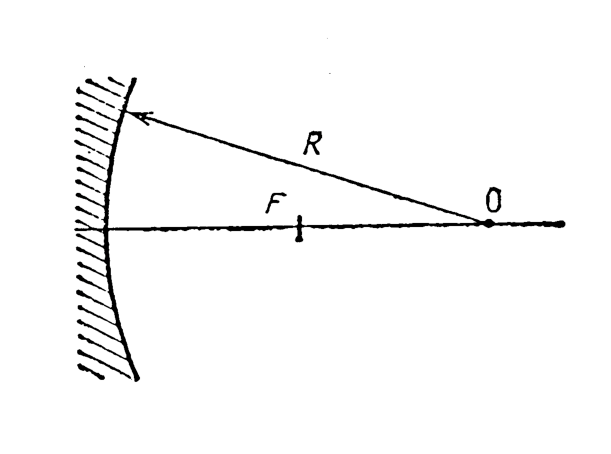
A spherical mirror is installed into a telescope. Its lateral diameter is and the radius of the curvature . In the main focus of the mirror there is an emission receiver in the form of a round disk. The disk is placed perpendicular to the optical axis of the mirror (Fig.7). What should the radius of the receiver be so that it could receive the entire flux of the emission reflected by the mirror? How would the received flux of the emission decrease if the detector’s dimensions decreased by 8 times?
Directions: 1) When calculating small values () one may perform a substitution ; 2) diffraction should not be taken into account.
Отговори
r ≈ D³/(16R²) ≈ 1.95·10⁻³ m ≈ 2 mm; the received flux decreases (the official solution says “decreased twice”, the effective area decreasing 4 times).
The official solution states the effective mirror area decreases 4 times and then that the flux Φ ∼ S is “decreased twice”; both kept as printed.
Решение
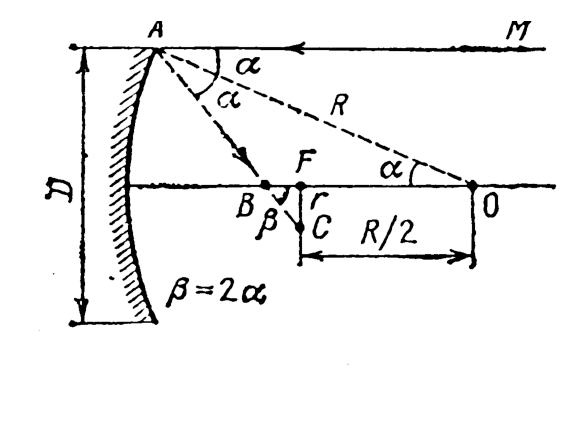
As known, rays parallel to the main optical axis of a spherical mirror, passing at little distances from it after having been reflected, join at the main focus of the mirror which is at the distance from the centre of the spherical surface. Let us consider now the movement of the ray reflected near the edge of the spherical mirror of large diameter (Fig. 6). The angle of incidence of the ray onto the surface is equal to the angle of reflection. That is why the angle within the triangle, formed by the radius of the sphere, traced to the incidence point of the ray by the reflected ray and an intercept BO of the main optical axis, is equal to . The angles BOA and MAO are equal, that is the angle BOA is equal to .
Thus, the triangle AOB is isosceles with its side AB being equal to the side BO. Since the sum of the lengths of its two other sides exceeds the length of its third side, , hence . This means that a ray parallel to the main optical axis of the spherical mirror and passing not too close to it, after having been reflected, crosses the main optical axis at the point lying between the focus and the mirror. The focal surface is crossed by this ray at the point which is at a certain distance from the main focus.
Thus, when reflecting a parallel beam of rays by a spherical mirror finite in size it does not join at the focus of the mirror but forms a beam with radius on the focal plane.
From we can write :
where is the maximum angle of incidence of the extreme ray onto the mirror, while :
Thus, . Let us express the values of , , via taking into account the small value of the angle :
Then
Substituting numerical data we will obtain: .
From the expression one can see that if the radius of the receiver is decreased 8 times the transversal diameter of the mirror, from which the light comes to the receiver, will be decreased 2 times and thus the “effective” area of the mirror will be decreased 4 times.
The radiation flux reflected by the mirror and received by the receiver will also be decreased twice since .
Acknowledgement
The authors would like to thank Professor Waldemar Gorzkowski (Poland) and Professor Ivo Volf (Czech Republic) for their providing the materials of the IV IPhO in the Polish and Czech languages.
References:
- O.Kabardin, V.Orlov, International Physics Olympiads for Pupils, Nauka, Moskva 1985
- W.Gorzkowski, Zadania z fiziki z calego swiata – 20 lat. Miedzyna – rodowych Olimpiad Fizycznych, WNT, Warszawa 1994
- V.Urumov, Prosventno Delo, Skopje 1999
- D.Kluvanec, I.Volf, Mezinarodni Fysikalni Olympiady (metodycky material), MaFy, Hradec Kralowe 1993
Оригинал в Архива: ipho70.pdf