IPhO 1970, Теория и експеримент — Задача 5. Experimental Problem
Problems of the IV International Olympiad, Moscow, 1970
The publication is prepared by Prof. S. Kozel & Prof. V.Orlov (Moscow Institute of Physics and Technology)
The IV International Olympiad in Physics for schoolchildren took place in Moscow (USSR) in July 1970 on the basis of Moscow State University. Teams from 8 countries participated in the competition, namely Bulgaria, Hungary, Poland, Romania, Czechoslovakia, the DDR, the SFR Yugoslavia, the USSR. The problems for the theoretical competition have been prepared by the group from Moscow University stuff headed by professor V.Zubov. The problem for the experimental competition has been worked out by B. Zvorikin from the Academy of Pedagogical Sciences.
It is pity that marking schemes were not preserved.
Условие
Determine the focal distances of lenses.
List of instruments: three different lenses installed on posts, a screen bearing an image of a geometric figure, some vertical wiring also fixed on the posts and a ruler.
Отговори
Typical results: F1 = (22,0 ± 0,4) cm, F2 = (12,3 ± 0,3) cm, F3 = (−8,4 ± 0,4) cm.
Typical results quoted in the official solution.
Решение
While looking at objects through lenses it is easy to establish that there were given two converging lenses and a diverging one.
The peculiarity of the given problem is the absence of a white screen on the list of the equipment that is used to observe real images. The competitors were supposed to determine the position of the images by the parallax method observing the images with their eyes.
The focal distance of the converging lens may be determined by the following method.
Using a lens one can obtain a real image of a geometrical figure shown on the screen. The position of the real image is registered by the parallax method: if one places a vertical wire (Fig.7) to the point, in which the image is located, then at small displacements of the eye from the main optical axis of the lens the image of this object and the wire will not diverge.
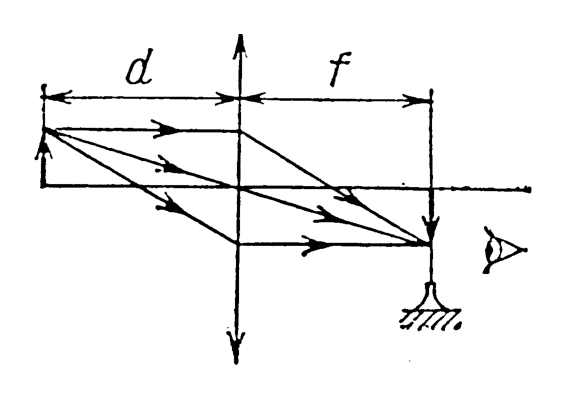
We obtain the value of focal distance from the formula of thin lens by the measured distances and :
In this method the best accuracy is achieved in the case of
The competitors were not asked to make a conclusion.
The error of measuring the focal distance for each of the two converging lenses can be determined by multiple repeated measurements. The total number of points was given to those competitors who carried out not less fewer than measurements of the focal distance and estimated the mean value of the focal distance Fav:
and the absolute error
or root mean square error
One could calculate the error by graphic method.
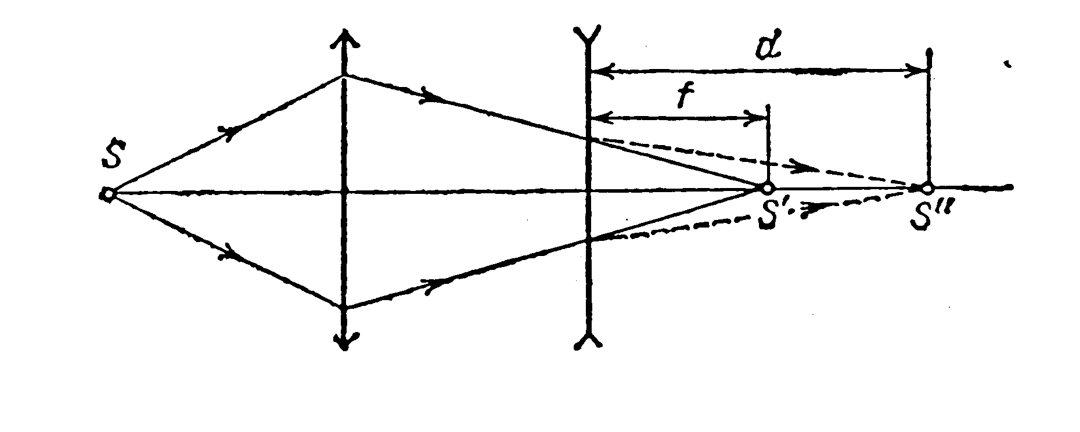
Determination of the focal distance of the diverging lens can be carried out by the method of compensation. With this goal one has to obtain a real image of the object using a converging lens. The position of the image can be registered using the parallax method.
If one places a diverging lens between the image and the converging lens the image will be displaced. Let us find a new position of the image . Using the reversibility property of the light rays, one can admit that the light rays leave the point . Then point is a virtual image of the point , whereas the distances from the optical centre of the concave lens to the points and are, respectively, the distances to the image and to the object (Fig.8). Using the formula of a thin lens we obtain
Here is the focal distance of the diverging lens. In this case the error of measuring the focal distance can also be estimated by the method of repeated measurements similar to the case of the converging lens.
Typical results are:
, , .
Acknowledgement
The authors would like to thank Professor Waldemar Gorzkowski (Poland) and Professor Ivo Volf (Czech Republic) for their providing the materials of the IV IPhO in the Polish and Czech languages.
References:
- O.Kabardin, V.Orlov, International Physics Olympiads for Pupils, Nauka, Moskva 1985
- W.Gorzkowski, Zadania z fiziki z calego swiata – 20 lat. Miedzyna – rodowych Olimpiad Fizycznych, WNT, Warszawa 1994
- V.Urumov, Prosventno Delo, Skopje 1999
- D.Kluvanec, I.Volf, Mezinarodni Fysikalni Olympiady (metodycky material), MaFy, Hradec Kralowe 1993
Оригинал в Архива: ipho70.pdf