IPhO 1971, Теория и експеримент — Задача 1. Question 1.
V International Physics Olympiad, 1971. Sofia, Bulgaria
Внимание: Бележка към темата
Решенията са архивна адаптация на Victor Ivanov, както е посочено в оригинала. Формули (1.13), (1.17) и (4.6), както и повтореното означение P₂ в числените резултати на задача 2, са запазени според източника. Добавеният множител g в краткия отговор на задача 1 е отделно обозначена редакционна поправка; текстът на архивното решение остава непроменен.
Source
The problems and the solutions are adapted by Victor Ivanov University of Sofia, Faculty of Physics, 5 James Bourchier Blvd., 1164 Sofia, Bulgaria
Reference: O. F. Kabardin, V. A. Orlov, in “International Physics Olympiads for High School Students”, eds. V. G. Razumovski, Moscow, Nauka, 1985. (In Russian).
Theoretical problems
Solutions — source
Solutions to the problems of the 5-th International Physics Olympiad, 1971, Sofia, Bulgaria
The problems and the solutions are adapted by Victor Ivanov Sofia State University, Faculty of Physics, 5 James Bourcier Blvd., 1164 Sofia, Bulgaria
Reference: O. F. Kabardin, V. A. Orlov, in “International Physics Olympiads for High School Students”, eds. V. G. Razumovski, Moscow, Nauka, 1985. (In Russian).
Theoretical problems
Условие
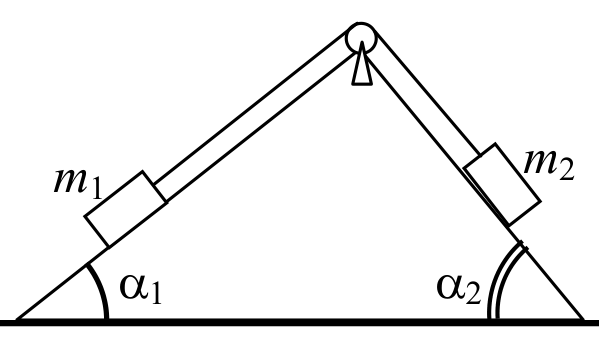
A triangular prism of mass is placed one side on a frictionless horizontal plane as shown in Fig. 1. The other two sides are inclined with respect to the plane at angles and respectively. Two blocks of masses and , connected by an inextensible thread, can slide without friction on the surface of the prism. The mass of the pulley, which supports the thread, is negligible.
• Express the acceleration of the blocks relative to the prism in terms of the acceleration of the prism.
• Find the acceleration of the prism in terms of quantities given and the acceleration due to gravity.
• At what ratio the prism will be in equilibrium?
Отговори
•
•
The archived formula (1.17) is printed without the factor g; it is added here for dimensional consistency. The solution text is kept as printed.
•
Решение
The blocks slide relative to the prism with accelerations and , which are parallel to its sides and have the same magnitude (see Fig. 1.1). The blocks move relative to the earth with accelerations:
(1.1) ;
(1.2) .
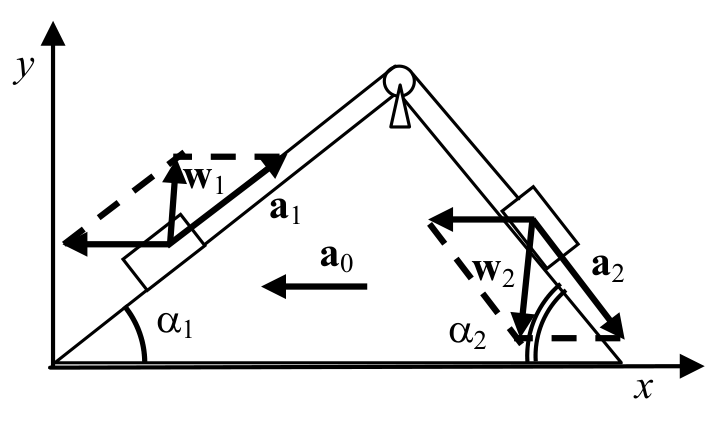
Now we project and along the - and -axes:
(1.3) ;
(1.4) ;
(1.5) ;
(1.6) .
The equations of motion for the blocks and for the prism have the following vector forms (see Fig. 1.2):
(1.7) ;
(1.8) ;
(1.9) .
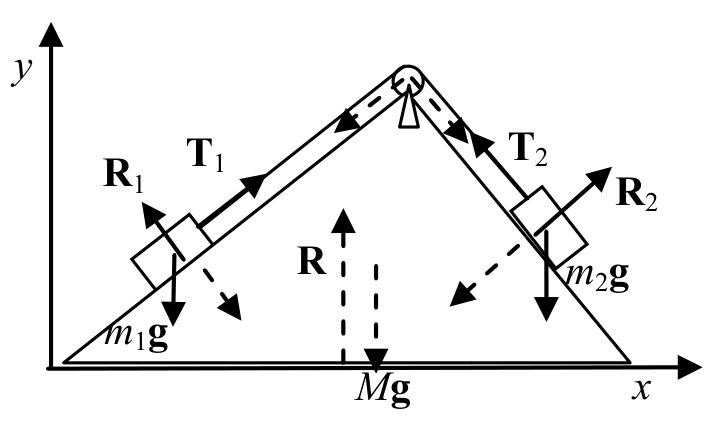
The forces of tension and at the ends of the thread are of the same magnitude since the masses of the thread and that of the pulley are negligible. Note that in equation (1.9) we account for the net force , which the bended thread exerts on the prism through the pulley. The equations of motion result in a system of six scalar equations when projected along and :
(1.10) ;
(1.11) ;
(1.12) ;
(1.13) ;
(1.14) ;
(1.15) .
By adding up equations (1.10), (1.12), and (1.14) all forces internal to the system cancel each other. In this way we obtain the required relation between accelerations and :
(1.16)
The straightforward elimination of the unknown forces gives the final answer for :
(1.17)
It follows from equation (1.17) that the prism will be in equilibrium () if:
(1.18)
Оригинал в Архива: ipho71_problems.pdf · решение от архива: ipho71_solutions.pdf · допълнителни данни: 1971_Sofia_Problems.pdf · допълнителни данни: 1971_Sofia_Solutions.pdf