IPhO 1971, Теория и експеримент — Задача 4. Question 4.
V International Physics Olympiad, 1971. Sofia, Bulgaria
Внимание: Бележка към темата
Решенията са архивна адаптация на Victor Ivanov, както е посочено в оригинала. Формули (1.13), (1.17) и (4.6), както и повтореното означение P₂ в числените резултати на задача 2, са запазени според източника. Добавеният множител g в краткия отговор на задача 1 е отделно обозначена редакционна поправка; текстът на архивното решение остава непроменен.
Source
The problems and the solutions are adapted by Victor Ivanov University of Sofia, Faculty of Physics, 5 James Bourchier Blvd., 1164 Sofia, Bulgaria
Reference: O. F. Kabardin, V. A. Orlov, in “International Physics Olympiads for High School Students”, eds. V. G. Razumovski, Moscow, Nauka, 1985. (In Russian).
Theoretical problems
Solutions — source
Solutions to the problems of the 5-th International Physics Olympiad, 1971, Sofia, Bulgaria
The problems and the solutions are adapted by Victor Ivanov Sofia State University, Faculty of Physics, 5 James Bourcier Blvd., 1164 Sofia, Bulgaria
Reference: O. F. Kabardin, V. A. Orlov, in “International Physics Olympiads for High School Students”, eds. V. G. Razumovski, Moscow, Nauka, 1985. (In Russian).
Theoretical problems
Условие
A spherical aquarium, filled with water, is placed in front of a flat vertical mirror. The radius of the aquarium is , and the distance between its center and the mirror is . A small fish, which is initially at the point nearest to the mirror, starts to move with velocity along the wall. An observer looks at the fish from a very large distance along a horizontal line passing trough the center of the aquarium.
What is the relative velocity at which the two images of the fish seen by the observer will move apart? Express your answer in terms of . Assume that:
- The wall of the aquarium is made of a very thin glass.
- The index of refraction of water is .
Отговори
Решение
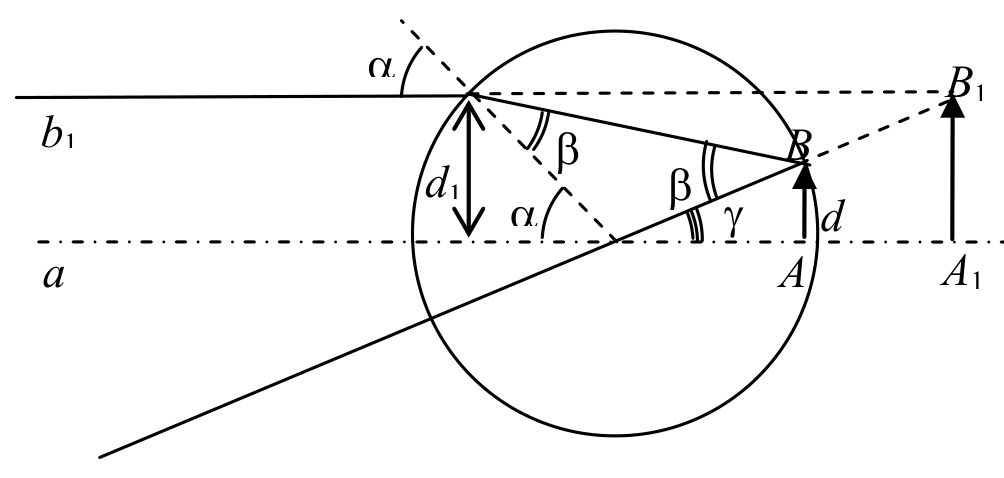
In a small time interval the fish moves upward, from point to point , at a small distance . Since the glass wall is very thin we can assume that the rays leaving the aquarium refract as if there was water – air interface. The divergent rays undergoing one single refraction, as show in Fig. 4.1, form the first, virtual, image of the fish. The corresponding vertical displacement of that image is equal to the distance between the optical axis and the ray , which leaves the aquarium parallel to . Since distances and are small compared to we can use the small-angle approximation: (rad). Thus we obtain:
(4.1) ;
(4.2) ;
(4.3) ;
(4.4) .
From equations (4.1) - (4.4) we find the vertical displacement of the first image in terms of :
(4.5)
and respectively its velocity in terms of :
(4.6)
The rays, which are first reflected by the mirror, and then are refracted twice at the walls of the aquarium form the second, real image (see Fig. 4.2). It can be considered as originating from the mirror image of the fish, which move along the line at exactly the same distance as the fish do.
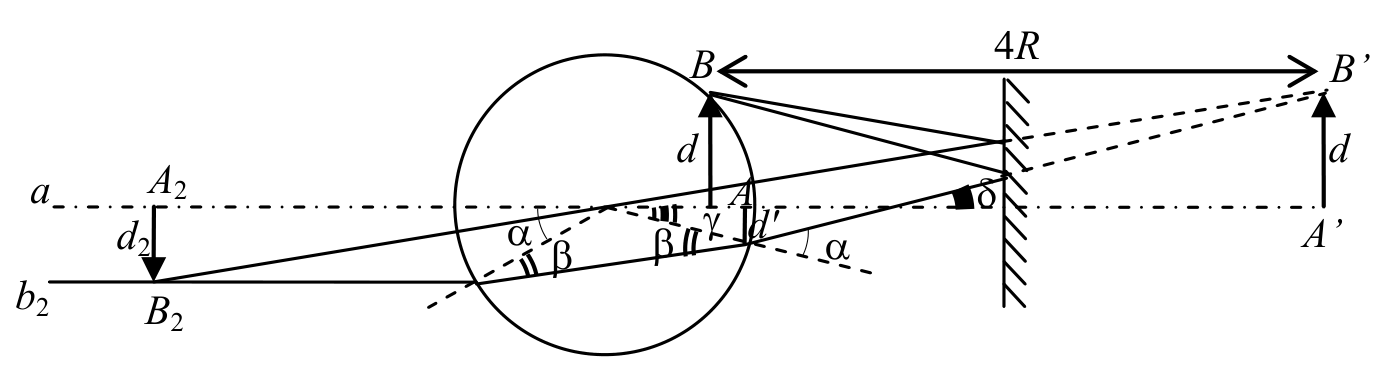
The vertical displacement of the second image is equal to the distance between the optical axis and the ray , which is parallel to . Again, using the small-angle approximation we have:
(4.7) ,
(4.8)
Following the derivation of equation (4.5) we obtain:
(4.9)
Now using the exact geometric relations:
(4.10)
and the Snell’s law (4.4) in a small-angle limit, we finally express in terms of :
(4.11)
and the velocity of the second image in terms of :
(4.12)
The relative velocity of the two images is:
(4.13)
in a vector form. Since vectors and are oppositely directed (one of the images moves upward, the other, downward) the magnitude of the relative velocity is:
(4.14)
Оригинал в Архива: ipho71_problems.pdf · решение от архива: ipho71_solutions.pdf · допълнителни данни: 1971_Sofia_Problems.pdf · допълнителни данни: 1971_Sofia_Solutions.pdf