IPhO 1971, Теория и експеримент — Задача 5. Experimental Problem
V International Physics Olympiad, 1971. Sofia, Bulgaria
Внимание: Бележка към темата
Решенията са архивна адаптация на Victor Ivanov, както е посочено в оригинала. Формули (1.13), (1.17) и (4.6), както и повтореното означение P₂ в числените резултати на задача 2, са запазени според източника. Добавеният множител g в краткия отговор на задача 1 е отделно обозначена редакционна поправка; текстът на архивното решение остава непроменен.
Source
The problems and the solutions are adapted by Victor Ivanov University of Sofia, Faculty of Physics, 5 James Bourchier Blvd., 1164 Sofia, Bulgaria
Reference: O. F. Kabardin, V. A. Orlov, in “International Physics Olympiads for High School Students”, eds. V. G. Razumovski, Moscow, Nauka, 1985. (In Russian).
Theoretical problems
Solutions — source
Solutions to the problems of the 5-th International Physics Olympiad, 1971, Sofia, Bulgaria
The problems and the solutions are adapted by Victor Ivanov Sofia State University, Faculty of Physics, 5 James Bourcier Blvd., 1164 Sofia, Bulgaria
Reference: O. F. Kabardin, V. A. Orlov, in “International Physics Olympiads for High School Students”, eds. V. G. Razumovski, Moscow, Nauka, 1985. (In Russian).
Theoretical problems
Условие
Apparatus: dc source, ammeter, voltmeter, rheostat (coil of high resistance wire with sliding contact), and connecting wires.
Problem: Construct appropriate circuit and establish the dependence of the electric power dissipated in the rheostat as a function of the current supplied by the dc source.
1. Make a plot of versus .
2. Find the internal resistance of the dc source.
3. Determine the electromotive force of the source.
4. Make a graph of the electric power versus resistance of the rheostat.
5. Make a graph of the total power dissipated in the circuit as a function of .
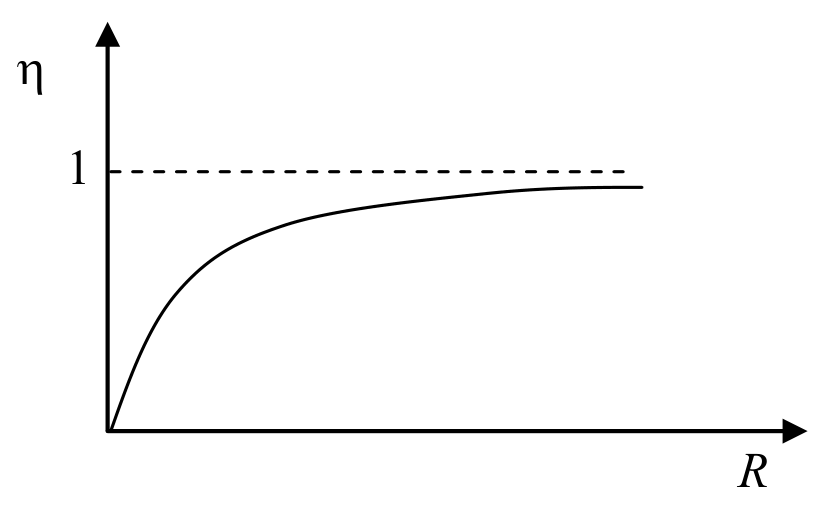
6. Make a graph of the efficiency of the dc source versus .
Отговори
- 2.
- 3.
Решение
The circuit is given in the figure below:
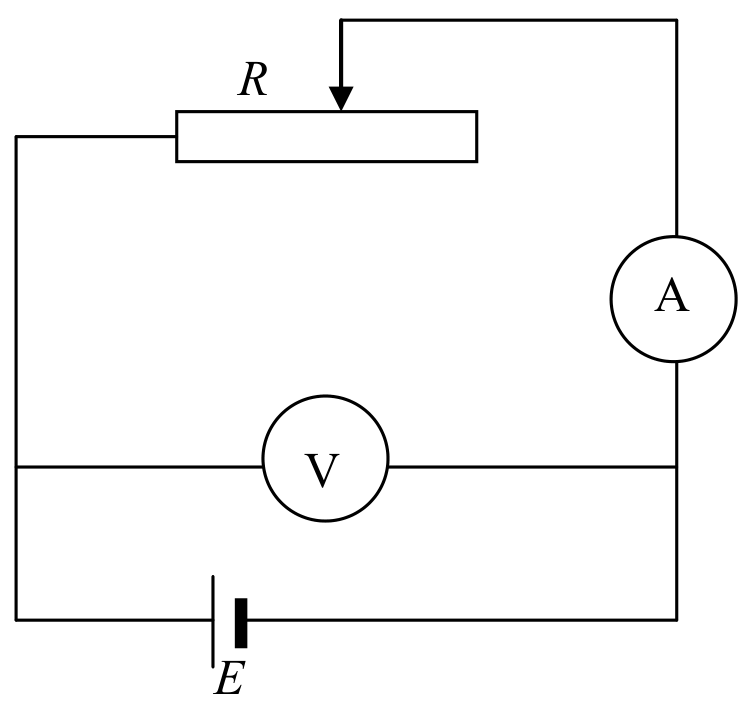
Sliding the contact along the rheostat sets the current supplied by the source. For each value of the voltage across the source terminals is recorded by the voltmeter. The power dissipated in the rheostat is:
provided that the heat losses in the internal resistance of the ammeter are negligible.
1.
A typical – curve is shown below:
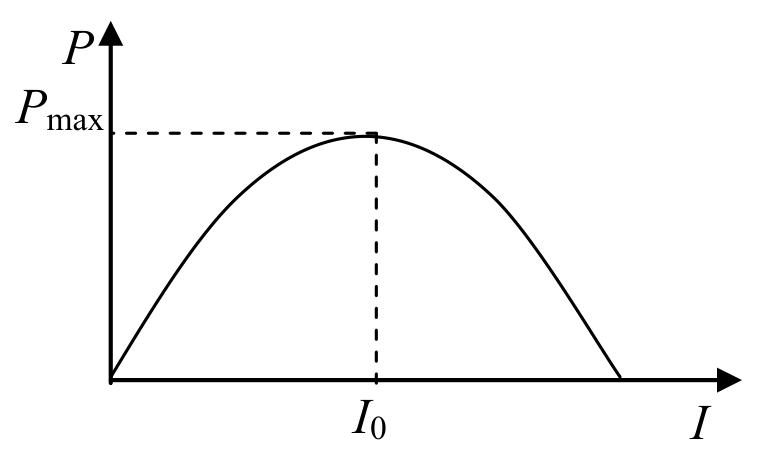
If the current varies in a sufficiently large interval a maximum power can be detected at a certain value, , of . Theoretically, the dependence is given by:
(5.1) ,
where and are the EMF and the internal resistance of the dc source respectively. The maxim value of therefore is:
(5.2)
and corresponds to a current:
(5.3)
2.
The internal resistance is determined trough (5.2) and (5.3) by recording and from the experimental plot:
3.
Similarly, EMF is calculated as:
4.
The current depends on the resistance of the rheostat as:
Therefore a value of can be calculated for each value of :
(5.4)
The power dissipated in the rheostat is given in terms of respectively by:
(5.5)
The – plot is given below:
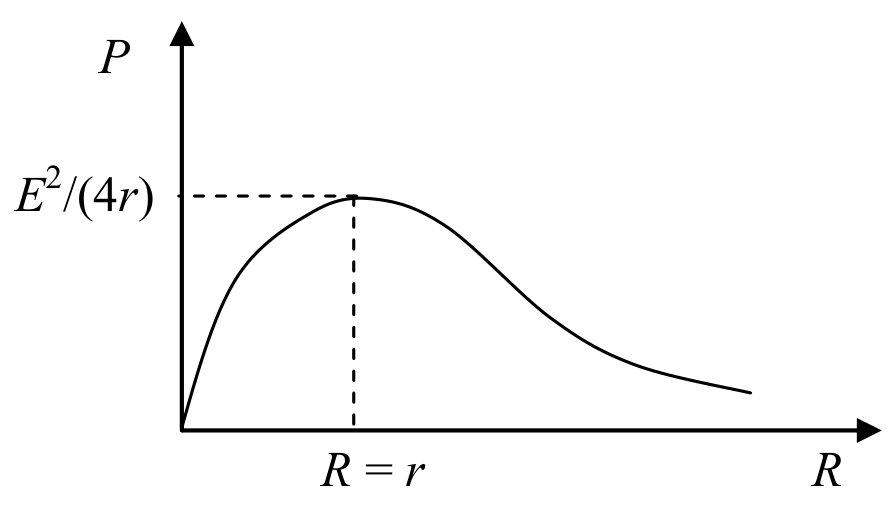
Its maximum is obtained at .
5.
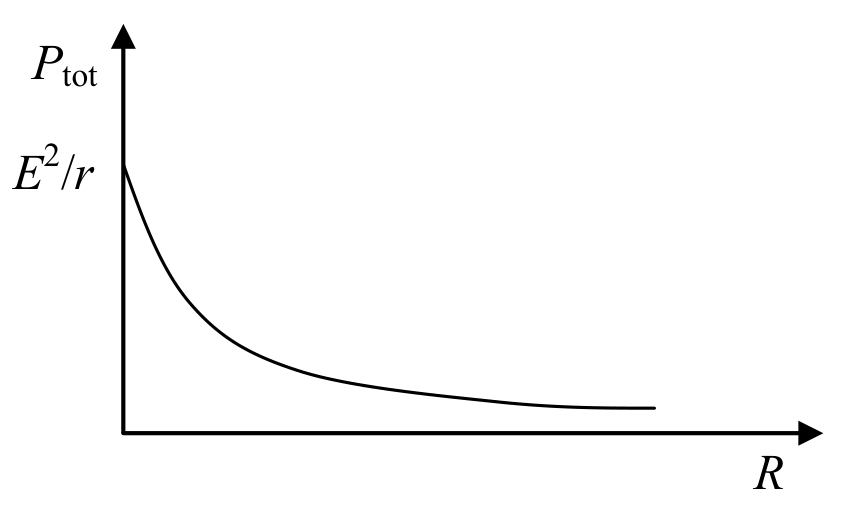
The total power supplied by the dc source is:
(5.6)
6.
The efficiency respectively is:
(5.7)
Оригинал в Архива: ipho71_problems.pdf · решение от архива: ipho71_solutions.pdf · допълнителни данни: 1971_Sofia_Problems.pdf · допълнителни данни: 1971_Sofia_Solutions.pdf