IPhO 1972, Теория и експеримент — Задача 4. Problem 4 (Optics)
Problems of the 6th International Physics Olympiad (Bucharest, 1972) · 10 т.
Romulus Pop, Civil Engineering University, Physics Department, Bucharest, Romania
The sixth IPhO was held in Bucharest and the participants were: Bulgaria, Czechoslovakia, Cuba, France, German Democratic Republic, Hungary, Poland, Romania, and Soviet Union. It was an important event because it was the first time when a non-European country and a western country participated (Cuba), and Sweden sent one observer.
The International Board selected four theoretical problems and an experimental problem. Each theoretical problem was scored from 0 to 10 and the maximum score for the experimental problem was 20. The highest score corresponding to actual marking system was 47,5 points. Each team consisted in six students. Four students obtained the first prize, seven students obtained the second prize, ten students obtained the third prize, thirteen students had got honorable mentions, and two special prizes were awarded too.
The article contains the competition problems given at the 6th International Physics Olympiad (Bucharest, 1972) and their solutions. The problems were translated from the book published in Romania concerning the first nine International Physics Olympiads², because I couldn’t find the original English version.
¹ E-mail: popr@tvet.ro
² Marius Gall and Anatolie Hristev, Probleme date la Olimpiadele de Fizica, Editura Didactica si Pedagogica – Bucuresti, 1978
Условие
A thin lens plane-convex with the diameter 2r, the curvature radius R and the refractive index n is positioned so that on its left side is air (n =1), and on its right side there is a transparent medium with the refractive index n ≠ 1. The convex face of the lens is directed towards air. In the air, at the distance sfrom the lens, measured on the principal optic ax, there is a punctual source of monochromatic light.
a) Demonstrate, using Gauss approximation, that between the position of the image, given by the distance s from the lens, and the position of the light source, exists the relation:
where f and f are the focal distances of the lens, in air, respectively in the medium with the refractive index n.
Observation: All the refractive indexes are absolute indexes.
b) The lens is cut perpendicular on its plane face in two equal parts. These parts are moved away at a distance (Billet lens). On the symmetry axis of the system obtained is led a punctual source of light at the distance s (s > f) (fig. 4.1). On the right side of the lens there is a screen E at the distance d. The screen is parallel with the plane face of the lens. On this screen there are N interference fringes, if on the right side of the lens is air.
Determine N function of the wave length.
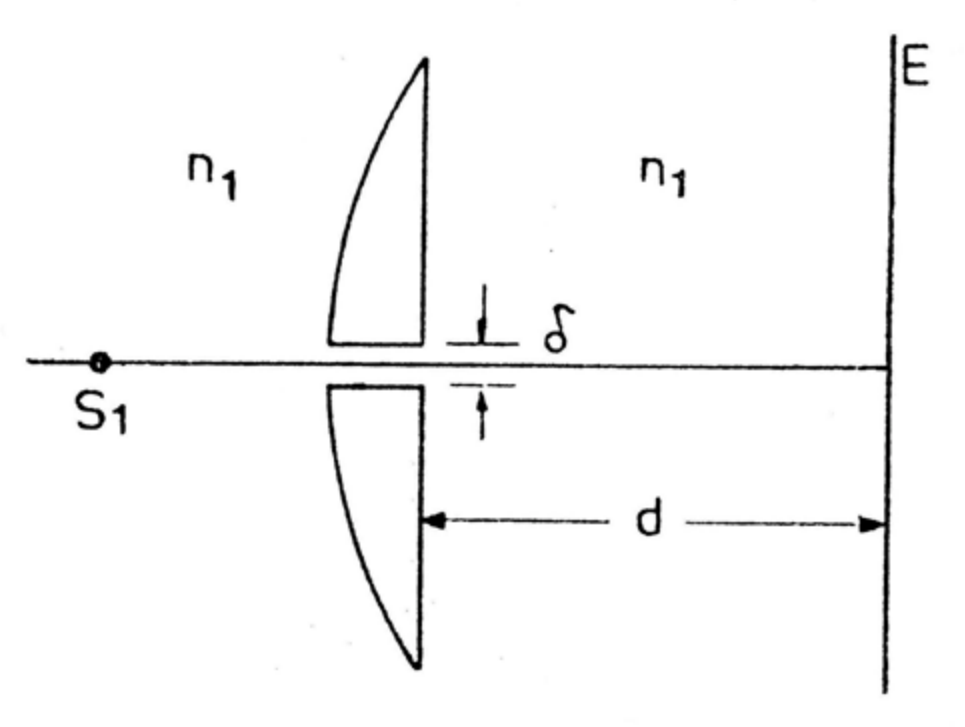
Отговори
- b)
Решение
a) From the Fermat principle it results that the time the light arrives from to is not dependent of the way, in gauss approximation ( and are conjugated points).
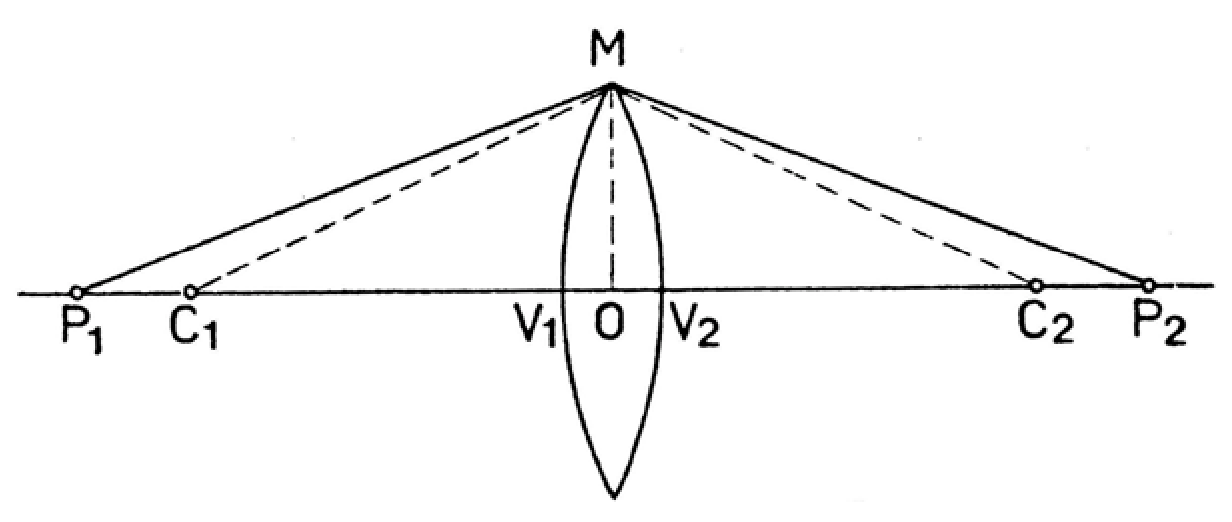
is the time the light roams the optical way (fig. 4.2):
because is much more smaller than or .
From condition , it results:
Taking in account the relation , and using , the relation (3) can be written:
If the point is at infinite, becomes the focal distance; the same for .
From the equations (30 and (4) it results:
The lens is plane-convex (fig. 4.3) and its focal distances are:
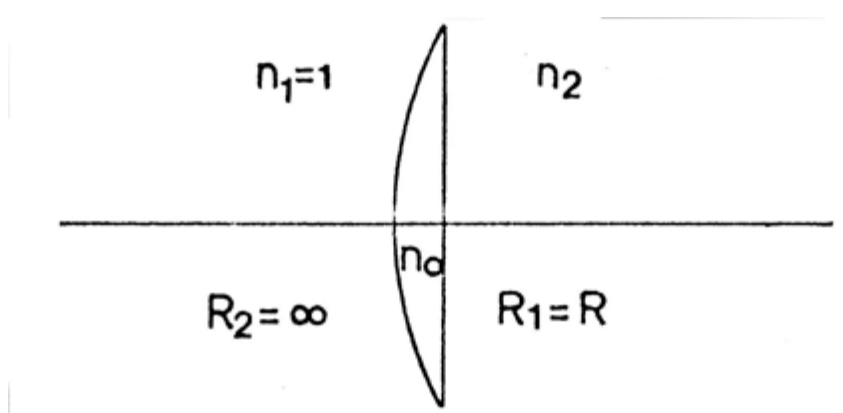
b) In the case of Billet lenses, and are the real images of the object S and can be considered like coherent light sources (fig. 4.4).
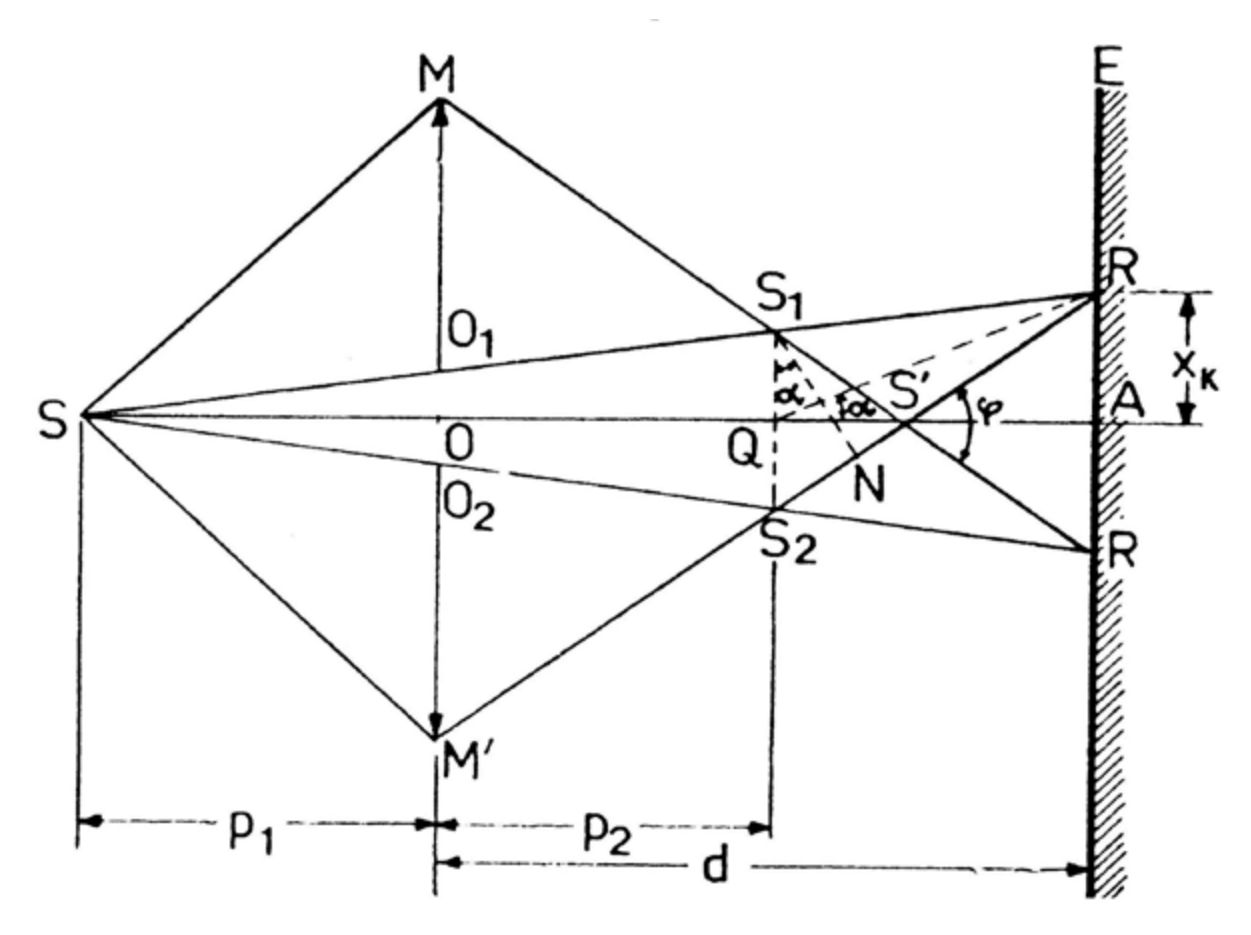
is much more smaller than r:
We calculate the width of the interference field (fig. 4.4).
Maximum interference condition is:
The fringe of k order is located at a distance from A:
The expression of the inter-fringes distance is:
The number of observed fringes on the screen is:
can be expressed from the lenses’ formula:
Оригинал в Архива: ipho72.pdf