IPhO 1972, Теория и експеримент — Задача 5. Experimental part (Mechanics)
Problems of the 6th International Physics Olympiad (Bucharest, 1972) · 20 т.
Romulus Pop, Civil Engineering University, Physics Department, Bucharest, Romania
The sixth IPhO was held in Bucharest and the participants were: Bulgaria, Czechoslovakia, Cuba, France, German Democratic Republic, Hungary, Poland, Romania, and Soviet Union. It was an important event because it was the first time when a non-European country and a western country participated (Cuba), and Sweden sent one observer.
The International Board selected four theoretical problems and an experimental problem. Each theoretical problem was scored from 0 to 10 and the maximum score for the experimental problem was 20. The highest score corresponding to actual marking system was 47,5 points. Each team consisted in six students. Four students obtained the first prize, seven students obtained the second prize, ten students obtained the third prize, thirteen students had got honorable mentions, and two special prizes were awarded too.
The article contains the competition problems given at the 6th International Physics Olympiad (Bucharest, 1972) and their solutions. The problems were translated from the book published in Romania concerning the first nine International Physics Olympiads², because I couldn’t find the original English version.
¹ E-mail: popr@tvet.ro
² Marius Gall and Anatolie Hristev, Probleme date la Olimpiadele de Fizica, Editura Didactica si Pedagogica – Bucuresti, 1978
Условие
There are given two cylindrical bodies (having identical external shapes and from the same material), two measuring rules, one graduated and other un-graduated, and a vessel with water.
It is known that one of the bodies is homogenous and the other has an internal cavity with the following characteristics:
- the cavity is cylindrical
- has the axis parallel with the axis of the body
- its length is practically equal with that of the body
Determine experimentally and justify theoretically:
a) The density of the material the two bodies consist of.
b) The radius of the internal cavity.
c) The distance between the axis of the cavity and the axis of the cylinder.
d) Indicate the sources of errors and appreciate which of them influences more the final results.
Write all the variants you have found.
Решение
a) Determination of the density of the material
The average density of the two bodies was chosen so that the bodies float on the water. Using the mass of the liquid crowded out it is determined the mass of the first body (the homogenous body):
where S is the area of the base immersed in water, H the length of the cylinder and ρ is the density of water.
The mass of the cylinder is:
It results the density of the body:
To calculate the area S it is measured the distance h above the water surface (fig. 5.1). Area is composed by the area of the triangle OAB plus the area of the circular sector with the angle 2π -2θ.
The triangle area:
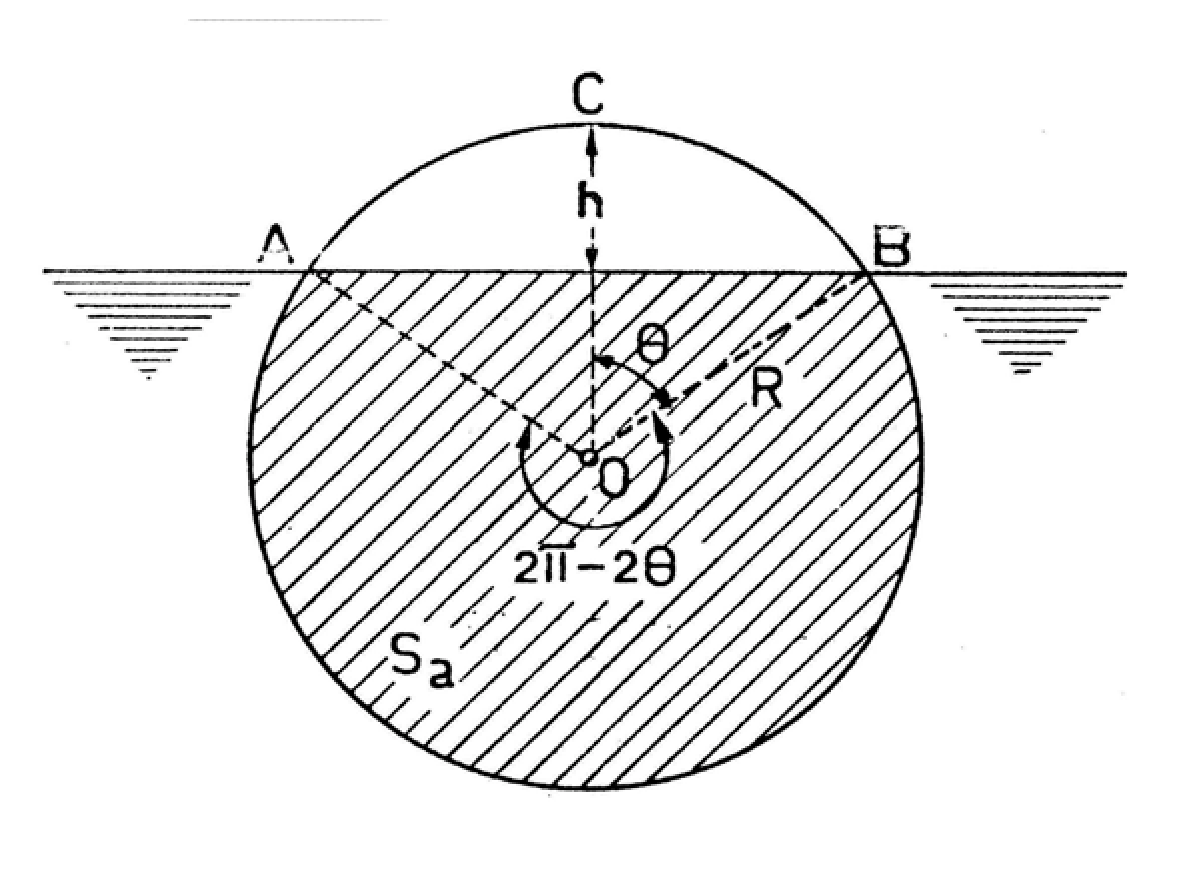
The circular sector area is:
The immersed area is:
where R and h are measured by the graduated rule.
b) The radius of the cylindrical cavity
The second body (with cavity) is dislocating a water mass:
where S’ is area immersed in water.
The mass of the body having the cavity inside is:
The cavity radius is:
S’ is determined like S.
c) The distance between the cylinder’s axis and the cavity axis
We put the second body on the horizontal table (or let it to float in water) and we trace the vertical symmetry axis AB (fig. 5.2).
Using the rule we make an inclined plane. We put the body on this plane and we determine the maximum angle of the inclined plane for the situation the body remains in rest (the body doesn’t roll). Taking in account that the weight centre is located on the axis AB on the left side of the cylinder axis (point G in fig. 5.2) and that at equilibrium the weight centre is on the same vertical with the contact point between the cylinder and the inclined plane, we obtain the situation corresponding to the maximum angle of the inclined plane (the diameter AB is horizontal).
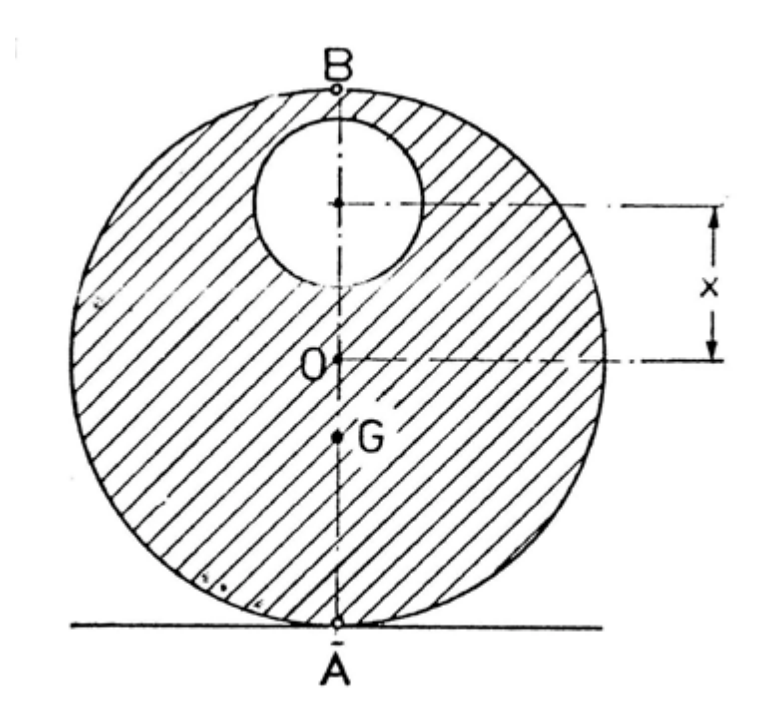
The distance OG is calculated from the equilibrium condition:
d) At every measurement it must be estimated the reading error. Taking in account the expressions for ρ, r and x it is evaluated the maximum error for the determination of these measures.
Оригинал в Архива: ipho72.pdf