IPhO 1974, Теория и експеримент — Задача 2. Problem 2
Problems of the 7th International Physics Olympiad (Warsaw, 1974) · 10 т.
Увод
Waldemar Gorzkowski
Institute of Physics, Polish Academy of Sciences, Warsaw, Poland ²
Abstract
The article contains the competition problems given at the 7th International Physics Olympiad (Warsaw, 1974) and their solutions.
Introduction
The 7th International Physics Olympiad (Warsaw, 1974) was the second one organized in Poland. It took place after a one-year organizational gap, as no country was able to organize the competition in 1973.
The original English version of the problems of the 7th IPhO has not been preserved. We would like to remind that the permanent Secretariat of the IPhOs was established only in 1983; previously the Olympic materials had been collected by individual people in their private archives and, in general, are not complete. English texts of the problems and simplified solutions are available in the book by R. Kunfalvi [1]. Unfortunately, they are somewhat deformed as compared to the originals. Fortunately, we have very precise Polish texts. Also the full solutions in Polish are available. This article is based on the books [2, 3] and article [4].
The competition problems were prepared especially for the 7th IPhO by Andrzej Szymacha (theoretical problems) and Jerzy Langer (experimental problem).
¹ This article has been sent for publication in Physics Competitions in September 2003
² e-mail: gorzk@ifpan.edu.pl
Условие
Consider a parallel, transparent plate of thickness – Fig. 1. Its refraction index varies as
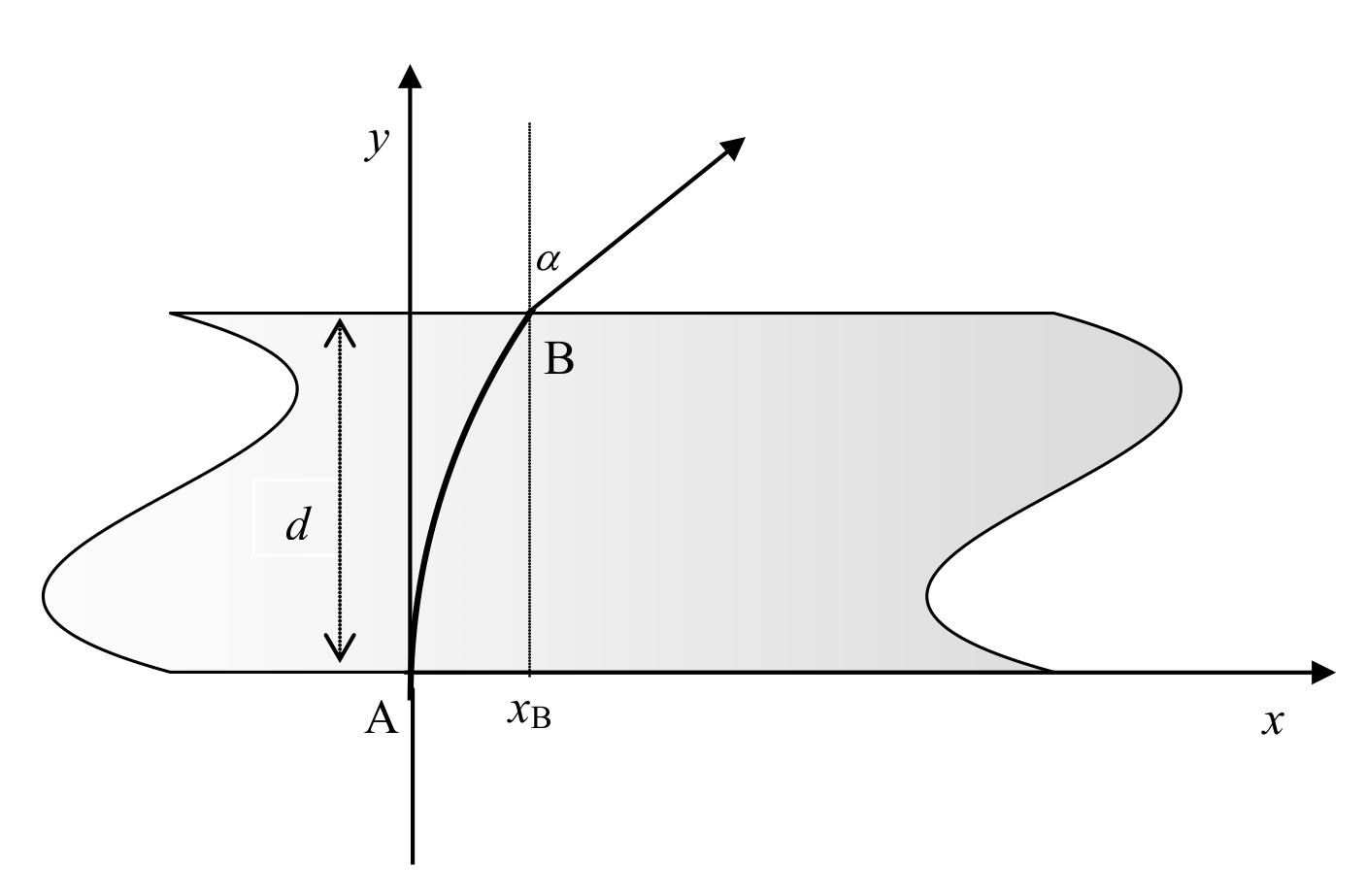
A light beam enters from the air perpendicularly to the plate at the point A () and emerges from it at the point B at an angle .
1. Find the refraction index at the point B.
2. Find (i.e. value of at the point B)
3. Find the thickness of the plate.
Data:
; ; .
Отговори
1. 1.3
2. 1 cm
3. 5 cm
Решение
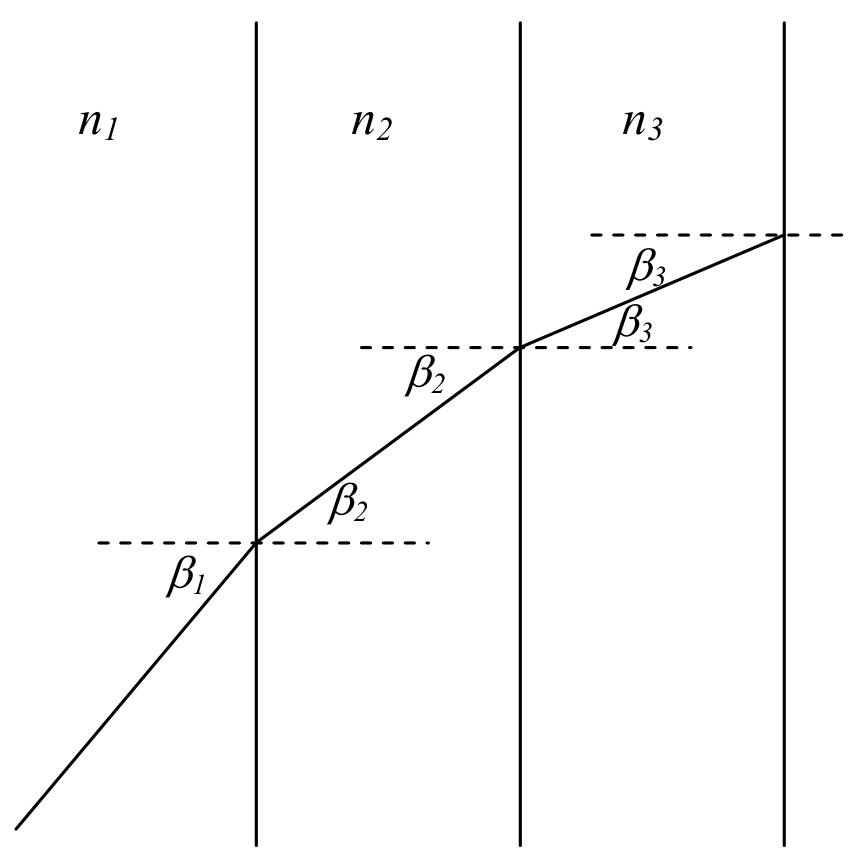
Consider a light ray passing through a system of parallel plates with different refractive indexes – Fig. 2. From the Snell law we have
i.e.
In the same way we get
Thus, in general:
This relation does not involve plates thickness nor their number. So, we may make use of it also in case of continuous dependence of the refractive index in one direction (in our case in the direction).
Consider the situation shown in Fig. 3.
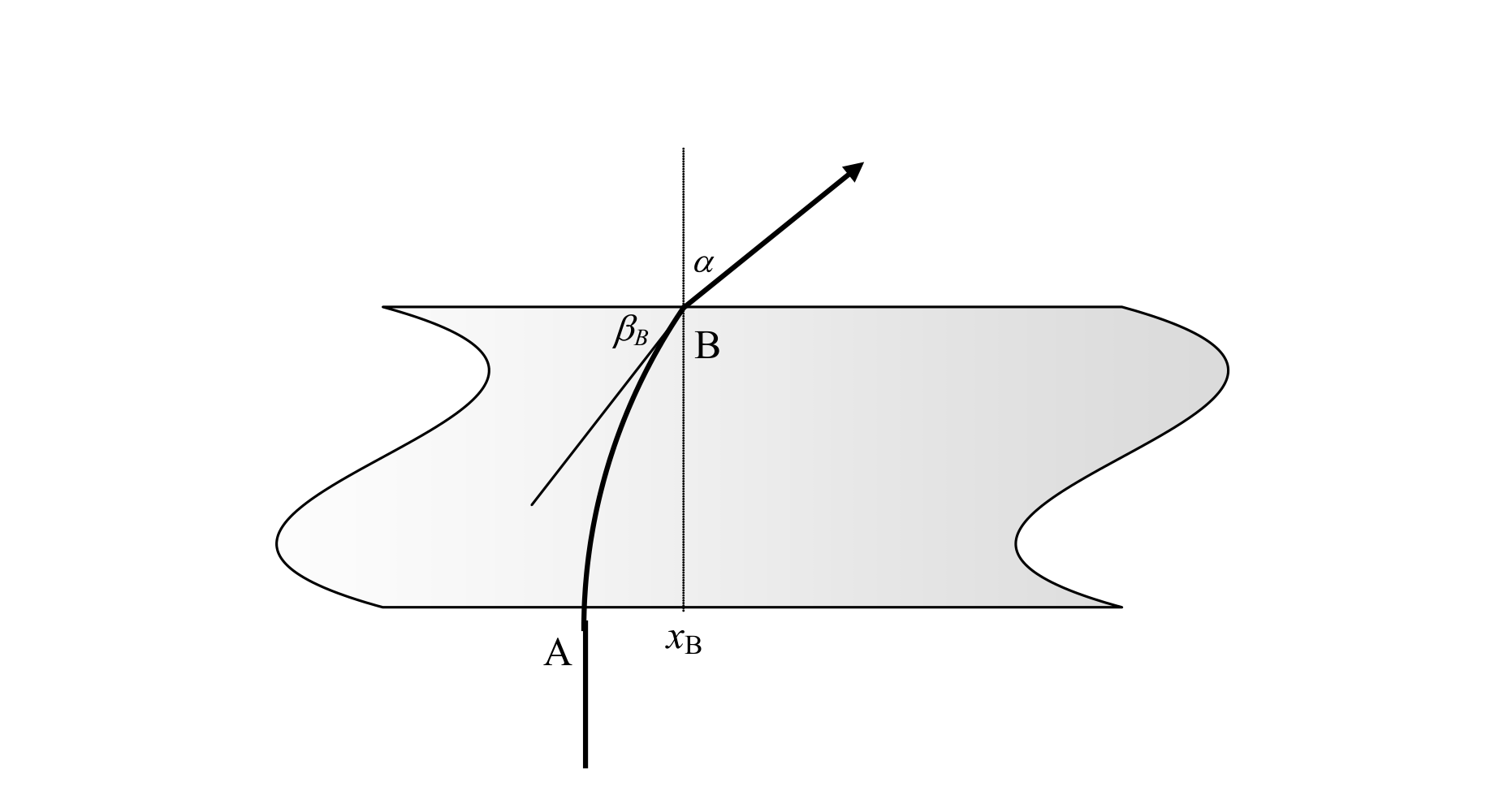
At the point A the angle . The refractive index at this point is . Thus, we have
Additionally, from the Snell law applied to the refraction at the point B, we have
Therefore
and finally
Numerically
The value of can be found from the dependence given in the text of the problem. We have
Numerically
The answer to the third question requires determination of the trajectory of the light ray. According to considerations described at the beginning of the solution we may write (see Fig. 4):
Thus
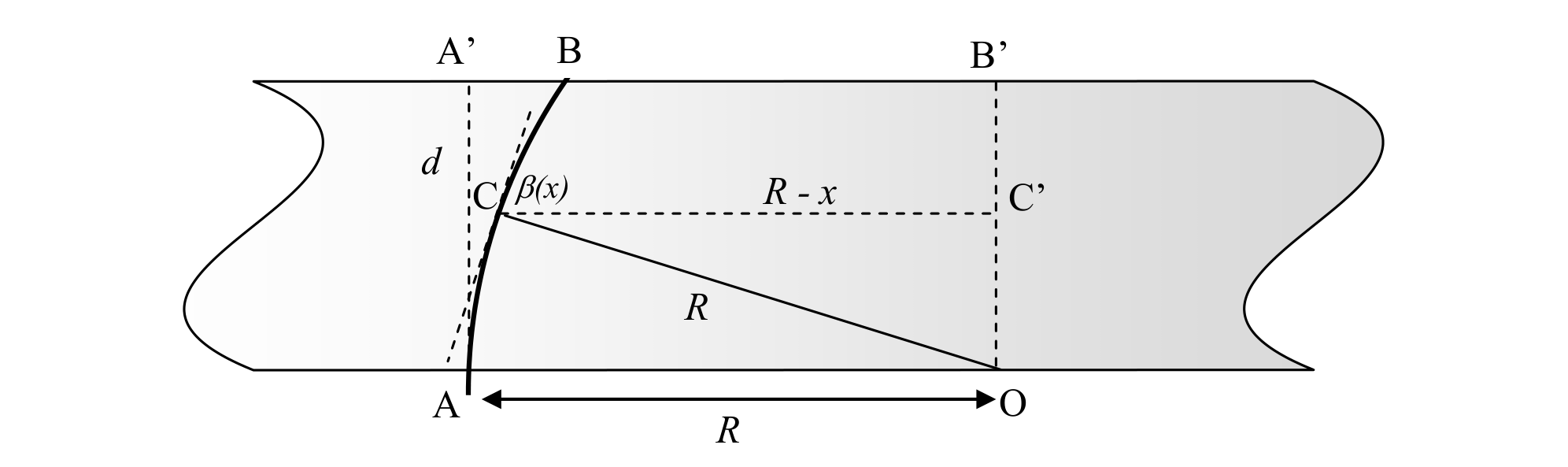
Consider the direction of the ray crossing a point C on the circle with radius and center in point O as shown in Fig. 4. We see that
Therefore, the angle must be equal to the angle formed at the point C by the light ray and CC'. It means that at the point C the ray must be tangent to the circle. Moreover, the ray that is tangent to the circle at some point must be tangent also at farther points. Therefore, the ray cannot leave the circle (as long as it is inside the plate)! But at the beginning the ray (at the point A) is tangent to the circle. Thus, the ray must propagate along the circle shown in Fig. 4 until reaching point B where it leaves the plate.
Already we know that A'B = 1 cm. Thus, B'B = 12 cm and from the rectangular triangle BB'O we get
The shape of the trajectory can be determined also by using more sophisticated calculations. Knowing we find :
But is the derivative of . So, we have
Thus
Value of const can be found from the condition
Finally:
It means that the ray moves in the plate along to the circle as found previously.
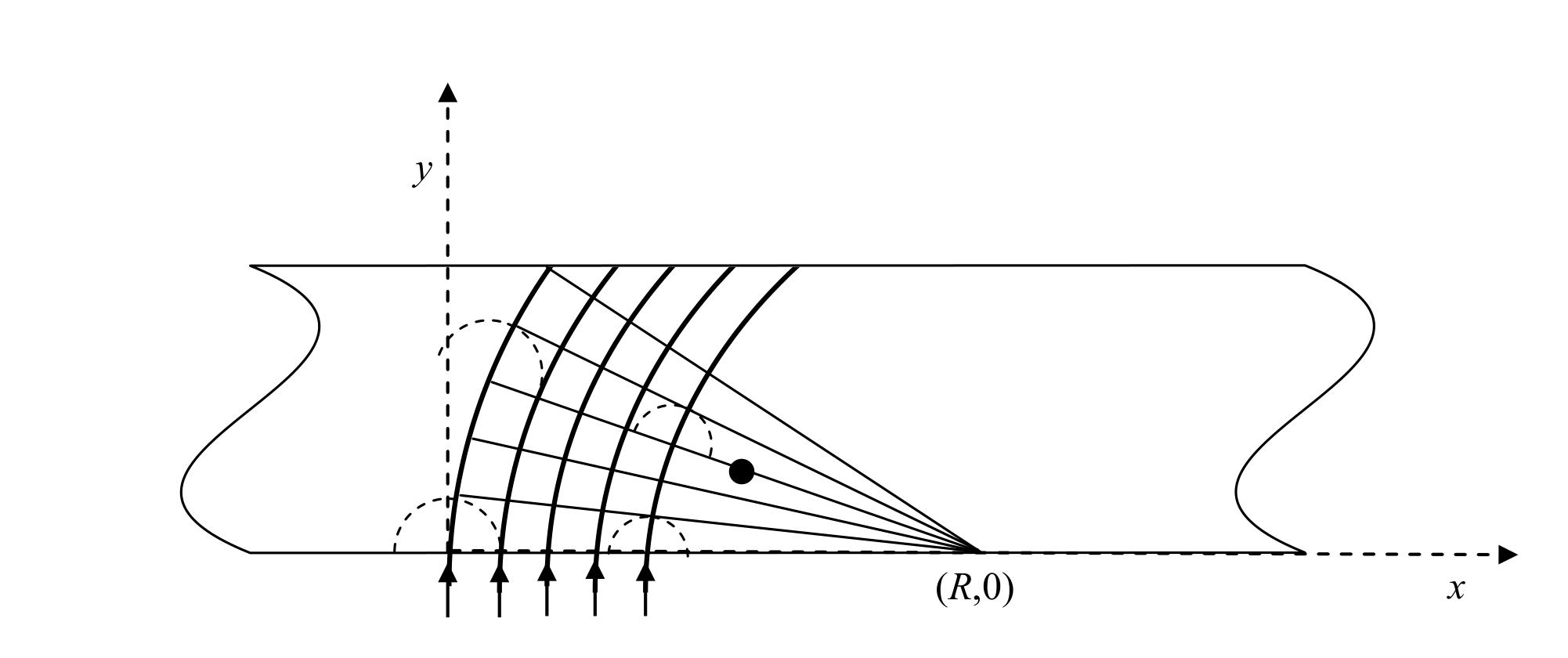
Now we will present yet another, already the third, method of proving that the light in the plate must move along the circle.
We draw a number of straight lines (inside the plate) close to each other and passing trough the point - Fig. 5. From the formula given in the text of the problem it follows that the refraction index on each of these lines is inversely proportional to the distance to the point . Now we draw several arcs with the center at . It is obvious that the geometric length of each arc between two lines is proportional to the distance to the point .
It follows from the above that the optical path (a product of geometric length and refractive index) along each arc between the two lines (close to each other) is the same for all the arcs.
Assume that at +-certain moment the wave front reached one of the lines, e.g. the line marked with a black dot in Fig. 5. According to the Huygens principle, the secondary sources on this line emit secondary waves. Their envelope forms the wave front of the real wave at some time . The wave fronts of secondary waves, shown in Fig. 5, have different geometric radii, but - in view of our previous considerations - their optical radii are exactly the same. It means that at the time the new wave front will correspond to one of the lines passing trough . At the beginning the wave front of the light coincided with the axis, it means that inside the plate the light will move along the circle with center at the point .
The solutions were marked according to the following scheme (draft):
| 1. | Proof of the relation const | up to 2 points |
| 2. | Correct description of refraction at points A and B | up to 2 points |
| 3. | Calculation of | up to 1 point |
| 4. | Calculation of | up to 5 points |
Acknowledgement
Author wishes to express many thanks to Prof. Jan Mostowski for reading the text and for many valuable comments and remarks that allowed improving the final version.
Literature
[1] R. Kunfalvi, Collection of Competition Tasks from the Ist trough XVth International Physics Olympiads, 1967 – 1984, Roland Eotvos Physical Society and UNESCO, Budapest 1985
[2] W. Gorzkowski, Olimpiady Fizyczne – XXIII I XXIV, WSiP, Warszawa 1977
[3] W. Gorzkowski, Zadania z fizyki z całego świata (z rozwiązaniami) - 20 lat Międzynarodowych Olimpiad Fizycznych, WNT, Warszawa 1994 [ISBN 83-204-1698-1]
[4] W. Gorzkowski, VII Międzynarodowa Olimpiada Fizyczna, Fizyka w Szkole, nr 3/75, pp. 23 – 28
Оригинал в Архива: ipho74.pdf