IPhO 1974, Теория и експеримент — Задача 3. Problem 3
Problems of the 7th International Physics Olympiad (Warsaw, 1974) · 10 т.
Увод
Waldemar Gorzkowski
Institute of Physics, Polish Academy of Sciences, Warsaw, Poland ²
Abstract
The article contains the competition problems given at the 7th International Physics Olympiad (Warsaw, 1974) and their solutions.
Introduction
The 7th International Physics Olympiad (Warsaw, 1974) was the second one organized in Poland. It took place after a one-year organizational gap, as no country was able to organize the competition in 1973.
The original English version of the problems of the 7th IPhO has not been preserved. We would like to remind that the permanent Secretariat of the IPhOs was established only in 1983; previously the Olympic materials had been collected by individual people in their private archives and, in general, are not complete. English texts of the problems and simplified solutions are available in the book by R. Kunfalvi [1]. Unfortunately, they are somewhat deformed as compared to the originals. Fortunately, we have very precise Polish texts. Also the full solutions in Polish are available. This article is based on the books [2, 3] and article [4].
The competition problems were prepared especially for the 7th IPhO by Andrzej Szymacha (theoretical problems) and Jerzy Langer (experimental problem).
¹ This article has been sent for publication in Physics Competitions in September 2003
² e-mail: gorzk@ifpan.edu.pl
Условие
A scientific expedition stayed on an uninhabited island. The members of the expedition had had some sources of energy, but after some time these sources exhausted. Then they decided to construct an alternative energy source. Unfortunately, the island was very quiet: there were no winds, clouds uniformly covered the sky, the air pressure was constant and the temperatures of air and water in the sea were the same during day and night. Fortunately, they found a source of chemically neutral gas outgoing very slowly from a cavity. The pressure and temperature of the gas are exactly the same as the pressure and temperature of the atmosphere.
The expedition had, however, certain membranes in its equipment. One of them was ideally transparent for gas and ideally non-transparent for air. Another one had an opposite property: it was ideally transparent for air and ideally non-transparent for gas. The members of the expedition had materials and tools that allowed them to make different mechanical devices such as cylinders with pistons, valves etc. They decided to construct an engine by using the gas from the cavity.
Show that there is no theoretical limit on the power of an ideal engine that uses the gas and the membranes considered above.
Отговори
- Isothermal expansion of the gas behind a membrane gives work proportional to , unbounded for large ; with large and short cycles the power has no theoretical limit.
Решение
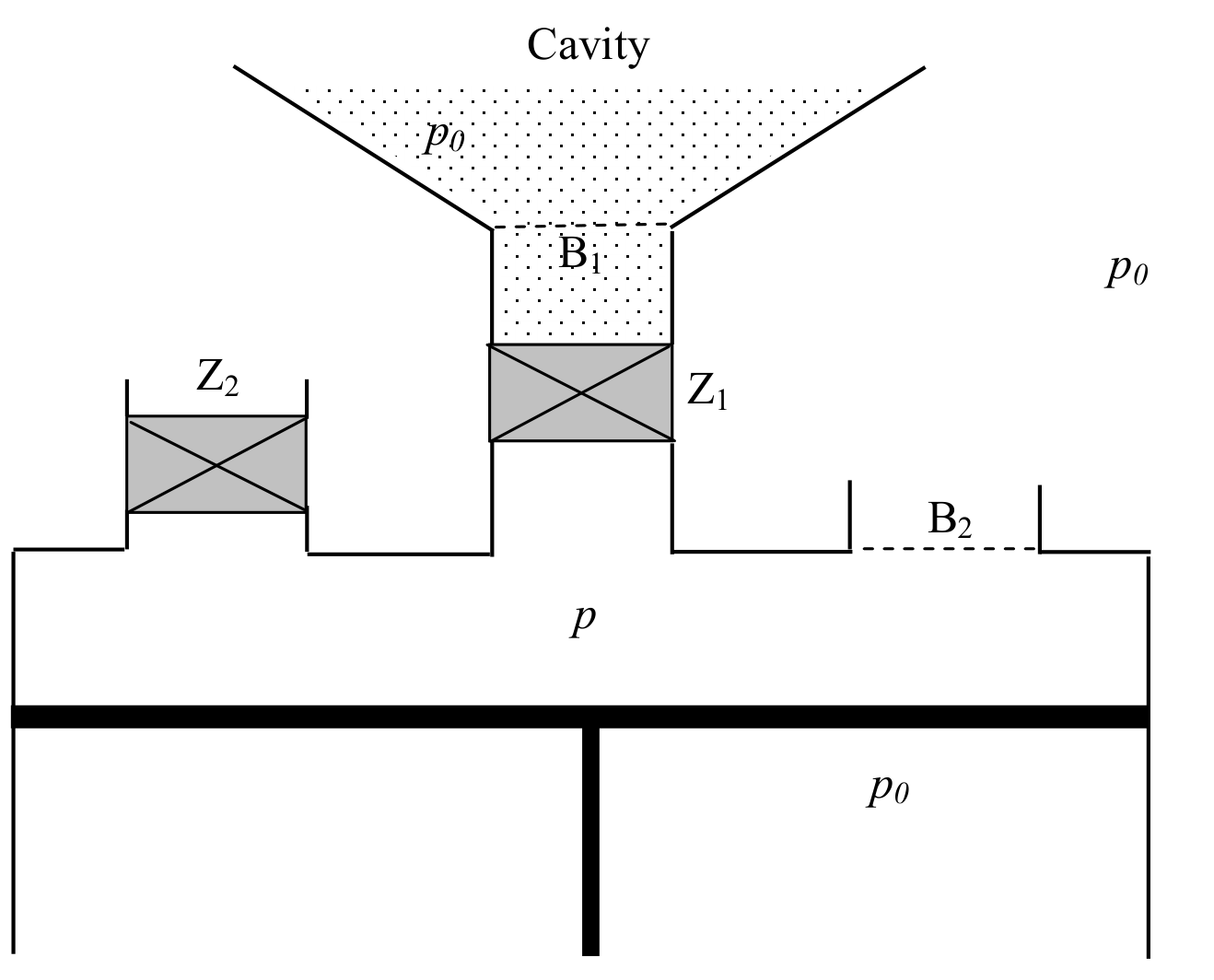
Let us construct the device shown in Fig. 6. B denotes the membrane transparent for the gas from the cavity, but non-transparent for the air, while B denotes the membrane with opposite property: it is transparent for the air but non-transparent for the gas.
Initially the valve Z is open and the valve Z is closed. In the initial situation, when we keep the piston at rest, the pressure under the piston is equal to due to the Dalton law. Let denotes an initial volume of the gas (at pressure ).
Now we close the valve Z and allow the gas in the cylinder to expand. During movement of the piston in the downwards direction we obtain certain work performed by excess pressure inside the cylinder with respect to the atmospheric pressure . The partial pressure of the gas in the cylinder will be reduced according to the formula , where denotes volume closed by the piston (isothermal process). Due to the membrane B the partial pressure of the air in the cylinder all the time is and balances the air pressure outside the cylinder. It means that only the gas from the cavity effectively performs the work.
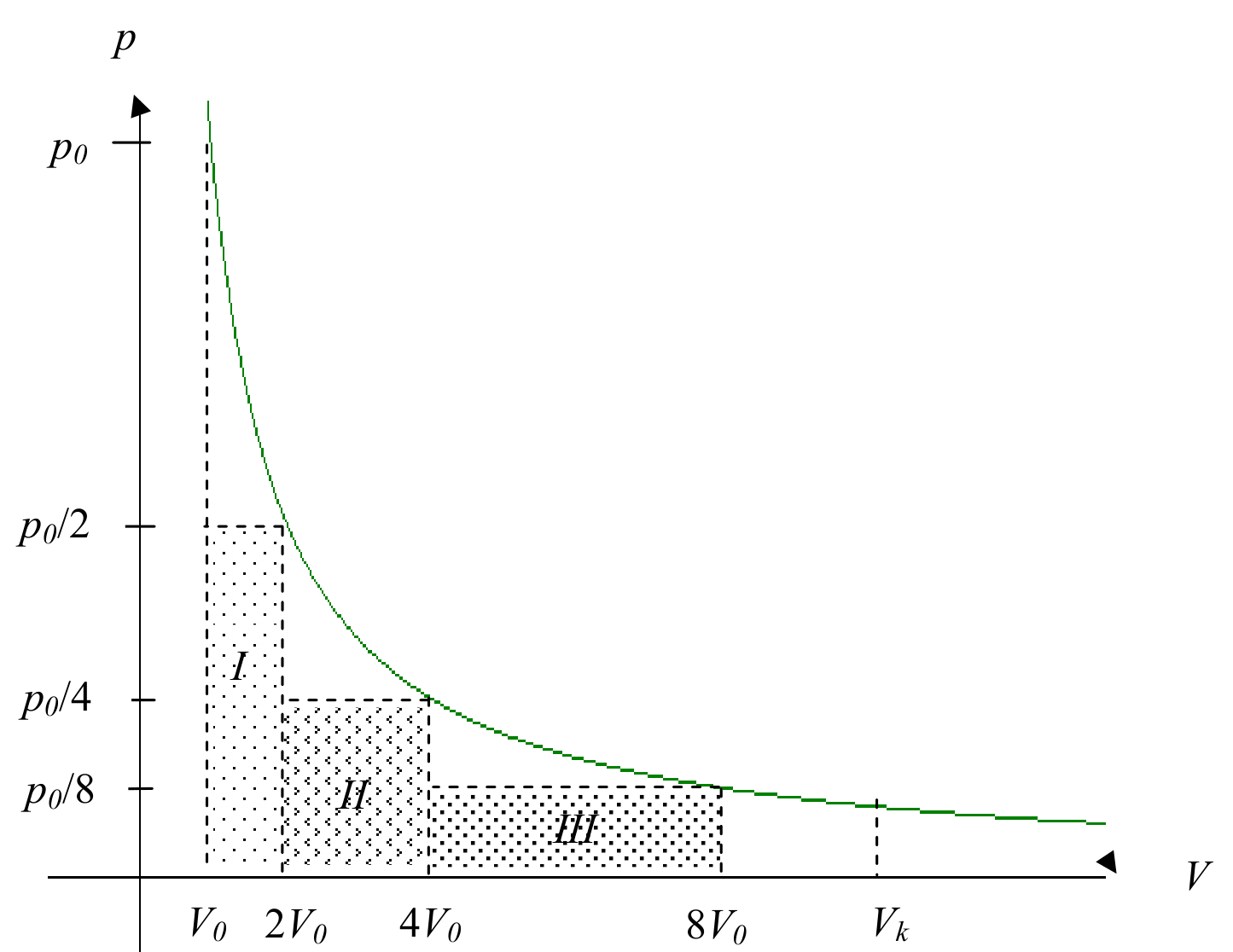
Consider the problem of limits for the work that can be performed during isothermal expansion of an initial portion of the gas. Let us analyze the graph of the function versus shown in Fig. 7.
It is obvious that the amount of work performed by the gas during isothermal expansion from to is represented by the area under the curve (shown in the graph) from to . Of course, the work is proportional to . We shall prove that for large enough the work can be arbitrarily large.
Consider It is clear that the rectangles I, II, III, … (see Fig. 7) have the same area and that one may draw arbitrarily large number of such rectangles under the considered curve. It means that during isothermal expansion of a given portion of the gas we may obtain arbitrarily large work (at the cost of the heat taken from the surrounding) – it is enough to take large enough.
After reaching we open the valve Z and move the piston to its initial position without performing any work. The cycle can be repeated as many times as we want.
In the above considerations we focused our attention on the work obtained during one cycle only. We entirely neglected dynamics of the process, while each cycle lasts some time. One may think that - in principle - the length of the cycle increases very rapidly with the effective work we obtain. This would limit the power of the device we consider.
Take, however, into account that, by proper choice of various parameters of the device, the time taken by one cycle can be made small and the initial volume of the gas can be made arbitrarily large (we consider only theoretical possibilities – we neglect practical difficulties entirely). E.g. by taking large size of the membrane B and large size of the piston we may minimize the time of taking the initial portion of the gas from the cavity and make this portion very great.
In our analysis we neglected all losses, friction, etc. One should remark that there are no theoretical limits for them. These losses, friction etc. can be made negligibly small.
The device we analyzed is very interesting: it produces work at cost of heat taken from surrounding without any difference in temperatures. Does this contradict the second law of thermodynamics? No! It is true that there is no temperature difference in the system, but the work of the device makes irreversible changes in the system (mixing of the gas from the cavity and the air).
The solutions were marked according to the following scheme (draft):
| 1. | Model of an engine and its description | up to 4 points |
| 2. | Proof that there is no theoretical limit for power | up to 4 points |
| 3. | Remark on II law of thermodynamics | up to 2 points |
Acknowledgement
Author wishes to express many thanks to Prof. Jan Mostowski for reading the text and for many valuable comments and remarks that allowed improving the final version.
Literature
[1] R. Kunfalvi, Collection of Competition Tasks from the Ist trough XVth International Physics Olympiads, 1967 – 1984, Roland Eotvos Physical Society and UNESCO, Budapest 1985
[2] W. Gorzkowski, Olimpiady Fizyczne – XXIII I XXIV, WSiP, Warszawa 1977
[3] W. Gorzkowski, Zadania z fizyki z całego świata (z rozwiązaniami) - 20 lat Międzynarodowych Olimpiad Fizycznych, WNT, Warszawa 1994 [ISBN 83-204-1698-1]
[4] W. Gorzkowski, VII Międzynarodowa Olimpiada Fizyczna, Fizyka w Szkole, nr 3/75, pp. 23 – 28
Оригинал в Архива: ipho74.pdf