IPhO 1974, Теория и експеримент — Задача 4. Experimental Problem
Problems of the 7th International Physics Olympiad (Warsaw, 1974) · 20 т.
Увод
Waldemar Gorzkowski
Institute of Physics, Polish Academy of Sciences, Warsaw, Poland ²
Abstract
The article contains the competition problems given at the 7th International Physics Olympiad (Warsaw, 1974) and their solutions.
Introduction
The 7th International Physics Olympiad (Warsaw, 1974) was the second one organized in Poland. It took place after a one-year organizational gap, as no country was able to organize the competition in 1973.
The original English version of the problems of the 7th IPhO has not been preserved. We would like to remind that the permanent Secretariat of the IPhOs was established only in 1983; previously the Olympic materials had been collected by individual people in their private archives and, in general, are not complete. English texts of the problems and simplified solutions are available in the book by R. Kunfalvi [1]. Unfortunately, they are somewhat deformed as compared to the originals. Fortunately, we have very precise Polish texts. Also the full solutions in Polish are available. This article is based on the books [2, 3] and article [4].
The competition problems were prepared especially for the 7th IPhO by Andrzej Szymacha (theoretical problems) and Jerzy Langer (experimental problem).
¹ This article has been sent for publication in Physics Competitions in September 2003
² e-mail: gorzk@ifpan.edu.pl
Условие
In a "black box" there are two identical semiconducting diodes and one resistor connected in some unknown way. By using instruments provided by the organizers find the resistance of the resistor.
Remark: One may assume that the diode conducts current in one direction only.
List of instruments: two universal volt-ammeters (without ohmmeters), battery, wires with endings, graph paper, resistor with regulated resistance.
Отговори
- , the slope of the straight line obtained by subtracting the two characteristics of the black box.
Решение
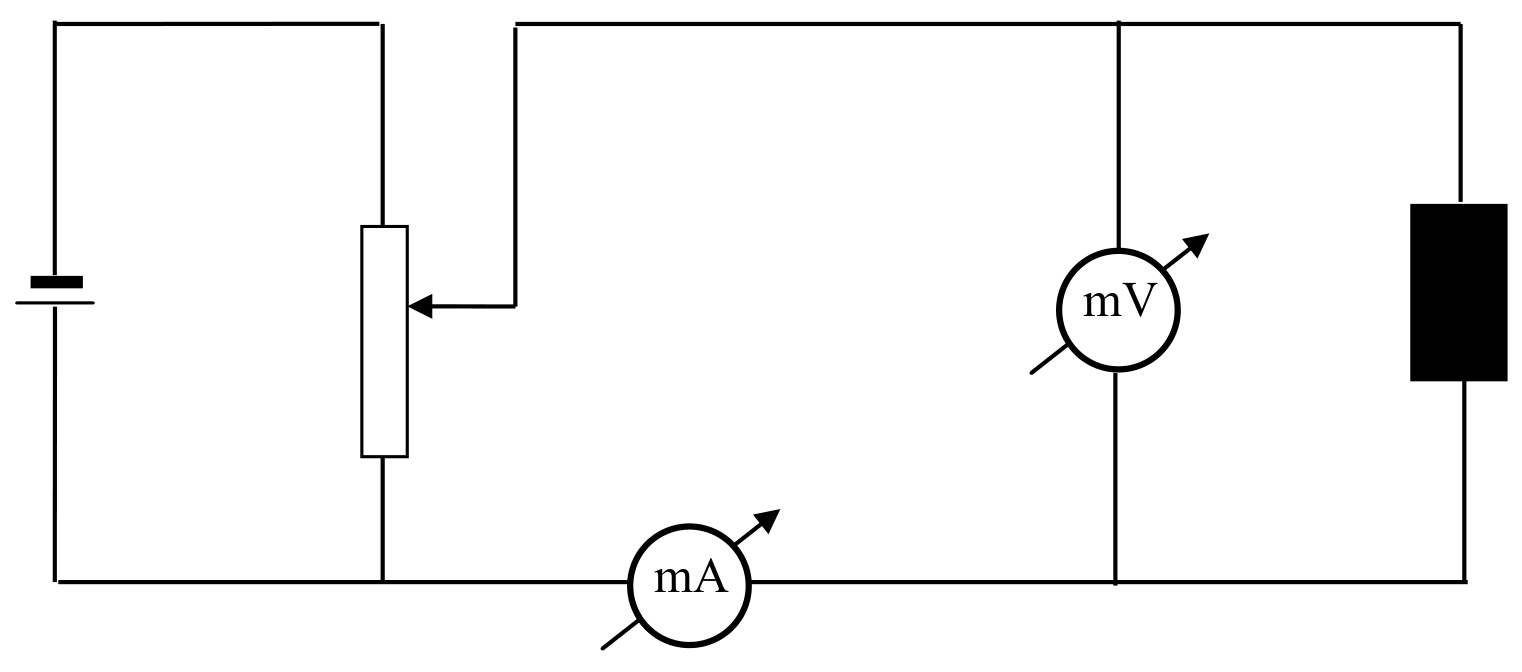
At the beginning we perform preliminary measurements by using the circuit shown in Fig. 8. For two values of voltage and , applied to the black box in both directions, we measure four values of current: , , and . In this way we find that:
- The black box conducts current in both directions;
- There is an asymmetry with respect to the sign of the voltage;
- In both directions current is a nonlinear function of voltage.
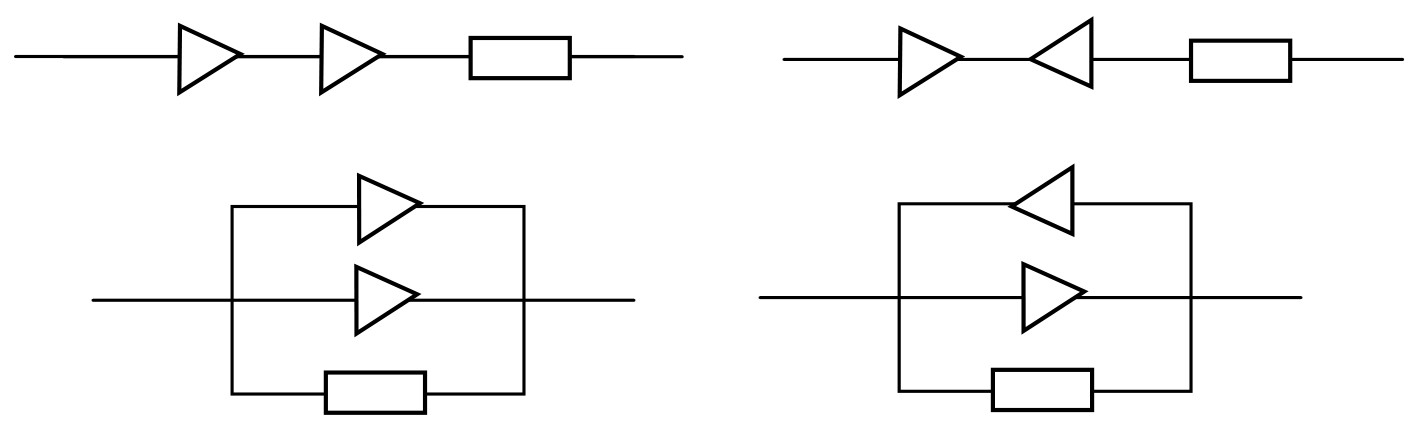
The diodes and resistor can be connected in a limited number of ways shown in Fig. 9 (connections that differ from each other in a trivial way have been omitted).
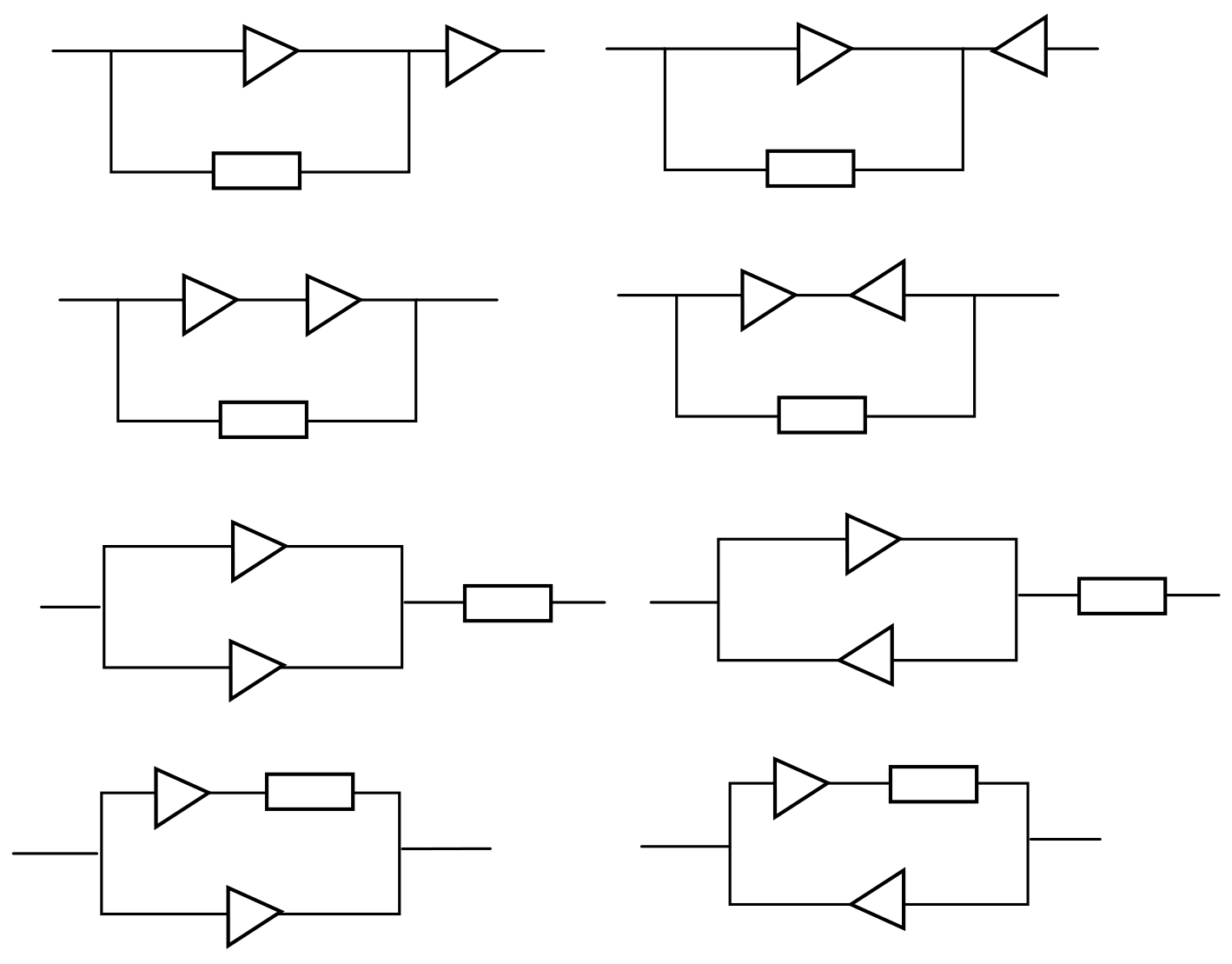
Only one of these connections has the properties mentioned at the beginning. It is:
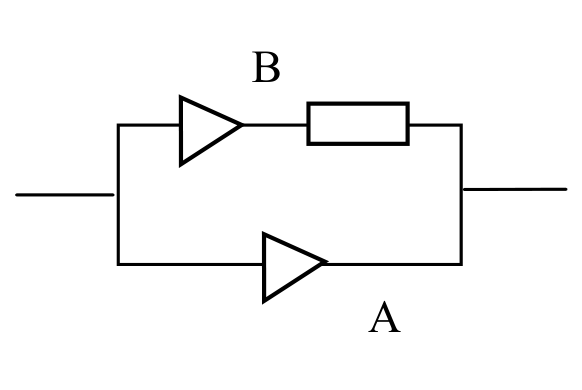
For absolute values of voltages we have
where denotes voltage on the resistor when a current flows trough the branch B, - voltage on the black box when the current flows through the branch A, and - voltage on the black box when the current flows through the branch B.
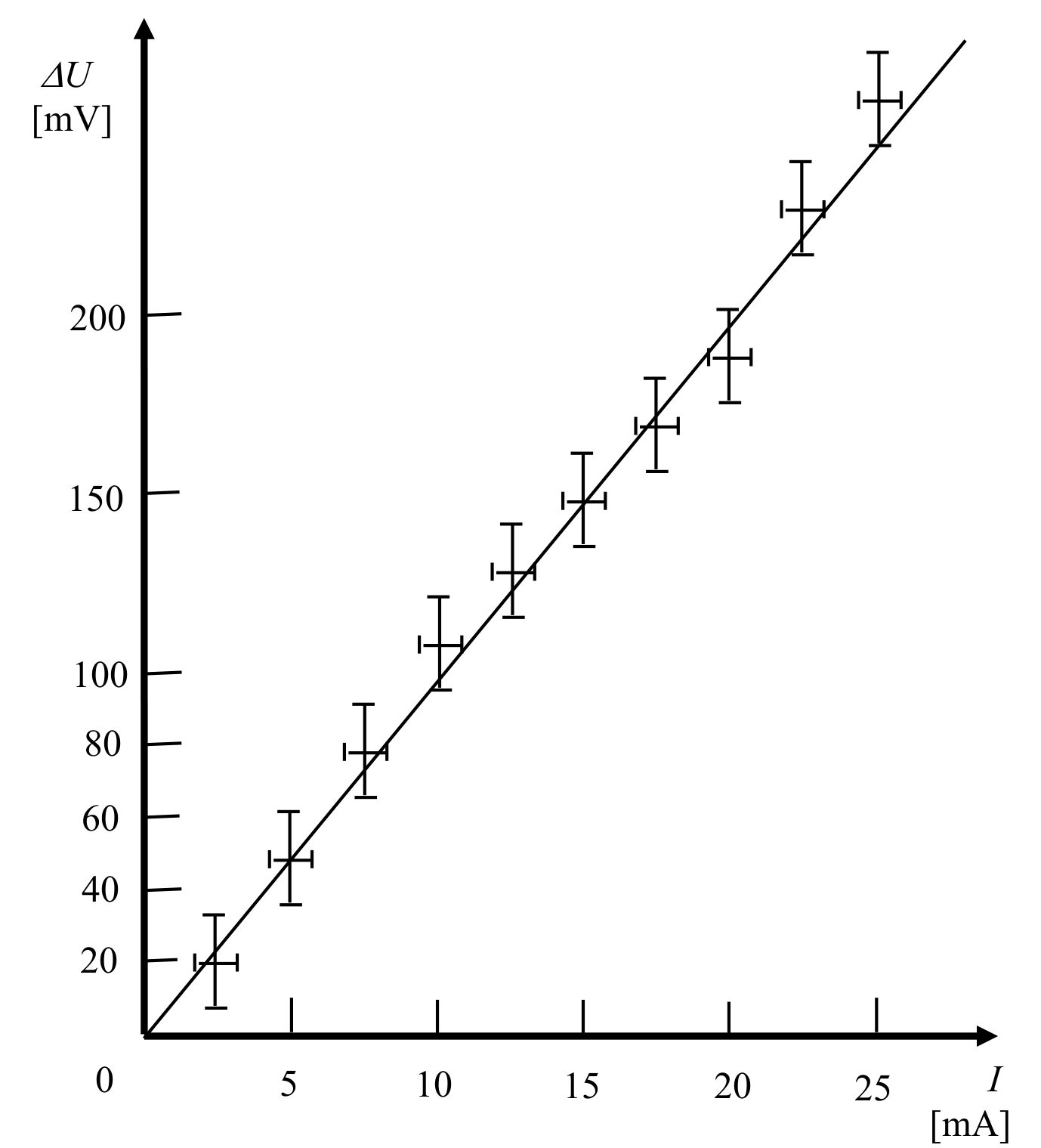
Therefore
It follows from the above that it is enough to take characteristics of the black box in both directions: by subtraction of the corresponding points (graphically) we obtain a straight line (example is shown in Fig. 11) whose slope allows to determine the value of .
The solutions were marked according to the following scheme (draft):
Theoretical part:
| 1. | Proper circuit and method allowing determination of connections the elements in the black box | up to 6 points |
| 2. | Determination of (principle) | up to 2 points |
| 3. | Remark that measurements at the same voltage in both directions make the error smaller | up to 1 point |
| 4. | Role of number of measurements (affect on errors) | up to 1 point |
Experimental part:
| 1. | Proper use of regulated resistor as potentiometer | up to 2 points |
| 2. | Practical determination of (including error) | up to 4 points |
| 3. | Proper use of measuring instruments | up to 2 points |
| 4. | Taking into account that temperature of diodes increases during measurements | up to 1 point |
| 5. | Taking class of measuring instruments into account | up to 1 point |
Acknowledgement
Author wishes to express many thanks to Prof. Jan Mostowski for reading the text and for many valuable comments and remarks that allowed improving the final version.
Literature
[1] R. Kunfalvi, Collection of Competition Tasks from the Ist trough XVth International Physics Olympiads, 1967 – 1984, Roland Eotvos Physical Society and UNESCO, Budapest 1985
[2] W. Gorzkowski, Olimpiady Fizyczne – XXIII I XXIV, WSiP, Warszawa 1977
[3] W. Gorzkowski, Zadania z fizyki z całego świata (z rozwiązaniami) - 20 lat Międzynarodowych Olimpiad Fizycznych, WNT, Warszawa 1994 [ISBN 83-204-1698-1]
[4] W. Gorzkowski, VII Międzynarodowa Olimpiada Fizyczna, Fizyka w Szkole, nr 3/75, pp. 23 – 28
Оригинал в Архива: ipho74.pdf