IPhO 1975, Теория и експеримент — Задача 3. Ions in a magnetic field
Problems of the 8th International Physics Olympiad (Güstrow, 1975) · 7 юли 1975 г. · 10 т.
Увод
Gunnar Friege & Gunter Lind
Introduction
The 8th International Physics Olympiad took place from the 7.7. to the 12.7. 1975 in Güstrow, in the German Democratic Republic (GDR). Altogether, 9 countries with 45 pupils participated. The teams came from Bulgaria, the German Democratic Republic, the Federal Republic of Germany (FRG), France, Poland, Rumania, Tchechoslowakia, Hungary and the USSR. The entire event took place in the pedagogic academy of Güstrow. Pupils and leaders were accommodated inside the university academy complex. On the schedule there was the competition and receptions as well as excursions to Schwerin, Rostock, and Berlin were offered. The delegation of the FRG reported of a very good organisation of the olympiad.
The problems and solutions of the 8th International Physics Olympiad were created by a commission of university physics professors and lecturers. The same commission set marking schemes and conducted the correction of the tests. The correction was carried out very quickly and was considered as righteous and, in cases of doubt, as very generous.
The main competition consisted of a 5 hour test in theory and a 4.5 hour experimental test. The time for the theoretical part was rather short and for the experimental part rather long. The problems originated from central areas of classical physics. The theoretical problems were relatively difficult, although solvable with good physics knowledge taught at school. The level of difficulty of the experimental problem was adequate. There were no additional devices necessary for the solution of the problems. Only basic formula knowledge was requested, and could be demanded from all pupils. Critics were only uttered concerning the second theoretical problem (thick lens). This problem requested relatively little physical understanding, but tested the mathematical skills and the routine in approaching problems (e.g. correct distinction of cases). However, it is also difficult to find substantial physics problems in the area of geometrical optics.
Altogether 50 points were the maximum to achieve; 30 in the theoretical test and 20 in the experimental test. The best contestant came from the USSR and had 43 points. The first prize (gold medal) was awarded with 39 points, the second prize (silver medal) with 34 points, the third prize (bronze medal) with 28 points and the fourth prize (honourable mention) with 22 points. Among the 45 contestants, 7 I. prizes, 9 II. prizes, 12 III. prizes and 8 IV. prizes were awarded, meaning that 80 % of all contestants were awarded.
The following problem descriptions and solution are based mainly on a translation of the original German version from 1975. Because the original drafts are not well preserved, some new sketches were drawn. We also gave the problems headlines and the solutions are in more detail.
Remark: This article was written due to the special request to us by Dr. W. Gorzkowski, in order to close one of the last few gaps in the IPhO-report collection.
Contact: Dr. Gunnar Friege, Leibniz-Institute for Science Education (IPN) at the University of Kiel, Olshausenstr. 62, 24098 Kiel, Germany, friege@ipn.uni-kiel.de
Условие
Theoretical problem 3: “Ions in a magnetic field”
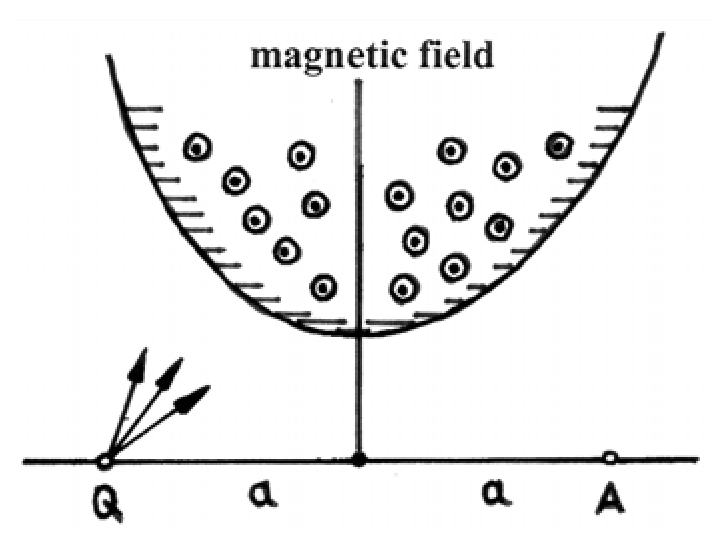
A beam of positive ions (charge +e) of the same and constant mass spread from point Q in different directions in the plane of paper (see figure). The ions were accelerated by a voltage . They are deflected in a uniform magnetic field that is perpendicular to the plane of paper. The boundaries of the magnetic field are made in a way that the initially diverging ions are focussed in point A (). The trajectories of the ions are symmetric to the middle perpendicular on .
Among different possible boundaries of magnetic fields a specific type shall be considered in which a contiguous magnetic field acts around the middle perpendicular and in which the points Q and A are in the field free area.
a) Describe the radius curvature of the particle path in the magnetic field as a function of the voltage and the induction . [2 т.]
b) Describe the characteristic properties of the particle paths in the setup mentioned above. [3 т.]
c) Obtain the boundaries of the magnetic field boundaries by geometrical constructions for the cases , and . [3 т.]
d) Describe the general equation for the boundaries of the magnetic field. [2 т.]
Remark: This illustrative figure was not part of the original problem formulation.
Отговори
a)
d)
Polar coordinates (r, φ) with origin at Q, from the official solution, equation (8).
Решение
Solution of problem 3:
a) The kinetic energy of the ion after acceleration by a voltage U is:
From equation (1) the velocity of the ions is calculated:
On a moving ion (charge and velocity ) in a homogenous magnetic field acts a Lorentz force . Under the given conditions the velocity is always perpendicular to the magnetic field. Therefore, the paths of the ions are circular with Radius . Lorentz force and centrifugal force are of the same amount:
From equation (3) the radius of the ion path is calculated:
b) All ions of mass travel on circular paths of radius inside the magnetic field. Leaving the magnetic field they fly in a straight line along the last tangent. The centres of curvature of the ion paths lie on the middle perpendicular on since the magnetic field is assumed to be symmetric to the middle perpendicular on . The paths of the focussed ions are above due to the direction of the magnetic field.
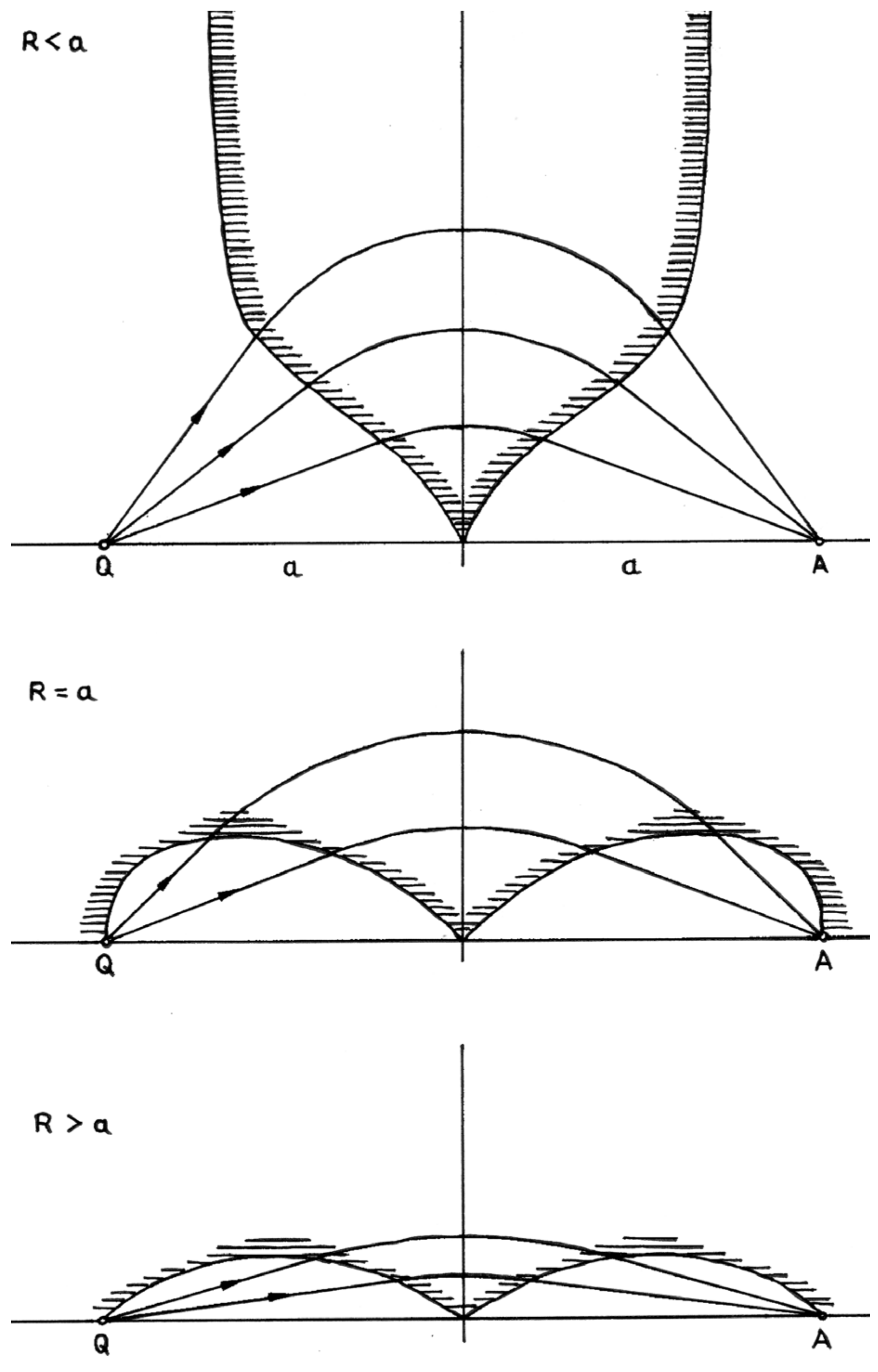
c) The construction method of the boundaries of the magnetic fields is based on the considerations in part b:
- Sketch circles of radius and different centres of curvature on the middle perpendicular on .
- Sketch tangents on the circle with either point Q or point A on these straight lines.
- The points of tangency make up the boundaries of the magnetic field. If then not all ions will reach point A. Ions starting at an angle steeper than the tangent at Q, do not arrive in A. The figure on the last page shows the boundaries of the magnetic field for the three cases , and .
d) It is convenient to deduce a general equation for the boundaries of the magnetic field in polar coordinates (, ) instead of using cartesian coordinates (, ).
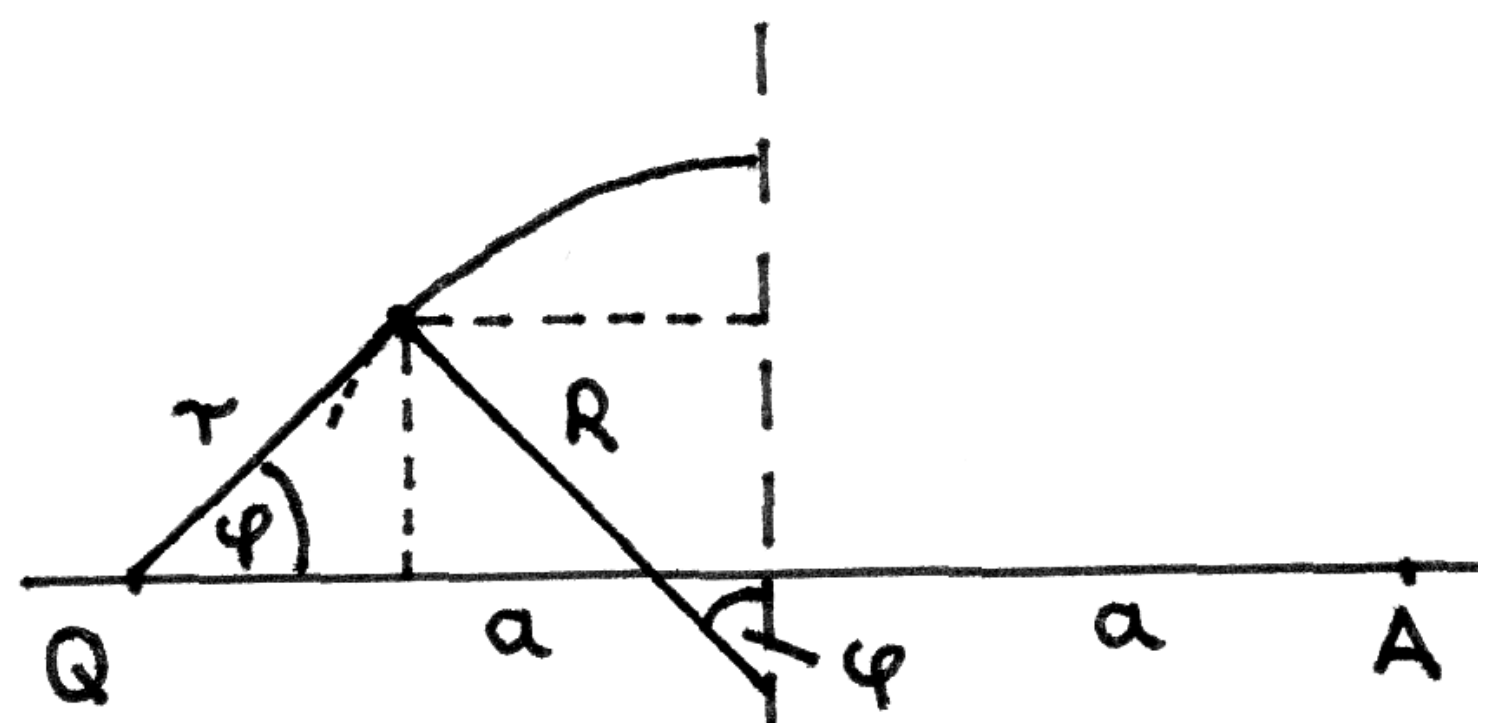
The following relation is obtained from the figure:
The boundaries of the magnetic field are given by:
Marking scheme
Problem 3: “Ions in a magnetic field” (10 points)
| Part a – derivation of equations (1) and (2) | 1 point |
|---|---|
| – derivation of equation (4) | 1 point |
| Part b – characteristics properties of the particle paths | 3 points |
| Part c – boundaries of the magnetic field for the three cases | 3 points |
| Part d | 2 points |
Оригинал в Архива: ipho75.pdf