IPhO 1976, Теория и експеримент — Задача 2. Problem 2
Problems of the 9th International Physics Olympiads (Budapest, Hungary, 1976)
Условие
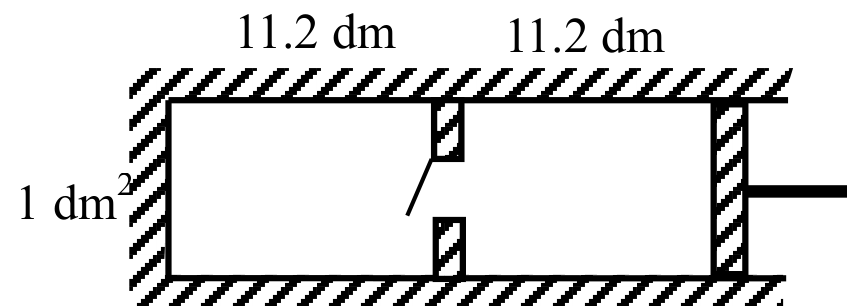
The walls of a cylinder of base 1 , the piston and the inner dividing wall are perfect heat insulators (Fig. 10). The valve in the dividing wall opens if the pressure on the right side is greater than on the left side. Initially there is 12 g helium in the left side and 2 g helium in the right side. The lengths of both sides are 11.2 dm each and the temperature is . Outside we have a pressure of 100 kPa. The specific heat at constant volume is , at constant pressure it is . The piston is pushed slowly towards the dividing wall. When the valve opens we stop then continue pushing slowly until the wall is reached. Find the work done on the piston by us.
Отговори
- 3640 J
Решение
The volume of 4 g helium at temperature and a pressure of 100 kPa is 22.4 (molar volume). It follows that initially the pressure on the left hand side is 600 kPa, on the right hand side 100 kPa. Therefore the valve is closed.
An adiabatic compression happens until the pressure in the right side reaches 600 kPa ().
hence the volume on the right side (when the valve opens):
From the ideal gas equation the temperature is on the right side at this point
During this phase the whole work performed increases the internal energy of the gas:
Next the valve opens, the piston is arrested. The temperature after the mixing has been completed:
During this phase there is no change in the energy, no work done on the piston.
An adiabatic compression follows from to :
hence
The whole work done increases the energy of the gas:
The total work done:
The work done by the outside atmospheric pressure should be subtracted:
The work done on the piston by us:
Literature
[1] W. Gorzkowski: Problems of the 1st International Physics Olympiad
Physics Competitions 5, no2 pp6-17, 2003
[2] R. Kunfalvi: Collection of Competition Tasks from the Ist through XVth International Physics Olympiads 1967-1984
Roland Eötvös Physical Society in cooperation with UNESCO, Budapest, 1985
[3] A Nemzetközi Fizikai Diákolimpiák feladatai I.-XV.
Eötvös Loránd Fizikai Társulat, Középiskolai Matematikai Lapok, 1985
Оригинал в Архива: ipho76.pdf