IPhO 1976, Теория и експеримент — Задача 3. Problem 3
Problems of the 9th International Physics Olympiads (Budapest, Hungary, 1976)
Условие
Somewhere in a glass sphere there is an air bubble. Describe methods how to determine the diameter of the bubble without damaging the sphere.
Решение
We can not rely on any value about the density of the glass. It is quite uncertain. The index of refraction can be determined using a light beam which does not touch the bubble. Another method consists of immersing the sphere into a liquid of same refraction index: its surface becomes invisible.
A great number of methods can be found.
We can start by determining the axis, the line which joins the centers of the sphere and the bubble. The easiest way is to use the “tumbler-over” method. If the sphere is placed on a horizontal plane the axis takes up a vertical position. The image of the bubble, seen from both directions along the axis, is a circle.
If the sphere is immersed in a liquid of same index of refraction the spherical bubble is practically inside a parallel plate (Fig. 11). Its boundaries can be determined either by a micrometer or using parallel light beams.
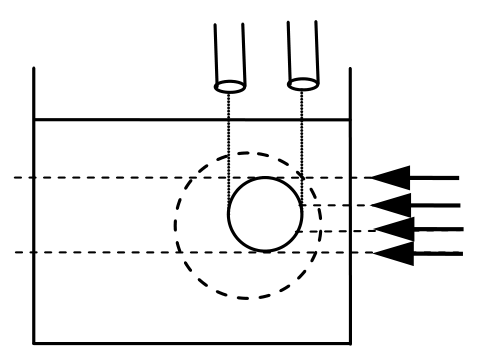
Along the axis we have a lens system consisting of two thick negative lenses. The diameter of the bubble can be determined by several measurements and complicated calculations.
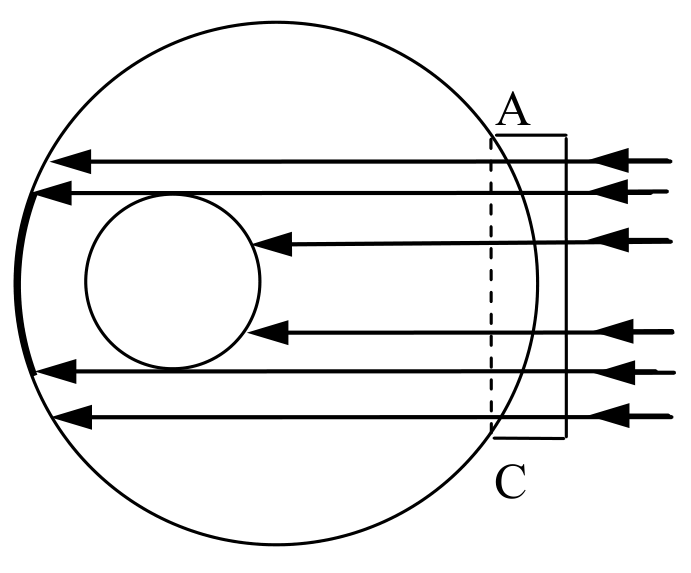
If the index of refraction of the glass is known we can fit a plano-concave lens of same index of refraction to the sphere at the end of the axis (Fig. 12). As ABCD forms a parallel plate the diameter of the bubble can be measured using parallel light beams.
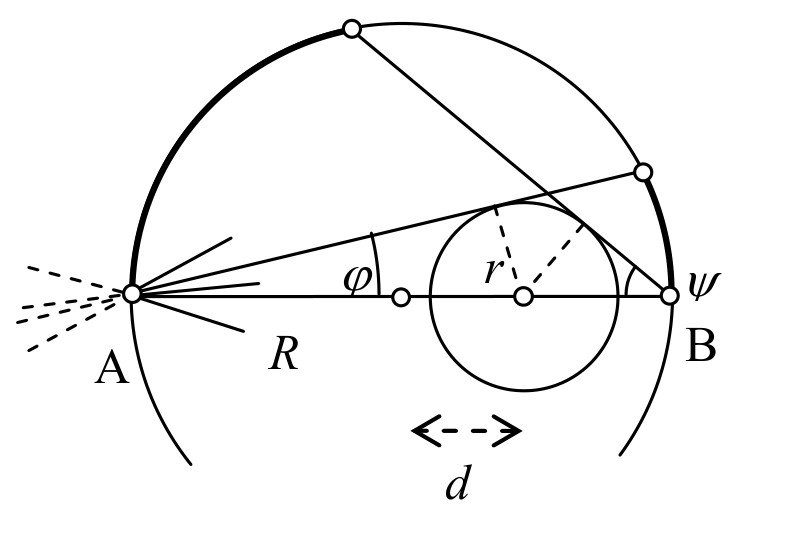
Focusing a light beam on point A of the surface of the sphere (Fig. 13) we get a diverging beam from point A inside the sphere. The rays strike the surface at the other side and illuminate a cap. Measuring the spherical cap we get angle . Angle can be obtained in a similar way at point B. From
we have
The diameter of the bubble can be determined also by the help of X-rays. X-rays are not refracted by glass. They will cast shadows indicating the structure of the body, in our case the position and diameter of the bubble.
We can also determine the moment of inertia with respect to the axis and thus the diameter of the bubble.
Literature
[1] W. Gorzkowski: Problems of the 1st International Physics Olympiad
Physics Competitions 5, no2 pp6-17, 2003
[2] R. Kunfalvi: Collection of Competition Tasks from the Ist through XVth International Physics Olympiads 1967-1984
Roland Eötvös Physical Society in cooperation with UNESCO, Budapest, 1985
[3] A Nemzetközi Fizikai Diákolimpiák feladatai I.-XV.
Eötvös Loránd Fizikai Társulat, Középiskolai Matematikai Lapok, 1985
Оригинал в Архива: ipho76.pdf