IPhO 1982, Теория и експеримент — Задача 4. Lens experiment
Problems of the 13th International Physics Olympiad (Malente, 1982) · 8 т.
Abstract
The 13th International Physics Olympiad took place in 1982 in the Federal Republic of Germany. This article contains the competition problems, their solutions and a grading scheme.
Увод
In 1982 the Federal Republic of Germany was the first host of the Physics Olympiad outside the so-called Eastern bloc. The 13th International Physics Olympiad took place in Malente, Schleswig-Holstein. The competition was funded by the German Federal Ministry of Science and Education. The organisational guidelines were laid down by the work group “Olympiads for pupils” of the conference of ministers of education of the German federal states. The Institute for Science Education (IPN) at the University of Kiel was responsible for the realisation of the event. A commission of professors, whose chairman was appointed by the German Physical Society, were concerned with the formulation of the competition problems. All other members of the commission came from physics department of the university of Kiel or from the college of education at Kiel.
The problems as usual covered different fields of classical physics. In 1982 the pupils had to deal with three theoretical and two experimental problems, whereas at the previous Olympiads only one experimental task was given. However, it seemed to be reasonable to put more stress on experimental work. The degree of difficulty was well balanced. One of the theoretical problems could be considered as quite simple (problem 3: “hot-air balloon”). Another theoretical problem (problem 1: “fluorescent lamp”) had a mean degree of difficulty and the distribution of the points was a normal distribution with only a few excellent and only a few unsatisfying solutions. The third problem (problem 2: “oscillation coat hanger”) turned out to be the most difficult problem. This problem was generally considered as quite interesting because different ways of solving were possible. About one third of the pupils did not find an adequate start to the problem, but nearly one third of the pupils was able to solve the substantial part of the problem. That means, this problem polarized between the pupils. The two experimental tasks were quite different in respect of the input for the experimental setup and the time required for dealing with the problems, whereas they were quite similar in the degree of difficulty. Both required demandingly theoretical considerations and experimental skills. Both experimental problems turned out to be rather difficult. The tasks were composed in a way that on the one hand almost every pupil had the possibility to come to certain partial results and that there were some difficulties on the other hand which could only be solved by very few pupils. The difficulty in the second experimental problem (problem5: “motion of a rolling cylinder”) was the explanation of the experimental results, which were initially quite surprising. The difficulty in the other task (problem 4: “lens experiment") was the revealing of an observation method with a high accuracy (parallax). The five hours provided for solving the two experimental problems were slightly too short. According to that, in both experiments only a few pupils came up with excellent solutions. In problem 5 nobody got the full points.
The problems presented here are based on the original German and English versions of the competition problems. The solutions are complete but in some parts condensed to the essentials. Almost all of the original hand-made figures are published here.
Contact: Leibniz-Institute for Science Education (IPN) at the University of Kiel, Olshausenstrasse 62, 24098 Kiel, Germany, ipho@ipn.uni-kiel.de
Условие
The apparatus consists of a symmetric biconvex lens, a plane mirror, water, a meter stick, an optical object (pencil), a supporting base and a right angle clamp. Only these parts may be used in the experiment.
a) Determine the focal length of the lens with a maximum error of .
b) Determine the index of refraction of the glass from which the lens is made.
The index of refraction of water is . The focal length of a thin lens is given by
where is the index of refraction of the lens material and and are the curvature radii of the refracting surfaces. For a symmetric biconvex lens we have , for a symmetric biconcave lens .
Отговори
b) 1.52
Nominal value given in the official solution (f' = 43.9 cm, fw = -94.5 cm, r = 31.2 cm, n = 1.52); the lenses were measured individually.
Решение
a) For the determination of , place the lens on the mirror and with the clamp fix the pencil to the supporting base. Lens and mirror are then moved around until the vertically downward looking eye sees the pencil and its image side by side.
In order to have object and image in focus at the same time, they must be placed at an equal distance to the eye. In this case object distance and image distance are the same and the magnification factor is 1.
It may be proved quite accurately, whether magnification 1 has in fact been obtained, if one concentrates on parallatical shifts between object and image when moving the eye: only when the distances are equal do the pencil-tips point at each other all the time.
The light rays pass the lens twice because they are reflected by the mirror. Therefore the optical mapping under consideration corresponds to a mapping with two lenses placed directly one after another:
i.e. the effective focal length is just half the focal length of the lens. Thus we find for magnification 1:
A different derivation of : For a mapping of magnification 1 the light rays emerging from a point on the optical axis are reflected into themselves. Therefore these rays have to hit the mirror at right angle and so the object distance equals the focal length of the lens in this case.
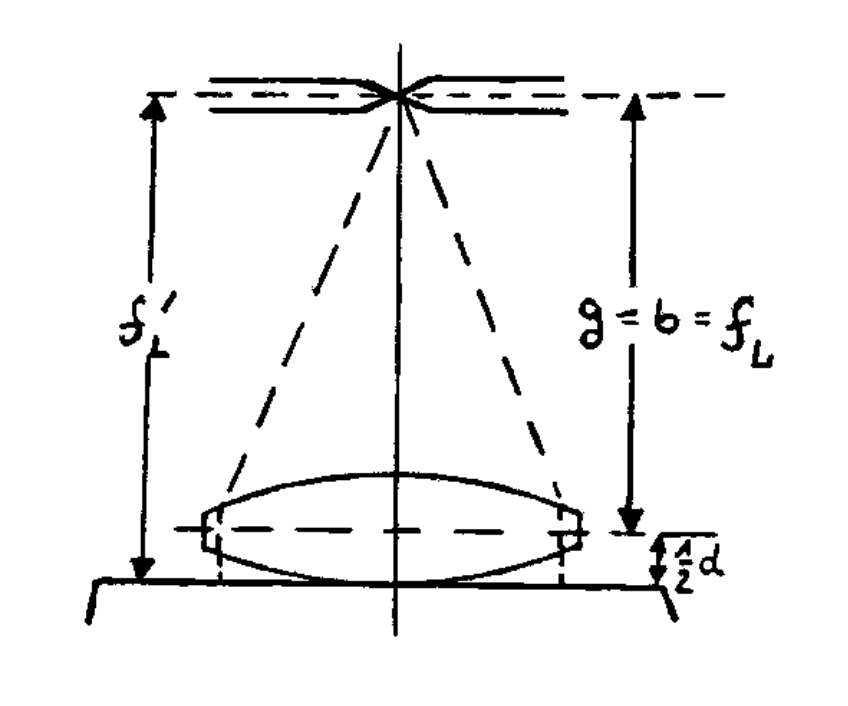
The distance between pencil point and mirror has to be determined with an accuracy, which enables one to state with a maximum error of . This is accomplished either by averaging several measurements or by stating an uncertainty interval, which is found through the appearance of parallaxe.
Half the thickness of the lens has to be subtracted from the distance between pencil-point and mirror.
The nominal value of the focal length of the lens is . However, the actual focal length of the single lenses spread considerably. Each lens was measured separately, so the individual result of the student can be compared with the exact value.
b) The refractive index of the lens material can be evaluated from the equation
if the focal length and the curvature radius of the symmetric biconvex lens are known. was determined in part a) of this problem.
The still unknown curvature radius of the symmetric biconvex lens is found in the following way: If one pours some water onto the mirror and places the lens in the water, one gets a plane-concave water lens, which has one curvature radius equalling the glass lens’ radius and the other radius is .
Because the refractive index of water is known in this case, one can evaluate the curvature radius through the formula above, where and :
Only the focal length of the combination of lenses is directly measured, for which we have
This focal length is to be determined by a mapping of magnification 1 as above.
Then the focal length of the water lens is
and one has the curvature radius .
Now the refractive index of the lens is determined by
with the known values of and , or, if one wants to express explicitly through the measured quantities: .
The nominal values are: , , , .
Grading schemes
| Problem 4: Lens experiment | pts. |
|---|---|
| correct description of experimental procedure | 1 |
| selection of magnification one | 0.5 |
| parallaxe for verifying his magnification | 1 |
| with derivation | 1 |
| several measurements with suitable averaging or other determination of error interval | 1 |
| taking into account the lens thickness and computing , including the error | 0.5 |
| idea of water lens | 0.5 |
| theory of lens combination | 1 |
| measurements of | 0.5 |
| calculation of n and correct result | 1 |
| 8 |
Оригинал в Архива: ipho82.pdf